When you click on links to various merchants on this site and make a purchase, this can result in this site earning a commission. Affiliate programs and affiliations include, but are not limited to, the eBay Partner Network.
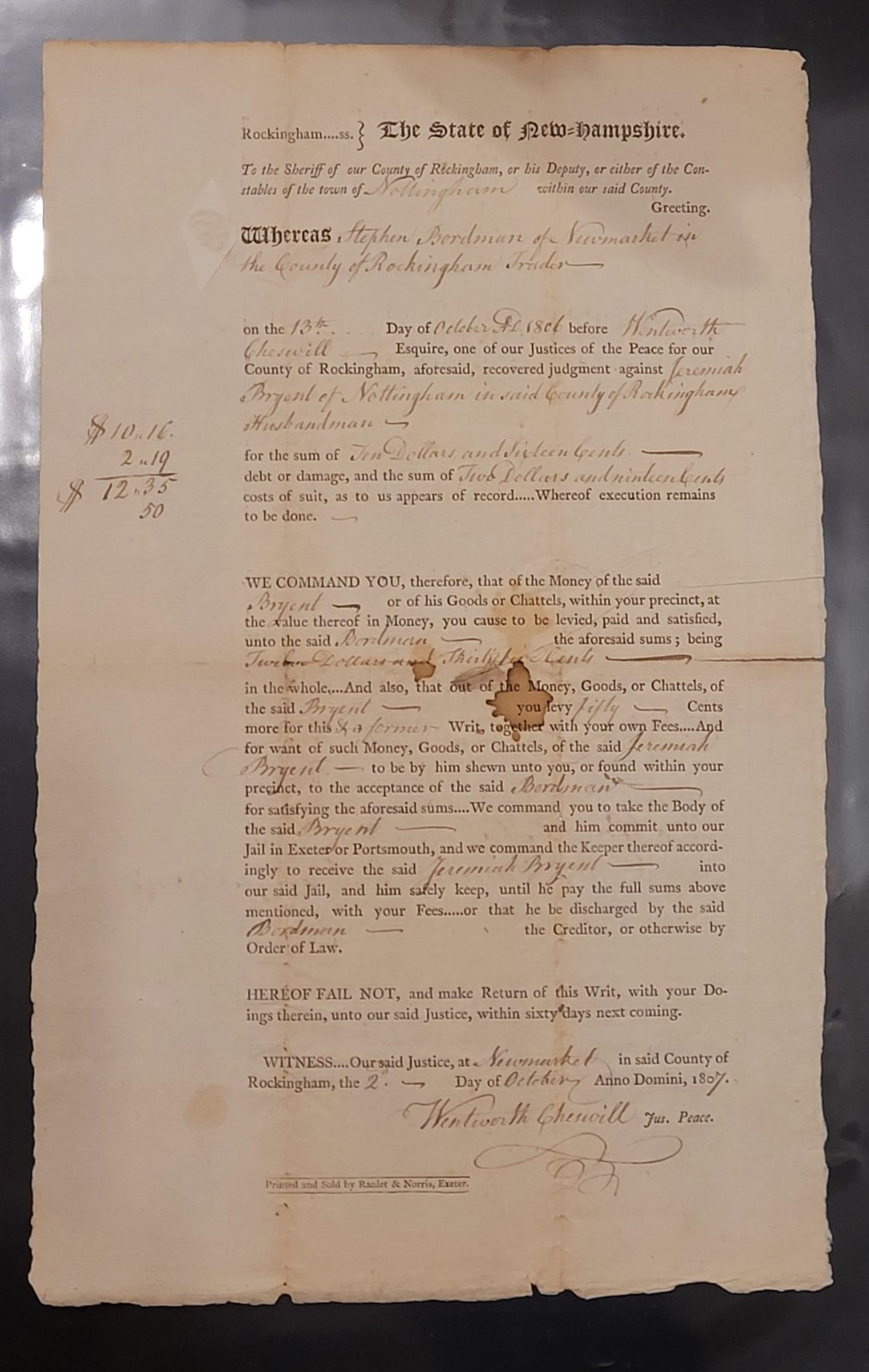
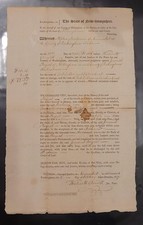
Front Text:
Header: Rockingham....ss. } The State of New-Hampshire.
To Direction: To the Sheriff of our County of Rockingham, or his Deputy, or either of the Constables of the town of Nottingham within our said County, Greeting.
Publisher Imprint: Printed and Sold by Ranlet & Norris, Exeter.
Side Math: $10.16 + $2.19 = $12.35 (plus 50 cents)
Back Text (Verso):
Docketing: Pl. Execution [19] Bordman vs Bryant
Sheriff\'s Return: Non Est Inventus — David Lawrence, Deputy Sheriff
Date: Nov. 21, 1807. (Non est inventus is Latin for \"not found,\" indicating the debtor could not be located within the officer\'s jurisdiction).
Historical Background & Significance
Wentworth Cheswell (Significance): Wentworth Cheswell (1746–1817) was a monumental figure in New Hampshire history. He was a Revolutionary War veteran (serving in the Saratoga campaign), a schoolmaster, a historian, and a prominent landowner. Crucially, Cheswell is widely recognized as one of the first African American elected officials in United States history, having served town offices in Newmarket, NH, and as a Justice of the Peace. Documents signed by him as a magistrate are heavily sought after by collectors of early American, legal, and African American history.
The Legal Context: This is a pre-Civil War judicial document—specifically a Writ of Execution coupled with a threat of debtor\'s prison. In early 19th-century New England, if a debtor (Jeremiah Bryant, a husbandman/farmer) could not pay a judgment obtained by a creditor (Stephen Bordman, a trader), the sheriff was authorized to seize property or, failing that, commit the debtor to the county jail in Exeter or Portsmouth until the debt was satisfied.
The Sheriff\'s Return: The back features the notation \"Non Est Inventus\" signed by Deputy Sheriff David Lawrence, meaning the debtor could not be found to be arrested or have assets seized.
Wentworth Cheswell[a] (11 April 1746 – 8 March 1817) was an American assessor, auditor, Justice of the Peace, teacher and Revolutionary War veteran in Newmarket, New Hampshire. He was of mixed race (one-quarter African and three-quarters European) and was listed in the census as white. Elected as town constable in 1768, he was elected to other positions, serving in local government every year but one until his death.
Cheswell is considered by George Mason University to be the first African American elected to public office in the history of the United States. Around the time of his marriage, Wentworth purchased a plot of land from his father Hopestill. His grandfather Richard is believed to be the first African American in New Hampshire to own land. A deed shows that Richard purchased 20 acres (8.1 ha) from the Hilton grant in 1717. In 1801, Wentworth was among the founders of the first library in the town and provided in his will for public access to his personal library.
Cheswell, Wentworth – Black Patriot Who Warned of the British Invasion... He also won election as town messenger for the Committee of Safety, which meant he had to carry news to and from Exeter, N.H. On Dec. 13, 1774, he and Paul Revere rode in different directions to warn Portsmouth citizens of the approach of two British warships. The British intended to retake gunpowder and weapons stolen by the colonists from Fort William and Mary.Wentworth Cheswell is considered New Hampshire’s first archaeologist and the first African-American elected to public office in the United States. He also rode north when Paul Revere rode west to warn colonists that the redcoats were coming.He was born on April 11, 1746, to a biracial father, Hopestill Cheswell (sometimes spelled Cheswill), and Katherine Keniston, who was white. Hopestill was the son of a white woman and an enslaved black man, Richard Cheswell. Under the laws of the day, Hopestill’s status followed his mother, so he was free.
Eventually Hopestill’s father bought his freedom. and in 1717 purchased 20 acres of land in Newmarket, N.H. Richard’s land purchase is considered the first by an African-American in New Hampshire.John Paul Jones HouseJohn Paul Jones House
Hopestill, a housewright and carpenter, built the John Paul Jones House in Portsmouth, N.H., as well as the Samuel Langdon House (now in Sturbridge Village) and the Bell Tavern (since burned in the Portsmouth fire of 1867).
WENTWORTH CHESWELL, TOWN LEADERHopestill earned enough money to send Wentworth to Governor Dummer Academy in Byfield, Mass. Wentworth took advantage of his unusual educational privilege and worked as a schoolmaster in Newmarket. By the time he reached 21 he owned more than 30 acres and a pew in the meetinghouse.
At 21 he married 17-year-old Mary Davis of Durham, N.H. They had 13 children. Their descendants identified as white, and the census listed Cheswell as white. Records of comments by his contemporaries suggest they viewed him as biracial.
In 1768, 22-year-old Wentworth Cheswell won election as town constable. George Mason University determined that made him the first African-American elected to public office. Cheswell beat out Vermont’s Alexander Twilight for the honor. For all but one year of his life, Cheswell held public office including town selectman, assessor, scrivener, justice of the peace and auditor.
The Midnight Ride of Paul Revere by Grant WoodThe Midnight Ride of Paul Revere by Grant Wood
RIDING WITH REVEREHe also won election as town messenger for the Committee of Safety, which meant he had to carry news to and from Exeter, N.H. On Dec. 13, 1774, he and Paul Revere rode in different directions to warn Portsmouth citizens of the approach of two British warships. The British intended to retake gunpowder and weapons stolen by the colonists from Fort William and Mary.
When the American Revolution broke out, Wentworth Cheswell enlisted in Col. John Langdon’s Company of Light Horse Volunteers and fought at the Battle of Saratoga. When he finished his military service he returned to Newmarket, where he ran a store next to his schoolhouse. He also did fieldwork and wrote reports on the town’s artifacts. For that he earned the distinction as New Hampshire’s first archaeologist.
Cheswell and other men also founded the Newmarket Social Library, to which he bequeathed his books.
Wentworth Cheswell died at age 70 of typhus on March 8, 1817. He and his descendants were buried on his farm.
Wentworth Cheswell[a] (11 April 1746 – 8 March 1817) was an American assessor, auditor, Justice of the Peace, teacher and Revolutionary War veteran in Newmarket, New Hampshire. He was of mixed race (one-quarter African and three-quarters European) and was listed in the census as white. Elected as town constable in 1768, he was elected to other positions, serving in local government every year but one until his death.
Cheswell is considered by George Mason University to be the first African American elected to public office in the history of the United States.[1] Around the time of his marriage, Wentworth purchased a plot of land from his father Hopestill. His grandfather Richard is believed to be the first African American in New Hampshire to own land. A deed shows that Richard purchased 20 acres (8.1 ha) from the Hilton grant in 1717. In 1801, Wentworth was among the founders of the first library in the town and provided in his will for public access to his personal library.New Hampshire historical marker outside Cheswell burial plot in Newmarket, NH
Contents1 Early life and education2 Early career3 Marriage and family4 Revolutionary War5 Local leader6 Legacy7 Notes8 References9 Further reading10 External linksEarly life and educationWentworth was the only child born in Newmarket, New Hampshire, to Hopestill Cheswell, a free black man of biracial ancestry, and his wife, Katherine (Keniston) Cheswell, a white woman. The senior Cheswell was a master housewright and carpenter who worked mostly in the thriving city of Portsmouth. Among other projects, Cheswell helped to build the Bell Tavern in 1743 on Congress Street and the John Paul Jones House, originally owned by Captain Gregory Purcell and now a designated National Historic Landmark. The Jones house was an example of classic mid-eighteenth century elite housing.[2] The Jones House for years served (and continues to) as the Portsmouth Historical Society Museum.[3] Cheswell also built the Samuel Langdon House, which was moved to Sturbridge Village; it is a central exhibit demonstrating 18th-century construction technology.[3]
Hopestill Cheswell was born free to a white mother and Richard Cheswell, an indentured black laborer in Exeter, New Hampshire, who was the first Cheswell recorded in New England.[3] (Because his mother was free, the boy was free, according to the principle of partus sequitur ventrem, by which children followed the mother\'s status, which was incorporated into slave law in the colonies.) After completing his servitude, Richard Cheswell purchased 20 acres (8.1 ha) of land from the Hilton Grant. The deed, dated 18 October 1717, is the earliest known deed showing land ownership by a black man in present-day New Hampshire. The land was located in what was to become the town of Newmarket. Hopestill was the only known child of this union.[2]
Hopestill Cheswell earned enough as a housewright to purchase a total of more than 100 acres (40 ha) of land between 1773 and 1749, which he farmed while working as a housewright. Later, he had part ownership of a sawmill and stream in Durham, New Hampshire, as well as \"mill privilege\" at another falls, to handle his need for lumber.[2] His prosperity helped provide for his son\'s education.[2]
He sent his son Wentworth to Governor Dummer Academy in Byfield, Massachusetts.[3] There the youth studied with the Harvard graduate William Moody,[2] who taught the classical subjects of Latin and Greek, reading, writing, and arithmetic, as well as swimming and horsemanship.
As Erik Tuveson noted in his master\'s thesis on the first three generations of Cheswells, the youth\'s education was:
an unusual privilege for a country boy of that time. Few people of the colonial era were formally educated, mostly due to cost and lack of inexpensive public schooling. Education of any formal sort in colonial New England carried a significant degree of elite social status.[3]
Early careerAfter completing his education, Wentworth Cheswell returned to Newmarket to become a schoolmaster. In 1765, he purchased his first parcel of land from his father. By early 1767, he was an established landowner with more than 30 acres (12 ha) and held a pew in the meetinghouse.[2] By 1770, he owned 114 acres (46 ha).[4]
Cheswill was first elected to public office in 1768 as the town constable, and later was elected to local offices every year (except for 1788) until his death in 1817, to positions such as town selectman, auditor, assessor, and others.[5][4] In 2008, George Mason University in Virginia declared Wentworth Cheswell to be the first African American elected to public office in the history of the United States. He preceded Alexander Twilight of Vermont (1836), Joseph Hayne Rainey of South Carolina (1870), and John Mercer Langston of Virginia (1888) for the title.
Marriage and familyCheswell married 17-year-old Mary Davis of Durham on 13 September 1767. Eleven months later, the first of their 13 children was born.[6] Their children were: Paul (1768), Thomas (1770), Samuel (1772), Sarah (1774), Mary (1775), Elizabeth (1778), Nancy (1780), Mehitable (1782), William (1785), a daughter (name unknown) (1785), Martha (1788), a daughter (name unknown) (1792), and Abigail (1792).Son Thomas Cheswell attended Phillips Exeter Academy and later became a deacon. Thomas\' wife and children remained in Newmarket, and are buried in Riverside Cemetery.[4]
Revolutionary WarDuring the American Revolutionary War, the citizens of Newmarket, including Cheswell, were unequivocally for the patriotic cause. In April 1776, along with 162 other Newmarket men, Cheswell signed the Association Test. Patriots collected signatures of people opposed to what they considered the hostile actions by the British fleets and armies. The abundance of the returns gave the signers of the Declaration of Independence assurance that their acts would be sanctioned and upheld by most of the colonists.
He was elected town messenger for the Committee of Safety, which entrusted him to carry news to and from the Provincial Committee at Exeter. On 13 December 1774, Paul Revere was dispatched to Portsmouth to warn the town that the British warships, frigate Scarborough and the sloop of war Canseau, were on their way to reinforce Fort William and Mary (known as \"The Castle\") and seize its powder and arms. When Portsmouth asked for help from neighboring communities, Newmarket held a town meeting to decide on their response. Townsmen voted to send 30 armed men to Portsmouth. Cheswell rode to Exeter to receive instructions from the Provincial committee on where the men were to be sent. He was also with the party which built rafts to defend Portsmouth Harbor.[citation needed]
On the morning of 14 December 1774, John Langdon made his way through Portsmouth with a drummer, collecting a crowd to descend on the fort. Several hundred men responded to his call, setting out for The Castle by way of the Piscataqua River. The colonists removed 100 barrels of gun powder, light cannons, and small arms. These captured supplies were later used by New Hampshire\'s forces against the British military, including at the Siege of Boston.
As a private, Cheswell served under Langdon in a select company called \"Langdon\'s Company of Light Horse Volunteers\", which helped to bolster the Continental Army at the Saratoga campaign. Langdon\'s company of Light Horse Volunteers made the 250-mile march to Saratoga, New York, to join with the Continental Army under General Horatio Gates, defeating British General John Burgoyne at the Battle of Saratoga, which was the first major American victory in the Revolution. Cheswell\'s only military service ended 31 October 1777. As with many other men, he served for a limited time, as his family was dependent on him for support.
Local leaderAfter his service in the war, Cheswell returned to Newmarket and continued his work in town affairs. He also ran a store next to the school house. Cheswell supported his family as a teacher, and was elected and appointed to serve in local government for all but one year of the remainder of his life, as selectman, auditor, assessor, scrivener, and other roles.[4] In 1778, Cheswell was elected to the convention to draft New Hampshire\'s first constitution, but he was unable to attend.[7]
He was interested in artifacts from the town and wrote about his studies; he has been called the first archeologist in New Hampshire for his work. The scholars W. Dennis Chesley and Mary B. Mcallister have said, \"Cheswell\'s writings clearly contain the seeds of modern archaeological theory. His eighteenth century fieldwork and reports, limited though they were, justify calling him New Hampshire\'s first archaeologist.\" Unfortunately The New Hampshire Archaeological Society has not taken the step to officially bestow the honor to him. [8]
In 1801, Cheswell and other men established the first library in Newmarket, the Newmarket Social Library. Of the estates of men who started the library, Cheswill\'s was valued the highest at over $13,000. In his will he stated,
I also order and direct that my Library and collection of Manuscripts be kept safe and together…if any should desire the use of any of the books and give caution to return the same again in reasonable time, they may be lent out to them, provided that only one book be out of said Library in the hands of any one at the same time.[6]
Cheswell was a self-appointed town historian. As scrivener, he copied many of the town records from 1727, including two regional Congregational Church meetings. He collected stories and took notes of town events as they occurred. Jeremy Belknap, who wrote a three-volume History of New Hampshire, quoted Cheswill more than once at length in his work, and credited him for his local histories. They corresponded several times.
In 1805, Cheswell was elected as the Justice of the Peace for Rockingham County. In that position, he executed deeds, wills, and legal documents, and was a justice in the trial of causes. He served as Justice until typhus fever caused his death on 8 March 1817, a month before his 71st birthday.[4]
In his will, Cheswell requested that:
the burying place in the orchard near my dwelling house be fenced with rocks, as I have laid out (if I should not live to finish it) and grave stones be provided for the graves therein….\"[citation needed]
His daughter Martha, as his last surviving heir, provided the following in her will:
the burying yard at my farm as now fenced in, for a burying place for all my connections and their descendants forever…on the express condition that they and their heirs and assigns shall forever maintain and support the fence around said burying yard in as good condition as it now is.[citation needed]
LegacyIn 1820, shortly after Cheswill died, the New Hampshire Senator David L. Morril used him as a positive example of the contributions of mixed-race persons in a speech to the United States Congress regarding the negative effects of discriminatory racial legislation. Morril opposed a bill to foroffer mulatto persons to become citizens of Missouri. In his speech Morril noted,\"In New Hampshire there was a yellow man by the name of Cheswell [sic], who, with his family, were respectable in points of abilities, property and character. He held some of the first offices in the town in which he resided, was appointed Justice of the Peace for that county, and was perfectly competent to perform with ability all the duties of his various offices in the most prompt, accurate, and acceptable manner.\" Angrily, Morril added, \"But this family are forofferden to enter and live in Missouri.\"[9]
Note: Cheswell was listed as white on the census, but Morril\'s reference suggests he was considered mulatto by some contemporaries.[9]Wentworth\'s grandfather Richard Cheswell, a former slave of African ancestry, is the first known resident by that surname in New England; all descendants share his African ancestry, as well as that of his English wife. PBS Frontline discussed the Cheswell family as among mixed-race American families in Blurred Racial Lines of Famous Families, associated with its program Secret Daughter (1996), based on June Cross\' memoir.[3]In 2006, Cheswell descendants and other New England residents raised funds to restore or replicate the Cheswell gravestones. In addition, they and members of the New Hampshire Old Graveyard Association worked to clean up the old Cheswell gravesite.[10] Some Cheswell descendants, whose families have identified as white for many generations, discovered their connection to the Cheswells and African-American heritage due to publicity in 2002 and following years of research about Wentworth Cheswell done by Rich Alperin, a local resident.[4] He also brought notice to an unpublished master\'s thesis by Erik R. Tuveson about the first three generations of Cheswells and other people of color in New Hampshire. It is available at the University of New Hampshire.[4][10]In 2007, a New Hampshire historical marker (number 209) highlighting Wentworth\'s accomplishments was erected at the Cheswell gravesite in Newmarket.[11]NotesWentworth spelled his surname as \"Cheswill\", as appears on his New Hampshire historical marker. The original headstone at his gravesite used the \"Cheswell\" spelling, which is also used by his descendants.
Health care reporter Brian Ward is Black and 28 and lives in Newmarket. He says he’s never seen a statue honoring a person of color his entire life – but then takes it back.
“I do remember one Black statue,” he says, “it was Louis Armstrong at the Louis Armstrong Airport in New Orleans. I think it was the first and only Black statue I\'ve ever seen.”Brian Ward has seen only one statue honoring a Black American, but that could soon change.CREDIT SEAN HURLEYWard knows there are others: Martin Luther King, Jr. in Washington D.C., Jackie Robinson at Dodger Stadium in Los Angeles. But are there any statues featuring Black Americans that aren’t tied to race, music, or sports, he asks?
“It can\'t just be ‘Oh, we have a great Black American.’”, Ward says. “Can we just treat anyone who did something good for America in the same light? And if we just look at the straight numbers it\'s all white statues right now. And you know, we could add a few more.”
If Newmarket councilor and restaurant owner Jon Kyper, who is white, has his way, a statue honoring a great Black American and former town resident, Wentworth Cheswill, will soon be commissioned.
“The first battle of The Revolution was not in Concord,” Kyper tells me, “it was actually technically in Portsmouth. The first sort of like engagement with the British troops at New Castle. And Wentworth Cheswill was the first person to round up people, and in some ways instigated this first battle of The Revolution.”Newmarket town councilor Jon Kyper.CREDIT SEAN HURLEYJon Kyper first learned of Cheswill from a friend, local English teacher John Herman.
“His race is definitely part of the story,” Herman says. “He had the same racial background as Sally Hemings, who was the slave of Thomas Jefferson but he was free. His father was free. His grandfather was a slave who was freed in 1716.”
Herman first read about Cheswill on the historical marker at the Cheswill Cemetery a decade ago and has been pursuing him, with difficulty, ever since.John Herman at the Cheswill Cemetery.CREDIT SEAN HURLEYThere are no books about Cheswill, no authentic paintings or renderings – but Cheswill created the first library in town, wrote Newmarket’s history, and is known as New Hampshire\'s first archaeologist.
“He was the moderator, the assessor. He was a town councilman. He was a school board member. He was the school teacher. He was the coroner. He was the constable. He served almost every single year of his life right up into his death. He was a judge. He was justice of the peace.”
When he was voted in as town constable, in 1768, at the age of 22, Cheswill became the first African-American to hold elected office in the United States.
Like Paul Revere, Cheswill was an elected member of the Committee of Safety and rode from secret meetings delivering messages through the woods on horseback - earning him the dubious nickname the ‘Black Paul Revere.\'
“People forget that what we know of Paul Revere comes from a poem that was written to get people involved in the Civil War. Years years years later, a fictionalized thing,” Herman says. “Paul Revere was court martialed and he was accused of being a coward. He had a horrible end to the American Revolution! But Wentworth Cheswill? I would put him on the horse, put him warning people that the British are coming.”
JerriAnne Boggis would, too.
“That should be the American story that we honor,” she says, “you know, that we look and say, ‘Wow, that\'s the hero story.’”JerriAnne Boggis at the African Burying Ground in Portsmouth.CREDIT SEAN HURLEYBoggis is Executive Director of the Black Heritage Trail in Portsmouth, where she focuses on bringing forgotten Black history in New Hampshire to light. She helped get a statue of Harriet Wilson, the first Black woman to publish a novel in North America, put up in Milford in 2006.
And that was just a start. “There\'re so many rich stories of African and African-American life here that weThe Harriet E. Wilson statue in Milford.CREDIT COURTESY: THE HARRIET WILSON PROJECT WEBSITEjust don\'t know about,” Boggis says. “So many people in our state that we could honor and their names, like Cheswill\'s, should be much more known for what they accomplished. His name should be everywhere, right? How then do we forget those names?”
The Harriet Wilson statue in Milford, Boggis says, is one way to make sure we remember.
“So you know, having these monuments not only creates that visible memory of that person,” she says, “but it also creates that story of a more welcoming community.”
Councilor Jon Kyper says it was shortly after the recent Black Lives Matter Movement began and statues started coming down that he had a thought.
“I think it\'s one of those things you don\'t think that much about, you know,” he says, “until people start tearing them down and lighting them on fire and then you think, you know, what statues shouldn\'t we have, but what statues should we have?”
Kyper contacted a monument company and was told that for around $35,000 he could have a full-sized bronze statue of Cheswill made and delivered anywhere he liked in town. Raising that money won’t be an issue, he says.
“I feel like the biggest debate is going to be over where and there\'s a number of good spots around the library in particular that would be cool,” Kyper says. “The idea of building a monument to him is just, you know, there\'s never been a better time than now, I guess, to do it.”
If all goes to plan, the Cheswill monument would become the second statue honoring a black American that Newmarket resident Brian Ward lays his eyes on.
“You know, it kind of makes me feel better when I have an idea of having a statue of someone,” Ward says. “Being able to point and say, ‘Yeah, my people have been here, we\'ve contributed here. We\'re not the outsider. We\'re not the interloper. We\'re also part of America. We\'re part of New Hampshire.’”
It’s Brian Ward’s hope and Jon Kyper’s plan - that on the anniversary of Wentworth Cheswill’s 275th birthday in April of 2021 – a new statue will be unveiled in Newmarket honoring a man who helped shape his town, his state and country. A man we should not only have never forgotten, but one we should have especially remembered,
He was the grandson of black slave Richard Cheswell (who early gained his freedom and in 1717 and became the first black to own property in the colony of New Hampshire); and he was the son of Hopestill Cheswell, a notable homebuilder who built the homes of several patriot leaders, including John Paul Jones and the Rev. Samuel Langdon. Wentworth was named after the famous Wentworth family, from whom came several state governors, including Benning Wentworth – the governor at the time of Wentworth’s birth.
In 1763, Wentworth began attending an academy in Byfield, Massachusetts (30 miles from his home), where for four years he received an extensive education, studying Latin, Greek, swimming, horsemanship, reading, writing, and arithmetic.
In 1767, he returned home and became a schoolteacher, also marrying Mary Davis (they eventually had 13 children – 4 sons and 9 daughters). At the age of 21, he had already become an established and educated property owner and a stalwart in his local church, even holding a church pew.
The following year, Wentworth was elected town constable – the first of many offices he held throughout his life. Two years later in 1770, he was elected town selectman (the selectmen were considered the “town fathers” of a community). Other town offices in which he served included seven years as Auditor, six years as Assessor, two years as Coroner, seven years as town Moderator (presiding over town meetings), and twelve years as Justice of the Peace, overseeing trials, settling disputes, and executing deeds, wills, and legal documents. (View an 1813 document signed by Cheswell as justice of the peace.) For half a century – including every year from 1768 until 1817 – Wentworth held some position in local government.
In addition to his civic service, Wentworth was also a patriot leader. In fact, the town selected him as the messenger for the Committee of Safety – the central nervous system of the American Revolution that carried intelligence and messages back and forth between strategic operational centers. Serving in that position, Wentworth undertook the same task as Paul Revere, making an all-night ride to warn citizens of imminent British invasion.
In April 1776, he signed a document in which he pledged, “at the risk of . . . live and fortune,” to take up arms to resist the British, and in September 1777, he enlisted in a company of Light Horse Volunteers commanded by Colonel John Langdon (Langdon later became one of the 55 Founding Fathers who drafted the U. S. Constitution, then a framer of the Bill of Rights, and later the New Hampshire governor). Langdon’s company made a 250-mile march to Saratoga, New York, to join with the Continental Army under General Horatio Gates to defeat British General Burgoyne at the Battle of Saratoga – the first major American victory in the Revolution.
After returning from Saratoga, in the spring of 1778, Wentworth was elected to the convention to draft the state’s first constitution, but some unknown event prevented his attendance.
Wentworth also served as Newmarket’s unofficial historian, copying town records from 1727 (including the records of various church meetings) and chronicling old stories of the town as well as its current events. Additionally, having investigated and made extensive notes on numerous artifacts and relics he discovered in the region around Newmarket, he is considered the state’s first archeologist. Therefore, when the Rev. Jeremy Belknap published his famous three-volume History of New Hampshire (1784-1792), he relied on (and openly acknowledged) much information he gleaned from Wentworth.
In 1801, Wentworth helped start the town library to preserve and disseminate useful knowledge and virtue. His commitment to providing helpful information is not surprising, for not only had he become a school teacher in 1767 but in 1776 he was elected as one of five men to regulate and oversee the schools of Newmarket.
In 1817, in his 71st year of age, Wentworth succumbed to typhus fever and was buried on the family farm, where other members of his family were later buried. In fact, when his daughter Martha died (his last surviving heir), her will provided that any members or descendants of the family could forever forward be buried on the farm. Unfortunately, that family graveyard long lay in disrepair, but in recent years friends and family have managed to restore it.
The legacy of Wentworth Cheswell is a lasting one: a patriot, teacher, and church leader; an historian, archeologist, and educator; a judge and official elected to numerous offices (he is considered the first black American elected to office in America). He is truly one of our forgotten patriots but he is a laudable example for all Americans – a hero worth remembering and honoring.Wentworth Cheswell was a teacher, auditor, assessor, selectman, and Justice of the Peace in New Hampshire. When he was elected town Constable of Newmarket, New Hampshire in 1768, he became the second person of African ancestry, after Mathias de Sousa of the Maryland colony, to be elected to public office in what would become the United States.
Cheswell, born on April 11, 1745 in Newmarket, New Hampshire, was listed in the census as white but was considered mulatto because his father Hopestill Cheswell was a bi-racial, free-born black man, and his mother Catherine (Keniston) was Caucasian. The Cheswell family name and all descendants are linked to Richard Cheswell, a former enslaved person.
Wentworth Cheswell was sent to Byfield, Massachusett, to attend Dummer Academy where he was educated in reading, writing, arithmetic, Greek, Latin, horsemanship, and swimming. Cheswell returned home after completing his education and became a Schoolmaster. He purchased his first piece of land from his father in 1765 and on September 13, 1767, Cheswell married Mary Davis. The couple had thirteen children.
In 1768, Cheswell was elected as the Town Constable of Newmarket, and was elected every year (excluding 1788) until his death as a public official. He served as Auditor, Assessor, and Town Selectman among other positions.
During the American Revolution he was elected Town Messenger for the Committee of Safety, a post that give him safe passage through battle lines to carry news to and from the Provincial Committee at Exeter. On December 13, 1774, Cheswell rode with Paul Revere to warn Portsmouth citizens of the approach of two British Warships. Along with other local men, Cheswell signed a document in April 1776, in which he pledged to take up arms and resist the British. He later helped build rafts which defended Portsmouth Harbor. Cheswell enlisted in the Continental Army on September 29, 1777, in a company of Light Horse volunteers, commanded by Colonel John Langdon but his service ended one month later on October 31, 1777.
Cheswell returned to Newmarket after the Revolution ended and became a teacher at the local schoolhouse. He also managed a store next to the school building. He is credited as being the area’s first archaeologist because of his fieldwork, findings, and reports about the area which are highlighted in the three-volume History of New Hampshire by Jeremy Belknap. He also co-founded the town’s first library, the Newmarket Social Library in 1801. Four years later, in 1805, Cheswell was elected Justice of the Peace, a position he held until his death.
On March 8, 1817, Wentworth Cheswell died at his home in Newmarket from typhus fever at the age of 70. He left specific instructions in his will for his family to create a memorial grave site on his property that continues to be maintained by the family descendants. The Cheswell family was highlighted in a PBS Frontline special, Blurred Racial Lines of Famous Families, and Secret Daughter, based on a 1996 memoir by June Cross.
Wentworth Cheswell was extremely active in service to the community and served in elected positions for almost the entirety of his life.
In addition to service to his church, Cheswell held many elected positions, including town constable, town selectman, auditor, assessor, coroner, presiding officer for town meetings, justice of the peace
Cheswell was a patriot leader and served as a messenger for the “Committee of Safety” an integral component of the American Revolution War effort. Creswell carried strategic messages that were essential part of the communications network. One of his notable actions was undertaking the same actions as Paul Revere, warning of the imminent British attack on the same time as Paul Revere. Revere rode West, Creswell rode North.
The midnight ride of Paul Revere is an example of what often happens in the retelling of history. We know of only one rider, yet there were several. Also riding and alerting people of the plans of the British where William Dawes, Samuel Prescott, Israel Bissell and although not on the same night, Sybil Ludington, a 16 year old girl.
Wentworth Cheswell came from a line of free Blacks in Hampshire. His grandfather earned his freedom in 1717 and became the first Black property owner in New Hampshire. His father was a house wright (home builder, i.e. contractor) and built the homes of several of our countries patriot leaders. Some of the homes built by Wentworth’s father were the homes of John Paul Jones and the Rev. Samuel Landon.
Wentworth’s father’s wealth allowed him to provide his son with the best education available. He attended Dummer Academy. Upon graduation, he became a school master and was active in the local church.
Although Wentworth Cheswell was of Black ancestry, he also had White ancestors and is listed in some places as White. However, under the law he is recognized as Black.
In 1768, Wentworth was elected constable of Newmarket, New Hampshire. A position of law enforcement. This was just the first position he held.
He served the town as an elected officer for decades. Serving in many capacities. He was also selected to serve on the school board
In 1770, he was elected to the position of selectman, which is like the Mayor.
Wentworth signed a pledge in 1776 to take up arms to resist the British. This pledge put his life and fortune at risk. Wentworth was fully vested in the independence of this country!
Cheswell served the town of New Market, New Hampshire in many capacities for 70 years
Wentworth Cheswell – Founding member of the United States of America, also rode the same night as Paul Revere. Warning of the coming of the British. Paul Revere rode West and that is where the initial action took place. However, Cheswell rode North and that is where the reinforcements that made victory possible came from.
Only 50 years after the defeat of the British at Yorktown, most Americans had already forgotten the extensive role black people had played on both sides during the War for Independence. At the 1876 Centennial Celebration of the Revolution in Philadelphia, not a single speaker acknowledged the contributions of African Americans in establishing the nation. Yet by 1783, thousands of black Americans had become involved in the war. Many were active participants, some won their freedom and others were victims, but throughout the struggle blacks refused to be mere bystanders and gave their loyalty to the side that seemed to offer the best prospect for freedom.
By 1775 more than a half-million African Americans, most of them enslaved, were living in the 13 colonies. Early in the 18th century a few New England ministers and conscientious Quakers, such as George Keith and John Woolman, had questioned the morality of slavery but they were largely ignored. By the 1760s, however, as the colonists began to speak out against British tyranny, more Americans pointed out the obvious contradiction between advocating liberty and owning slaves. In 1774 Abigail Adams wrote, “it always appeared a most iniquitious scheme to me to fight ourselves for what we are daily robbing and plundering from those who have as good a right to freedom as we have.”
Widespread talk of liberty gave thousands of slaves high expectations, and many were ready to fight for a democratic revolution that might offer them freedom. In 1775 at least 10 to 15 black soldiers, including some slaves, fought against the British at the battles of Lexington and Bunker Hill. Two of these men, Salem Poor and Peter Salem, earned special distinction for their bravery. By 1776, however, it had become clear that the revolutionary rhetoric of the founding fathers did not include enslaved blacks. The Declaration of Independence promised liberty for all men but failed to put an end to slavery; and although they had proved themselves in battle, the Continental Congress adopted a policy of excluding black soldiers from the army.
In spite of these discouragements, many free and enslaved African Americans in New England were willing to take up arms against the British. As soon states found it increasingly difficult to fill their enlistment quotas, they began to turn to this untapped pool of manpower. Eventually every state above the Potomac River recruited slaves for military service, usually in exchange for their freedom. By the end of the war from 5,000 to 8,000 blacks had served the American cause in some capacity, either on the battlefield, behind the lines in noncombatant roles, or on the seas. By 1777 some states began enacting laws that encouraged white owners to give slaves for the army in return for their enlistment bounty, or allowing masters to use slaves as substitutes when they or their sons were drafted. In the South the idea of arming slaves for military service met with such opposition that only free blacks were normally allowed to enlist in the army.
Most black soldiers were scattered throughout the Continental Army in integrated infantry regiments, where they were often assigned to support roles as wagoners, cooks, waiters or artisans. Several all-black units, commanded by white officers, also were formed and saw action against the British. Rhode Island’s Black Battalion was established in 1778 when that state was unable to meet its quota for the Continental Army. The legislature agreed to set free slaves who volunteered for the duration of the war, and compensated their owners for their value. This regiment performed bravely throughout the war and was present at Yorktown where an observer noted it was “the most neatly dressed, the best under arms, and the most precise in its maneuvers.”
Although the Southern states were reluctant to recruit enslaved African Americans for the army, they had no objections to using free and enslaved blacks as pilots and able-bodied seaman. In Virginia alone, as many as 150 black men, many of them slaves, served in the state navy. After the war, the legislature granted several of these men their freedom as a reward for faithful service. African Americans also served as gunners, sailors on privateers and in the Continental Navy during the Revolution. While the majority of blacks who contributed to the struggle for independence performed routine jobs, a few, such as James Lafayette, gained renown serving as spies or orderlies for well-known military leaders.
Black participation in the Revolution, however, was not limited to supporting the American cause, and either voluntarily or under duress thousands also fought for the British. Enslaved blacks made their own assessment of the conflict and supported the side that offered the best opportunity to escape bondage. Most British officials were reluctant to arm blacks, but as early as 1775, Virginia’s royal governor, Lord Dunmore, established an all-black “Ethiopian Regiment” composed of runaway slaves. By promising them freedom, Dunmore enticed over 800 slaves to escape from “rebel” masters. Whenever they could, enslaved blacks continued to join him until he was defeated and forced to leave Virginia in 1776. Dunmore’s innovative strategy met with disfavor in England, but to many blacks the British army came to represent liberation.In the American Revolution, gaining freedom was the strongest motive for Black enslaved people who joined the Patriot or British armies. It is estimated that 20,000 African Americans joined the British cause, which promised freedom to enslaved people, as Black Loyalists. Around 9,000 African Americans became Black Patriots.[1]
As between 200,000 and 250,000 soldiers and militia served the American cause during the revolution in total, that would mean Black soldiers made up approximately four percent of the Patriots\' numbers. Of the 9,000 Black soldiers, 5,000 were combat dedicated troops.[2] Notably, the average length of time in service for an African American soldier during the war was four and a half years (due to many serving for the whole eight-year duration), which was eight times longer than the average period for white soldiers. Meaning that while they were only four percent of the manpower base, they comprised around a quarter of the Patriots\' strength in terms of man-hours, though this includes supportive roles.[3]
In contrast, about 20,000 escaped enslaved people joined and fought for the British army.[4] Much of this number was seen after Dunmore\'s Proclamation, and subsequently the Philipsburg Proclamation issued by Sir Henry Clinton.[5] Though between only 800–2,000 people who were enslaved reached Dunmore himself, the publication of both proclamations incentive nearly 100,000 enslaved people to escape across the American Colonies, many lured by the promise of freedom.[6]
Crispus Attucks was shot dead by British soldiers in the Boston Massacre in 1770 after he shouted, \"Kill them! Kill them! Knock them over!\" while the soldiers were being battered with shells, ice, and coal by a mob armed with clubs.[7] He is considered an iconic martyr of Patriots. [8]Contents1 African-American Patriots2 African-American sailors3 Patriot resistance to using African Americans4 African-American Loyalists in British military service5 Dunmore\'s proclamation6 Patriot military response to Dunmore\'s proclamation7 Black Regiment of Rhode Island8 Fate of Black Loyalists9 Role of other combatants with African ancestry10 See also11 References12 BibliographyAfrican-American PatriotsMain article: Black Patriot
Engraving of Crispus Attucks being shot during the Boston Massacre. (John Bufford after William L. Champey, c. 1856)[9]Prior to the revolution, many free African Americans supported the anti-British cause, most famously Crispus Attucks, believed to be the first person killed at the Boston Massacre. At the time of the American Revolution, some Black men had already enlisted as Minutemen. Both free and enslaved Africans had served in private militias, especially in the North, defending their villages against attacks by Native Americans. In March 1775, the Continental Congress assigned units of the Massachusetts militia as Minutemen. They were under orders to become activated if the British troops in Boston took the offensive. Peter Salem, who had been freed by his owner to join the Framingham militia, was one of the Black men in the military. He served for nearly five years.[10] In the Revolutionary War, slave owners often let the people they enslaved to enlist in the war with promises of freedom, but many were put back into slavery after the conclusion of the war.[11]
In April 1775, at Lexington and Concord, Black men responded to the call and fought with Patriot forces. Prince Estabrook was wounded some time during the fighting on 19 April, probably at Lexington.[12] The Battle of Bunker Hill also had African-American soldiers fighting along with white Patriots, such as Peter Salem;[13] Salem Poor, Barzillai Lew, Blaney Grusha,[citation needed] Titus Coburn, Alexander Ames, Cato Howe, and Seymour Burr. Many African Americans, both enslaved and free, wanted to join with the Patriots. They believed that they would achieve freedom or expand their civil rights.[14] In addition to the role of soldier, Black men also served as guides, messengers, and spies.
On April 26, 1777, during Tyron\'s raid on Danbury Connecticut, a slave named Adams, in an act of reckless daring, was killed when firing upon the British. [15]
American states had to meet quotas of troops for the new Continental Army, and New England regiments recruited Black enslaved people by promising freedom to those who served in the Continental Army. During the course of the war, about one-fifth of the men in the northern army were Black.[16] At the Siege of Yorktown in 1781, Baron Closen, a German officer in the French Royal Deux-Ponts Regiment, estimated about one-quarter of the American army to be Black men.[17]
African-American sailorsBecause of manpower shortages at sea, both the Continental Navy and Royal Navy signed African Americans into their navies. Even southern colonies, which worried about putting guns into the hands of enslaved people for the army, had no qualms about using Black men to pilot vessels and to handle the ammunition on ships.[citation needed] In state navies, some African Americans served as captains: South Carolina had significant numbers of Black captains.[18] Some African Americans had been captured from the Royal Navy and used by the Patriots on their vessels.[citation needed]
Patriot resistance to using African AmericansRevolutionary leaders began to be fearful of using Black men in the armed forces. They were afraid that enslaved people who were armed would rise against them. Slave owners became concerned that military service would eventually free their people.[citation needed]
In May 1775, the Massachusetts Committee of Safety enrolled enslaved people in the armies of the colony. The action was adopted by the Continental Congress when they took over the Patriot Army. But Horatio Gates in July 1775 issued an order to recruiters, ordering them not to enroll \"any deserter from the Ministerial army, nor any stroller, negro or vagabond. . .\" in the Continental Army.[19] Most Black men were integrated into existing military units, but some segregated units were formed.
African-American Loyalists in British military serviceMain article: Black LoyalistThe British regular army had some fears that, if armed, Black men would start slave rebellions. Trying to placate southern planters, the British used African Americans as laborers, skilled workers, foragers and spies. Except for those Black men who joined Lord Dunmore\'s Ethiopian Regiment, only a few Black men, such as Seymour Burr, served in the British army while the fighting was concentrated in the North. It was not until the final months of the war, when manpower was low, that loyalists used Black men to fight for Britain in the South.[20]
In Savannah, Augusta, and Charleston, when threatened by Patriot forces, the British filled gaps in their troops with African Americans. In October 1779, about 200 Black Loyalist soldiers assisted the British in successfully defending Savannah against a joint French and rebel American attack.[21]
In total, historians estimate that approximately 20,000 Africans, composed primarily of escaped, conscripted, or \'freed\' formerly enslaved people, fought for the British army.[22]
Dunmore\'s proclamationLord Dunmore, the royal governor of Virginia, was determined to maintain British rule in the southern colonies and promised to free those enslaved men of rebel owners who fought for him. On November 7, 1775, he issued a proclamation: \"I do hereby further declare all indented servants, Negroes, or others, (appertaining to Rebels,) free, that are able and willing to bear arms, they joining His Majesty\'s Troops.\" By December 1775 the British army had 300 enslaved men wearing a military uniform. Sewn-on the breast of the uniform was the inscription \"Liberty to Slaves\". These enslaved men were designated as \"Lord Dunmore\'s Ethiopian Regiment.\"
Patriot military response to Dunmore\'s proclamationDunmore\'s Black soldiers aroused fear among some Patriots. The Ethiopian unit was used most frequently in the South, where the African population was oppressed to the breaking point.[23] As a response to expressions of fear posed by armed Black men, in December 1775, Washington wrote a letter to Colonel Henry Lee III, stating that success in the war would come to whatever side could arm Black men the fastest; therefore, he suggested policy to execute any of the enslaved who would attempt to gain freedom by joining the British effort.[24] Washington issued orders to the recruiters to reenlist the free Black men who had already served in the army; he worried that some of these soldiers might cross over to the British side.
Congress in 1776 agreed with Washington and authorized re-enlistment of free Black men who had already served. Patriots in South Carolina and Georgia resisted enlisting enslaved men as armed soldiers. African Americans from northern units were generally assigned to fight in southern battles. In some Southern states, southern Black enslaved men substituted for their masters in Patriot service.[citation needed]
Black Regiment of Rhode IslandIn 1778, Rhode Island was having trouble recruiting enough white men to meet the troop quotas set by the Continental Congress. The Rhode Island Assembly decided to adopt a suggestion by General Varnum and enlist enslaved men in 1st Rhode Island Regiment.[25] Varnum had raised the idea in a letter to George Washington, who forwarded the letter to the governor of Rhode Island. On February 14, 1778, the Rhode Island Assembly voted to allow the enlistment of \"every able-bodied negro, mulatto, or Indian man slave\" who chose to do so, and that \"every slave so enlisting shall, upon his passing muster before Colonel Christopher Greene, be immediately discharged from the service of his master or mistress, and be absolutely free....\"[26] The slave owners who enlisted were to be compensated by the Assembly in an amount equal to the market value of the man who had been enslaved.
A total of 88 men who had been enslaved enlisted in the regiment over the next four months, joined by some free Black men. The regiment eventually totaled about 225 men; probably fewer than 140 were Black men.[27] The 1st Rhode Island Regiment became the only regiment of the Continental Army to have segregated companies of Black soldiers.
Under Colonel Greene, the regiment fought in the Battle of Rhode Island in August 1778. The regiment played a fairly minor but still-praised role in the battle. Its casualties were three killed, nine wounded, and eleven missing.[28]
Like most of the Continental Army, the regiment saw little action over the next few years, as the focus of the war had shifted to the south. In 1781, Greene and several of his Black soldiers were killed in a skirmish with Loyalists. Greene\'s body was mutilated by the Loyalists, apparently as punishment for having led Black soldiers against them. Forty of the Black men in his unit were also killed. [29] A Monument to the First Rhode Island Regiment memorializing the bravery of the Black soldiers that fought and died with Greene was erected in 1982 in Yorktown Heights, New York.
Fate of Black LoyalistsOn July 21, 1781, as the final British ship left Savannah, more than 5,000 enslaved African Americans were transported with their Loyalist masters for Jamaica or St. Augustine. About 300 Black people in Savannah did not evacuate, fearing that they would be re-enslaved. They established a colony in the swamps of the Savannah River. By 1786, many were back in bondage.[citation needed]
The British evacuation of Charleston in December 1782 included many Loyalists and more than 5,000 Black men. More than half of these were enslaved by the Loyalists; they were taken by their masters for resettlement in the West Indies, where the Loyalists started or bought plantations. The British also settled freed formerly enslaved people in Jamaica and other West Indian islands, eventually granting them land. Another 500 enslaved people were taken to east Florida, which remained under British control.[citation needed]
The British promised freedom to enslaved people who left rebels to side with the British. In New York City, which the British occupied, thousands of refugee enslaved people migrated there to gain freedom. The British created a registry of people who had escaped slavery, called the Book of Negroes. The registry included details of their enslavement, escape, and service to the British. If accepted, the former enslaved person received a certificate entitling transport out of New York. By the time the Book of Negroes was closed, it had the names of 1,336 men, 914 women, and 750 children, who were resettled in Nova Scotia. They were known in Canada as Black Loyalists. Sixty-five percent of those evacuated were from the South. About 200 formerly enslaved people were taken to London with British forces as free people.[30]
After the war, many freed Black people living in London and Nova Scotia struggled with discrimination, a slow pace of land grants and, in Canada, with the more severe climate. Supporters in England organized to establish a colony in West Africa for the resettlement of Poor Blacks of London, most of whom were formerly enslaved in America. Freetown was the first settlement established of what became the colony of Sierra Leone. Black Loyalists in Nova Scotia were also asked if they wanted to relocate. Many chose to go to Africa, and on January 15, 1792, 1,193 Black people left Halifax for West Africa and a new life. Later the African colony was supplemented by Afro-Caribbean maroons transported by the British from Jamaica, as well as Africans who were liberated by the British in their intervention in the Atlantic slave trade, after Britain prohibited it in 1807.
The African-American Patriots who served the Continental Army, found that the postwar military held no rewards for them. It was much reduced in size, and state legislatures such as Connecticut and Massachusetts in 1784 and 1785, respectively, banned all Blacks, free or enslaved, from military service. Southern states also banned all enslaved men from their militias. North Carolina was among the states that allowed free people of color to serve in their militias and bear arms until the 1830s. In 1792, the United States Congress formally excluded African Americans from military service, allowing only \"free able-bodied white male citizens\" to serve.[31]
At the time of the ratification of the Constitution in 1789, free Black men could vote in five of the thirteen states, including North Carolina. That demonstrated that they were considered citizens not only of their states but of the United States.[32]
Many enslaved men who fought in the war gained freedom, but others did not. Some owners reneged on their promises to free them after their service in the military.
Some African-American descendants of Revolutionary war veterans have documented their lineage. Professor Henry Louis Gates and Judge Lawrence W. Pierce, as examples, have joined the Sons of the American Revolution based on documenting male lines of ancestors who served.
In the first two decades following the Revolution, northern states abolished slavery, some by a gradual method. In the US as a whole, by 1810 the number of free Black people reached 186,446, or 13.5 percent of all Black people.[33] Northern states abolished slavery by law or in their new constitutions. By 1810, 75 percent of all African Americans in the North were free. By 1840, virtually all African Americans in the North were free.[33]
Although southern state legislatures maintained the institution of slavery, in the Upper South, especially, numerous slaveholders were inspired by revolutionary ideals to free the people they had enslaved. In addition, in this period Methodist, Baptist and Quaker preachers also urged manumission. The proportion of free Black people in the Upper South increased markedly, from less than 1 percent of all Black people to more than 10 percent, even as the number of enslaved people was increasing overall.[34] More than half of the number of free Black people in the United States were concentrated in the Upper South.[34] In Delaware, nearly 75 percent of Black people were free by 1810.[35] This was also a result of a changing economy, as many planters had been converting from labor-intensive tobacco to mixed commodity crops, with less need for intensive labor.
After that period, few enslaved people were freed. The invention of the cotton gin made cultivation of short-staple cotton profitable, and the Deep South was developed for this product. This drove up the demand for labor from people who were enslaved in that developing area, creating a demand for more than one million people to be enslaved to be transported to the Deep South in the domestic slave trade.[36]
The 2000 film, The Patriot, features an African-American character named Occam (played by Jay Arlen Jones). He is an enslaved man who fights in the war in place of his master. After serving a year in the Continental Army, he becomes a free man and continues to serve with the militia until the end of the war.
The 2011 young adult novel, Forge, by Laurie Halse Anderson, follows a teenage African-American youth who escaped from slavery to join the war.[37]
Role of other combatants with African ancestryWhile not American-based, a French regiment of colored troops (the Chasseurs-Volontaires de Saint-Domingue) under the command of Comte d\'Estaing and one of the largest combatant contingent of color in the American Revolutionary War, fought on behalf of the Patriots in the Siege of Savannah.
African Americans were not invisible during the RevolutionThrough the Eyes of the British“Our non-emancipated soldiers are almost irresistibly tempted to desert to our foes, who never fail to employ them against us,” wrote an anonymous Patriot in Philadelphia in 1777. He was referring to the small number of enslaved men who had signed on to fight in the Continental Army. Most of them did so because they had no choice: their masters forced them to to take their spot in the army. However, this individual’s concerns focused on the glaring temptation that many enslaved Africans and Black Americans faced as the British Army had promised any slave their freedom in trade for their service in His Majesty’s army. For some Americans, the prospect of armed slaves fighting against the American Cause was loyalist in Lord Dunmore\'s \"Ethiopian Regiment\"Wikimedia CommonsFrom the start of American Revolution, many in Great Britain favored arming slaves with British weapons and resources; the hope being it would deprive the Southern states of workers, create an insurrection, and bring the American economy to a halt. Lord Dunmore, serving as Royal Governor of Virginia in 1775, issued a proclamation declaring that any slave who escaped and joined the British Army would earn their freedom. Soon, Dunmore had a fighting force of nearly 800 soldiers. After several battles, Dunmore’s Ethiopian Regiment was decimated by smallpox and disbanded.
The British also encouraged slaves to run away because they wanted to remove skilled slaves from American hands. Enslaved people were often trained and very talented in carpentry, masonry, as blacksmiths, shoemakers, seamstresses, bakers, and distillers. Many slaves in Maryland and Virginia used their knowledge of the tidal regions of the Chesapeake Bay to evade capture from their masters. Others, such as a free man named Jerry, were arrested for giving weapons to escaped slaves in support of the British. When South Carolina Royal Governor William Campbell protested his death sentence, an angry mob threatened to hang Jerry on his front doorstep. A man named Tye became a raider for New Jersey Loyalists around Monmouth, employing about 25 men of all nationalities. Tye’s Black Brigade was very successful until being gunned down by Captain Joshua Huddy, who defended his house from being plundered. Huddy single-handedly put down the raiders and kept his house.
Not all enslaved people took the British at their word. While it was generally believed within circles of enslaved people that the British offered the better opportunity of freedom from bondage, others refused to leave their plantations. Some stayed behind even after their masters had left, and refused to leave when British forces descended upon the vacant properties. Many recognized that Loyalist citizens owned slaves too. British officers were also known to acquire captured slaves for themselves. Even still, tens of thousands of enslaved people escaped their masters and crossed the British lines. Seldom few would actually see action in the British army.
The majority of African slaves who fled to the British were given non-military jobs with the army. These were usually manual labor positions that saw breastworks built and trenches dug. Indeed, the work experience that enslaved individuals brought with them proved formidable for British commanders who found useful methods of employing them. While a majority of the men were put to manual labor, others were given military training and armed with muskets. In 1779, the southern British army armed 200 slaves to defend Savannah, Georgia. Other former slaves in British uniforms fought in Virginia in 1781. A slave named Billy was convicted of treason by a Virginia court for attacking civilians from a British ship. His master, a lawyer, successfully overturned his death sentence by arguing that, as a slave, he could not be legally tried because he was not recognized as a citizen with rights. Despite this rare case, the effect of arming former slaves was immediate. American slave-owning communities “ran their slaves” by moving them regularly out of reach of British scouting parties. Many escaped slaves who were captured by their masters were punished by being sold at sale. In some cases, this actually proved to be a blessing. These very few were immediately freed by their purchaser.
As the British army became trapped at Yorktown, Virginia in 1781, many enslaved people with the British had come down with smallpox. In one of his last decisions as commander, British Gen. Charles, Lord Cornwallis ordered all infected persons to return to their plantations. He hoped the disease would spread among the healthy population and devastate the countryside. His plan failed, and the British fell at Yorktown in October, essentially ending the British Army’s war against American Independence. As the peace treaty was being hammered out overseas in 1782, British commander Guy Carleton was being hounded by American farmers and masters who demanded the British hand over their property. Several state assemblies conveyed the help of Gen. Washington to persuade Carleton to comply. Washington and Carleton held a meeting, but the British refused to recognize any escaped person who had crossed over prior to a ceasefire agreement in 1782 as property. The problem was tens of thousands of former slaves, thousands of whom were women and children, had escaped to the British lines, and more than enough had lied and assumed the identities of free people instead of slaves. In the end, the Americans did not get their escaped slaves back and over 50,000 former slaves left North America with the British army in 1783. For decades, the unresolved situation lead to fierce anti-British resentment in the South, who lost a disproportionate amount of their enslaved population. Of the 50,000, many settled in Nova Scotia and the Caribbean while others sailed back to West Africa and Great Britain.Fighting for American Independence“I served in the Revolution, in General Washington’s army...I have stood in battle, where balls, like hail, were flying all around me. The man standing next to me was shot by my side - his blood spouted upon my clothes, which I wore for weeks. My nearest blood, except that which runs in my veins, was shed for liberty. My only brother was shot dead instantly in the Revolution. Liberty is dear to my heart - I cannot endure the thought, that my countrymen should be slaves.” - Dr. Harris, a veteran of the 1st Rhode Island Regiment, in an address to an anti-slavery society meeting in Francestown, New Hampshire, Watercolor illustrating Continental soldiers at the Siege of Yorktown which includes a member of the 1st Rhode Island RegimentWikimedia CommonsThe 1st Rhode Island Regiment was an assembled unit in the Continental Army that has been documented as having a large and visible body of African-American soldiers within its ranks. Best remembered for their efforts to repel Hessian advancements during the Battle of Rhode Island in 1778, they were led by Maj. Gen. James Mitchell Varnum. Estimates indicate that between 120-140 soldiers out of 250 were Black. Though integrated like nearly all other Continental regiments, the 1st Rhode Island is remembered for employing slaves and freedmen before it was approved by Congress and Gen. Washington. Up until 1778, the Continental Army did not allow African-Americans to serve. Exceptions were made, however, to those who had served since the early days in Boston in 1775. These men were allowed. New recruits were not. Seeing this, Lord Dunmore issued his proclamation in 1775, enticing African-Americans, enslaved and free, to join the British. Washington did an about-face, but the states were still reluctant to arm African-Americans. This changed at the state level as 1778 saw huge shortages in enlistments from local townships. To fill their quotas, they began allowing enslaved people and free African-Americans to enlist. In return, slaves were promised their freedom for their service. By 1781, the Continental army was noted as being nearly one-forth African-American at Yorktown. Regiments were not segregated, and a German officer marveled at the professionalism and dress attire of America’s first Black soldiers.
Lemuel Haynes was born to a Black father and a white mother; he was indentured at five months of age to a white farmer who was also a Deacon. Haynes was raised as his son and was given an education. He eventually joined the Granville, Massachusetts militia in 1774 when he was 21 years old. He learned military tactics and was trained in Native American stealth-maneuvering. Haynes would write poems about his experiences during the war. He would later become the first Black ordained Congregational minister in the United States, and was a strong voice in the abolitionist movement. Some of his poetry consisted of the lines, “For Liberty, each Freeman strives; As it’s a Gift of God; And for it, willing yield their Lives,” (from The Battle of Lexington, 1775), and “I think it not [an exaggeration] to affirm, that even an African, has Equally as good a right to his Liberty in common with Englishmen...consequently, the practice of slave-keeping, which so much abounds in this land is illicit.” (from Liberty Further Extended, 1776).
Barzillai Lew served in the French and Indian War with his father. He married Dinah Bowman in 1768, a freedwoman from Lexington, Massachusetts who was a pianist. They would have several children who would all grow up to be musicians. Lew enlisted as a fifer/drummer in May 1775 in the 27th Massachusetts Regiment. He participated in the successful raid at Fort Ticonderoga in 1775 that brought the cannons back to Boston that drove the British out in 1776. He also fought at Bunker Hill in June 1775, playing the tune, “There’s Nothing Makes the British Run Like Yankee Doodle Dandy.” He was also witness to British Gen. John Burgoyne’s surrender to American forces at Saratoga, NY in 1777. The powder horn he carried throughout the war now sits in an African-American History museum in TrumbullPeter Salem, a former slave, is credited with shooting and killing British Maj. John Pitcairn during the Battle of Bunker Hill in June 1775. Artist and soldier John Trumball painted the famous depiction of Bunker Hill, which he also participated in. Salem’s head can be seen in the top left corner beneath the three waving flags. Pitcairn can be seen to the right-of-center beneath the raised British flag, dying in his son’s arms. Salem had been in Concord, Massachusetts when the British marched to take the stockpiles of munitions there. Along with other American militia, Salem drove the British back to Boston. He would reenlist several times during the war, serving nearly five years before retiring to Massachusetts where he married and settled in Leicester. A monument stands there in his honor to this day.
Peter Salem image of \"The Death of General Warren at the Battle of Bunker\'s Hill\" which highlights Peter SalemJohn TrumbullAnother brave American soldier, Salem Poor, was noted for his bravery during the events around Boston in 1775. Poor is credited with killing British Lt. Col. James Abercrombie, who is shown in Trumball’s painting, centered, laying flat on his back. Poor may or may not be the African-American depicted standing behind the white soldier with a drawn sword in the far right corner. For his efforts, Col. William Prescott petitioned to have him recognized for his services, “...we declare that a Negro man called Salem Poor of Col. Frye’s Regiment, Capt. Ames Company in the late Battle of Charleston, behaved like an experienced officer, as well as an excellent soldier, to set forth particulars of his conduct would be tedious. We would only beg leave to say in the person of this Negro centers a brave & gallant Soldier.” Poor would be with Washington at Valley Forge in 1778.
James Armistead Lafayette was a slave in Virginia owned by William Armistead. After gaining permission to join the war effort from his master, he came upon the British Army in Virginia in 1781 to gather intelligence for the turncoat, Benedict Arnold. In realty, Armistead was a double agent gathering intelligence for the Continental army under Maj. Gen. Lafayette. Armistead was very successful; his reports were vital to the planning of the Siege at Yorktown. He was so good at fooling the British that Gen. Charles, Lord Cornwallis is said to have been stunned at seeing Armistead standing next to Lafayette after the British surrender. Unable to secure his freedom because he had not technically served in the American army, William Armistead, along with the help of Lafayette, petitioned the Virginia assembly to free him. He was granted his freedom, and took Lafayette’s name as a thank you. In 1824, when Lafayette returned to the United States and toured Virginia, James Armistead Lafayette approached the tavern where the celebrated French general was receiving the cheers of the locals. Upon entering the tavern, Lafayette recognized him, embraced him and offered his thanks for his service. Armistead saluted the general one last time, and departed. Gen. Lafayette, a former slave owner turned abolitionist, once said, “I would never have drawn my sword in the cause of America if I could have conceived that thereby I was founding a land of slavery.”
Black Continental SoldierA drawing of a Black Continental soldier.National Parks ServiceJames Forten is perhaps the most successful African-American in the early decades of the United States. Born free in Philadelphia, he was inspired as a boy when he heard the new Declaration of Independence read aloud in July 1776. Raised with a healthy work ethic and educated by abolitionist Quakers, Forten enlisted on an American privateer at age 14. Captured by the British, he evaded being sold into slavery by impressing the British captain with his skills and knowledge. He was instead treated as a prisoner of war and sent to the infamous prison ship HMS Jersey. 11,000 Americans died aboard the disease infested prison ships anchored in the New York Harbor during the war. Forten was paroled after seven months and joined a merchant ship where he spent years at sea. When he returned to Philadelphia, he took a job working for a shipping company owned by a family friend. Forten quickly learned how to make sails and riggings for tall ships. When the chance came to buy the company in 1798, Forten did so and revolutionized the industry. Soon, he became one of the wealthiest individuals in Philadelphia. Forten employed both Black and white workers and sought to improve the conditions of American society. He used his talents and influence to promote the abolitionist movement in the United States. Originally, he considered paying for free African-Americans to resettle in other countries, but he was convinced to change his position by Black Americans who considered the United States their home. He was a staunch opponent of the American Colonization Society, which sought ways to transport freed slaves and born-free African-Americans to colonize the new countries of Sierra Leone and Liberia. He befriended a young William Lloyd Garrison, a future firebrand in the abolitionist movement, and the two started the influential newspaper, The Liberator, which he contributed editorials to before his death in 1842.
Phillis Wheatley was born in Africa, and was kidnapped into slavery as a young girl. Purchased by John Wheatley of Boston in 1761 as a servant girl for his wife Susanna, Phillis showed her quick learning capabilities and was given an education by the Wheatley family. Phillis soon mastered Latin and Greek and was writing poetry by 1770. In 1773, she published Poems on Various Subjects, Religious and Morale. It was the first publication of poetry by an African-American in the United States, and was recognized by the likes of John Hancock. Phillis wrote poems about George Washington taking command of the Continental Army in 1775. In return, Washington wrote her a letter thanking her, and invited the young woman to visit him at the army encampment in March 1776. It is unknown if she did. Having been freed following the deaths of John and Susanna Wheatley in the 1770s, Phillis married and struggled to earn a living for her family. Her writing work fell out of favor with the public during the war, and battling frail health, she passed away in 1784.
Portrait of a black Revolutionary War sailor.The story of how the original thirteen American colonies broke away from Great Britain and formed the United States is well known. Less well known is how African-Americans felt and what they did during the War of Independence.
At the time of the American Revolution, slaves made up at least 25 percent of the population of North Carolina. In actual numbers, blacks totaled perhaps seventy thousand but no more than 5 percent of them were free. Most blacks, whether slave or free, lived in the countryside and worked the land, planting, harvesting, and preparing crops for market.
Those who lived in North Carolina’s few towns worked at trades or were servants to slaveholders. A few of them were “hired out” by their owners to work for others who needed their labor. All of their earnings, except perhaps for a small allowance, went to the slaves’ owners.
Skilled slaves worked as carpenters, coopers (making barrels), blacksmiths (making iron into tools and shoeing horses), wheelwrights (making and repairing wheels), and in many other skilled occupations. In coastal towns, such as Wilmington and New Bern, they worked in trades that were important to the shipping business. Also in these towns, they may have controlled parts of the local economy, for example, selling almost all the food staples, fish, and fowl (birds).
Just as whites were divided by the conflict between the colonies and England, so blacks faced difficult choices. African-Americans fought for both sides, providing manpower to both the British and the revolutionaries. Their actions during the war were often decided by what they believed would best help them throw off the shackles of slavery. Most believed that victory by the British would lead to the end of slavery.
Fears of a slave revolt gripped the South. Before the war, British military leaders recognized that the southern colonies could be greatly weakened by an uprising of slaves against their masters. The white colonists knew this, too. Joseph Hewes, one of North Carolina’s signers of the Declaration of Independence, accused the British of planning to “let loose Indians on our Frontiers” and to “raise the Negroes against us,” a plot that included arming slaves. James Iredell of Edenton charged the British with “exciting [the blacks] to cut our throats, and involve Men, Women and Children in one universal Massacre.” Edenton and Wilmington organized patrols to keep careful watch on black residents at night.
Slaves, however, did not need encouragement to strike for freedom. In every colony from Maryland to Georgia, slaves weighed their chances for freedom and seemed on the edge of revolt. Massachusetts revolutionary John Adams commented on a “grapevine” that spread news among slaves: “The [N]egroes have a wonderful art of communicating intelligence among themselves; it will run several hundreds of miles in a week or fortnight [two weeks].
Aroused perhaps by British promises of freedom, slaves in Pitt and Beaufort counties tried to break the chains of bondage. In July 1775 the Pitt County Committee of Safety discovered a slave plot for an insurrection just before it was to start. A posse of one hundred men captured the suspected leaders and jailed more than forty blacks. The same month other blacks were captured along the Pitt-Craven county line. Their plan, according to the confessions (probably obtained through torture), was to “destroy the family where they lived” and then to march “from House to House (Burning as they went) until they arrived in the Back Country.” There they were to be welcomed by the British who would reward them by settling the former slaves “in a free government of their own.”
Meanwhile, in Virginia, the royal governor, Lord Dunmore, promised freedom to all the slaves and indentured servants of revolutionaries who would take up arms and fight for “His Majesty’s crown and dignity.” The effect was electric. Immediately, slaves rushed to Norfolk to join “Lord Dunmore’s Ethiopian Regiment.” Across the chest of each black soldier appeared the words LIBERTY TO SLAVES. During the winter of 1775/1776, Dunmore commanded approximately 2,000 men, half of them black. At the Battle of Great Bridge near Norfolk in December 1775, North Carolina troops under General Robert Howe fought against the combined British-black army.
Along the North Carolina coast in the spring of 1776, slaves were going over to the British. William Hooper, another of North Carolina’s signers of the Declaration of Independence, sadly noted, “The [N]egroes are deserting from the Sea Coast... Three of mine were intercepted on their way and are now in Goal [jail].” The muster rolls (lists of people in military units or on ships) of British ships stationed off Cape Fear recorded the names of blacks who “deserted from the Rebels” or “fled for Protection.” The HMS Scorpion reported that thirty-six blacks, including at least eleven women, came aboard on March 3, 1776.
The stories of two blacks—one slave, one free—reveal clearly the African-American commitment to freedom and removal from a slave society. When John Provey, a free black from the lower Cape Fear River region, enlisted in the British army in June 1776, he left all his property behind. Provey filed a request with the British government for help in recovering his lost property. On his list were a “small dwelling House,” two horses, a small field of Indian corn and potatoes, a dozen fowl, a dozen ducks, and a bed and household furniture. Provey went to live in London, England.
Thomas Peters, a slave and also a native of the lower Cape Fear River region, joined the British army in 1776. He became a sergeant with the Black Pioneers, a unit of support troops for the British army. When the British evacuated New York in 1783, Peters went with them to Nova Scotia, Canada. There he became the leader of a large group of black loyalists. This group argued that the British had not lived up to their promises of land grants and fair treatment in exchange for their loyalty and service. Finally, Peters convinced the British to resettle 1,200 black loyalists in Sierra Leone, Africa, a British colony. There they had their own government, they enjoyed equality as British subjects, and they lived free since slavery was outlawed. Peters’s colony was the foundation of the modern African republic.
The problem of what to do about slaves and free blacks was a continuing concern for the revolutionaries. There was fear of armed blacks, especially in the South.
After Lord Dunmore’s proclamation of freedom for slaves who joined the British army, the patriots had to consider offering freedom from slavery in exchange for service in their army. When General George Washington saw the brave performance of black soldiers at Bunker Hill, he took action to bring black troops into the army.
However, southern states, especially South Carolina, resisted efforts to arm blacks. Only Maryland permitted slaves to enlist, but free blacks joined the armies and navies in Virginia, North Carolina, Massachusetts, Delaware, and Connecticut. Perhaps as many as three-fourths of Rhode Island’s Continental troops included slaves who exchanged their service for freedom.
At White Plains, New York, in August 1778, muster rolls for the Continental army recorded 755 blacks. Fifty-eight of them, probably free men, were with the North Carolina Continental Line. Black soldiers were more likely to serve as laborers and craftsmen. They built fortifications, made weapons and ammunition, cleared roads, and shod horses. They also acted as spies, guides, musicians, or servants to white officers.
North Carolina’s most famous black soldier was John Chavis, who spent three years in the Fifth Virginia Regiment. After the war, he won fame as a Presbyterian minister and teacher of both black and white students in Raleigh. In 1832 he declared, “Tell them that if I am Black I am free born American & a revolutionary soldier & therefore ought not to be thrown intirely out of the scale of notice.”
Blacks who fought with the revolutionaries included Jonathan Overton, who died in 1849 at the age of 101. A newspaper described him as “a soldier of the Revolution” who had “served under Washington, and was at the battle of Yorktown, besides other less important engagements.” Another was Ned Griffen, who was purchased by William Kitchen to serve as his substitute in the army. But Kitchen refused to give the slave his freedom for this service as he had promised. Griffen petitioned the General Assembly, which granted him his freedom “forever hereafter” and gave him the right to vote. And there was the slave James of Perquimans County who served as a sailor on a Continental ship. He was captured twice by the British, and both times he “Embraced the Earliest Opportunity in Making his Escape to Return to this Country.” The county court freed him because he had served on an “American Armed Vessel.”
Many blacks looked to the British troops for their liberation. Wherever the British marched, slaves followed. When British General Cornwallis invaded the Carolinas in 1780/1781, slaves flocked to him. British officers put blacks to work in the service of the king’s army performing many of the same duties they carried out in the American army.
During Cornwallis’s advance through the Carolinas, he let blacks search for food and goods along the way. Their raids sent alarm through the farms and homesteads of the countryside. Writing from eastern North Carolina in the spring of 1781, Jean Blair reported at least two thousand blacks in different parties had been “sent out by L[ord] Cornwallis to plunder and get provisions. It is said they have no Arms but what they find in the houses they plunder.”
Farther west in Rowan County, Cornwallis’s movements encouraged another slave uprising. Blacks there realized that “War was Coming on,” and they began to collect weapons. Their plan was to rise up against the “white people.” Slaves would have to decide “which side” they were for—“the Americans or the British.” Though the plot was discovered in time, it showed the feelings in the slave community.
That decision—which side to support—had no neat and simple answer. When the British evacuated Wilmington in November 1781, William Hooper’s slaves acted in different ways. Three of them left with the British. A fourth, Lavinia, “went on board the fleet... and much against her will was forced ashore by some of my friends, and returned to me,” Hooper explained. Lavinia’s brother, John, however, resisted British bribes. Though offered clothes, money, and freedom, John refused to leave his master. He “stole through British sentries” and traveled seventy miles to rejoin the Hooper family.
Cornwallis’s surrender at Yorktown in October 1781 found thousands of black refugees who had to be dealt with. On the one hand, the British military (and the patriot forces, as well) had promised freedom for blacks who had helped their cause. On the other hand, there were thousands of loyalist slaveowners. The Americans wanted to prevent a mass exodus of blacks from the United States. One British general wrote “…the slaves are exceeding unwilling to return to hard labour, and severe punishment from their former masters.”
As many as 5,000 blacks sailed with the British from Charleston in late 1782. In New York, the commander of the British army took the position that any black who was with the British army before November 30, 1782, would be considered free. American slaveholders tried to reclaim their slave property but had little success. Boston King, a black Baptist preacher, recalled, “This dreadful rumour [re-enslavement] filled us with inexpressible anguish and terror, especially when we saw our old masters, coming from Virginia, North-Carolina, and other parts, and seizing upon their slaves in the streets of New-York, or even dragging them out of their beds.”
In the end more than 3,000 blacks left from New York with the British, most bound for Nova Scotia in Canada. At least 8,300 blacks were taken to East Florida from Savannah and Charleston. Of course many remained in a state of slavery to loyalists who had fled. But many had earned their freedom during the war.
It is not surprising that when opportunities for freedom arose, more often than not slaves fled to the British. Lavinia’s liberty ship sailed without her, but thousands of other African-Americans seized their freedom. With the Revolution’s language of equality, independence, and liberty, slaves needed no introduction to the ideas at the heart of the struggle with Great Britain.African Americans, also known as Black Americans and formerly called Afro-Americans, or, historically, Negroes or Colored (both now considered to be pejorative), are an American racial and ethnic group who, as defined by the United States census, consists of Americans who have ancestry from \"any of the Black racial groups of Africa\".[3] African Americans constitute the second largest racial and ethnic group in the U.S. after White Americans.[4] The term \"African American\" generally denotes descendants of Africans enslaved in the United States.[5][6] According to annual estimates from the U.S. Census Bureau, as of July 1, 2024, the overall Black population was estimated at 42,951,595, representing approximately 12.63% of the total U.S. population.[7]
African-American history began in the 16th century, when mainly West African and Central African slave traders sold African artisans, farmers, and warriors to European slave traders, who transported them across the Atlantic to the Western Hemisphere. They were sold as slaves to European colonists and put to work on plantations, particularly in the southern colonies. A few were able to achieve freedom through manumission or escape, and founded independent communities before and during the American Revolution. After the United States was founded in 1783, most American Black people continued to be enslaved, primarily in the American South, with four million enslaved people only liberated after the Northern victory over the South in the Civil War of 1861 to 1865.[8]
During Reconstruction, African Americans gained citizenship and adult-males the right to vote; however, due to widespread belief in White supremacy, they were treated as second-class citizens and soon effectively disenfranchised in the South. These circumstances changed due to participation in the military conflicts of the United States, substantial migration out of the South, the elimination of legal racial segregation, and the civil rights movement which sought political and social freedom. However, racism against African Americans and racial socioeconomic disparity remain a problem into the 21st century.
In the 20th and 21st centuries, immigration has played an increasingly significant role in the African-American community. As of 2022, 10% of the U.S. Black population were immigrants, and 20% were either immigrants or the children of immigrants.[9] While some Black immigrants or their children may also come to identify as African American, the majority of first-generation immigrants do not, preferring to identify with their nation of origin.[10][11] Most African Americans are of West African and coastal Central African ancestry, with varying amounts of Western European and Native American ancestry.[12]
African-American culture has had a significant influence on worldwide culture, making numerous contributions to the English language, literature, politics, cuisine, sports, and music. The African-American contribution to popular music is so profound that most American popular music, including gospel, blues, jazz, rock and roll, R&B, soul, funk, disco, hip hop, and house has its origins either partially or entirely in the African-American community.[13][14]
HistoryMain article: African American historySee also: African immigration to the United StatesColonial eraMain article: Slavery in the colonial history of the United StatesSee also: Atlantic slave trade
Major slave trading regions of Africa, 15th?19th centuriesThe vast majority of those who were enslaved and transported in the transatlantic slave trade were people from several Central and West African ethnic groups. They had been captured directly by European slave traders in coastal raids,[15] or captured and sold by West African slave traders or by half-European \"merchant princes\"[16] to European slave traders, who brought them to the Americas.[17]
The first African slaves in what is now the United States arrived in the early 16th century. Africans were among Juan Ponce de León\'s 1513 voyage that landed in what would become Spanish Florida, and enslaved Africans arrived around the same time to Spanish Puerto Rico.[18][19]
Africans also came via Santo Domingo in the Caribbean to the San Miguel de Gualdape colony (most likely located in the Winyah Bay area of present-day South Carolina), founded by Spanish explorer Lucas Vázquez de Ayllón in 1526.[20] The ill-fated colony was almost immediately disrupted by a fight over leadership, during which the slaves revolted and fled the colony to seek refuge among local Native Americans. De Ayllón and many of the colonists died shortly afterward, due to an epidemic and the colony was abandoned. The settlers and the slaves who had not escaped returned to the Island of Hispaniola, whence they had come.[20]
The enslaved explorer Esteban arrived in Florida with the Narváez expedition in 1528, a journey that first landed in Santo Domingo and later traveled into Spanish Texas and the Southwest before ending in Mexico.[21]
The marriage between Luisa de Abrego, a free Black domestic servant from Seville, and Miguel Rodríguez, a White Segovian conquistador in 1565 in St. Augustine (Spanish Florida), is the first known and recorded Christian marriage anywhere in what is now the continental United States.[22]Slaves processing tobacco in 17th-century Virginia, illustration from 1670The first recorded Africans in English America (including most of the future United States) were \"20 and odd negroes\" who arrived in Jamestown, Virginia via Cape Comfort in August 1619 as indentured servants.[23] As many Virginian settlers began to die from harsh conditions, more and more Africans were brought to work as laborers.[24]
An indentured servant (who could be White or Black) would work for several years (usually four to seven) without wages. The status of indentured servants in early Virginia and Maryland was similar to slavery. Servants could be bought, sold, or leased, and they could be physically beaten for disobedience or attempting to running away. Unlike slaves, they were freed after their term of service expired or if their freedom was purchased. Their children did not inherit their status, and on their release from contract they received \"a year\'s provision of corn, double apparel, tools necessary\", and a small cash payment called \"freedom dues\".[25] Africans could legally raise crops and cattle to purchase their freedom.[26] They raised families, married other Africans and sometimes intermarried with Native Americans or European settlers.[27]The first slave sale at New Amsterdam in 1655; illustration from 1895 by Howard Pyle[28]By the 1640s and 1650s, several African families owned farms around Jamestown, and some became wealthy by colonial standards and purchased indentured servants of their own. In 1640, the Virginia General Court recorded the earliest documentation of lifetime slavery when they sentenced John Punch, a Negro, to lifetime servitude under his master Hugh Gwyn, for running away.[29][30]
In Spanish Florida, some Spanish married or had unions with Pensacola, Creek or African women, both enslaved and free, and their descendants created a mixed-race population of mestizos and mulattos. The Spanish encouraged slaves from the colony of Georgia to come to Florida as a refuge, promising freedom in exchange for conversion to Catholicism. King Charles II issued a royal proclamation freeing all slaves who fled to Spanish Florida and accepted conversion and baptism. Most went to the area around St. Augustine, but escaped slaves also reached Pensacola. St. Augustine had mustered an all-Black militia unit defending Spanish Florida as early as 1683.[31]Reproduction of a handbill advertising a slave sale in Charleston, South Carolina, in 1769One of the Dutch African arrivals, Anthony Johnson, would later own one of the first Black \"slaves\", John Casor, resulting from the court ruling of a civil case.[32][33]
The popular conception of a race-based slave system did not fully develop until the 18th century. The Dutch West India Company introduced slavery in 1625 with the importation of eleven Black slaves into New Amsterdam (present-day New York City). All the colony\'s slaves, however, were freed upon its surrender to the English.[34]
Massachusetts was the first English colony to legally recognize slavery in 1641. In 1662, Virginia passed a law that children of enslaved women would take the status of the mother, rather than that of the father, as was the case under common law. This legal principle was called partus sequitur ventrum.[35][36]
By an act of 1699, Virginia ordered the deportation of all free Blacks, effectively defining all people of African descent who remained in the colony as slaves.[37] In 1670, the colonial assembly passed a law prohibiting free and baptized Blacks (and Native Americans) from purchasing Christians (in this act meaning White Europeans) but allowing them to buy people \"of their owne nation\".[38]1774 image of a fugitive slave in a New York newspaper, offering a $10 reward (equivalent to $288 in 2024). Slave owners, including George Washington and Thomas Jefferson, placed around 200,000 runaway slave adverts in newspapers across the US before slavery ended in 1865.[39][40]In Spanish Louisiana, although there was no movement toward abolition of the African slave trade, Spanish rule introduced a new law called coartación, which allowed slaves to buy their freedom, and that of others.[41] Although some did not have the money to do so, government measures on slavery enabled the existence of many free Blacks. This caused problems to the Spaniards with the French creoles (French who had settled in New France) who had also populated Spanish Louisiana. The French creoles cited that measure as one of the system\'s worst elements.[42]
First established in South Carolina in 1704, groups of armed White men?slave patrols?were formed to monitor enslaved Black people.[43] Their function was to police slaves, especially fugitives. Slave owners feared that slaves might organize revolts or slave rebellions, so state militias were formed to provide a military command structure and discipline within the slave patrols. These patrols were used to detect, encounter, and crush any organized slave meetings which might lead to revolts or rebellions.[43]
The earliest African American congregations and churches were organized before 1800 in both northern and southern cities following the Great Awakening. By 1775, Africans made up 20% of the population in the American colonies, which made them the second largest ethnic group after English Americans.[44]
From the American Revolution to the Civil WarMain article: Slavery in the United States
Crispus Attucks, the first \"martyr\" of the American Revolution. He was of Native American and African American descent.During the 1770s, Africans, both enslaved and free, helped rebellious American colonists secure their independence by defeating the British in the American Revolutionary War.[45] Blacks played a role in both sides in the American Revolution. Activists in the Patriot cause included James Armistead, Prince Whipple, and Oliver Cromwell.[46][47] Around 15,000 Black Loyalists left with the British after the war, most of them ending up as free Black people in England[48] or its colonies, such as the Black Nova Scotians and the Sierra Leone Creole people.[49][50]
In the Spanish Louisiana, Governor Bernardo de Gálvez organized Spanish free Black men into two militia companies to defend New Orleans during the American Revolution. They fought in the 1779 battle in which Spain captured Baton Rouge from the British. Gálvez also commanded them in campaigns against the British outposts in Mobile, Alabama, and Pensacola, Florida. He recruited slaves for the militia by pledging to free anyone who was seriously wounded and promised to secure a low price for coartación (buy their freedom and that of others) for those who received lesser wounds. During the 1790s, Governor Francisco Luis Héctor, baron of Carondelet reinforced local fortifications and recruit even more free Black men for the militia. Carondelet doubled the number of free Black men who served, creating two more militia companies?one made up of Black members and the other of pardo (mixed race). Serving in the militia brought free Black men one step closer to equality with Whites, allowing them, for example, the right to carry arms and boosting their earning power. However, actually these privileges distanced free Black men from enslaved Blacks and encouraged them to identify with Whites.[42]
Slavery had been tacitly enshrined in the US Constitution through provisions such as Article I, Section 2, Clause 3, commonly known as the 3/5 compromise. Due to the restrictions of Section 9, Clause 1, Congress was unable to pass an Act Prohibiting Importation of Slaves until 1807.[51] Fugitive slave laws (derived from the Fugitive Slave Clause of the Constitution?Article IV, Section 2, Clause 3) were passed by Congress in both 1793 and 1850, guaranteeing the right of a slaveholder to recover an escaped slave anywhere within the US.[40] Slave owners, who viewed enslaved people as property, ensured that it became a federal crime to aid or assist those who had fled slavery or to interfere with their capture.[39] By that time, slavery, which almost exclusively targeted Black people, had become the most critical and contentious political issue in the Antebellum United States, repeatedly sparking crises and conflicts. Among these were the Missouri Compromise, the Compromise of 1850, the infamous Dred Scott decision, and John Brown\'s raid on Harpers Ferry.Frederick Douglass, c.?1850Prior to the Civil War, eight serving presidents had owned slaves, a practice that was legally protected under the US Constitution.[52] By 1860, the number of enslaved Black people in the US had grown to between 3.5 and 4.4 million, largely as a result of the Atlantic slave trade. In addition, 488,000?500,000 Black people lived free (with legislated limits)[53] across the country.[54] With legislated limits imposed upon them in addition to \"unconquerable prejudice\" from Whites according to Henry Clay.[55] In response to these conditions, some free Black people chose to leave the US and emigrate to Liberia in West Africa.[53] Liberia had been established in 1821 as a settlement by the American Colonization Society (ACS), with many abolitionist members of the ACS believing Black Americans would have greater opportunities for freedom and equality in Africa than they would in the US.[53]
Slaves not only represented a significant financial investment for their owners, but they also played a crucial role in producing the country\'s most valuable product and export: cotton. Enslaved people were instrumental in the construction of several prominent structures such as, the United States Capitol, the White House and other Washington, D.C.?based buildings.[56] Similar building projects existed in the slave states.Slaves Waiting for Sale: Richmond, Virginia, 1853. Note the new clothes. The domestic slave trade broke up many families, and individuals lost their connection to families and clans.By 1815, the domestic slave trade had become a significant and major economic activity in the United States, continuing to flourish until the 1860s.[57] Historians estimate that nearly one million individuals were subjected to this forced migration, which was often referred to as a new \"Middle Passage\". The historian Ira Berlin described this internal forced migration of enslaved people as the \"central event\" in the life of a slave during the period between the American Revolution and the Civil War. Berlin emphasized that whether enslaved individuals were directly uprooted or lived in constant fear that they or their families would be involuntarily relocated, \"the massive deportation traumatized Black people\" throughout the US.[58] As a result of this large-scale forced movement, countless individuals lost their connection to families and clans, and many ethnic Africans lost their knowledge of varying tribal origins in Africa.[57]
The 1863 photograph of Wilson Chinn, a branded slave from Louisiana, along with the famous image of Gordon and his scarred back, served as two of the earliest and most powerful examples of how the newborn medium of photography could be used to visually document and encapsulate the brutality and cruelty of slavery.[59]Slave trader\'s business on Whitehall Street Atlanta, Georgia, 1864 during the American Civil War with a Union corporal of the United States Colored Troops sitting by the doorEmigration of free Blacks to their continent of origin had been proposed since the Revolutionary war. After Haiti became independent, it tried to recruit African Americans to migrate there after it re-established trade relations with the United States. The Haitian Union was a group formed to promote relations between the countries.[60] After riots against Blacks in Cincinnati, its Black community sponsored founding of the Wilberforce Colony, an initially successful settlement of African American immigrants to Canada. The colony was one of the first such independent political entities. It lasted for a number of decades and provided a destination for about 200 Black families emigrating from a number of locations in the United States.[60]
In 1863, during the American Civil War, President Abraham Lincoln signed the Emancipation Proclamation. The proclamation declared that all slaves in Confederate-held territory were free.[61] Advancing Union troops enforced the proclamation, with Texas being the last state to be emancipated, in 1865.[62]Harriet Tubman, c.?1869Slavery in a few border states continued until the ratification of the Thirteenth Amendment in December 1865.[63] While the Naturalization Act of 1790 limited US citizenship to Whites only,[64][65] the 14th Amendment (1868) gave Black people citizenship, and the 15th Amendment (1870) gave Black men the right to vote.[66]
Reconstruction era and Jim CrowMain articles: Reconstruction era and Jim Crow lawsAfrican Americans quickly set up congregations for themselves, as well as schools and community/civic associations, to have space away from White control or oversight. While the post-war Reconstruction era was initially a time of progress for African Americans, that period ended in 1876. By the late 1890s, Southern states enacted Jim Crow laws to enforce racial segregation and disenfranchisement.[67] Segregation was now imposed with Jim Crow laws, using signs used to show Blacks where they could legally walk, talk, drink, rest, or eat.[68] For those places that were racially mixed, non-Whites had to wait until all White customers were dealt with.[68] Most African Americans obeyed the Jim Crow laws, to avoid racially motivated violence. To maintain self-esteem and dignity, African Americans such as Anthony Overton and Mary McLeod Bethune continued to build their own schools, churches, banks, social clubs, and other businesses.[69]
In the last decade of the 19th century, racially discriminatory laws and racial violence aimed at African Americans began to mushroom in the United States, a period often referred to as the \"nadir of American race relations\". These discriminatory acts included racial segregation?upheld by the United States Supreme Court decision in Plessy v. Ferguson in 1896?which was legally mandated by southern states and nationwide at the local level of government, voter suppression or disenfranchisement in the southern states, denial of economic opportunity or resources nationwide, and private acts of violence and mass racial violence aimed at African Americans unhindered or encouraged by government authorities.[70]
Great migration and civil rights movementMain articles: Great Migration and civil rights movement
A group of White men pose for a 1919 photograph as they stand over the Black victim, Will Brown, who had been lynched and had his body mutilated and burned during the Omaha race riot of 1919 in Omaha, Nebraska. Postcards and photographs of lynchings were popular souvenirs in the US.[71]The desperate conditions of African Americans in the South sparked the Great Migration during the first half of the 20th century which led to a growing African American community in Northern and Western United States.[72] The rapid influx of Blacks disturbed the racial balance within Northern and Western cities, exacerbating hostility between both Blacks and Whites in the two regions.[73] The Red Summer of 1919 was marked by hundreds of deaths and higher casualties across the US as a result of race riots that occurred in more than three dozen cities, such as the Chicago race riot of 1919 and the Omaha race riot of 1919. Overall, Blacks in Northern and Western cities experienced systemic discrimination in a plethora of aspects of life. Within employment, economic opportunities for Blacks were routed to the lowest-status and restrictive in potential mobility. At the 1900 Hampton Negro Conference, Reverend Matthew Anderson said: \"...the lines along most of the avenues of wage earning are more rigidly drawn in the North than in the South.\"[74] Within the housing market, stronger discriminatory measures were used in correlation to the influx, resulting in a mix of \"targeted violence, restrictive covenants, redlining and racial steering\".[75] While many Whites defended their space with violence, intimidation, or legal tactics toward African Americans, many other Whites migrated to more racially homogeneous suburban or exurban regions, a process known as White flight.[76]Rosa Parks being fingerprinted after being arrested for not giving up her seat on a bus to a White personDespite discrimination, drawing cards for leaving the hopelessness in the South were the growth of African American institutions and communities in Northern cities. Institutions included Black oriented organizations (e.g., Urban League, NAACP), churches, businesses, and newspapers, as well as successes in the development in African American intellectual culture, music, and popular culture (e.g., Harlem Renaissance, Chicago Black Renaissance). The Cotton Club in Harlem was a Whites-only establishment, with Blacks (such as Duke Ellington) allowed to perform, but to a White audience.[77] Black Americans also found a new ground for political power in Northern cities, without the enforced disabilities of Jim Crow.[78][79]
By the 1950s, the civil rights movement was gaining momentum. A 1955 lynching that sparked public outrage about injustice was that of Emmett Till, a 14-year-old boy from Chicago. Spending the summer with relatives in Money, Mississippi, Till was killed for allegedly having wolf-whistled at a White woman. Till had been badly beaten, one of his eyes was gouged out, and he was shot in the head. The visceral response to his mother\'s decision to have an open-casket funeral mobilized the Black community throughout the US.[80] Vann Newkirk wrote \"the trial of his killers became a pageant illuminating the tyranny of White supremacy\".[80] The state of Mississippi tried two defendants, but they were speedily acquitted by an all-White jury.[81] One hundred days after Emmett Till\'s murder, Rosa Parks refused to give up her seat on the bus in Alabama?indeed, Parks told Emmett\'s mother Mamie Till that \"the photograph of Emmett\'s disfigured face in the casket was set in her mind when she refused to give up her seat on the Montgomery bus.\"[82]March on Washington for Jobs and Freedom, August 28, 1963, shows civil rights leaders and union leaders.The March on Washington for Jobs and Freedom and the conditions which brought it into being are credited with putting pressure on presidents John F. Kennedy and Lyndon B. Johnson. Johnson put his support behind passage of the Civil Rights Act of 1964 that banned discrimination in public accommodations, employment, and labor unions, and the Voting Rights Act of 1965, which expanded federal authority over states to ensure Black political participation through protection of voter registration and elections.[83] By 1966, the emergence of the Black Power movement, which lasted from 1966 to 1975, expanded upon the aims of the civil rights movement to include economic and political self-sufficiency, and freedom from White authority.[84]
During the post-war period, many African Americans continued to be economically disadvantaged relative to other Americans. Average Black income stood at 54 percent of that of White workers in 1947, and 55 percent in 1962. In 1959, median family income for Whites was $5,600 (equivalent to $60,405 in 2024), compared with $2,900 (equivalent to $31,281 in 2024) for non-White families. In 1965, 43 percent of all Black families fell into the poverty bracket, earning under $3,000 (equivalent to $29,933 in 2024) a year. The 1960s saw improvements in the social and economic conditions of many Black Americans.[85]
From 1965 to 1969, Black family income rose from 54 to 60 percent of White family income. In 1968, 23 percent of Black families earned under $3,000 (equivalent to $27,126 in 2024) a year, compared with 41 percent in 1960. In 1965, 19 percent of Black Americans had incomes equal to the national median, a proportion that rose to 27 percent by 1967. In 1960, the median level of education for Blacks had been 10.8 years, and by the late 1960s, the figure rose to 12.2 years, half a year behind the median for Whites.[85]
Post?civil rights eraMain article: Post?civil rights era in African-American history
U.S. President Barack Obama\'s official photograph in the Oval Office on 6 December 2012.Politically and economically, African Americans have made substantial strides during the post?civil rights era. In 1967, Thurgood Marshall became the first African American Supreme Court Justice. In 1968, Shirley Chisholm became the first Black woman elected to the US Congress. In 1989, Douglas Wilder became the first African American elected governor in US history. Clarence Thomas succeeded Marshall to become the second African American Supreme Court Justice in 1991. In 1992, Carol Moseley-Braun of Illinois became the first African American woman elected to the US Senate. There were 8,936 Black officeholders in the United States in 2000, showing a net increase of 7,467 since 1970. In 2001, there were 484 Black mayors.[86]
In 2005, the number of Africans immigrating to the United States, in a single year, surpassed the peak number who were involuntarily brought to the United States during the Atlantic slave trade.[87] On November 4, 2008, Democratic Senator Barack Obama?the son of a White American mother and a Kenyan father?defeated Republican Senator John McCain to become the first African American to be elected president. At least 95 percent of African American voters voted for Obama.[88][89] He also received overwhelming support from young and educated Whites, a majority of Asians,[90] and Hispanics,[90] picking up a number of new states in the Democratic electoral column.[88][89] Obama lost the overall White vote, although he won a larger proportion of White votes than any previous non-incumbent Democratic presidential candidate since Jimmy Carter.[91] Obama was reelected for a second and final term, by a similar margin on November 6, 2012.[92] In 2021, Kamala Harris, the daughter of a Jamaican father and Indian mother, became the first woman, the first African American, and the first Asian American to serve as Vice President of the United States.[93][failed verification] In June 2021, Juneteenth, a day which commemorates the end of slavery in the US, became a federal holiday.[94]
DemographicsFurther information: Historical racial and ethnic demographics of the United States § Black population as a percentage of the total population by U.S. region and state (1790?2010), List of U.S. communities with African-American majority populations, List of U.S. counties with African-American majority populations, and List of U.S. states by African-American population
Black Americans (alone) population pyramid in 2020
Proportion of African Americans in each US state, Washington, D.C., and Puerto Rico as of the 2020 United States Census
Proportion of Black Americans (alone or in combination) in each county of the fifty states, Washington, D.C., and Puerto Rico as of the 2020 United States census
Majority Black American counties in the United States according to the 2020 census
US census map indicating US counties with fewer than 25 Black or African American inhabitants
Graph showing the percentage of the African American population living in the American South, 1790?2010. Note the major declines between 1910 and 1940 and 1940?1970, and the reverse trend post-1970. Nonetheless, the absolute majority of the African American population has always lived in the American South.In 1790, when the first US census was taken, Africans (including slaves and free people) numbered about 760,000?about 19.3% of the population. In 1860, at the start of the Civil War, the African American population had increased to 4.4 million, but the percentage rate dropped to 14% of the overall population of the country. The vast majority were slaves, with only 488,000 counted as \"freemen\". By 1900, the Black population had doubled and reached 8.8 million.[95]
In 1910, about 90% of African Americans lived in the South. Large numbers began migrating north looking for better job opportunities and living conditions, and to escape Jim Crow laws and racial violence. The Great Migration, as it was called, spanned the 1890s to the 1970s. From 1916 through the 1960s, more than 6 million Black people moved north. But in the 1970s and 1980s, that trend reversed, with more African Americans moving south to the Sun Belt than leaving it.[96]
The African American population in the United States declined over time as a percentage of the total population until 1930, and has been rising since then:
African Americans in the United States[97]Year Number % of totalpopulation % Change(10 yr) Slaves % in slavery1790 757,208 19.3% (highest) ? 697,681 92%1800 1,002,037 18.9% 32.3% 893,602 89%1810 1,377,808 19.0% 37.5% 1,191,362 86%1820 1,771,656 18.4% 28.6% 1,538,022 87%1830 2,328,642 18.1% 31.4% 2,009,043 86%1840 2,873,648 16.8% 23.4% 2,487,355 87%1850 3,638,808 15.7% 26.6% 3,204,287 88%1860 4,441,830 14.1% 22.1% 3,953,731 89%1870 4,880,009 12.7% 9.9% ? ?1880 6,580,793 13.1% 34.9% ? ?1890 7,488,788 11.9% 13.8% ? ?1900 8,833,994 11.6% 18.0% ? ?1910 9,827,763 10.7% 11.2% ? ?1920 10.5 million 9.9% 6.8% ? ?1930 11.9 million 9.7% (lowest) 13% ? ?1940 12.9 million 9.8% 8.4% ? ?1950 15.0 million 10.0% 16% ? ?1960 18.9 million 10.5% 26% ? ?1970 22.6 million 11.1% 20% ? ?1980 26.5 million 11.7% 17% ? ?1990 30.0 million 12.1% 13% ? ?2000 34.6 million 12.3% 15% ? ?2010 38.9 million 12.6% 12% ? ?2020 41.1 million 12.4% 5.6% ? ?By 1990, the African American population reached about 30 million and represented 12% of the US population, roughly the same proportion as in 1900.[98]
African American groups in the USAYears Non-Hispanic Blacks Black Hispanics Total# % # %2020 39,940,338 12.1% 1,163,862 0.3% 41,104,200At the time of the 2000 US census, 54.8% of African Americans lived in the South. In that year, 17.6% of African Americans lived in the Northeast and 18.7% in the Midwest, while only 8.9% lived in the Western states. The west does have a sizable Black population in certain areas, however. California, the nation\'s most populous state, has the fifth largest African American population, only behind New York, Texas, Georgia, and Florida. According to the 2000 census, approximately 2.05% of African Americans identified as Hispanic or Latino in origin,[99] many of whom may be of Brazilian, Puerto Rican, Dominican, Cuban, Haitian, or other Latin American descent. The only self-reported ancestral groups larger than African Americans are the Irish and Germans.[100]Band rehearsal on 125th Street in Harlem, the historic epicenter of African American culture. New York City is home by a significant margin to the world\'s largest Black population of any city outside Africa, at over 2.2 million. African immigration to New York City is now driving the growth of the city\'s Black population.[101]According to the 2010 census, nearly 3% of people who self-identified as Black had recent ancestors who immigrated from another country. Self-reported non-Hispanic Black immigrants from the Caribbean, mostly from Jamaica and Haiti, represented 0.9% of the US population, at 2.6 million.[102] Self-reported Black immigrants from sub-Saharan Africa also represented 0.9%, at about 2.8 million.[102] Additionally, self-identified Black Hispanics represented 0.4% of the United States population, at about 1.2 million people, largely found within the Puerto Rican and Dominican communities.[103] Self-reported Black immigrants hailing from other countries in the Americas, such as Brazil and Canada, as well as several European countries, represented less than 0.1% of the population. Mixed-race Hispanic and non-Hispanic Americans who identified as being part Black, represented 0.9% of the population. Of the 12.6% of United States residents who identified as Black, around 10.3% were \"native Black American\" or ethnic African Americans, who are direct descendants of West/Central Africans brought to the US as slaves. These individuals make up well over 80% of all Blacks in the country. When including people of mixed-race origin, about 13.5% of the US population self-identified as Black or \"mixed with Black\".[104] However, according to the US Census Bureau, evidence from the 2000 census indicates that many African and Caribbean immigrant ethnic groups do not identify as \"Black, African Am., or Negro\". Instead, they wrote in their own respective ethnic groups in the \"Some Other Race\" write-in entry. As a result, the census bureau devised a new, separate \"African American\" ethnic group category in 2010 for ethnic African Americans.[105] Nigerian Americans and Ethiopian Americans were the most reported sub-Saharan African groups in the United States.[106]
In the 2020 census, the African American population was undercounted at an estimated rate of 3.3%, up from 2.1% in 2010.[107]
Proportion in each countyAfrican American (Alone) population distribution over has the largest African American population by state with approximately 4 million.[108] Followed by Texas is Florida, with 3.8 million, and Georgia, with 3.6 million.[109] Mississippi is the state with the highest African American share of the population at 39%. Followed by Mississippi is Louisiana at 34%, and Georgia at 32%.[108]
US citiesFurther information: List of U.S. cities with large Black populations and List of U.S. metropolitan areas with large African-American populationsAfter 100 years of African Americans leaving the south in large numbers seeking better opportunities and treatment in the west and north, a movement known as the Great Migration, there is now a reverse trend, called the New Great Migration. As with the earlier Great Migration, the New Great Migration is primarily directed toward cities and large urban areas, such as Charlotte, Houston, Dallas, Fort Worth, Huntsville, Raleigh, Tampa, San Antonio, New Orleans, Memphis, Nashville, Jacksonville, and so forth.[110] A growing percentage of African Americans from the west and north are migrating to the southern region of the US for economic and cultural reasons. In 2020, New York City, Chicago, and Los Angeles metropolitan areas had the highest decline in African Americans, while Atlanta, Dallas, and Houston had the highest increase respectively.[111][112] Despite recent declines, as of 2020, the New York City metropolitan area still has the largest African American metropolitan population in the United States and the only to have over 3 million African Americans.[113][114]
Among cities of 100,000 or more, South Fulton, Georgia had the highest percentage of Black residents of any large US city in 2020, with 93%. Other large cities with African American majorities include Jackson, Mississippi (80%), Detroit, Michigan (80%), Birmingham, Alabama (70%), Miami Gardens, Florida (67%), Memphis, Tennessee (63%), Montgomery, Alabama (62%), Baltimore, Maryland (60%), Augusta, Georgia (59%), Shreveport, Louisiana (58%), New Orleans, Louisiana (57%), Macon, Georgia (56%), Baton Rouge, Louisiana (55%), Hampton, Virginia (53%), Newark, New Jersey (53%), Mobile, Alabama (53%), Cleveland, Ohio (52%), and Brockton, Massachusetts (51%).
Claiborne County, Mississippi is the Blackest county in the U.S. at 87% Black in 2020. Cook County, Illinois has the largest Black population in the U.S. with 1,185,601 Black residents in 2020.
The nation\'s most affluent community with an African American majority resides in View Park?Windsor Hills, California, with an annual median household income of $159,618 and median home price of about $1.5 million in 2025.[115][116] Other largely affluent and African American communities include Prince George\'s County (namely Mitchellville, Woodmore, Upper Marlboro) and Charles County in Maryland,[117] DeKalb County (namely Stonecrest, Lithonia, Smoke Rise) and South Fulton in Georgia, Charles City County in Virginia, Baldwin Hills in California, Hillcrest and Uniondale in New York, and Cedar Hill, DeSoto, and Missouri City in Texas. Additionally, there is a significant affluent Black presence in the southern Chicago suburbs of Cook County, Illinois. A report from the National Association of Real Estate Brokers (NAREB) indicated that 5 of the top 10 municipalities nationwide (with at least 500 Black households) registering the highest Black homeownership rates were in this area - including Olympia Fields, South Holland, Flossmoor, Matteson, and Lynwood.[118] In 2006, Queens County, New York was the only county with a population of 65,000 or more where African Americans had a higher median household income than White Americans.[119]
Seatack, Virginia is currently the oldest African American community in the United States.[120] It survives today with a vibrant and active civic community.[121]
EducationMain article: History of African-American education
Former slave reading, 1870During slavery, anti-literacy laws were enacted in the US that prohibited education for Black people. Slave owners saw literacy as a threat to the institution of slavery. As a North Carolina statute stated, \"Teaching slaves to read and write, tends to excite dissatisfaction in their minds, and to produce insurrection and rebellion.\"[122]
When slavery was finally abolished in 1865, public educational systems were expanding across the country. By 1870, around seventy-four institutions in the south provided a form of advanced education for African American students. By 1900, over a hundred programs at these schools provided training for Black professionals, including teachers. Many of the students at Fisk University, including the young W. E. B. Du Bois, taught school during the summers to support their studies.[123]
African Americans were very concerned to provide quality education for their children, but White supremacy limited their ability to participate in educational policymaking on the political level. State governments soon moved to undermine their citizenship by restricting their right to vote. By the late 1870s, Blacks were disenfranchised and segregated across the American South.[124] White politicians in Mississippi and other states withheld financial resources and supplies from Black schools. Nevertheless, the presence of Black teachers, and their engagement with their communities both inside and outside the classroom, ensured that Black students had access to education despite these external constraints.[125][126]
During World War II, demands for unity and racial tolerance on the home front provided an opening for the first Black history curriculum in the country.[127] For example, during the early 1940s, Madeline Morgan, a Black teacher in the Chicago public schools, created a curriculum for students in grades one through eight highlighting the contributions of Black people to the history of the United States. At the close of the war, Chicago\'s Board of Education downgraded the curriculum\'s status from mandatory to optional.[128]
Predominantly Black schools for kindergarten through twelfth grade students were common throughout the US before the 1970s. By 1972, however, desegregation efforts meant that only 25% of Black students were in schools with more than 90% non-White students. However, since then, a trend towards re-segregation affected communities across the country: by 2011, 2.9 million African American students were in such overwhelmingly minority schools, including 53% of Black students in school districts that were formerly under desegregation orders.[129][130]
As late as 1947, about one third of African Americans over 65 were considered to lack the literacy to read and write their own names. By 1969, illiteracy as it had been traditionally defined, had been largely eradicated among younger African Americans.[131]Astrophysicist Neil deGrasse Tyson is director of New York City\'s Hayden Planetarium.Between 1995 and 2009, freshmen college enrollment for African Americans increased by 73 percent and only 15 percent for Whites.[132] Black women are enrolled in college more than any other race and gender group, leading all with 9.7% enrolled according to the 2011 US census.[133][134] The average high school graduation rate of Blacks in the United States has steadily increased to 71% in 2013.[135] Separating this statistic into component parts shows it varies greatly depending upon the state and the school district examined. 38% of Black males graduated in the state of New York but in Maine 97% graduated and exceeded the White male graduation rate by 11 percentage points.[136] In much of the southeastern United States and some parts of the southwestern United States the graduation rate of White males was in fact below 70% such as in Florida where 62% of White males graduated from high school. Examining specific school districts paints an even more complex picture. In the Detroit school district, the graduation rate of Black males was 20% but 7% for White males. In the New York City school district 28% of Black males graduate from high school compared to 57% of White males. In Newark County[where?] 76% of Black males graduated compared to 67% for White males. Further academic improvement has occurred in 2015. Roughly 23% of all Blacks have bachelor\'s degrees. In 1988, 21% of Whites had obtained a bachelor\'s degree versus 11% of Blacks. In 2015, 23% of Blacks had obtained a bachelor\'s degree versus 36% of Whites.[137] Foreign born Blacks, 9% of the Black population, made even greater strides. They exceed native born Blacks by 10 percentage points.[137]
College Board, which runs the official college-level advanced placement (AP) programs in American high schools, have has received criticism in recent years that its curricula have focused too much on Euro-centric history.[138] In 2020, College Board reshaped some curricula among history-based courses to further reflect the African diaspora.[139] In 2021, College Board announced it would be piloting an AP African American Studies course between 2022 and 2024. The course officially launched in August 2024.[140][141]
In June 2023, the Supreme Court ended race-based affirmative action at American colleges and universities. This landmark Supreme Court decision is widely believed to contribute to a decline in African American enrollment at the nation\'s most selective and prominent colleges and universities, where African American applicants often have, on average, lower standardized test scores and GPAs compared to the overall applicant pool. In response, many of the nation\'s most popular historically black colleges and universities (HBCUs) have reported a significant surge in applications and to a 2025 study, African Americans have the highest average student debt. African Americans with bachelor\'s degrees owe an average of $52,726 in student loans. Nearly 70% of African Americans took out a loan to fund their undergraduate education.[146]
Historically Black colleges and universitiesMain articles: Historically black colleges and universities, List of historically black colleges and universities, and African American student access to medical schoolsHistorically black colleges and universities (HBCUs), which were founded when segregated institutions of higher learning did not admit African Americans, continue to thrive and educate students of all races today. There are 107 HBCUs representing three percent of the nation\'s colleges and universities with the majority established in the Southeast.[147][148] HBCUs have been largely responsible for establishing and expanding the African American middle-class by providing more career opportunities for African Americans.[149][150]
Economic statusFurther information: Black-owned businessThe economic disparity between the races in the US has marginally improved since the end of slavery. In 1863, two years prior to emancipation, Black people owned 0.5 percent of the national wealth, while in 2019 it is just over 1.5 percent.[151] Racial disparity in poverty rates has narrowed since the civil rights era, with the poverty rate among African Americans decreasing from 24.7% in 2004 to 18.8% in 2020, compared to 10.5% for all Americans.[152][153] Poverty is associated with higher rates of marital stress and dissolution, physical and mental health problems, disability, cognitive deficits, low educational attainment, and crime.[154]
African Americans have a long and diverse history of business ownership. Although the first African American business is unknown, slaves captured from West Africa are believed to have established commercial enterprises as peddlers and skilled craftspeople as far back as the 17th century. Around 1900, Booker T. Washington became the most famous proponent of African American businesses. His critic and rival W. E. B. DuBois also commended business as a vehicle for African American advancement.[155]This graph shows the real median US household income by race: 1967 to 2011, in 2011 dollars.[156]African Americans had a combined buying power of over $1.6 trillion as of 2021, a 171% increase of their buying power in 2000 but lagging significantly in growth behind American Latinos and Asians in the same timer period (with 288% and 383%, respectively; for reference, US growth overall was 144% in the same period); however, African American net worth had shrunk 14% in the previous year despite strong growth in property prices and the S&P 500. In 2002, African American-owned businesses accounted for 1.2 million of the US\'s 23 million businesses.[157] As of 2011, African American-owned businesses account for approximately 2 million US businesses.[158] Black-owned businesses experienced the largest growth in number of businesses among minorities from 2002 to 2011.[158]
Twenty-five percent of Blacks had white-collar occupations (management, professional, and related fields) in 2000, compared with 33.6% of Americans overall.[159][160] In 2001, over half of African American households of married couples earned $50,000 or more.[160] Although in the same year African Americans were over-represented among the nation\'s poor, this was directly related to the disproportionate percentage of African American families headed by single women; such families are collectively poorer, regardless of ethnicity.[160]
In 2006, the median earnings of African American men was more than Black and non-Black American women overall, and in all educational levels.[161][162][163][164][165] At the same time, among American men, income disparities were significant; the median income of African American men was approximately 76 cents for every dollar of their European American counterparts, although the gap narrowed somewhat with a rise in educational level.[161][166]
Overall, the median earnings of African American men were 72 cents for every dollar earned of their Asian American counterparts, and $1.17 for every dollar earned by Hispanic men.[161][164][167] On the other hand, by 2006, among American women with post-secondary education, African American women have made significant advances; the median income of African American women was more than those of their Asian-, European- and Hispanic American counterparts with at least some college education.[162][163][168]
The US public sector is the single most important source of employment for African Americans.[169] During 2008?2010, 21.2% of all Black workers were public employees, compared with 16.3% of non-Black workers.[169] Both before and after the onset of the Great Recession, African Americans were 30% more likely than other workers to be employed in the public sector.[169] The public sector is also a critical source of decent-paying jobs for Black Americans. For both men and women, the median wage earned by Black employees is significantly higher in the public sector than in other industries.[169]
In 1999, the median income of African American families was $33,255 compared to $53,356 of European Americans. In times of economic hardship for the nation, African Americans suffer disproportionately from job loss and underemployment, with the Black underclass being hardest hit. The phrase \"last hired and first fired\" is reflected in the Bureau of Labor Statistics unemployment figures. Nationwide, the October 2008 unemployment rate for African Americans was 11.1%,[170] while the nationwide rate was 6.5%.[171] In 2007, the average income for African Americans was approximately $34,000, compared to $55,000 for Whites.[172] African Americans experience a higher rate of unemployment than the general population.[173]
The income gap between Black and White families is also significant. In 2005, employed Blacks earned 65% of the wages of Whites, down from 82% in 1975.[152] The New York Times reported in 2006 that in Queens, New York, the median income among African American families exceeded that of White families, which the newspaper attributed to the growth in the number of two-parent Black families. It noted that Queens was the only county with more than 65,000 residents where that was true.[119] In 2011, it was reported that 72% of Black babies were born to unwed mothers.[174] The poverty rate among single-parent Black families was 39.5% in 2005, according to Walter E. Williams, while it was 9.9% among married-couple Black families. Among White families, the respective rates were 26.4% and 6% in poverty.[175]
Collectively, African Americans are more involved in the American political process than other minority groups in the United States, indicated by the highest level of voter registration and participation in elections among these groups in 2004.[176] African Americans also have the highest level of Congressional representation of any minority group in the US.[177]
African American homeownership
The US homeownership rate according to race[178]Homeownership in the US is the strongest indicator of financial stability and the primary asset most Americans use to generate wealth. African Americans continue to lag behind other racial groups in homeownership.[179] In the first quarter of 2021, 45.1% of African Americans owned their homes, compared to 65.3% of all Americans.[180] The African American homeownership rate has remained relatively flat since the 1970s despite an increase in anti-discrimination housing laws and protections.[181] The African American homeownership rate peaked in 2004 at 49.7%.[182]
The average White high school drop-out still has a slightly better chance of owning a home than the average African American college graduate usually due to unfavorable debt-to-income ratios or credit scores among most African American college graduates.[183][184] Since 2000, fast-growing housing costs in most cities have made it even more difficult for the US African American homeownership rate to significantly grow and reach over 50% for the first time in history. From 2000 to 2022, the median home price in the US grew 160%, outpacing average annual household income growth in that same period, which only grew about 30%.[185][186][187] South Carolina is the state with the most African American homeownership, with about 55% of African Americans owning their own homes.[188][189]
Black people, who make up 12% of the total U.S. population, make up 32% of all people experiencing homelessness, according to the data.[190]
PoliticsYear Candidate ofthe plurality Politicalparty % ofBlackvote Result1980 Jimmy Carter Democratic 83% Lost1984 Walter Mondale Democratic 91% Lost1988 Michael Dukakis Democratic 89% Lost1992 Bill Clinton Democratic 83% Won1996 Bill Clinton Democratic 84% Won2000 Al Gore Democratic 90% Lost2004 John Kerry Democratic 88% Lost2008 Barack Obama Democratic 95% Won2012 Barack Obama Democratic 93% Won2016 Hillary Clinton Democratic 88% Lost2020 Joe offeren Democratic 87% Won2024 Kamala Harris Democratic 85% LostSince the mid 20th century, a large majority of African Americans support the Democratic Party. In the 2024 Presidential election, 86% of African American voters supported Democrat Kamala Harris, while 13% supported Republican Donald Trump.[191] Although there is an African American lobby in foreign policy, it has not had the impact that African American organizations have had in domestic policy.[192]
Many African Americans were excluded from electoral politics in the decades following the end of Reconstruction. For those that could participate, until the New Deal, African Americans were supporters of the Republican Party because it was Republican President Abraham Lincoln who helped in granting freedom to American slaves; at the time, the Republicans and Democrats represented the sectional interests of the North and South, respectively, rather than any specific ideology, and both conservative and liberal were represented equally in both parties.
The African American trend of voting for Democrats can be traced back to the 1930s during the Great Depression, when Franklin D. Roosevelt\'s New Deal program provided economic relief to African Americans. Roosevelt\'s New Deal coalition turned the Democratic Party into an organization of the working class and their liberal allies, regardless of region. The African American vote became even more solidly Democratic when Democratic presidents John F. Kennedy and Lyndon B. Johnson pushed for civil rights legislation during the 1960s. In 1960, nearly a third of African Americans voted for Republican Richard Nixon.[193]
Conservatism has been growing among African Americans, particularly since the 2020 Presidential election. In the 2024 election, Trump secured a slightly larger share of the African American vote compared to his 2020 performance.[194][195][196]
Black national anthem
\"Lift Every Voice and Sing\" being sung by the family of Barack Obama, Smokey Robinson and others in the White House in 2014\"Lift Every Voice and Sing\" is often referred to as the Black national anthem in the United States.[197] In 1919, the National Association for the Advancement of Colored People (NAACP) had dubbed it the \"Negro national anthem\" for its power in voicing a cry for liberation and affirmation for African-American people.[198]
ReligionReligious affiliation of African Americans in 2007[199]Black Protestant (59.0%)Evangelical Protestant (15.0%)Mainline Protestant (4.00%)Roman Catholic (5.00%)Jehovah\'s Witness (1.00%)Other Christian (1.00%)Muslim (1.00%)Other religion (1.00%)Unaffiliated (11.0%)Atheist or agnostic (2.00%)Main article: Religion of Black AmericansFurther information: Black church, Hoodoo (folk magic), and Louisiana Voodoo
Mount Zion United Methodist Church is the oldest African American congregation in Washington, D.C.
Masjid Malcolm Shabazz in Harlem, New York CityThe majority of African Americans are Protestant, many of whom follow the historically Black churches.[200] The term Black church refers to churches which minister to predominantly African American congregations. Black congregations were first established by freed slaves at the end of the 17th century, and later when slavery was abolished more African Americans were allowed to create a unique form of Christianity that was culturally influenced by African spiritual traditions.[201] One of these early African American Christian cultural traditions in the Black Church is the Watchnight service, also called Freedom\'s Eve, where African American congregations all over the nation come together on New Year\'s Eve through New Years morning in remembrance of the eve and New Year of their emancipation, sharing testimonies, being baptized and partaking in praise and worship.[202]
According to a 2007 survey, more than half of the African American population are part of the historically Black churches.[203] The largest Protestant denomination among African Americans are the Baptists,[204] distributed mainly in four denominations, the largest being the National Baptist Convention, USA and the National Baptist Convention of America.[205] The second largest are the Methodists,[206] the largest denominations are the African Methodist Episcopal Church and the African Methodist Episcopal Zion Church.[205][207]
Pentecostals are distributed among several different religious bodies, with the Church of God in Christ as the largest among them by far.[205] About 16% of African American Christians are members of White Protestant communions,[206] these denominations (which include the United Church of Christ) mostly have a 2 to 3% African American membership.[208] There are also large numbers of Catholics, constituting 5% of the African American population.[203] Of the total number of Jehovah\'s Witnesses, 22% are Black.[200]
Some African Americans follow Islam. Historically, between 15 and 30% of enslaved Africans brought to the Americas were Muslims, but most of these Africans were converted to Christianity during the era of American slavery.[209] During the twentieth century, some African Americans converted to Islam, mainly through the influence of Black nationalist groups that preached with distinctive Islamic practices; including the Moorish Science Temple of America, and the largest organization, the Nation of Islam, founded in the 1930s, which attracted at least 20,000 people by 1963.[210][211] Prominent members included activist Malcolm X and boxer Muhammad Ali.[212]Muhammad Ali converted to Islam in 1964.Malcolm X is considered the first person to start the movement among African Americans towards mainstream Islam, after he left the Nation and made the pilgrimage to Mecca.[213] In 1975, Warith Deen Mohammed, the son of Elijah Muhammad took control of the Nation after his father\'s death and guided the majority of its members to orthodox Islam.[214]
African American Muslims constitute 20% of the total US Muslim population,[215] the majority are Sunni or orthodox Muslims, some of these identify under the community of W. Deen Mohammed.[216][217] The Nation of Islam led by Louis Farrakhan has a membership ranging from 20,000 to 50,000 members.[218]
There is also a small but growing group of African American Jews, making up less than 0.5% of African Americans or about 2% of the Jewish population in the United States. The majority of African-American Jews are Ashkenazi, while smaller numbers identify as Sephardi, Mizrahi, or other.[219][220][221] Many African-American Jews are affiliated with denominations such as the Reform, Conservative, Reconstructionist, or Orthodox branches of Judaism, but the majority identify as \"Jews of no religion\", commonly known as secular Jews. A significant number of people who identify themselves as \"Black Jews\" are affiliated with syncretic religious groups, largely the Black Hebrew Israelites, whose beliefs include the claim that African Americans are descended from the Biblical Israelites.[222] Jews of all races typically do not accept Black Hebrew Israelites as Jews, in part because they are usually not Jewish according to Jewish law,[223] and in part because these groups are sometimes associated with antisemitism.[224][225] African-American Jews have criticized the Black Hebrew Israelites, regarding the movement as primarily composed of Black non-Jews who have appropriated Black-Jewish identity.[226]
Confirmed atheists are less than one half of one percent, similar to numbers for also: African-American LGBT communityAccording to a Gallup survey, 4.6% of Black or African Americans self-identified as LGBT in 2016,[230] while the total portion of American adults in all ethnic groups identifying as LGBT was 4.1% in 2016.[230] African Americans are more likely to identify themselves as lesbian, gay, bisexual, or transgender than any other racial or ethnic group in the United States.[231]
HealthFurther information: Race and health in the United States § African AmericansSee also: Impact of the COVID-19 pandemic on black people § United StatesGeneral healthSee also: Alzheimer\'s disease in African AmericansThe life expectancy for Black men in 2008 was 70.8 years.[232] Life expectancy for Black women was 77.5 years in 2008.[232] In 1900, when information on Black life expectancy started being collated, a Black man could expect to live to 32.5 years and a Black woman 33.5 years.[232] In 1900, White men lived an average of 46.3 years and White women lived an average of 48.3 years.[232] African American life expectancy at birth is persistently five to seven years lower than European Americans.[233] Black men have shorter lifespans than any other group in the US besides Native American men.[234]
Black people have higher rates of obesity, diabetes, and hypertension than the US average.[232] For adult Black men, the rate of obesity was 31.6% in 2010.[235] For adult Black women, the rate of obesity was 41.2% in 2010.[235] African Americans have higher rates of mortality than any other racial or ethnic group for 8 of the top 10 causes of death.[236] In 2013, among men, Black men had the highest rate of getting cancer, followed by White, Hispanic, Asian/Pacific Islander (A/PI), and American Indian/Alaska Native (AI/AN) men. Among women, White women had the highest rate of getting cancer, followed by Black, Hispanic, Asian/Pacific Islander, and American Indian/Alaska Native women.[237] African Americans also have higher prevalence and incidence of Alzheimer\'s disease compared to the overall average.[238][239]
Black women lead the nation in abortions. According to a 2022 report, Black women made up 40% of abortions despite making up 13% of the U.S. woman population.[240][241] African-Americans are more likely than White Americans to die due to health-related problems developed by alcoholism. Alcohol abuse is the main contributor to the top 3 causes of death among African Americans.[242]
In December 2020, African Americans were less likely to be vaccinated against COVID-19 due to mistrust in the US medical system. From 2021 to 2022, there was an increase in African Americans who became vaccinated.[243][244][245] Still, in 2022, COVID-19 complications became the third leading cause of death for African Americans.[246]
Violence is a major problem within the African American community.[247][248] A report from the US Department of Justice states \"In 2005, homicide victimization rates for Blacks were 6 times higher than the rates for Whites\".[249] The report also found that \"94% of Black victims were killed by Blacks.\"[249] Of the nearly 20,000 recorded US homicides in 2022, African Americans made up the majority of offenders and victims despite making up less than 15% of the population.[250] In 2024, all of the top 5 most dangerous US cities have a significant Black population and highly concerning Black-on-Black violent crime rate.[251] Black males age 15?44 are the only race/sex category for which homicide is a top 5 cause of death.[234] Black women are 3 times more likely to be killed by an intimate partner than White women.[247] Black children are 3 times more likely to die due to parental abuse and neglect than White children.[252]
Sexual healthAccording to the Centers for Disease Control and Prevention, African Americans have higher rates of sexually transmitted infections (STIs) compared to Whites, with 5 times the rates of syphilis and chlamydia, and 7.5 times the rate of gonorrhea.[253]
The disproportionately high incidence of HIV/AIDS among African Americans has been attributed to homophobic influences, lack of condom usage, and lack of proper healthcare.[254] The prevalence of HIV/AIDS among Black men is seven times higher than the prevalence for White men, and Black men are more than nine times as likely to die from HIV/AIDS-related illness than White men.[234] The prevalence of HIV/AIDS among Black women is 20 times higher than White women, and Black women are more than 15 times as likely to die from HIV/AIDS-related illness than White women.[255][256]
Mental healthAfrican Americans have several barriers for accessing mental health services. Counseling has been frowned upon and distant in utility and proximity to many people in the African American community. In 2004, a qualitative research study explored the disconnect with African Americans and mental health. The study was conducted as a semi-structured discussion which allowed the focus group to express their opinions and life experiences. The results revealed a couple key variables that create barriers for many African American communities to seek mental health services such as the stigma, lack of four important necessities; trust, affordability, cultural understanding and impersonal services.[257]
Historically, many African American communities did not seek counseling because religion was a part of the family values.[258] African American who have a faith background are more likely to seek prayer as a coping mechanism for mental issues rather than seeking professional mental health services.[257] In 2015 a study concluded, African Americans with high value in religion are less likely to utilize mental health services compared to those who have low value in religion.[259]
In the United States, counseling approaches are based on the experience of White Americans and do not fit within the African American culture. African American families tend to resolve concerns within the family, and it is viewed by the family as a strength. On the other hand, when African Americans seek counseling, they face a social backlash and are criticized. They may be labeled \"crazy\", viewed as weak, and their pride is diminished.[257] Because of this, many African Americans instead seek mentorship within communities they trust.
Terminology is another barrier in relation to African Americans and mental health. There is more stigma on the term psychotherapy versus counseling. In one study, psychotherapy is associated with mental illness whereas counseling approaches problem-solving, guidance and help.[257] More African Americans seek assistance when it is called counseling and not psychotherapy because it is more welcoming within the cultural and community.[260] Counselors are encouraged to be aware of such barriers for the well-being of African American clients. Without cultural competency training in health care, many African Americans go unheard and misunderstood.[257]
In 2021, African Americans had the third highest suicide rate trailing American Indians/Alaska Natives and White Americans. However, African Americans had the second highest increase of its suicide rate from 2011 to 2021, growing 58%.[261] As of 2024, suicide is the second leading cause of death among African-Americans between the ages of 15 and 24, with Black men being four times more likely to kill themselves than Black women.[262]
GeneticsSee also: Genetic history of the African diasporaGenome-wide studies
Genetic clustering of 128 African Americans, by Zakharia et al. (2009). Each vertical bar represents an individual. The color scheme of the bar plot matches that in the PCA plot.[263]Recent studies of African Americans using genetic testing have found ancestry to vary by region and sex of ancestors. These studies found that on average, African Americans have 73.2?82.1% Sub-Saharan African, 16.7?24% European, and 0.8?1.2% Native American genetic ancestry, with large variation between individuals.[264][265][266] Commercial testing services have reported similar variation, with ranges from 0.6 to 2 percent Native American, 19 to 29 percent European, and 65 to 80 percent Sub-Saharan African ancestry.[267]
According to a genome-wide study by Bryc et al. (2009), the mixed ancestry of African Americans in varying ratios came about as the result of sexual contact between West/Central Africans (more frequently females) and Europeans (more frequently males). This can be understood as being the result of enslaved African American females being raped by White males.[268] Consequently, the 365 African Americans in their sample have a genome-wide average of 78.1% West African ancestry and 18.5% European ancestry, with large variation among individuals (ranging from 99% to 1% West African ancestry). The West African ancestral component in African Americans is most similar to that in present-day speakers from the non-Bantu branches of the Niger-Congo family.[264][note 2]
Correspondingly, Montinaro et al. (2014) observed that around 50% of the overall ancestry of African Americans traces comes from a population similar to the Niger-Congo-speaking Yoruba of southern Nigeria and southern Benin, reflecting the centrality of this West African region in the Atlantic slave trade. The next most frequent ancestral component found among African Americans was derived from Great Britain, in keeping with historical records. It constitutes a little over 10% of their overall ancestry and is most similar to the Northwest European ancestral component also carried by Barbadians.[270] Zakharia et al. (2009) found a similar proportion of Yoruba-like ancestry in their African American samples, with a minority also drawn from Mandenka and Bantu populations. Additionally, the researchers observed an average European ancestry of 21.9%, again with significant variation between individuals.[263] Bryc et al. (2009) note that populations from other parts of the continent may also constitute adequate proxies for the ancestors of some African American individuals; namely, ancestral populations from Guinea Bissau, Senegal and Sierra Leone in West Africa and Angola in Southern Africa.[264] An individual African American person can have over fifteen African ethnic groups in their genetic makeup alone due to the slave trade covering such vast areas.[271]
Altogether, genetic studies suggest that African Americans are a genetically diverse people. According to DNA analysis led in 2006 by Penn State geneticist Mark D. Shriver, around 58 percent of African Americans have at least 12.5% European ancestry (equivalent to one European great-grandparent and their forebears), 19.6 percent of African Americans have at least 25% European ancestry (equivalent to one European grandparent and their forebears), and 1 percent of African Americans have at least 50% European ancestry (equivalent to one European parent and their forebears).[272][273] According to Shriver, around 5 percent of African Americans also have at least 12.5% Native American ancestry (equivalent to one Native American great-grandparent and their forebears).[274][275] Research suggests that Native American ancestry among people who identify as African American is a result of relationships that occurred soon after slave ships arrived in the American colonies, and European ancestry is of more recent origin, often from the decades before the Civil War.[276]
Y-DNAAfricans bearing the E-V38 (E1b1a) likely traversed across the Sahara, from east to west, approximately 19,000 years ago.[277] E-M2 (E1b1a1) likely originated in West Africa or Central Africa.[278] According to a Y-DNA study by Sims et al. (2007), the majority (?60%) of African Americans belong to various subclades of the E-M2 (E1b1a1, formerly E3a) paternal haplogroup. This is the most common genetic paternal lineage found today among West/Central African males and is also a signature of the historical Bantu migrations. The next most frequent Y-DNA haplogroup observed among African Americans is the R1b clade, which around 15% of African Americans carry. This lineage is most common today among Northwestern European males. The remaining African Americans mainly belong to the paternal haplogroup I (?7%), which is also frequent in Northwestern Europe.[279]
mtDNAAccording to an mtDNA study by Salas et al. (2005), the maternal lineages of African Americans are most similar to haplogroups that are today especially common in West Africa (>55%), followed closely by West-Central Africa and Southwestern Africa (<41%). The characteristic West African haplogroups L1b, L2b,c,d, and L3b,d and West-Central African haplogroups L1c and L3e in particular occur at high frequencies among African Americans. As with the paternal DNA of African Americans, contributions from other parts of the continent to their maternal gene pool are insignificant.[280]
Racism and social statusSee also: Income inequality in the United StatesFormal political, economic and social discrimination against minorities has been present throughout American history. Leland T. Saito, Associate Professor of Sociology and American Studies & Ethnicity at the University of Southern California, writes, \"Political rights have been circumscribed by race, class and gender since the founding of the United States, when the right to vote was restricted to White men of property. Throughout the history of the United States, race has been used by Whites for legitimizing and creating difference and social, economic and political exclusion.\"[65]
Those who economically gained the most from slavery were the planter class, owners of large-scale plantations where large numbers of enslaved Africans were held captive and forced to produce crops to create wealth for a White elite.[281] Having a prominent role in politics with eight presidents owning slaves while in office, upon the end of the Civil War the planter class kept control of their land and remained politically influential, with the London School of Economics stating, \"this persistence in \"de facto power\" in turn allowed them to block economic reforms, disenfranchise Black voters, and restrict the mobility of workers.\"[282]
Although they have gained a greater degree of social equality since the civil rights movement, African Americans have remained stagnant economically, which has hindered their ability to break into the middle class and beyond. As of 2020, the racial wealth gap between Whites and Blacks remains as large as it was in 1968, with the typical net worth of a White household equivalent to that of 11.5 Black households.[283] Despite this, African Americans have increased employment rates and gained representation in the highest levels of American government in the post?civil rights era.[284] However, widespread racism remains an issue that continues to undermine the development of social status.[284][285]
Economically, of all the racially Black ethnic groups on the globe, African Americans are the wealthiest and most successful, with one in every fifty African American families being millionaires.[286] This equates in 2023 to approximately 1.79 million African American millionaires in the United States,[287][288] which is more than the number of millionaires in any racially Black country, and many other countries, around the world.
Policing and criminal justiceSee also: Race and crime in the United States and Racial profiling in the United StatesIn the US, which has the largest per-capita prison population in the world, African Americans are overrepresented as the second largest population of prison inmates (38%) in 2023, coming second to Whites who made up 57% of the prison population.[289] According to the National Registry of Exonerations, Blacks are roughly 7.5 times more likely to be wrongfully convicted of murder in the US than Whites.[290] In 2012, the New York City Police Department detained people more than 500,000 times under the city\'s stop-and-frisk law. Of the total detained, 55% were African-Americans, while Black people made up 20% of the city\'s population.[291]Al Sharpton led the Commitment March: Get Your Knee Off Our Necks protest on August 28, 2020.African American males are more likely to be killed by police when compared to other races.[292] This is one of the factors that led to the creation of the Black Lives Matter movement in 2013.[293] A historical issue in the US where women have weaponized their White privilege in the country by reporting on Black people, often instigating racial violence,[294][295] difficult White women?who have been given a different name over the centuries by African Americans?calling the police on Black people became widely publicized in 2020.[296][297] According to The Guardian, \"The specter of Karen persisted as Black Lives Matter protests and civil unrest spread around the country following Floyd\'s murder and reckonings with racism began to roil institutions, toppling careers as well as statues\".[298]
In the aftermath of the peak Black Lives Matter protests and widespread police reform efforts in the early 2020s, crime rates surged across the nation, especially in predominantly Black neighborhoods. Many cities experienced near-record or record levels of violence and other criminal activity. As a result, numerous municipalities scaled back police reform initiatives and increased funding for law enforcement.[299][300][301]
Social issuesAfter over 50 years, marriage rates for all Americans began to decline while divorce rates and out-of-wedlock births have climbed.[302] These changes have been greatest among African Americans. After more than 70 years of racial parity Black marriage rates began to fall behind Whites.[302] Single-parent households have become common, and according to US census figures released in January 2010, only 38 percent of Black children live with both their parents.[303] In 2021, statistics show that over 80 percent marriages in the African American ethnic group marry within their ethnic group.[304]Although the ban on interracial marriage ended in California in 1948, entertainer Sammy Davis Jr. faced a backlash for his involvement with a White woman in 1957.The first ever anti-miscegenation law was passed by the Maryland General Assembly in 1691, criminalizing interracial marriage.[305] In a speech in Charleston, Illinois in 1858, Abraham Lincoln stated, \"I am not, nor ever have been in favor of making voters or jurors of negroes, nor of qualifying them to hold office, nor to intermarry with white people\".[306] By the late 1800s, 38 US states had anti-miscegenation statutes.[305] By 1924, the ban on interracial marriage was still in force in 29 states.[305] While interracial marriage had been legal in California since 1948, in 1957 actor Sammy Davis Jr. faced a backlash for his involvement with White actress Kim Novak.[307] Harry Cohn, the president of Columbia Pictures, with whom Novak was under contract, gave in to his concerns that a racist backlash against the relationship could hurt the studio.[307] Davis briefly married Black dancer Loray White in 1958 to protect himself from mob violence.[307] Inebriated at the wedding ceremony, Davis despairingly said to his best friend, Arthur Silber Jr., \"Why won\'t they let me live my life?\" The couple never lived together, and commenced divorce proceedings in September 1958.[307] In 1958, officers in Virginia entered the home of Mildred and Richard Loving and dragged them out of bed for living together as an interracial couple, on the basis that \"any white person intermarry with a colored person\"?or vice versa?each party \"shall be guilty of a felony\" and face prison terms of five years.[305] In 1967 the law was ruled unconstitutional (via the 14th Amendment adopted in 1868) by the US Supreme Court in Loving v. Virginia.[305]
In 2008, Democrats overwhelmingly voted 70% against California Proposition 8, African Americans voted 58% in favor of it while 42% voted against Proposition 8.[308] On May 9, 2012, Barack Obama, the first Black president, became the first US president to support same-sex marriage. Since Obama\'s endorsement there has been a rapid growth in support for same-sex marriage among African Americans. As of 2012, 59% of African Americans support same-sex marriage, which is higher than support among the national average (53%) and White Americans (50%).[309]
Polls in North Carolina,[310] Pennsylvania,[311] Missouri,[312] Maryland,[313] Ohio,[314] Florida,[315] and Nevada[316] have also shown an increase in support for same sex marriage among African Americans. On November 6, 2012, Maryland, Maine, and Washington all voted for approve of same-sex marriage, along with Minnesota rejecting a constitutional amendment banning same-sex marriage. Exit polls in Maryland show about 50% of African Americans voted for same-sex marriage, showing a vast evolution among African Americans on the issue and was crucial in helping pass same-sex marriage in Maryland.[317]
Black Americans hold far more conservative opinions on abortion, extramarital sex, and raising children out of wedlock than Democrats as a whole.[318] On financial issues, however, African Americans are in line with Democrats, generally supporting a more progressive tax structure to provide more government spending on social services.[319]
Political legacy
Dr. Martin Luther King Jr. remains the most prominent political leader in the American civil rights movement and perhaps the most influential African American political figure in general.African Americans have fought in every war in the history of the United States.[320]
The gains made by African Americans in the civil rights movement and in the Black Power movement not only obtained certain rights for African Americans but changed American society in far-reaching and fundamentally important ways. Prior to the 1950s, Black Americans in the South were subject to de jure discrimination, or Jim Crow laws. They were often the victims of extreme cruelty and violence, sometimes resulting in deaths: by the post World War II era, African Americans became increasingly discontented with their long-standing inequality. In the words of Martin Luther King Jr., African Americans and their supporters challenged the nation to \"rise up and live out the true meaning of its creed that all men are created equal ...\"[321]
The civil rights movement marked an enormous change in American social, political, economic and civic life. It brought with it boycotts, sit-ins, nonviolent demonstrations and marches, court battles, bombings and other violence; prompted worldwide media coverage and intense public debate; forged enduring civic, economic and religious alliances; and disrupted and realigned the nation\'s two major political parties.
Over time, it has changed in fundamental ways the manner in which Blacks and Whites interact with and relate to one another. The movement resulted in the removal of codified, de jure racial segregation and discrimination from American life and law, and heavily influenced other groups and movements in struggles for civil rights and social equality within American society, including the Free Speech Movement, the disabled, the women\'s movement, and migrant workers. It also inspired the Native American rights movement, and in King\'s 1964 book Why We Can\'t Wait he wrote the US \"was born in genocide when it embraced the doctrine that the original American, the Indian, was an inferior race.\"[322][323]
Media and coverageSee also: Representation of African Americans in media and African-American newspapers
BET founder Robert L. Johnson with former US President George W. BushSome activists and academics contend that American news media coverage of African American news, concerns, or dilemmas is inadequate,[324][325][326] or that the news media present distorted images of African Americans.[327]
To combat this, Robert L. Johnson founded Black Entertainment Television (BET), a network that targets young African Americans and urban audiences in the United States. Over the years, the network has aired such programming as rap and R&B music videos, urban-oriented movies and television series, and some public affairs programs. On Sunday mornings, BET would broadcast Christian programming; the network would also broadcast non-affiliated Christian programs during the early morning hours daily. According to Viacom, BET is now a global network that reaches households in the United States, Caribbean, Canada, and the United Kingdom.[328] The network has gone on to spawn several spin-off channels, including BET Her (originally launched as BET on Jazz).[329]
Another network targeting African Americans is TV One. TV One is owned by Urban One, founded and controlled by Catherine Hughes. Urban One is one of the nation\'s largest radio broadcasting companies and the largest African American-owned radio broadcasting company in the United States.[330]
In June 2009, NBC News launched a new website named TheGrio.[331] It is the first African American video news site that focuses on underrepresented stories in existing national news.[332]
Black-owned and oriented media outletsThe Africa Channel ? Dedicated to programming about African culture.aspireTV ? a digital cable and satellite channel owned by businessman and former basketball player Magic Johnson.ATTV ? an independent public affairs and educational channel.BET Media Group ? The most prominent multimedia outlet targeting Afro-Americans.BETBET HerVH1 ? Originally a MTV spin-off focused on light genres of music, the network\'s programming became slanted towards African American culture during the 2010s.[333]Bounce TV ? a digital multicast network owned by the E. W. Scripps Company.Fox Soul ? a digital television and streaming network primarily airing original talk shows and syndicated programmingOprah Winfrey Network ? a cable and satellite network founded by Oprah Winfrey and jointly owned by Warner Bros. Discovery and Harpo Studios. While not exclusively targeting African Americans, much of its original programming is geared towards a similar demographic.Revolt ? a music channel and media company founded by Sean \"Puff Daddy\" Combs.Soul of the South Network ? a regional broadcast network.TheGrio ? a digital multicast network focused on news and opinion-based programming.TV One ? a general entertainment network targeting adults.Cleo TV ? a sister network targeting millennial and Generation X womenWe TV ? Owned by AMC Networks, became slanted towards Black women during the 2010sCultureFurther information: African-American cultureSee also: African-American art
A traditional soul food dinner consisting of fried chicken with macaroni and cheese, collard greens, breaded fried okra, and cornbreadFrom their earliest presence in North America, African Americans have significantly contributed literature, art, agricultural skills, cuisine, clothing styles, music, language, and social and technological innovation to American culture. The cultivation and use of many agricultural products in the United States, such as yams, peanuts, rice, okra, sorghum, grits, watermelon, indigo dyes, and cotton, can be traced to West African and African American influences. Notable examples include George Washington Carver, who created nearly 500 products from peanuts, sweet potatoes, and pecans.[334] Soul food is a variety of cuisine popular among African Americans. It is closely related to the cuisine of the Southern United States. The descriptive terminology may have originated in the mid-1960s, when soul was a common definer used to describe African American culture (for example, soul music). African Americans were the first peoples in the United States to make fried chicken, along with Scottish immigrants to the South. Although the Scottish had been frying chicken before they emigrated, they lacked the spices and flavor that African Americans had used when preparing the meal. The Scottish American settlers therefore adopted the African American method of seasoning chicken.[335] However, fried chicken was generally a rare meal in the African American community and was usually reserved for special events or celebrations.[336]
LanguageMain article: African-American EnglishSee also: Black American Sign Language, Gullah language, Afro-Seminole Creole, and Louisiana CreoleAfrican-American English is a variety (dialect, ethnolect, and sociolect) of American English, commonly spoken by urban working-class and largely bi-dialectal middle-class African Americans.[337] It shares parts of its grammar and phonology with the Southern American English dialect. African American English differs from Standard American English (SAE) in certain pronunciation characteristics, tense usage, and grammatical structures, which were derived from West African languages (particularly those belonging to the Niger?Congo family).[338]
Virtually all habitual speakers of African American English can understand and communicate in Standard American English. As with all linguistic forms, AAVE\'s usage is influenced by various factors, including geographical, educational and socioeconomic background, as well as formality of setting.[338] Additionally, there are many literary uses of this variety of English, particularly in African American literature.[339]
Other languages are spoken by specific sub-communities. The Gullah language is an English-based creole language spoken mostly in the coastal regions of South Carolina and Georgia by the Gullah;[340] an off-shoot of this is Afro-Seminole Creole spoken by Black Seminoles mostly now in Mexico and Brackettville, Texas.[341] Louisiana Creole is a French-based creole and spoken mostly in Louisiana.[342]
Traditional namesMain article: African-American namesAfrican-American names are part of the cultural traditions of African Americans, most of these cultural names having no connection to Africa but strictly an African American cultural practice that developed in the United States during enslavement.[343] This new evidence became apparent by census records which show African Americans and White Americans, though they spoke the same language, chose to use different names even during times of enslavement, which is where and when the development of African American cultural names began.[343]
Prior to this newer information, it was only thought that before the 1950s, and 1960s, most African-American names closely resembled those used within European-American culture.[344] Babies of that era were generally given a few common names, with children using nicknames to distinguish the various people with the same name. With the rise of 1960s civil rights movement, there was a dramatic increase in names of various origins.[345]
By the 1970s, and 1980s, it had become common among African Americans to invent new names for themselves, although many of these invented names took elements from popular existing names. Prefixes such as La/Le, Da/De, Ra/Re and Ja/Je, and suffixes like -ique/iqua, -isha and -aun/-awn are common, as are inventive spellings for common names. The book Baby Names Now: From Classic to Cool?The Very Last Word on First Names places the origins of \"La\" names in African-American culture in New Orleans.[346]
Even with the rise of inventive names, it is still common for African Americans to use biblical, historical, or traditional European names. Daniel, Christopher, Michael, David, James, Joseph, and Matthew were thus among the most frequent names for African-American boys in 2013.[344][347][348]
The name LaKeisha is typically considered American in origin but has elements that were drawn from both French and West/Central African roots. Names such as LaTanisha, JaMarcus, DeAndre, and Shaniqua were created in the same way. Punctuation marks are seen more often within African American names than other American names, such as the names Mo\'nique and D\'Andre.[344]
Music
The King & Carter Jazzing Orchestra photographed in Houston, Texas, January 1921
Chuck Berry is considered a pioneer of rock and roll.African American music is one of the most pervasive African American cultural influences in the United States today and is among the most dominant in mainstream popular music. Hip hop, R&B, funk, rock and roll, soul, blues, and other contemporary American musical forms originated in Black communities and evolved from other Black forms of music, including blues, doo-wop, barbershop, ragtime, bluegrass, jazz, and gospel music.
African American-derived musical forms have also influenced and been incorporated into virtually every other popular music genre in the world, including country and techno. African American genres are the most important ethnic vernacular tradition in America, as they have developed independent of African traditions from which they arise more so than any other immigrant groups, including Europeans; make up the broadest and longest lasting range of styles in America; and have, historically, been more influential, interculturally, geographically, and economically, than other American vernacular traditions.[349]
DanceAfrican Americans have also had an important role in American dance. Bill T. Jones, a prominent modern choreographer and dancer, has included historical African American themes in his work, particularly in the piece \"Last Supper at Uncle Tom\'s Cabin/The Promised Land\". Likewise, Alvin Ailey\'s artistic work, including his \"Revelations\" based on his experience growing up as an African American in the South during the 1930s, has had a significant influence on modern dance. Another form of dance, stepping, is an African American tradition whose performance and competition has been formalized through the traditionally Black fraternities and sororities at universities.[350]
SportsThis section is an excerpt from African Americans in sports.[edit]Discussions of race and sports in the United States, where the two subjects have always been intertwined in American history, have focused to a great extent on African Americans. Depending on the type of sport and performance level, African Americans are reported to be over- or under-represented. African Americans compose the highest percentage of the minority groups active at the professional level, but are among those who show the lowest participation overall. And though the list of African Americans in professional sports remains high, it only represents a small fraction of aspiring black athletes.
Literature and academics
Toni Morrison, recipient of the Nobel Prize for literatureMany African American authors have written stories, poems, and essays influenced by their experiences as African Americans. African American literature is a major genre in American literature. Famous examples include Langston Hughes, James Baldwin, Richard Wright, Zora Neale Hurston, Ralph Ellison, Nobel Prize winner Toni Morrison, and Maya Angelou.
African American inventors have created many widely used devices in the world and have contributed to international innovation. Norbert Rillieux created the technique for converting sugar cane juice into white sugar crystals. Moreover, Rillieux left Louisiana in 1854 and went to France, where he spent ten years working with the Champollions deciphering Egyptian hieroglyphics from the Rosetta Stone.[351] Most slave inventors were nameless, such as the slave owned by the Confederate President Jefferson Davis who designed the ship propeller used by the Confederate navy.[352]
By 1913, over 1,000 inventions were patented by Black Americans. Among the most notable inventors were Jan Matzeliger, who developed the first machine to mass-produce shoes,[353] and Elijah McCoy, who invented automatic lubrication devices for steam engines.[354] Granville Woods had 35 patents to improve electric railway systems, including the first system to allow moving trains to communicate.[355] Garrett A. Morgan developed the first automatic traffic signal and gas mask.[356]
Lewis Howard Latimer invented an improvement for the incandescent light bulb.[357] More recent inventors include Frederick McKinley Jones, who invented the movable refrigeration unit for food transport in trucks and trains.[358] Lloyd Quarterman worked with six other Black scientists on the creation of the atomic bomb (code named the Manhattan Project)[359] and helped develop the first nuclear reactor.[360]
As part of the preservation of their culture, African Americans have continuously launched their own publications and publishing houses, such as Robert Sengstacke Abbott, founder of the Chicago Defender newspaper, and Carter G. Woodson, the founder of Black History Month who spent over thirty years documenting and publishing African American history in journals and books. The Johnson Publishing Company, founded by John H. Johnson in 1942, is a National Historic parade float displayed the word \"Afro-Americans\" in 1911.The term African American was popularized by Jesse Jackson in the 1980s,[6] although there are recorded uses from the 18th and 19th centuries,[362] for example, in post-emancipation holidays and conferences.[363][364] Earlier terms also used to describe Americans of African ancestry referred more to skin color than to ancestry. Other terms (such as colored, person of color, or negro) were included in the wording of various laws and legal decisions which some thought were being used as tools of White supremacy and oppression.[365]Michelle Obama was the First Lady of the United States; she and her husband, President Barack Obama, are the first African Americans to hold these positions.A 16-page pamphlet entitled \"A Sermon on the Capture of Lord Cornwallis\" is notable for the attribution of its authorship to \"An African American\". Published in 1782, the book\'s use of this phrase predates any other yet identified by more than 50 years.[366]
In the 1980s, the term African American was advanced to give descendants of American slaves, and other American Blacks who lived through the slavery era, a heritage and a cultural base.[365] The term was popularized in Black communities around the country via word of mouth and ultimately received mainstream use after Jesse Jackson\'s use in 1988. Subsequently, major media outlets adopted it.[365]
Surveys in the 1990s and the first decade of the 21st century showed that the majority of Black Americans had no preference for African American versus Black American,[367] although they had a slight preference for the latter in personal settings and the former in more formal settings.[368] By 2021, according to polling from Gallup, 58% of Black Americans expressed no preference for what their group should be called, with 17% each preferring Black and African-American. Among those with no preference, Gallup found a slight majority favored Black \"if [they] had to choose.\"[369]
In 2020, the Associated Press updated its AP Stylebook to direct its writers to capitalize the first letter of Black when it is used \"in a racial, ethnic or cultural sense, conveying an essential and shared sense of history, identity and community among people who identify as Black, including those in the African diaspora and within Africa.\"[370] The New York Times and other outlets made similar changes at the same time.[371]
In 2023, the government released a new more detailed breakdown due to the rise in racially Black immigration into the US, listing African American as a compound termed ethnicity, distinguished from other racially Black ethnicities such as Nigerian, Jamaican etc.[372]
The term African American embraces pan-Africanism as earlier enunciated by prominent African thinkers such as Marcus Garvey, W. E. B. Du Bois, and George Padmore. The term Afro-Usonian, and variations of such, are more rarely used.[373][374]
Official identity
Racially segregated Negro section of keypunch operators at the US Census BureauSince 1977, in an attempt to keep up with changing social opinion, the United States government has officially classified Black people (revised to Black or African American in 1997) as \"having origins in any of the Black racial groups of Africa.\"[375] Other federal offices, such as the US Census Bureau, adhere to the Office of Management and Budget standards on race in their data collection and tabulation efforts.[376] In preparation for the 2010 US census, a marketing and outreach plan called 2010 Census Integrated Communications Campaign Plan (ICC) recognized and defined African Americans as Black people born in the United States. From the ICC perspective, African Americans are one of three groups of Black people in the United States.[377]
The ICC plan was to reach the three groups by acknowledging that each group has its own sense of community that is based on geography and ethnicity.[378] The best way to market the census process toward any of the three groups is to reach them through their own unique communication channels and not treat the entire Black population of the US as though they are all African Americans with a single ethnic and geographical background. The Federal Bureau of Investigation of the US Department of Justice categorizes Black or African American people as \"[a] person having origins in any of the Black racial groups of Africa\" through racial categories used in the UCR Program adopted from the Statistical Policy Handbook (1978) and published by the Office of Federal Statistical Policy and Standards, US Department of Commerce, derived from the 1977 Office of Management and Budget classification.[379]
AdmixtureSee also: Interracial marriage in the United States, Miscegenation § United States, Multiracial American, One-drop rule, and hypodescentHistorically, \"race mixing\" between Black and White people was taboo in the United States. So-called anti-miscegenation laws, barring Blacks and Whites from marrying or having sex, were established in colonial America as early as 1691,[380] and endured in many Southern states until the Supreme Court ruled them unconstitutional in Loving v. Virginia (1967). The taboo among American Whites surrounding White-Black relations is a historical consequence of the oppression and racial segregation of African Americans.[381] Historian David Brion Davis notes the racial mixing that occurred during slavery was frequently attributed by the planter class to the \"lower-class white males\" but Davis concludes that \"there is abundant evidence that many slaveowners, sons of slaveowners, and overseers took Black mistresses or in effect raped the wives and daughters of slave families.\"[382] A famous example was Thomas Jefferson\'s mistress, Sally Hemings.[383] Although publicly opposed to race mixing, Jefferson, in his Notes on the State of Virginia published in 1785, wrote: \"The improvement of the Blacks in body and mind, in the first instance of their mixture with the whites, has been observed by every one, and proves that their inferiority is not the effect merely of their condition of life\".[384]
Harvard University historian Henry Louis Gates Jr. wrote in 2009 that \"African Americans...are a racially mixed or mulatto people?deeply and overwhelmingly so\". After the Emancipation Proclamation, Chinese American men married African American women in high proportions to their total marriage numbers due to few Chinese American women being in the United States.[385] African slaves and their descendants have also had a history of cultural exchange and intermarriage with Native Americans,[386] although they did not necessarily retain social, cultural or linguistic ties to Native peoples.[387] There are also increasing intermarriages and offspring between non-Hispanic Blacks and Hispanics of any race, especially between Puerto Ricans and African Americans.[388]
Racially mixed marriages have become increasingly accepted in the United States since the civil rights movement.[389] Approval in national opinion polls has risen from 36% in 1978, to 48% in 1991, 65% in 2002, 77% in 2007.[390] A Gallup poll conducted in 2013 found that 84% of Whites and 96% of Blacks approved of interracial marriage, and 87% overall.[391] Black men are more than twice as likely to date and marry interracially than Black women.[392]
At the end of World War II, some African American military men stationed in Japan and Germany impregnated local non-Black women, resulting in the birth of thousands of mixed-race children. Many of these families later immigrated to the United States.[393][394]
Terminology disputeAuthor Debra Dickerson has argued that the term Black should refer strictly to the descendants of Africans who were brought to America as slaves, and not to the sons and daughters of Black immigrants who lack that ancestry. Thus, under her definition, President Barack Obama, who is the son of a Kenyan, is not Black.[395][396] She makes the argument that grouping all people of African descent together regardless of their unique ancestral circumstances would inevitably deny the lingering effects of slavery within the American community of slave descendants, in addition to denying Black immigrants recognition of their own unique ancestral backgrounds. \"Lumping us all together\", Dickerson wrote, \"erases the significance of slavery and continuing racism while giving the appearance of progress.\"[395] Similar comments have been made concerning Kamala Harris, the daughter of a Caribbean immigrant, who was elected vice president in 2020.[397][398][399]
Similar viewpoints to Dickerson\'s have been expressed by author Stanley Crouch in a New York Daily News piece, Charles Steele Jr. of the Southern Christian Leadership Conference[400] and African American columnist David Ehrenstein of the Los Angeles Times, who accused White liberals of flocking to Blacks who were Magic Negros, a term that refers to a Black person with no past who simply appears to assist the mainstream White (as cultural protagonists/drivers) agenda.[401] Ehrenstein went on to say \"He\'s there to assuage white \'guilt\' they feel over the role of slavery and racial segregation in American history.\"[401]
The American Descendants of Slavery (ADOS) movement coalesces around this view, arguing that Black descendants of American slavery deserve a separate ethnic category that distinguishes them from other Black groups in the United States.[402] Their terminology has gained popularity in some circles, but others have criticized the movement for a perceived bias against (especially poor and Black) immigrants, and for its often inflammatory rhetoric.[397][403][404] Politicians such as Obama and Harris have received especially pointed criticism from the movement, as neither are ADOS and have spoken out at times against policies specific to them.[398][399]
Many Pan-African movements and organizations that are ideologically Black nationalist, anti-imperialist, anti-Zionist, and Scientific socialist like The All-African People\'s Revolutionary Party (A-APRP), have argued that African (relating to the diaspora) or New Afrikan should be used instead of African American.[405] Most notably, Malcolm X and Kwame Ture expressed similar views that African Americans are Africans who \"happen to be in America\", and should not claim or identify as being American if they are fighting for Black (New Afrikan) liberation. Historically, this is due to the enslavement of Africans during the transatlantic slave trade, ongoing anti-Black violence, and structural racism in countries like the United States.[406][407]
Terms no longer in common useBefore the independence of the Thirteen Colonies until the abolition of slavery in 1865, an African American slave was commonly known as a negro. Free negro was the legal status in the territory of an African American person who was not enslaved.[408] In response to the project of the American Colonization Society to transport free Blacks to the future Liberia, a project most Blacks strongly rejected, the Blacks at the time said they were no more African than White Americans were European, and referred to themselves with what they considered a more acceptable term, \"colored Americans\". The term was used until the second quarter of the 20th century, when it was considered outmoded ? although it was retained in the name of the National Association for the Advancement of Colored People (NAACP) ? and generally gave way again to the exclusive use of negro,. By the 1940s, the term was commonly capitalized (Negro); but by the mid-1960s, it was considered disparaging. By the end of the 20th century, negro had come to be considered inappropriate and was rarely used and perceived as a pejorative.[409][410] The term is rarely used by younger Black people, but remained in use by many older African Americans who had grown up with the term, particularly in the Southern US.[411] The term remains in use in some contexts, such as the United Negro College Fund, an American philanthropic organization.
There are many other deliberately insulting terms, many of which were in common use (e.g., nigger), but had become unacceptable in normal discourse before the end of the 20th century. One exception is the use, among the Black community, of the slur nigger rendered as nigga, representing the pronunciation of the word in African American English. This usage has been popularized by American rap and hip-hop music cultures and is used as part of an in-group lexicon and speech. It is not necessarily derogatory and, when used among Black people, the word is often used to mean \"homie\" or \"friend\".[412] Acceptance of intra-group usage of the word nigga is still debated, although it has established a foothold among younger generations. The NAACP denounces the use of both nigga and nigger.[413]
See alsoflag United States portalAfrican-American artAfrican American cinemaAfrican-American middle classAfrican-American neighborhoodAfrican-American politics:African-American leftismAfrican-American socialismBlack anarchismBlack conservatism in the United StatesBlack liberalismBlack populismBlack women in American politicsAfrican-American upper classAfrican diaspora in the AmericasAfrophobiaAP African American StudiesBlack Belt in the American SouthBlack Hispanic and Latino AmericansBlack meccaBlack OzarkersBlack SouthernersBrown BabiesCivil rights movement (1865?1896)Civil rights movement (1896?1954)JuneteenthNational Museum of African American History and CultureNorth Africans in the United StatesSociety and Black people in the Spanish Colonial AmericasSouth African AmericansStereotypes of African AmericansTimeline of the civil rights movementAfrican immigration to the United StatesWest Indian AmericansAfrican American?Jewish relationsAfrican American?Korean American relationsDiasporaAfrican Americans in AfricaAfrican Americans in GhanaAmerico-Liberian peopleSierra Leone Creole peopleNigerian AmericansEthiopian AmericansAfro-Caribbean peopleBahamian AmericansBarbadian AmericansGrenadian AmericansHaitian AmericansJamaican AmericansTrinidadian and Tobagonian AmericansAfrican Americans in CanadaAfrican Americans in FranceAfrican Americans in IsraelBlack Nova ScotiansSamaná AmericansHaitian emigrationMerikinsListsIndex of articles related to African AmericansList of African-American neighborhoodsList of majority-Black counties in the United StatesList of African-American newspapers and media outlets