When you click on links to various merchants on this site and make a purchase, this can result in this site earning a commission. Affiliate programs and affiliations include, but are not limited to, the eBay Partner Network.
Click here to see all products in our store!
* International Buyers - Please Note:
Import Duties & Taxes Policy
United States
All shipments to the U.S. are sent DDP (Delivered Duty Paid). Import duty, taxes and brokerage are prepaid — no extra payment at delivery.
Other Countries
Unless duties/taxes are already collected by at checkout, shipments are sent DDU (Delivered Duty Unpaid) and the buyer is responsible for import VAT/GST, duty, and carrier fees on delivery.
*Description
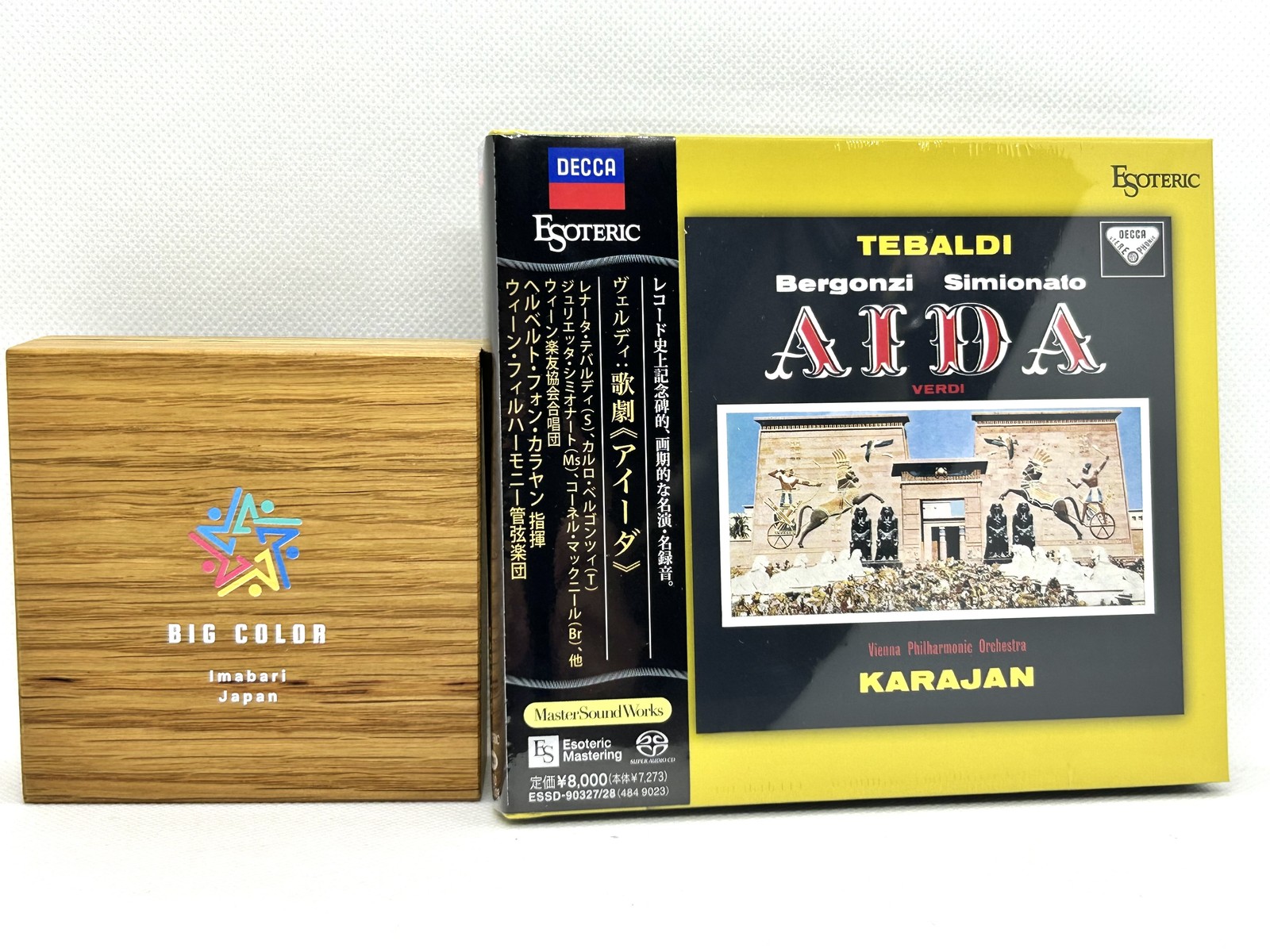
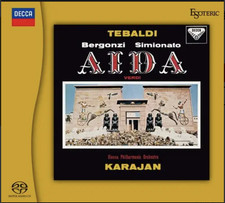
Karajan’s first *Aida*—widely regarded as a landmark performance and recording in the history of vinyl—is finally here.
Featuring a star-studded lineup of Italian singers from the golden age, masterfully conducted by Karajan at the height of his career…
The result is simply flawless.
The Decca production team, which aimed to create a recording of “an opera you can see just by listening,” consisted of the same masterful artists behind *The Ring of the Nibelung*.
Both musically and in terms of sound quality, this is truly a legacy of the 20th century.
[Track List]
Giuseppe Verdi (1813–1901)
Opera *Aida* (4 acts)
DISC 1
[1] Prelude (Preludio)
Act I (Atto Primo)
Scene I (Scena I)
[2] Si, corre voce che l’Etiope ardisca (Ramfis, Radames)
[3] Se quel guerrier io fossi!...Celeste Aida (Radames)
[4] Quale insolita gioia (Amneris, Radames, Aida)
[5] “Alta cagion v’aduna” (The King, the Messenger, Radames, Aida, Amneris, Ramfis, Ministers and Captains, Priests)
[6] “Ritorna vincitor!” (Aida)
Scene II
[7] “Possente Ftha” (Priestess, with the Chorus of Priestesses, Ramfis, and Priests)
[8] Mortal, Beloved by the Gods (Ramfis, Priests, Radames, Priestesses)
Act II
Scene I
[9] Who Among the Hymns and Applause (Slaves, Amneris)
[10] The Fate of War Was Fatal to You (Amneris, Aida)
[11] Come! To the sacred banks of the Nile (Chorus, Amneris, Aida)
Scene II
[12] Glory to Egypt (People, Women, Priests)
[13] Triumphal March
[14] Come, O avenging warrior (People, Priests)
[15] Savior of the Fatherland, I salute you (The King, Radames, Ramfis, and Priests)
[16] What do I see! Is it him? My father! (Aida, Radames, Amneris, Amonasro, The King)
[17] Let this throne I sit upon speak for me (Amonasro)
[18] But you, O King, you mighty lord (Aida, Prisoners and Slaves, Ramfis and Priests, Amneris, The King, The People, Amonasro, Radames)
Disc 2
[1] O King, by the sacred gods (Radames, The King, Amneris, Priests, The People, Ramfis)
[2] Glory to Egypt, to Isis (The King and the People, Slaves and Prisoners, Ramfis and Priests, Aida, Radames, Amneris, Amonasro)
Act III
[3] O you who are of Osiris (Chorus, Priestesses, Ramfis, Amneris)
[4] Here Radames will see!... O my homeland (Aida)
[5] Heaven! My father! (Aida, Amonasro)
[6] Yet I see you again, my sweet Aida... (Radames, Aida)
[7] Let us flee these unwelcome passions (Aida, Radames)
[8] You! Amonasro! You! The king? (Radames, Aida, Amonasro)
Act IV
Scene I
[9] My hated rival slips away from me (Amneris)
[10] The priests are already gathering (Amneris, Radames)
[11] Oh, my dear! I feel myself dying! (Amneris, Ramfis, and the Priests)
[12] Radames! Radames! Radames! (Ramfis, Priests, Amneris)
Scene II
[13] The fatal stone has closed over me (Radames, Aida)
[14] My heart foresees your doom (Aida, Radames, Priestesses)
[15] O land, farewell (Aida, Radames, Chorus
[Cast & Credits]
Aida (Ethiopian princess enslaved in Egypt): Renata Tebaldi (soprano)
Radames (Egyptian general): Carlo Bergonzi (tenor)
Amneris (Egyptian princess): Giulietta Simionato (mezzo-soprano)
Amonasro (King of Ethiopia and Aida’s father): Cornell McNeill (baritone)
Ramfis (High Priest of Egypt): Arnold van Mil (bass)
King of Egypt: Fernando Corena (bass)
Messenger: Piero de Palma (tenor)
Priestess: Eugenia Latti (soprano)
Libretto: Antonio Ghislanzoni
Vienna Musikverein Choir
Chorus Master: Reinhold Schmidt
Vienna Philharmonic Orchestra
Conductor: Herbert von Karajan
[Recording] September 2–15, 1959, Sofiensaal, Vienna
Renowned as a landmark performance and recording in the history of classical music, the long-awaited *Aida* conducted by Karajan is finally here.
Karajan recorded the complete *Aida* twice; his second recording with the Vienna Philharmonic in 1979 (EMI) was previously released by Esoteric as part of the “Karajan & Callas / Great Four Operas” (ESSE-90072/80) by Esoteric, a 9-disc set featuring four works: R. Strauss’s *Salome*, *Carmen* conducted by Preetle with Maria Callas, and *Tosca* conducted by Preetle with Maria Callas.
However, many consider this, Karajan’s first *Aida*, to be an even more highly regarded recording.
It was the first complete recording of the opera in stereo, as well as the Vienna Philharmonic’s first recording of an Italian opera; at the time of its release, it was hailed as a groundbreaking performance and recording, described as “a nearly ideal recorded a Verdi opera premiered in December 1871, depicts the tragic love story of a man and a woman torn between two nations—Pharaonic-era Egypt and Ethiopia.
The libretto was written by Camille du Locle, the director of the Paris Opera.
Although *Aida* is said to have been commissioned by the Viceroy of Egypt to commemorate the opening of the Suez Canal in 1869, Verdi was drawn to the story—which depicts the conflict between love and law, and between the state and the individual—and began composing in accordance with the Viceroy’s wish to stage this majestic tale set in Cairo during his own reign.
After its completion, the premiere took place at the Khedivial Opera House in Cairo, Egypt.
In addition to the standout moments for each singer, the work is packed with highlights, such as the melody of the “Triumphal March” in Act II, Scene 2.
Herbert von Karajan (1908–1989), one of the leading maestros of the latter half of the 20th century, began his international career in 1946 after World War II, signing a contract with EMI and conducting the Vienna Philharmonic, and from around 1950, he built his reputation through numerous recordings primarily with the Philharmonia Orchestra. From 1955, he served as artistic director of the Berlin Philharmonic, and from 1956, he concurrently held the positions of artistic director at the Salzburg Festival and the Vienna State Opera, earning him the nickname “The Emperor.”
Karajan’s first opera recordings were Mozart’s *The Marriage of Figaro* and *The Magic Flute* (1950) with the Vienna Philharmonic. He subsequently made several other opera recordings, and after assuming the role of Artistic Director of the Vienna State Opera, he conducted works such as Wagner’s four-part *The Ring of the Nibelung*—for which he also served as stage director—as well as Mozart and major Italian operas, as well as Stravinsky’s *Oedipus Rex*.
He was also a leading figure in the opera world, a true specialist who insisted on performances in the original languages, fostered active exchanges between singers and directors through a partnership with La Scala, and implemented various reforms.
Shortly after the recording industry entered the stereo era in 1958, Karajan signed contracts with both Gramophone and Decca, beginning recordings in March 1959.
Decca, which had experienced rapid growth with the advent of the LP, was the label most eager to record complete operas, and it chose this production of *Aida* for Karajan and the Vienna Philharmonic’s first opera recording.
One reason for this choice was likely the acclaim the production had received at the State Opera since May of the previous year.
With the exception of McNeill (Aida’s father), the cast was selected primarily from among the Italian singers with whom he had previously performed.
For the role of Radames (the Egyptian general), Decca’s management strongly advocated for Del Monaco, who had appeared on the Erede recording (recorded in 1952).
However, it is said that Karajan and producer Karscho refused to yield, insisting on casting the young Bergonzi—who had received rave reviews for his performances with Tebaldi in *Madama Butterfly* and *La Bohème*, recorded the previous year in Rome under the baton of Serafin.
This episode illustrates the determination of Karajan and Karscho to make this production the very best, even if it meant going against the wishes of upper management.
Their efforts paid off: this recording of *Aida* was released in Europe and the United States during the 1959 Christmas season—just three months after it was recorded—and was hailed as “an almost ideal recorded performance.”
Karajan’s conducting and the superb performances by the renowned singers Tebaldi, Simionato, and Bergonzi—arguably the best cast of the era—perfectly illustrate the reasons for this acclaim.
The recording took place in 1959, the year following the release of *Das Rheingold*, the first installment of Solti’s immortal 20th-century masterpiece, *The Ring of the Nibelung*; the recording staff and location were identical.
The Decca Sound of that era—described as “a grand and powerful sound that remains more than relevant today”—is once again shown at its best here.
The excellence of the Decca staff’s recording work had been highly acclaimed even back then, and the results of this recording—a hallmark of producer Karscho, who had long studied “how to capture the spatial effects of the theater” on record—became a major talking point.
While the magnificent rendering of the Triumphal Scene (Act II, Scene 2) in this *Aida* was the subject of great discussion from the outset, Karscho’s work on other passages—such as the priestesses’ song outside the temple in Act I, Scene 2; the chorus and march heard from outside in Amneris’s room in Act II, Scene 1; the prayer song inside the temple during the scene on the banks of the Nile in Act III; the royal palace hall and the underground trial in Act IV, Scene 1; and the temple and dungeon in Act IV, Scene 2—all of which present extreme challenges in achieving a sense of depth and three-dimensionality even on a live stage—by utilizing several smaller halls within the Sophiensaal.
Although it was a two-track stereo recording made before the development of multichannel recording, it was highly acclaimed for “realizing the sounds specified in the score—sounds that would be impossible even in a theater.”
*Aida* was produced with every artist and staff member dedicating their heart and soul to the project.
We hope that by listening to this first-ever Super Audio CD hybrid release, remastered for this occasion, many fans will once again recognize this as a monumental performance and recording in the history of recorded music.
This is the first time this recording has been released as a Super Audio CD hybrid.We have remastered the recording from the original master specifically for Super Audio CD.As always, we have worked without compromise, from the selection of the master to the final DSD mastering process.In particular, for the DSD mastering, we utilized “Esoteric Mastering.” We employed ESOTERIC’s top-of-the-line equipment—the Master Sound Discrete DAC and Master Sound Discrete Clock—which had been meticulously calibrated. Furthermore, by sparing no expense in using MEXCEL cables, we were able to transfer the information contained in the original master to disc with a spacious, open sound.
*Shipping
We ship using FedEx, DHL and UPS or Japan Post.
*Payment
We usually ship within 3〜7 business days of receiving cleared payment.