When you click on links to various merchants on this site and make a purchase, this can result in this site earning a commission. Affiliate programs and affiliations include, but are not limited to, the eBay Partner Network.
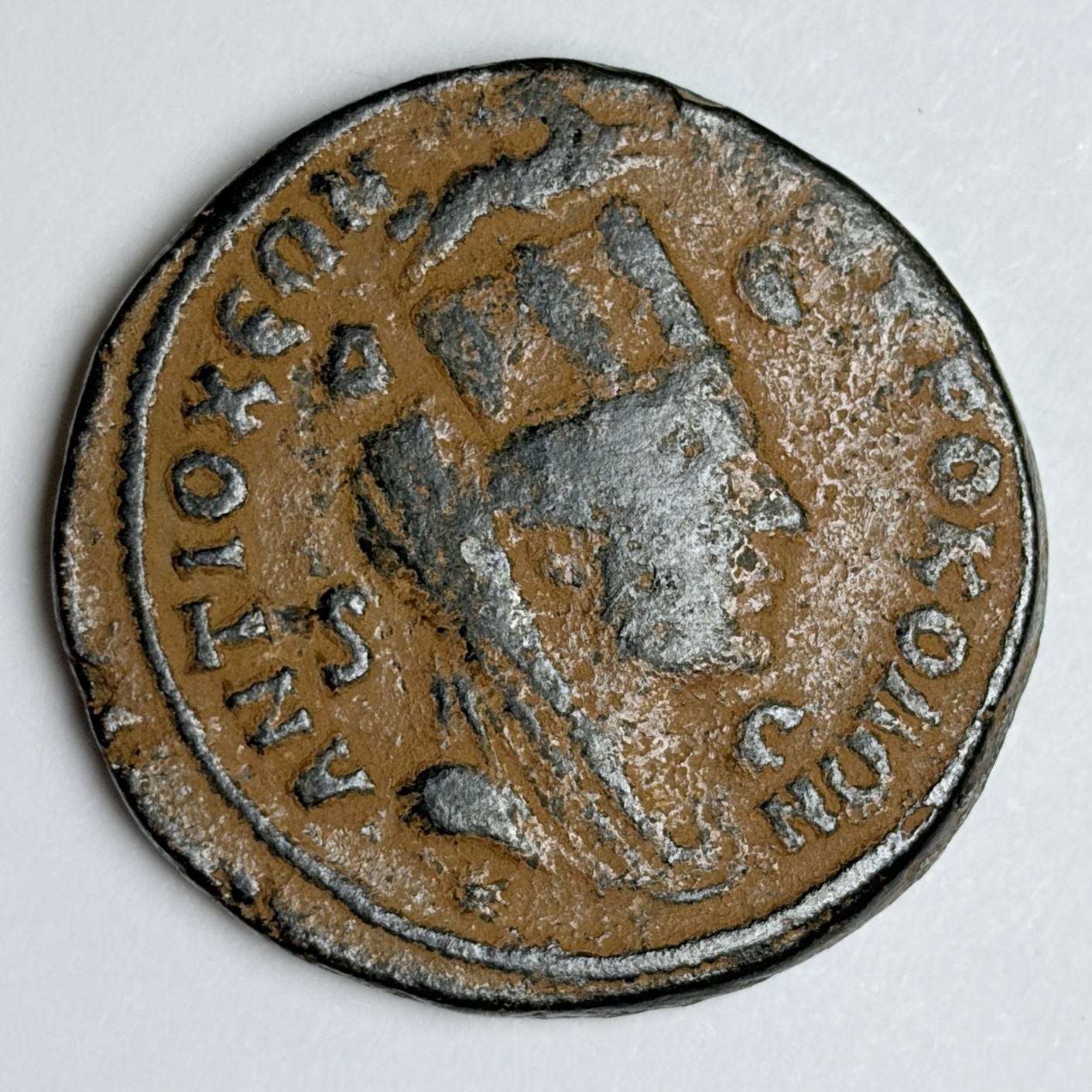
Roman Provincial Coin of Egypt
Emperor Philip I - Philip The Arab
(244-249 AD)Struck 247-249 AD at mint of Antioch
Bronze AE30 - 30mm -17.30 grams
Reference:BMC 531-SNGCop 271
Grade: Choice F
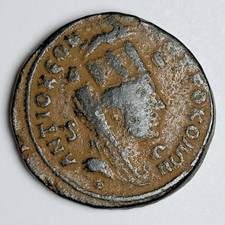
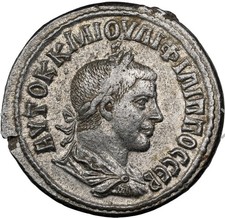
Obverse:AYTOK K M IOYΛI ΦIΛIΠΠOC CEB, Laureate, draped and cuirassed bust of Philip the Arab facing rightReverse:ANTIOXEΩN MHTΡO KOΛΩN Δ-E S-C, Turreted, veiled and draped bust of Tyche facing right, ram jumping right above, star below
Arrives with specifications page for your reference
See theGenuine HistoryCollection
Philip I (Latin: Marcus Julius Philippus; c. 204 – September 249), commonly known as Philip the Arab, was Roman emperor from 244 to 249. After the death of Gordian III in February 244, Philip, who had been Praetorian prefect, rose to power. He quickly negotiated peace with the Sasanian Empire and returned to Rome to be confirmed by the Senate. According to many historians, he was possibly the first Christian Roman Emperor.
Although his reign lasted only five years, it marked an unusually stable period in a century that is otherwise known for having been turbulent. Near the end of his rule, Philip commemorated Rome\'s first millennium. In September 249 he was killed during or shortly after the Battle of Verona against the usurper Trajan Decius, who was subsequently recognized by the Senate as his successor.
Born in modern-day Shahba, Syria, in what was then Arabia Petraea, Philip\'s ethnicity was most likely Arab. While he publicly adhered to the Roman religion, he was later asserted to have been a Christian, and in the later half of the 3rd century and into the beginning of the 4th century, some Christian clergymen held that Philip had been the first Christian ruler of Rome. He was described as such in many published works that became widely known during the Middle Ages, including *Chronicon* (‘Chronicle’); *Historiae Adversus Paganos* (‘History Against the Pagans’); and *Historia Ecclesiastica* (‘Ecclesiastical History’). Consequently, Philip\'s religious affiliation remains a divisive topic in modern scholarly debate about his life.
Bust of Philip I at The State Hermitage Museum in Saint Petersburg, 2010
Antiochwas a city located in northern Syria at the site of modern Antakya, Turkey. Founded in 300 BC, Antioch became one of the most important cities of the ancient eastern Mediterranean. The capital of the Hellenistic Seleucid Empire, it remained significant under the Roman and Byzantine Empires, and during the Crusades was the center of the Principality of Antioch.
Seleucus I Nicator, a successor of Alexander the Great, founded Antioch alongside three other cities to secure the surrounding region, which he had recently conquered. He chose a site on the Orontes River in the southwest Amuq plain, a fertile lowland which provided valuable resources for Antioch; the city was strategically located and came to dominate trade routes. It served as the Seleucid capital from 240 BC until 63 BC, when the Romans took control; it was thereafter the capital of Roman Syria. Antioch may have been inhabited by over 500,000 inhabitants at its peak, making the city the third largest in the Roman Empire after Rome and Alexandria.
The city was the main center of Hellenistic Judaism at the end of the Second Temple period. As one of the cities of the pentarchy, Antioch was called \"the cradle of Christianity\" as a result of its longevity and the pivotal role that it played in the emergence of early Christianity. The Christian New Testament asserts that the name \"Christian\" first emerged in Antioch. From the early 4th century, Antioch was the seat of the comes Orientis, head of the Diocese of the East. The city declined to relative insignificance during the Middle Ages due to warfare, repeated earthquakes, and a change in trade routes. The remains of the ancient city of Antioch are mostly buried beneath alluvial deposits from the Orontes River.
The city still lends its name to the Greek Orthodox Patriarchate of Antioch, one of the most important modern churches of the Levant and the eastern Mediterranean. The city also attracts Muslim pilgrims who visit the Habib-i Nejjar Mosque, which they believe to contain the tomb of Habib the Carpenter, mentioned in surah Yā-Sīn of the Quran.Map of Antioch in Ancient and early Medieval times under Roman rule