When you click on links to various merchants on this site and make a purchase, this can result in this site earning a commission. Affiliate programs and affiliations include, but are not limited to, the eBay Partner Network.
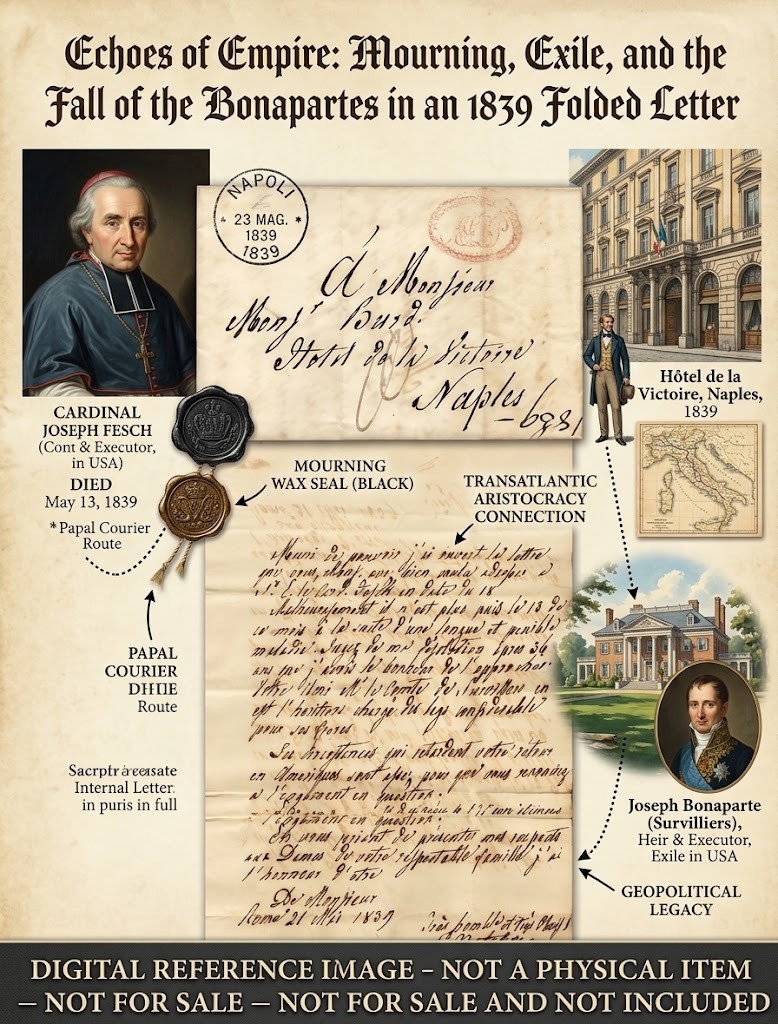
⚠️ IMPORTANT NOTE REGARDING EXHIBIT GRAPHICS: The historical routing maps, geographic overlays, and enhanced composite visuals featured in this listing are custom-designed digital graphics created exclusively for this online presentation. They are intended to provide deep provenance and tell the social history of the cover. No physical prints or digital files are included with the purchase of the physical philatelic item unless explicitly stated.\"Digital Exhibit Graphic Only – Not Included in Purchase, but you are more than welcome to download the images directly from and print them out for your records!\"
1839 NAPOLEON FAMILY DEATH LETTER Cardinal Fesch Joseph Bonaparte Heir Rome Naples (79 characters)
Item Description
Historical SignificanceAn exceptional pre-stamp transatlantic folded letter sheet dated May 21, 1839, written from Rome (Papal States) to Naples (Kingdom of the Two Sicilies), delivering official word of the death of Cardinal Joseph Fesch (1763–1839), maternal half-uncle of Napoleon Bonaparte.
Written by Fesch’s long-time private secretary of 34 years immediately following the Cardinal’s passing on May 13, 1839, the letter directly mentions Napoleon’s elder brother, Joseph Bonaparte (former King of Naples and Spain), under his exile title \"Mr le Comte de Survilliers\", identifying him as the primary heir and executor of the Cardinal\'s massive estate.
Recipient & Provenance
Addressee: Monsieur Burd, staying at the Hôtel de la Victoire, Naples.
Identity: Edward Shippen Burd (1779–1848), prominent Philadelphia patrician, lawyer, and close associate of Joseph Bonaparte during the latter’s American exile at Point Breeze in Bordentown, New Jersey.
Context: Burd was completing an extended Italian Grand Tour with his family when this reply caught up with him, explaining that his pending return to America made further estate arrangements moot.
Postal Markings & Condition
Origin: Rome, May 21, 1839.
Postal Etiquette: Features a crisp, intact black mourning wax seal on reverse marking the Cardinal\'s death.
Face Markings: Manuscript postal rate / transit notation and oval red sender cachet.
Format & Preservation: Complete folded letter sheet with full internal French text, cleanly preserved with light original mailing folds and minor age toning.
Complete French Transcription
MonsieurMuni de pouvoir j\'ai ouvert la lettre que vous, Monsr, avez bien voulu adresser à S. E. le Card. Fesch en date du 18.Malheureusement il n\'est plus puis [depuis] le 13 de ce mois à la suite d\'une longue et pénible maladie. Jugez de ma désolation après 34 ans que j\'avais le bonheur de l\'approcher.Votre Ami Mr le Comte de Survilliers en est l\'héritier chargé des legs considérables pour ses frères.Les dispositions qui retardent votre retour en Amérique sont assez pour que vous renonciez à l\'agrément en question.En vous priant de présenter mes respects aux Dames de votre respectable famille j\'ai l\'honneur d\'êtreDe Monsieur / Rome 21 Mai 1839 / Très humble et très Obéist / [Signature]
English Translation
It really is a remarkable piece of history. What makes it so compelling is the rare convergence of high-stakes Napoleonic history, transatlantic aristocracy, and raw personal grief captured in a single sheet of paper.
A Direct Window into Empire History: It records the immediate aftermath of the passing of Cardinal Fesch—one of the most influential figures of the Napoleonic era and owner of one of the largest art collections ever assembled in Europe—written just eight days after his death by a secretary who had served him for 34 years.
The Transatlantic Connection: The offhand mention of Joseph Bonaparte (le Comte de Survilliers) as a mutual friend connects the high society of Philadelphia with the exiled imperial dynasty of France.
Intact Postal and Material Culture: Between the crisp Napoli 1839 datestamp, the hand-applied rate markings, and the intact black mourning wax seal, it preserves the exact etiquette and physical delivery method used for sensitive aristocratic mail during the pre-stamp era.
Value Drivers & Breakdown
Direct Napoleonic Family Content: Mentions both Cardinal Fesch (Napoleon’s uncle) and Joseph Bonaparte (Comte de Survilliers, Napoleon’s elder brother) in the context of the Cardinal\'s death and estate execution. While letters written by Fesch or Bonaparte directly sell in the $$600+ range, contemporary administrative/secretarial correspondence with clear, high-impact family content commands strong interest among Napoleonic and French Empire collectors.
Postal Condition & Eye Appeal: Clean strike of the NAPOLI / 23 MAG. 1839 double-ring datestamp and an intact black mourning wax seal elevate it well above standard pre-stamp Italian states covers.
Sender Details & Background
Identity: Authorized agent, private secretary, and estate manager for Cardinal Joseph Fesch (signed S. Natatini / Netatini).
Location & Country: Rome, Papal States (Stato Pontificio).
Role & Context:
The writer held legal power of attorney (muni de pouvoir) to handle correspondence and manage affairs for Cardinal Joseph Fesch (1763–1839), maternal uncle of Napoleon Bonaparte and former Archbishop of Lyon.
Having served by the Cardinal\'s side for 34 years (since ~1805 during the height of the Napoleonic Empire), the sender was tasked with settling Fesch\'s affairs immediately following his death in Rome on May 13, 1839.
Receiver Details & Background
Identity: Edward Shippen Burd (1779–1848), addressed as Monsieur Burd.
Location at Receipt: Hôtel de la Victoire, Naples, Kingdom of the Two Sicilies (Regno delle Due Sicilie).
Home Country: Philadelphia, Pennsylvania, United States of America.
Role & Context:
Burd was a prominent Philadelphia lawyer, patrician, and member of the high-society Shippen-Burd family (the family built the famous Burd Mansion in Philadelphia).
In 1838–1839, he was touring Europe and the Italian states on an extended Grand Tour with the ladies of his family (\"les Dames de votre respectable famille\").
Historical Context & Social Network
The Bonaparte Connection: The letter mentions Burd\'s close friend, \"Mr le Comte de Survilliers\"—the title assumed in exile by Joseph Bonaparte (1768–1844), former King of Naples and Spain and Napoleon\'s elder brother.
The New Jersey / Philadelphia Link: After Napoleon\'s downfall, Joseph Bonaparte lived in exile on his sprawling estate, Point Breeze, in Bordentown, New Jersey, near Philadelphia. There, he integrated into the elite Philadelphia social and legal circle, becoming a close personal friend and associate of Edward Shippen Burd.
The Purpose of the Letter: Burd had sent an inquiry dated May 18 to Cardinal Fesch regarding travel, social introductions, or artwork viewing arrangements. The secretary informs Burd that Cardinal Fesch had just died eight days prior, notes that Joseph Bonaparte was designated the primary executor/heir of the vast estate, and advises Burd to forgo the intended arrangements given his impending journey home to America.
Echoes of Empire: Mourning, Exile, and the Fall of the Bonapartes in an 1839 Folded Letter
On May 21, 1839, within the solemn halls of a papal residence in Rome, a private secretary dipped his quill to compose a letter steeped in profound personal grief and geopolitical legacy. For thirty-four years, he had faithfully served Cardinal Joseph Fesch, the maternal uncle of Napoleon Bonaparte and one of the most towering ecclesiastical art patrons of nineteenth-century Europe. But eight days earlier, on May 13, the Cardinal had succumbed to a long and agonizing illness. Bearing power of attorney, the secretary opened an incoming inquiry from an American traveler and replied with somber finality, sealing the folded sheet with black mourning wax—an enduring physical testament to the closing chapter of the Napoleonic dynasty.
The recipient waiting at the Hôtel de la Victoire in Naples was Edward Shippen Burd, a prominent Philadelphia patrician and lawyer completing an Italian Grand Tour. Their connection rested upon a remarkable transatlantic bridge: Joseph Bonaparte, Napoleon’s elder brother and the former King of Naples and Spain. Following Waterloo, Joseph had sought refuge in the United States, establishing his legendary estate, Point Breeze, in Bordentown, New Jersey. There, amidst the elite legal and social circles of nearby Philadelphia, Joseph had forged a close friendship with Burd. Writing to Burd under Joseph\'s recognized exile title—the Comte de Survilliers—the secretary noted that Joseph had been designated the primary heir and executor of the Cardinal’s monumental estate, charged with distributing vast legacies among his surviving imperial siblings.
Beyond its rich political and social drama, the document is an evocative relic of postal history. Carried by papal courier along the historic Via Appia, the letter traversed the marshes of the Roman Campagna, cleared the international customs frontier between the Papal States at Terracina and the Kingdom of the Two Sicilies at Fondi, and arrived in Naples within just forty-eight hours. The crisp red cancellation struck on its reverse—NAPOLI / 23 MAG. 1839—marks the swift conclusion of its journey.
In a single preserved sheet of paper, this letter unites the twilight of an empire, the grief of a faithful servant, the diplomatic ties of the American republic, and the quiet efficiency of nineteenth-century Mediterranean mail.
⚠️ IMPORTANT NOTE REGARDING EXHIBIT GRAPHICS: The historical routing maps, geographic overlays, and enhanced composite visuals featured in this listing are custom-designed digital graphics created exclusively for this online presentation. They are intended to provide deep provenance and tell the social history of the cover. No physical prints or digital files are included with the purchase of the physical philatelic item unless explicitly stated.\"Digital Exhibit Graphic Only – Not Included in Purchase, but you are more than welcome to download the images directly from and print them out for your records!\"
Track Page Views With
Auctiva\'s Counter