When you click on links to various merchants on this site and make a purchase, this can result in this site earning a commission. Affiliate programs and affiliations include, but are not limited to, the eBay Partner Network.
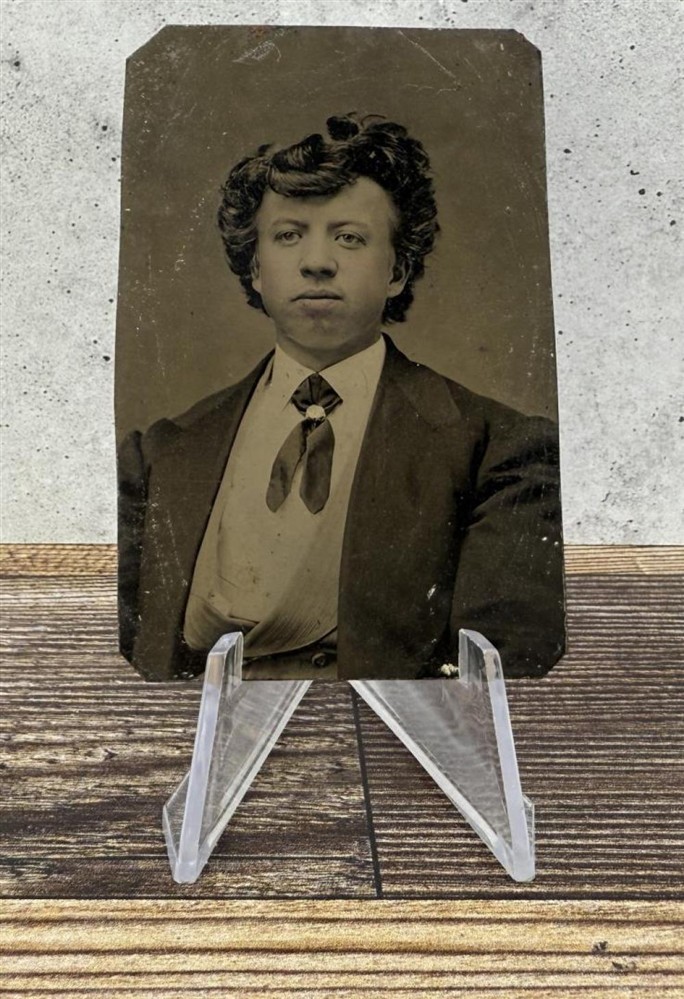
Condition Notes: Slightly undersized 1/6 plate measures 2x3 in. Extremely clear and sharp image with minimal scratches to the image side. Hand-coloring on the cheeks and lips. One semi-circular \"dent\" in the metal at the peak of her hair on the (viewer\'s) right side, with no image loss at that spot. Overall an extremely good to very fine image.
Slightly Small 1/6 plate: 2 x 3 in.
Believed to date from circa 1865–1885, during the height of tintype portraiture and Reconstruction-era self-representation.
The unidentified subject is posed in formal studio attire: dark jacket, white blouse, and loosely tied neck wear. Her direct gaze and composed posture reflect the era’s use of photography as a tool of dignity and self-representation, particularly among free Black Americans during Reconstruction.
Her attire - a tailored jacket and necktie - echoes masculine fashion of the era, suggesting a bold assertion of identity and dignity. Her smoothed hairstyle reflects the complex interplay between personal style and societal expectations, especially for free African American women navigating Reconstruction-era norms.
Her Clothing
The outfit she’s wearing—a dark jacket with lapels, white shirt, and loosely tied neck wear, closely resembles a gentleman’s suit of the mid-to-late 19th century. This kind of styling wasn’t common for women in tintypes unless it was:
A deliberate statement: Cross-gender presentation could signal autonomy, resistance to gender norms, or simply access to formal wear in a studio setting.
Aesthetic choice: Some women adopted masculine styles to convey seriousness, professionalism, or modernity—especially in urban or abolitionist circles.
Economic or social signaling: Clothing might reflect her role in a household or community, such as a teacher, activist, or businesswoman.
In the context of a free African American woman, this styling could be a subtle assertion of equality, literacy, or civic presence—especially during Reconstruction, when photography was used to counteract racist imagery and assert Black dignity.
Her Hair
Her hair appears smoothed or straightened, possibly with heat or pomade—techniques used in the 19th century before chemical relaxers. This choice may reflect:
Navigating Eurocentric beauty standards: Straight hair was often seen as “respectable” or “refined” in white-dominated society, and many Black women adopted it to access opportunities or to avoid discrimination.
Studio preparation: Photographers sometimes encouraged clients to present in their “best” attire and grooming, which could include hair styling aligned with dominant norms.
Personal expression: Straightened hair could also reflect individual taste, pride in appearance, or a desire to be seen as fashionable.
This styling choice doesn\'t erase her identity. It shows how Black women negotiated visibility and respect in a society that often denied both.
The Hand-Tinting
Subtle hand-coloring is visible on the subject’s cheeks, a common 19th-century studio technique used to enhance realism and warmth. This artistic touch adds depth to the portrait and underscores its role in self-representation during Reconstruction.
Condition
Surface wear consistent with age, including light scratches and rounded corners. No framing or studio markings present.
Genuine Historical Photo from the Era – No Modern Copies
2 picture(s) included as part of our description. Please examine carefully before purchase. If you have any questions before purchase please contact us here: we are very happy to help in any way we can.
ET1407-3500 2508 HALDR10
Reprint or publishing rights for photographs are not granted with purchase.
Powered by SixBit\'s eCommerce Solution