When you click on links to various merchants on this site and make a purchase, this can result in this site earning a commission. Affiliate programs and affiliations include, but are not limited to, the eBay Partner Network.
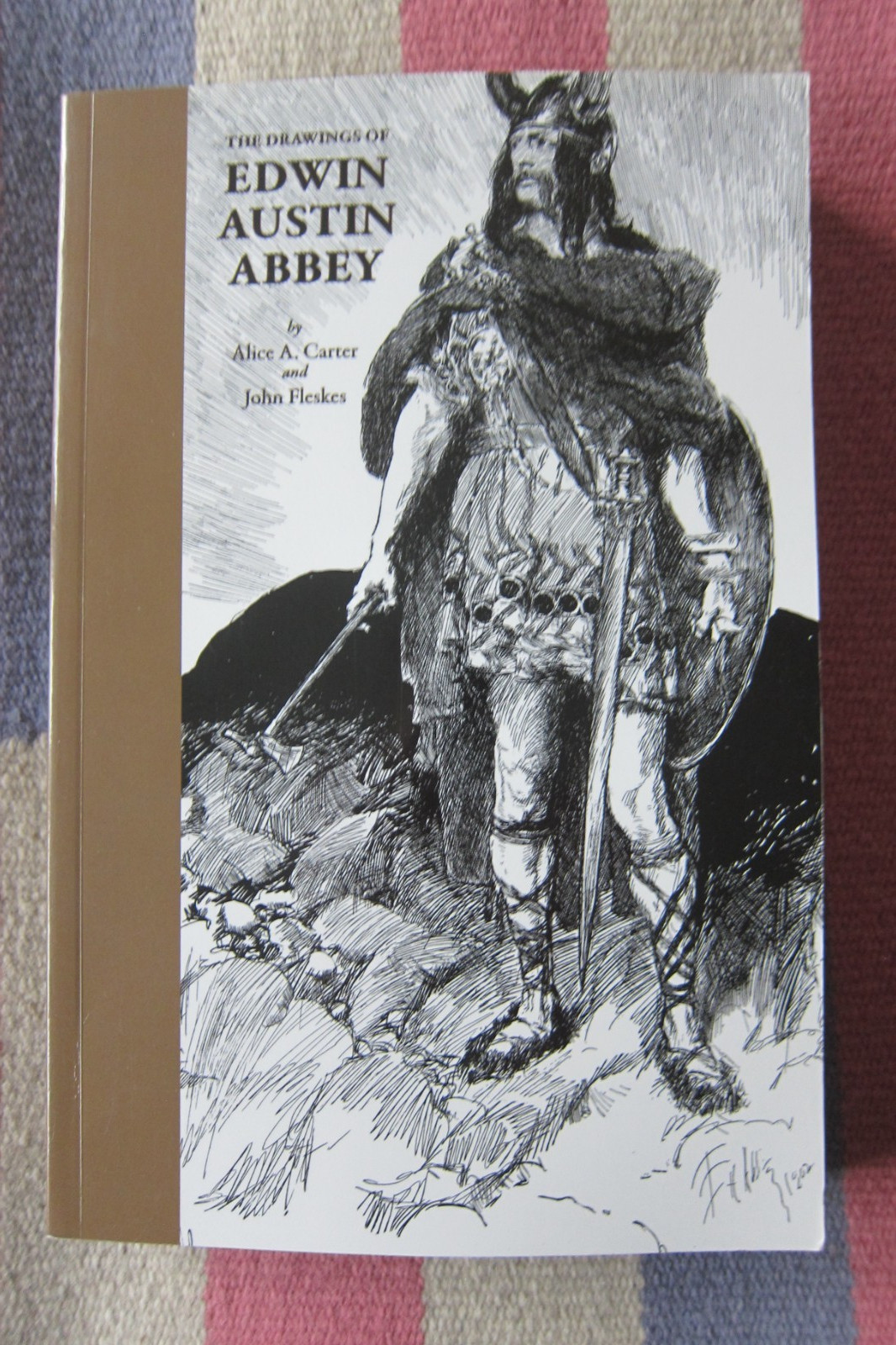
Edwin Austin AbbeyRA(April 1, 1852– August 1, 1911) was an American muralist, illustrator, and painter. He flourished at the beginning of what is now referred to as the \"golden age\" ofillustration, and is best known for his drawings and paintings ofShakespeareanandVictoriansubjects, as well as for his painting ofEdward VII\'scoronation.[1][2][3]His most famous set of murals,The Quest and Achievement of theHoly Grail, adorns theBoston Central Library.
Early life and educationEdwin Austin Abbey, an 1888 illustration byJohn Singer Sargentnow housed at theYale University Art Gallery
Abbey was born inPhiladelphia, on April 1, 1852, tocommercialbrokerWilliam Maxwell Abbey and Margery Ann Kiple.[4][5]He studied art at thePennsylvania Academy of the Fine Artsin Philadelphia[6]underChristian Schussele.[7]
CareerKing Lear, Act I, Scene I(1897–98) now housed at theMetropolitan Museum of Art
Abbey began as an illustrator, producing numerous illustrations and sketches magazines, includingHarper\'s Weekly(1871–1874) andScribner\'s Magazine. His illustrations began appearing inHarper\'s Weeklybefore Abbey was twenty years old. He moved to New York City in 1871. His illustrations were strongly influenced by French and German black and white art:[8]Adolph MenzelandDaniel Vierge; and by English artists.[5]He illustrated several best-selling books, includingChristmas StoriesbyCharles Dickens(1875),Selections from the Poetry ofRobert Herrick(1882), andShe Stoops to ConquerbyOliver Goldsmith(1887). Abbey also illustrated a four-volume set ofThe Comedies of Shakespearefor Harper & Brothers in 1896.
In 1878, he moved to England at the request of his employers to gather material for illustrations of the poems ofRobert Herrick,[1]published in 1882,[9]and he settled permanently there in 1883.[10]
In 1883, he was elected to theRoyal Institute of Painters in Water-Colours.[1]About this time, he was appraised critically by the American writer,S.G.W. Benjamin:
It must be taken into consideration that he is still very young; that he now for the first time visits the studios and galleries of Europe; that his advantages for a regular art education have been very moderate, and that he is practically self-educated. And then compare with these disadvantages the amount and the quality of the illustrations he has turned out, and we see represented in him genius of a high order, combining almost inexhaustible creativeness, clearness and vividness of conception, a versatile fancy, a poetic perception of beauty, a quaint, delicate humor, a wonderful grasp of whatever is weird and mysterious, and admirable chiaro-oscuro, drawing, and composition. When we note such a rare combination of qualities, we cease to be surprised at the cordial recognition awarded his genius by the best judges, both in London and Paris, even before he had left this country.[11]
He also created illustrations forGoldsmith\'sShe Stoops to Conquer(1887), for a volume ofOld Songs(1889), and for the comedies (and a few of the tragedies) ofShakespeare. Among his water-colours are \"The Evil Eye\" (1877), \"The Rose in October\" (1879), \"An Old Song\" (1886), \"The Visitors\" (1890), and \"The Jongleur\" (1892). Possibly his best known pastels are \"Beatrice\", \"Phyllis\", and \"Two Noble Kinsmen\".[9]
In 1890, he made his first appearance with an oil painting, \"A May Day Morn\", at theRoyal Academyin London. He exhibited \"Richard duke of Gloucester and the Lady Anne\" there in 1896, and in that year was electedA.R.A., becoming a full member in 1898.[9]He received a gold medal at thePan-American Expositionand was commissioned to paint thecoronationof KingEdward VIIin 1901;[4]in the next year, he was chosen to paint the coronation. It was the official painting of the occasion and, hence, resides atBuckingham Palace. He did receive a knighthood,[10]although some say he refused it in 1907. Friendly with other expatriate American artists, he summered atBroadway, Worcestershire, England, where he painted and vacationed alongsideJohn Singer Sargentat the home ofFrancis Davis Millet.
He completed murals for theBoston Central Libraryin the 1890s.[4]The frieze for the Library was titled \"The Quest and Achievement of the Holy Grail\". It took Abbey eleven years to complete this series of murals in his England studio. In 1897 he received the honorary degree ofA.M.from Yale university.[4]In 2024, theYale University Art Gallerycompleted restoration of his \"Study for the Apotheosis of Pennsylvania\" using a technique known as \"mist lining\" which repaired structural defects in the canvas.[12]
In 1904 he painted a mural for theRoyal Exchange, LondonReconciliation of the Skinners & Merchant Taylors\' Companies by Lord Mayor Billesden, 1484.