When you click on links to various merchants on this site and make a purchase, this can result in this site earning a commission. Affiliate programs and affiliations include, but are not limited to, the eBay Partner Network.
This listing is for a RARESIGNED
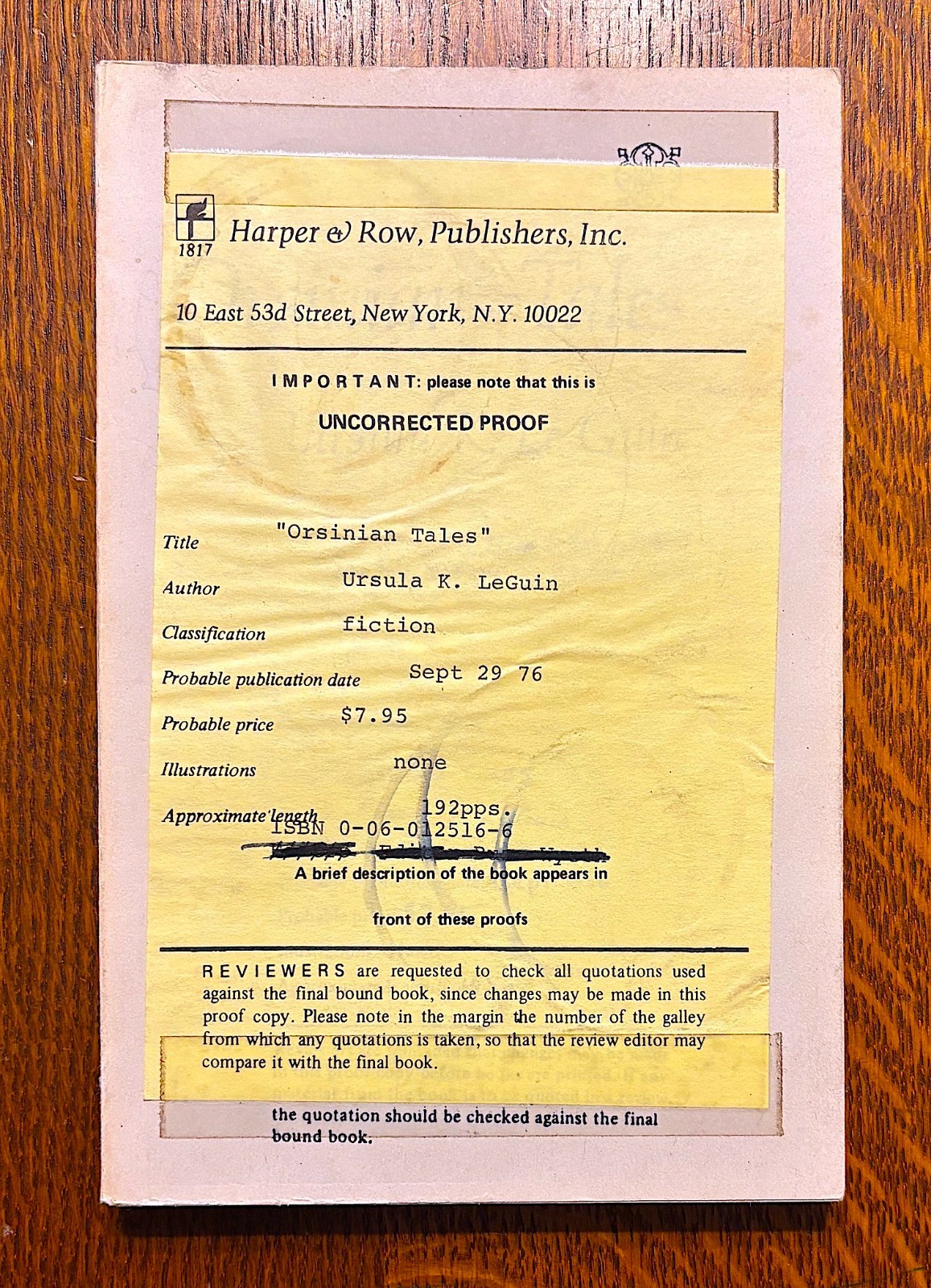
1976 Harper & Row UNCORRECTED PROOF
Pre-First Edition First Printing Review Copy
of
ORSINIAN TALES
by the Hugo, Nebula, and
National Book Award Winningauthor
URSULA K. LE GUIN
This is anUNCORRECTED PROOF REVIEW COPY sent out to reviewers and booksellers before the 1st Edition was released. This Proof was issued before an Advanced Reader\'s Copy (ARC) and is very rare!
Thishas been SIGNEDby the author, Ursula Le Guin, on the title page. It has been signed in black archival penwith her name. It has been flat signed - simply signed with only her name and no dedication or inscription.
I took this book to one of Ursula\'s book signings at Powell\'s Books in Portland, Oregon and she autographed it IN MY PRESENCE. The pictures above are from that signing...
Condition is as follows: This is a VERY RARE Uncorrected Proof from the publisher sent out to reviewers. Is it is softcover wraps and the review information slip is taped to the front cover of the wrap. This fragile item is in amazing condition for it\'s 50 year old journey. It may be unread as there is no reading crease on the spine.
The paper review information is taped to the front cover of the wraps - it appears to have some coffee cup rings on it, and there is some very slight wear to corners, edges, and head and tail of spine. There is also the beginnings of separation at the bottom of the first inside hinge.
If you collect celebrated women\'s authors, Fantasy or Science Fiction, Young Adult booksor just love the GENIUS of Ursula K. Le Guin, then this will be a WELCOME addition to your collection!!
Shipping will be choice of $6.85 for Media Mail or $17.85 Priority Shipping.The book will be carefully wrapped in bubble wrap and sent in a box so it arrives in its original condition. We pride ourselves on packing and shipping - this will get to you safely!
I GLADLY ship worldwideso please email for worldwide shipping costs. Payment must be received within 7 days of sale end - please email with any questions!
Please check out my other itemsthat I haveup for sale and in my store! I am always listing wonderfulRare Books and Signed First Editions,as well as special Antiquesfound on my many travels..
Remember -this is coming fromOREGONwhich is aNO SALES TAX STATE.If you buy this,you will not be charged any Oregon sales taxby mefor this listing!!(but also remember, your own state and may still charge you!)
Thanks for looking!
ABOUT THE BOOK
ORSINIAN TALES
In a career spanning half a century, Ursula K. Le Guin produced a body of work that testifies to her aoffering faith in the power and art of words. She is perhaps best known for imagining future intergalactic worlds in brilliant books that challenge our ideas of what is natural and inevitable in human relations—and that celebrate courage, endurance, risk-taking, and above all, freedom in the face of the psychological and social forces that lead to authoritarianism and fanaticism.
It is less well known that she first developed these themes in richly imagined historical fiction set in the imaginary East European country of Orsinia, including the enchanting stories collected in Orsinian Tales. These brilliantly rendered stories recount episodes of personal drama set against a history that spans Orsinia’s emergence as an independent kingdom in the twelfth century to its absorption by the eastern Bloc after World War II. Here is a dimension of Le Guin’s extraordinary literary imagination that will surprise and delight readers.
Complete with a newly researched chronology of the author’s life and career.
A 1977 National Book Award Finalist for Fiction
Orsinian Tales was originally published by Harper & Row in 1976. It is now available as an eBook Classic from Library of America, and is included in The Complete Orsinia.
Praise
“One hopes that Le Guin will return to this bleak, lovely land soon and often.”
— Kirkus Reviews
“What breathes life into each of her tales is not documentary pretense but the primary act of imagination underlying the whole book.”
—Gerald Jonas, The New York Times
Themes
The stories in the collection share few links, except those derived from the use of a common geographical setting. The only link between characters appears in the stories Brothers and Sisters and A Week in the Country, both of which deal with members of the Fabbre family (whose history is continued in the later story Unlocking the Air). Common to all the stories, however, are emotionally moving personal events—often romantic—set against the backdrop of much larger political events such as wars and revolutions. Continually reasserted are the rights of the individual—sometimes alone, but often in conjunction with others—to his or her own thoughts and emotions, not dictated by society, convention, or the State.
Continuations
Additional stories in the cycle include the following:
- the novel Malafrena (1979), set in the Orsinia of the 1820s
- the Borges-like story \"Two Delays on the Northern Line\", containing two tangentially linked episodes of uncertain date
- \"Unlocking the Air\"
The last-named story extends Orsinian history up to the downfall of Communism in Orsinia—and the rest of Eastern Europe—in the winter of 1989.
Orsinia
The stories are set in a fictional country somewhere in Central Europe, at different times during the period 1150–1989 (though only two stories take place before the 20th century). This country, \"Orsinia\", appears in Le Guin\'s earliest writings,and it was invented by Le Guin when she was a young adult learning the craft of a writer. The names Orsinia and Ursula are both derived from the Latin word ursus, \'bear\' (ursula is the diminutive of ursa, \'female bear\'; ursinus means \'bear-like). Le Guin once said that since Orsinia was her country, it should bear her name.
The history of Orsinia generally follows that of other countries of Central Europe, particularly those that were formerly part of Austria-Hungary.Formerly an independent kingdom (in \"The Lady of Moge\"), by the 19th century it was a dependency of the Austrian Empire(in Malafrena). Orsinia was involved in the First World War(in \"Conversations at Night\"), and after that war it was independent for a time. Its fate during World War II is not mentioned, but in 1946 or 1947, it became a satellite state in the Eastern bloc. A revolt was attempted in 1956 (in \"The Road East\"), but it was crushed and followed by reprisals (in \"A Week in the Country\"); Orsinia remained a repressive police state for several decades. In November 1989, following a series of non-violent protests, the government fell, to be replaced by a transitional regime promising free elections (in \"Unlocking the Air\"). Le Guin did not publish any Orsinian stories dealing with its history since that event.[c]
The Orsinian stories borrow episodes from (and sometimes explicitly refer to) the history of the Czech lands, in addition to Hungary and other countries of Central Europe.However, the collection is not a mere fictionalization of any real country, but rather one imagined with its own unique characteristics and history, distilled from Le Guin\'s personal interpretation of and reaction to historical events.[f]
Contents
- \"The Fountains\"
- \"The Barrow\" (1976,The Magazine of Fantasy & Science Fiction, October 1976)
- \"Ile Forest\"
- \"Conversations At Night\"
- \"The Road East\"
- \"Brothers and Sisters\" (1976, The Little Magazine, Vol. 10, Nos. 1 & 2)
- \"A Week in the Country\" (1976, The Little Magazine, Vol. 9, No. 4)
- \"An die Musik\" (1961, The Western Humanities Review, Vol XV, No. 3)
- \"The House\"
- \"The Lady of Moge\"
- \"Imaginary Countries\" (1973, The Harvard Advocate)
Ursula K. Le Guin
From Wikipedia, the free encyclopedia
Ursula Kroeber Le Guin
(October 21, 1929 - January 22, 2018) was an American author best known for her works of speculative fiction, including science fiction works set in her Hainish universe, and theEarthseafantasy series. She was first published in 1959 and her literary career spanned nearly sixty years, producing more than twenty novels and over a hundred short stories, in addition to poetry, literary criticism, translations, and children\'s books. Frequently described as an author of science fiction, Le Guin has also been called a \"major voice in American Letters\". Le Guin said she would prefer to be known as an \"American novelist\".
Her works explore Taoist, anarchist, ethnographic, feminist, psychological and sociological themes. She has received several Hugo and Nebula awards, and was awarded the Gandalf Grand Master award in 1979 and the Science Fiction and Fantasy Writers of America Grand Master Award in 2003. She has received eighteen Locus Awards, more than any other author. Her novelThe Farthest Shorewon the National Book Award for Children\'s Books in 1973.
Le Guin was the Professional Guest of Honor at the 1975 World Science Fiction Convention in Melbourne, Australia. She received the Library of CongressLiving Legendsaward in the \"Writers and Artists\" category in April 2000 for her significant contributions to America\'s cultural heritage. In 2004, Le Guin was the recipient of the Association for Library Service to Children\'s May Hill Arbuthnot Honor Lecture Award. She was honored by The Washington Center for the Book for her distinguished body of work with the Maxine Cushing Gray Fellowship for Writers on 18 October 2006. Robert Heinlein in part dedicated his 1982 novel Friday to Ursula.
Biography
Le Guin was born and raised in Berkeley, California, the daughter of the anthropologist Alfred L. Kroeber and the writer Theodora Kroeber. Her father was granted the first Ph.D. in Anthropology in the United States in 1901 (Columbia University). Her mother\'s biography of Alfred Kroeber, Alfred Kroeber: A Personal Configuration, is a good source for Le Guin\'s early years and for the biographical elements in her late works, especially her interest in social anthropology.
She received her B.A. (Phi Beta Kappa) from Radcliffe College in 1951, and M.A. from Columbia University in 1952. She later studied in France, where she met her husband, historian Charles Le Guin. They were married in 1953.
She became interested in literature when she was very young. At the age of eleven she submitted her first story to the magazine Astounding Science Fiction (it was rejected). Her earliest writings (little published at the time, but some appeared in adapted form much later in Orsinian Tales and Malafrena), were non-fantastic stories of imaginary countries. Searching for a publishable way to express her interests, she returned to her early interest in science fiction and began to be published regularly in the early 1960s. She became famous after the publication of her 1969 novel The Left Hand of Darkness, which won the Hugo and Nebula awards.
Le Guin has lived in Portland, Oregon since 1958. She has three children and four grandchildren.
Themes
Much of Le Guin\'s science fiction places a strong emphasis on the social sciences, including sociology and anthropology, thus placing it in the subcategory known as soft science fiction. Her writing often makes use of unusual alien cultures to convey a message about human culture in general, for example, the exploration of sexual identity through the hermaphroditic race in The Left Hand of Darkness. Such themes place her work in the canon of feminist science fiction. Her works are also often concerned with ecological issues.
Le Guin\'s work is marked by the attention she pays to the ordinary actions and transactions of everyday life. For example in \'Tehanu\' it is central to the story that the main characters are concerned with the everyday business of looking after animals, tending gardens and doing domestic chores. Thus, her works can be seen as anthropological. They examine what humans do — on Earth or off. She creates \"un-Earthly\" perspectives to explore political and cultural themes. Le Guin has also written fiction set much closer to home; many of her short stories are set in our world in the present or the near future.
A number of Le Guin\'s science fiction works, including her novels The Dispossessed and The Left Hand of Darkness, are set in a future, post-Imperial galactic civilization loosely connected by a co-operative body known as the Ekumen. Le Guin describes the Ekumen as a conduit for the exchange of information, goods, and mutual cultural understanding but not a governing body in any sense. Much of her science fiction work deals with the consequences of contact between different worlds and cultures and the Ekumen serves as a framework in which to stage these interactions. For example, the novels The Left Hand of Darkness and The Telling deal with the consequences of the arrival of Ekumen envoys (known as \"mobiles\") on remote planets and the culture shock that ensues.
A notable feature of her science fiction work that sets it apart from much of mainstream \'hard\' science fiction is that none of the civilizations she depicts possess reliable or useful faster-than-light travel. This comes into play in some of the stories and novels of the Ekumen. The protagonist of The Dispossessed is a physicist working on theories that could lead to faster-than-light communication. In other stories (some written earlier) we see the importance to the League of Worlds and the later Ekumen of a means of instantaneous interstellar communication, a device called the ansible.
A remarkable thematic element to the Hainish Cycle novels and stories is in relation to the Ekumen\'s \"Mobiles,\" who give up their connections to their home planets in order to travel in time-dilation (a few days pass for them on board their space ships while decades pass on both the worlds they are leaving behind and on the worlds they are heading towards). Generations pass where they left and are traveling to as they travel, their loved ones long gone back home when they arrive. This dynamic of loneliness creates an incredible pathos for the author\'s characters (often the protagonist), as they deal with leaving behind all they know and cultures they often do not expect to arrive to.
In this loose background scenario, the human species originated on the planet Hain in the distant past, near the galactic center. A Galactic Empire had expanded far across the galaxy over many millennia but, because it lacked faster-than-light (FTL) travel or communication, the Empire was finally stretched beyond its limits by the vast distances involved and it collapsed catastrophically. Thousands of years passed, during which time the populations of many outlying planets became so isolated from the central galactic civilization that they lost all knowledge of their origins, reverting to more archaic forms of civilization and technology, and in some cases developing significant evolutionary differences.
Some of the stories in A Fisherman of the Inland Sea describes \"Churten\" technology that provides travel faster than the speed of light that is impractical because it warps reality and the consciousnesses of (fantasy)
The Earthsea novels
- A Wizard of Earthsea, 1968
- The Tombs of Atuan, 1971
- The Farthest Shore, 1972 (Winner of the National Book Award)
- Tehanu: The Last Book of Earthsea, 1990 (Winner of the Nebula Award)
- Tales from Earthsea, 2001
- The Other Wind, 2001
Note: The short story \"Dragonfly\" from Tales from Earthsea is intended to fit in between Tehanu and The Other Wind and, according to Le Guin, is \"an important bridge in the series as a whole\".
The Earthsea short stories
- \"The Word of Unbinding\", 1975 (in The Wind\'s Twelve Quarters; originally published in the January 1964 issue of Fantastic)
- \"The Rule of Names\", 1975 (in The Wind\'s Twelve Quarters)
- \"Dragonfly\" (in Legends, ed. Robert Silverberg; also in Tales from Earthsea)
- Tales from Earthsea, short story collection, 2001 (winner of Endeavour Award)
Hainish Cycle (science fiction)
The Hainish Cycle novels
- Rocannon\'s World, 1966
- Planet of Exile, 1966
- City of Illusions, 1967
- The Left Hand of Darkness, 1969 (winner of the Hugo Award and Nebula Award)
- The Dispossessed: An Ambiguous Utopia, 1974 (winner of the Hugo Award and Nebula Award)
- The Word for World is Forest, 1976 (winner of the Hugo Award)
- Four Ways to Forgiveness, 1995 (Four Stories of the Ekumen)
- Worlds of Exile and Illusion, 1996 (omnibus of Rocannon\'s World, Planet of Exile and City of Illusions)
- The Telling, 2000 (winner of Endeavour Award)
The Hainish Cycle short stories
- \"Dowry of the Angyar\", 1964 (appears as \"Semley\'s Necklace\" in The Wind\'s Twelve Quarters; also used as the prologue of Rocannon\'s World)
- \"Winter\'s King\", 1969 (in The Wind\'s Twelve Quarters)
- \"Vaster Than Empires and More Slow\", 1971 (in The Wind\'s Twelve Quarters)
- \"The Day Before the Revolution\", 1974 (in The Wind\'s Twelve Quarters; winner of the Nebula Award and Locus Award)
- \"The Shobies\' Story\", 1990 (in A Fisherman of the Inland Sea)
- \"Dancing to Ganam\", 1993 (in A Fisherman of the Inland Sea)
- \"Another Story OR A Fisherman of the Inland Sea\", 1994 (in A Fisherman of the Inland Sea)
- \"The Matter of Seggri\", 1994 (in The Birthday of the World; winner of the James Tiptree, Jr. Award)
- \"Unchosen Love\", 1994 (in The Birthday of the World)
- \"Solitude\", 1994 (in The Birthday of the World; winner of the Nebula Award)
- \"Coming of Age in Karhide\", 1995 (in The Birthday of the World)
- \"Mountain Ways\", 1996 (in The Birthday of the World; winner of the James Tiptree, Jr. Award)
- \"Old Music and the Slave Women\", 1999 (in The Birthday of the World)
Miscellaneous novels and story cycles
- The Lathe of Heaven, 1971 (made into TV movies, 1980 and 2002)
- The Eye of the Heron, 1978 (first published in the anthology Millennial Women)
- Malafrena, 1979
- The Beginning Place, 1980 (also published as Threshold, 1986)
- Always Coming Home, 1985
- Lavinia, 2008
- Direction of the Road,?
Note: Le Guin has said that The Eye of the Heron might form part of the Hainish cycle. The other tales are unconnected with any of her other works, except that Malafrena takes place in the same realistic-but-imagined part of Europe as Orsinian Tales.
Short story collections
- The Wind\'s Twelve Quarters, 1975
- Orsinian Tales, 1976
- The Compass Rose, 1982
- Buffalo Gals, and Other Animal Presences, 1987
- Searoad, 1991
- A Fisherman of the Inland Sea, 1994
- Unlocking the Air and Other Stories, 1996
- The Birthday of the World, 2002
- Changing Planes, 2003
- The Unreal and the Real: Volume One - Where on Earth, 2012
- The Unreal and the Real: Volume Two - Outer Space, Inner Lands, 2012
Books for children and young adults
The Catwings Collection
- Catwings, 1988
- Catwings Return, 1989
- Wonderful Alexander and the Catwings, 1994
- Jane on her Own, 1999
Annals of the Western Shore
- Gifts, 2004
- Voices, 2006
- Powers, 2007
Other books for children and young adults
- Very Far Away from Anywhere Else, 1976, ISBN 0-15-205208-9
- Leese Webster, 1979, ISBN 0-689-30715-2
- Solomon Leviathan\'s Nine Hundred and Thirty-First Trip Around the World, 1984, ISBN 0-399-21491-7
- A Visit from Dr. Katz, 1988, ISBN 0-689-31332-2
- Fire and Stone, 1989, ISBN 0-689-31408-6
- Fish Soup, 1992, ISBN 0-689-31733-6
- A Ride on the Red Mare\'s Back, 1992, ISBN 0-531-07079-4
- Tom Mouse, 2002, ISBN 0-7613-1599-3 Language of the Night, 1979, revised edition 1992
- Dancing at the Edge of the World, 1989
- Revisioning Earthsea, 1992 (a published lecture - essay)
- Steering the Craft, 1998 (about writing)
- The Wave in the Mind, 2004
Poetry
- Wild Angels, 1975
- Hard Words and Other Poems, 1981
- Wild Oats and Fireweed, 1988
- Going Out with Peacocks and Other Poems, 1994
- Sixty Odd: New Poems, 1999
- Incredible Good Fortune, 2006
- Finding My Elegy, 2012
Translations and Renditions
- Lao Tzu: Tao Te Ching, a Book about the Way & the Power of the Way, 1997 (a rendition and commentary) ISBN 1-57062-333-3
- Kalpa Imperial, 2003, from Angélica Gorodischer\'s Spanish original.
- Selected Poems of Gabriela Mistral, from Gabriela Mistral\'s Spanish originals.
See also: \"The Ones Who Walk Away From Omelas\"
Le Guin is a prolific author and has published many works that are not listed here. Many works were originally published in science fiction literary magazines. Those that have not since been anthologized have fallen into obscurity.
Adaptations to film and television
Despite her many awards and her considerable popularity, Le Guin\'s major SF and Fantasy works have not as yet been widely adapted for film or television. For television, The Lathe of Heaven has been adapted twice, in 1980 by thirteen/WNET New York, with her own participation, and in 2002 by the A&E Network; while the first two books of the Earthsea trilogy were adapted into the miniseries Legend of Earthsea in 2004 by the Sci Fi Channel. This adaptation was extremely poorly received by both readers of the books and Le Guin herself, who reports that she was \"cut out of the process\" and that the miniseries was \"[a] far cry from the Earthsea I envisioned.\"
The animated feature film Tales from Earthsea based on characters and events from the 3rd and 4th Earthsea books, was produced by Studio Ghibli in 2005 under the direction of Gor� Miyazaki. Le Guin was generally disappointed with the film, if not as outrightly disapproving as she been of the Sci Fi Channel miniseries, as both adaptations added major characters and events which she felt were unfaithful to her work in terms of both content and spirit. Most of all, she was saddened that Goro\'s father Hayao Miyazaki missed his chance to direct an Earthsea film. (The elder Miyazaki had asked permission to create an Earthsea adaptation back in the early 1980s, but Le Guin, not knowing his work, or indeed anime in general, turned him down. After viewing My Neighbour Totoro, she then came to the idea that if anyone should be allowed to direct an Earthsea film, it should be Hayao Miyazaki.)
About the Author
Ursula K. Le Guin is the author of more than one hundred short stories, two collections of essays, four volumes of poetry, and nineteen novels. Her best-known fantasy works, the Earthsea books, have sold millions of copies in America and England, and have been translated into sixteen languages. Her first major work of science fiction, The Left Hand of Darkness, is considered epochmaking in the field because of its radical investigation of gender roles and its moral and literary complexity.
Three of Le Guin\'s books have been finalists for the American Book Award and the Pulitzer Prize, and among the many honors her writing has received are the National Book Award, five Hugo Awards, five Nebula Awards, the Kafka Prize, a Pushcart Prize, and the Harold D. Vursell Award of the American Academy and Institute of Arts and Letters. She lives in Portland, Oregon.
Keywords: Leguin Autograph Autographed flatsigned flat signed Leo Diane Dillon Caldecott cover art