When you click on links to various merchants on this site and make a purchase, this can result in this site earning a commission. Affiliate programs and affiliations include, but are not limited to, the eBay Partner Network.
Pre-Columbian Veracruz Sonriente “Smiling Face” Terracotta Head with Scroll-Motif Headdress | Circa 600–900 CEHistorical Context & Origin Region: Gulf Coast Mexico, VeracruzCulture: Classic Veracruz, associated with the Remojadas traditionMaterial: Hollow-formed terracotta / earthenware ceramicPeriod: Late Classic Period, circa 600–900 CE Description An expressive Pre-Columbian terracotta head attributed to the Classic Veracruz tradition of Gulf Coast Mexico, belonging stylistically to the celebrated group of figures commonly known as Sonrientes, or “Smiling Figures.” The hollow ceramic head presents a broad, animated face with gently narrowed eyes, rounded cheeks, a prominent nose, and a slightly open smiling mouth. The unusual sense of expression is particularly characteristic of Veracruz ceramic sculpture, where smiling human figures represent one of the most distinctive sculptural traditions of ancient Mesoamerica. Museum examples of related Veracruz smiling figures are generally dated between approximately the 6th and 10th centuries CE. Above the face is a substantial headdress decorated with boldly modeled and incised motifs. One side incorporates a large scrolling design while the opposite side displays an elongated geometric element. Small apertures are present around the upper portion of the head, adding further detail to the surviving ceramic construction. The reverse reveals the hollow interior and surviving structural edges, indicating that the head likely formed part of a larger modeled figure. The lower neck is likewise fragmentary, preserving evidence of its original attachment to the body. Features - Distinctive Sonriente, or “Smiling Figure,” facial expression - Broad face with rounded cheeks and gently narrowed eyes - Slightly open modeled mouth emphasizing the smiling expression - Elaborate raised and incised headdress decoration - Prominent scroll and geometric motifs across the headdress - Hollow ancient ceramic construction - Small apertures around the upper portion of the head - Preserved ears and strongly modeled facial contours - Large surviving head likely from an originally more complete figure - Natural buff and tan earthen surface with age-related deposits and patination Cultural Significance The smiling ceramic figures of ancient Veracruz are among the most recognizable forms of Pre-Columbian Gulf Coast sculpture. Known today as sonrientes, they are especially notable because conspicuous displays of emotion are comparatively uncommon in surviving Mesoamerican figurative art. Related smiling figures form part of a long tradition of hollow ceramic sculpture produced in south-central Veracruz. Their precise function remains uncertain. Various interpretations have connected these animated figures with ceremonial performance, music, dance, ritual activity, and other forms of communal celebration. Some surviving examples hold rattles or appear in active poses, reinforcing their possible connection with performance. The exact meaning of their characteristic smiles, however, continues to be debated. Ceramic sculpture reached a particularly sophisticated level in Veracruz during the Classic and Late Classic periods, with both hand modeling and mold-assisted production employed to create expressive human and supernatural figures. Condition The head survives as a substantial fragment from a larger hollow ceramic figure. The lower neck and rear attachment area are incomplete, exposing the hollow interior. Surface wear, abrasions, minor chips, small losses, mineral deposits, discoloration, and firing irregularities are present throughout and are consistent with considerable age. The principal facial features and headdress decoration remain remarkably well defined. Dimensions (Approximate) Height: 6.5 inWidth: 6 inDepth: 4.25 in Age (Approximate) 1,100–1,400 years old Provenance From a private collection in Ottawa, Ontario. The owner was a lifelong collector of Pre-Columbian art and artifacts who traveled extensively throughout South America. The collection is accompanied by an original colour photograph documenting a selection of artifacts (including this one) displayed in the collector’s home, inscribed “Sept 1989” on the reverse. The photograph is printed on AGFA Prestige photographic paper, a paper stock consistent with the inscribed period, providing additional documentation that the collection was established by at least the late 1980s. Following the owner’s passing, the collection was liquidated by the family. Learn More Explore a comparable Remojadas Sonriente ceramic head from Veracruz at the Princeton University Art Museum Discover our curated Ancient Pre-Columbian Artifacts & Relics Collection Pre-Columbian Veracruz Sonriente “Smiling Face” Terracotta Head with Scroll-Motif Headdress | Circa 600–900 CE
Historical Context & Origin
Region: Gulf Coast Mexico, Veracruz
Culture: Classic Veracruz, associated with the Remojadas tradition
Material: Hollow-formed terracotta / earthenware ceramic
Period: Late Classic Period, circa 600–900 CE
Description
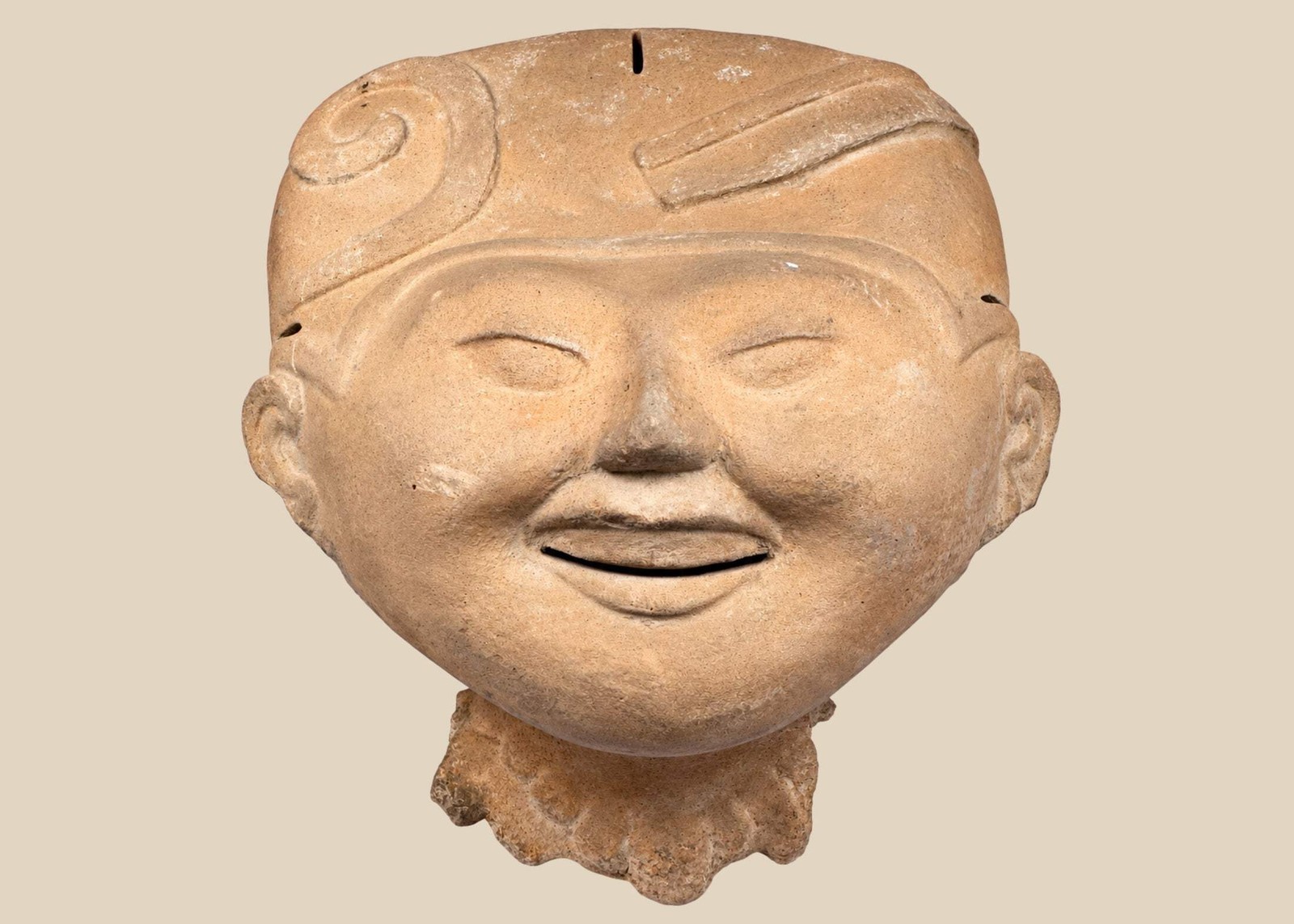
An expressive Pre-Columbian terracotta head attributed to the Classic Veracruz tradition of Gulf Coast Mexico, belonging stylistically to the celebrated group of figures commonly known as Sonrientes, or “Smiling Figures.”
The hollow ceramic head presents a broad, animated face with gently narrowed eyes, rounded cheeks, a prominent nose, and a slightly open smiling mouth. The unusual sense of expression is particularly characteristic of Veracruz ceramic sculpture, where smiling human figures represent one of the most distinctive sculptural traditions of ancient Mesoamerica. Museum examples of related Veracruz smiling figures are generally dated between approximately the 6th and 10th centuries CE.
Above the face is a substantial headdress decorated with boldly modeled and incised motifs. One side incorporates a large scrolling design while the opposite side displays an elongated geometric element. Small apertures are present around the upper portion of the head, adding further detail to the surviving ceramic construction.
The reverse reveals the hollow interior and surviving structural edges, indicating that the head likely formed part of a larger modeled figure. The lower neck is likewise fragmentary, preserving evidence of its original attachment to the body.
Features
- Distinctive Sonriente, or “Smiling Figure,” facial expression
- Broad face with rounded cheeks and gently narrowed eyes
- Slightly open modeled mouth emphasizing the smiling expression
- Elaborate raised and incised headdress decoration
- Prominent scroll and geometric motifs across the headdress
- Hollow ancient ceramic construction
- Small apertures around the upper portion of the head
- Preserved ears and strongly modeled facial contours
- Large surviving head likely from an originally more complete figure
- Natural buff and tan earthen surface with age-related deposits and patination
Cultural Significance
The smiling ceramic figures of ancient Veracruz are among the most recognizable forms of Pre-Columbian Gulf Coast sculpture. Known today as sonrientes, they are especially notable because conspicuous displays of emotion are comparatively uncommon in surviving Mesoamerican figurative art. Related smiling figures form part of a long tradition of hollow ceramic sculpture produced in south-central Veracruz.
Their precise function remains uncertain. Various interpretations have connected these animated figures with ceremonial performance, music, dance, ritual activity, and other forms of communal celebration. Some surviving examples hold rattles or appear in active poses, reinforcing their possible connection with performance. The exact meaning of their characteristic smiles, however, continues to be debated.
Ceramic sculpture reached a particularly sophisticated level in Veracruz during the Classic and Late Classic periods, with both hand modeling and mold-assisted production employed to create expressive human and supernatural figures.
Condition
The head survives as a substantial fragment from a larger hollow ceramic figure. The lower neck and rear attachment area are incomplete, exposing the hollow interior.
Surface wear, abrasions, minor chips, small losses, mineral deposits, discoloration, and firing irregularities are present throughout and are consistent with considerable age. The principal facial features and headdress decoration remain remarkably well defined.
Dimensions (Approximate)
Height: 6.5 in
Width: 6 in
Depth: 4.25 in
Age (Approximate)
1,100–1,400 years old
Provenance
From a private collection in Ottawa, Ontario. The owner was a lifelong collector of Pre-Columbian art and artifacts who traveled extensively throughout South America.
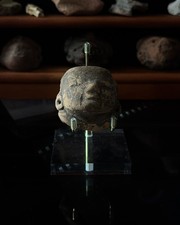
The collection is accompanied by an original colour photograph documenting a selection of artifacts (including this one) displayed in the collector’s home, inscribed “Sept 1989” on the reverse. The photograph is printed on AGFA Prestige photographic paper, a paper stock consistent with the inscribed period, providing additional documentation that the collection was established by at least the late 1980s. Following the owner’s passing, the collection was liquidated by the family.
Learn More
Explore a comparable Remojadas Sonriente ceramic head from Veracruz at the Princeton University Art Museum
Discover our curated Ancient Pre-Columbian Artifacts & Relics Collection
× × × × × × × × × × × × × × ×
Buy now and save! Shipping info
Click the Shipping & Payments tab above the listing description for more info
FREE Shipping
See more... Standard Shipping - $0.00 Standard Int\'l Shipping - $0.00
Click the Shipping & Payments tab above the listing description for more info!
Additional delivery notes
PICK UP OPTION
Sorry, our items are NOT available for pick-up.
PAYMENT
Immediate payment is required upon selecting \"Buy It Now\" or upon checking out through the cart.
We accept payment via All Major Credit Cards (Visa, Mastercard, AMEX, Discover), Google Pay, PayPal, & Apple Pay (on mobile & App).
Thank you for shopping with us on !
Additional Information
No additional information at this time
Ask seller a question
Contact
To contact our Customer Service Team, simply click the button here and our Customer Service team will be happy to assist.
Ask seller a question
© Relic and Rarity
Shipping & Payments
Shipping is FREE for this item
Payment
Accepted Payment Methods
Immediate payment is required upon selecting \"Buy It Now\" or upon checking out through the cart.
We accept payment via All Major Credit Cards (Visa, Mastercard, AMEX, Discover), Google Pay, PayPal, & Apple Pay (on mobile & App).
Thank you for shopping with us on !
Returns
Returns are accepted
Items must be returned within 7 days of the purchase
Buyer will pay for return shipping.
If you are not fully satisfied, items may be returned in their original condition within seven days for a full store credit toward any other item in our collection at its listed retail price. Store credits are non-transferable and non-assignable.
integration by