When you click on links to various merchants on this site and make a purchase, this can result in this site earning a commission. Affiliate programs and affiliations include, but are not limited to, the eBay Partner Network.
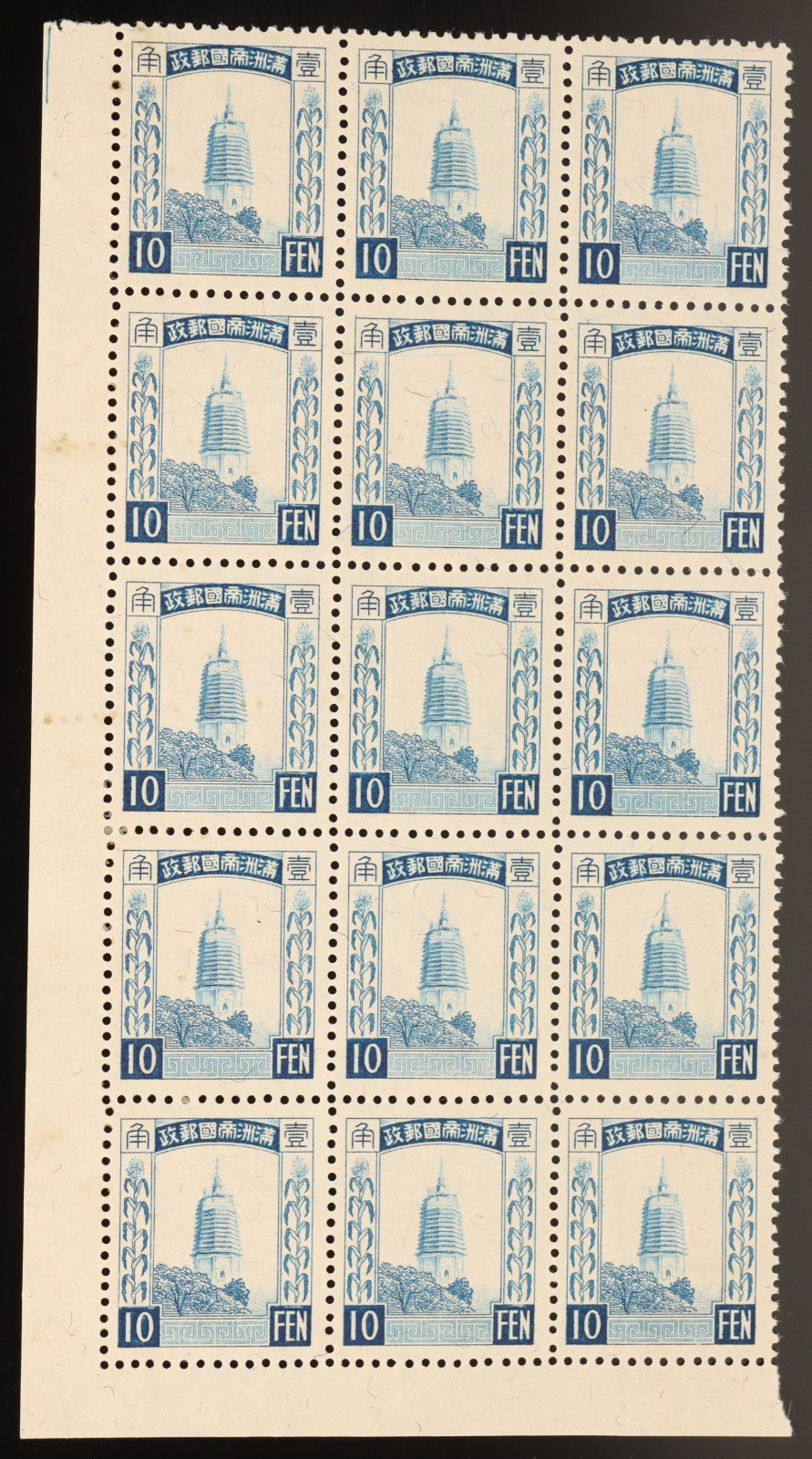
The design depicts the historic White Pagoda at Liaoyang, one of the best-known landmarks used on Manchukuo\'s early definitive stamps. The pagoda is a monumental 13-story structure approximately 70 metres high and was repeatedly featured on Manchukuo postage during the 1930s.
This particular 10 fen value was introduced in July 1935 as an additional denomination of the Third Regular Issue following changes in postal rates. The six Chinese characters across the upper tablet read “Manchu Empire Postal Administration.” This is an important identifying feature: earlier pagoda issues carried only five characters, while the six-character inscription reflected Manchukuo\'s change from a state to an empire following Puyi\'s enthronement as Emperor Kangde in 1934.
The stamp was recess engraved and printed by the Central Bank of Manchukuo Printing Department at Hsinking. It was produced on distinctive watermarked granite paper, incorporating fine colored fibers as a security feature, and perforated approximately 13×13½.
The survival of fifteen connected examples together with substantial original sheet margins makes this considerably more attractive than an ordinary single stamp.
Catalogue references:
Scott 57
Chan MK55
J.S.C.A. 49
An excellent large multiple for collectors of Manchukuo, classic China-area philately, Asian postal history, architecture and engraved stamps.