When you click on links to various merchants on this site and make a purchase, this can result in this site earning a commission. Affiliate programs and affiliations include, but are not limited to, the eBay Partner Network.
Ships Monday August 31st. Ships UPS 2nd Day Air; no option for UPS Grounddue to elevated temperatures forecastedmost of the US week of August 30th.
Please read sale text at least to heading "Description of Pictures and Additional Information Below"before purchasing.
I do not "Bank" queens;banking diminishes a queen's pheromone signature. She will be pulled "fresh" no sooner than the day before shipping! Normally pulled morning of shipment if weather permitting.
For sale is a 2026 Honey Bee Queen considered nominal 50% Caucasian (Maternal) -Caucasian Carniolan Italian Hybrid. These queens in particular are granddaughtersof Instrumentally Inseminated (aka Artificially Inseminated) Caucasian Breeder Queen - daughtersraised fromoverwintered100%Queen grafted from her in 2023;both open-mated in my apiaries located(elevation ca. 1550 ft)in the Holston River Valley of the Appalachian Mountains in Northeast Tennessee. This Breeder Queen is in her 4th season having overwintered thrice and has yielded very productive daughters.I am strong proponent of genetic diversity coupled with significant Caucasian apiary genetics for gentle colonies that over-winter successfully; but not just survive, also thrive come spring.Winter colony survival for past four years was 100%, 100%, 97% and 96%, respectively.
I am not a commercial queen raiser on a two week cycle that barely provides queens time to lay six square inches of eggs in a mini-mating nuc. I plan on a four week cycle as I want to observe a sealed brood pattern before I remove a queen for my use or sale. I will pull only queens that have brood equivalent of two typical medium frames or better. Obviously queens can be produced much cheaper on a two week cycle since twice as many can be produced in a season.Listing quantities may vary or the listing ended early subject to local sales and my apiary needs.
The development of a queen's pheromone signature and poise is not instantaneous. It takes time for the queen to fully develop her reproductive system and the glands that produce pheromones.As the queen matures and her pheromone signature strengthens, she also develops a more authoritative presence and posture. This "poise" is a reflection of her reproductive maturity and the overall health/vigor of her colony.Research shows Queens on a two or even a three week cycle do not have ample time to properly develop pheromones and poise; lack of which is primary reason many purchased queens are often superseded prematurely. I will not offer for sell any queen that I would not use myself.
Each queen and her attendants will be shipped in JZ BZ Queen Cage with standard time release Queen Candy.JZs BZs Queen Cages are impregnated with a pheromone to aid in acceptance. Push In Cages offer the highest success rate of introduction as it allows the queen to demonstrate herself to the hive (lay) and the beekeeper to decide when she is released.
Youmust have an existing hive of bees to install the queen, you cannot start a new hive with a queen and a few attendants.
These Queen(s) aremarked White -standard colorfor 2026.
Queen(s) will ship either UPS Ground or UPS 2nd Day Air or UPS Next Day Air - your choice. Upgrade to 2nd Day Air for only $6 more highly recommended for those located in Pacific Time Zone and strongly consider by those located in Mountain Time Zone.
Box containing your queen(s) will be delivered to address listed on your account to physical location (typically a covered area) where you normally receive packages from UPS.
Queens will not last long in the heat and/or sunbaked location on a hot day.Check tracking status often on ups.com (not ). Work with your local UPS if you will not be present at time of delivery.If necessary, you can redirect a UPS package to a local UPS Store using a UPS My Choice Account that you create.
Queens can die during transit if exposed to extreme temperatures, etc. It is strongly recommended you inspect your queen(s) immediately. Please send me a photo of the dead queen via message system within 12 hours of receipt; return to me may be required so please do not discard queen(s) or the packaging.
Unfortunately I cannot guarantee their acceptance, survival, or performance in your hive because there are many, many factors that are well beyond my control once you receive.
************ Description of Pictures and Additional Information Below ************
I have been keeping honey bees since I was 18 for 45+ years now. Like many beekeepers starting out then I sourced my bees from the South. My favorite line was a 4-way hybrid cross of Caucasian/Carniolan developed by Dadant and later produced by York Bee Company. Then came the arrival of theVarroa destructor, great fear followed, everyone was afraid to purchase, borders closed and the industry I became accustomed was soon decimated - myfavorite re-queens, and the Caucasian in particular, was all but lost it seemed.
My apiaries (primary drone base for grafted queens) are now best described as a mix of overwintered Italian/Carniolan/Caucasian primarily from queens I have raised. Although I added additional Caucasian genetics previous years, obtaining the AI/II breeder queen in 2022 allowed me to move more quickly towards my goals. I have established a higher percentage of Caucasian for many reasons that include; calm, gentle, longest tongue, winter-hardy, and conservative use of stores; don't eat themselves to starvation during a dearth like Italians. Most importantly I had 100%, 100%, 97% and 96% winter colony survival the last four years respectively!
I am very hot natured and I work my bees using light smoke wearing Pocket T-Shirts of various colors, no gloves and a veil 50% of the time. I last wore gloves five years ago to manage a "Hot Hive" I caught in a swarm trap; yes, re-queened soon after. I am comfortable pulling the top off of my hives with no smoke or veil most any time. Robbed my hives last four years during July dearth using Fume Board with Bee-Go and leaf blower with one sting or less each year. Not bragging on my abilities, just good sought after genetics.
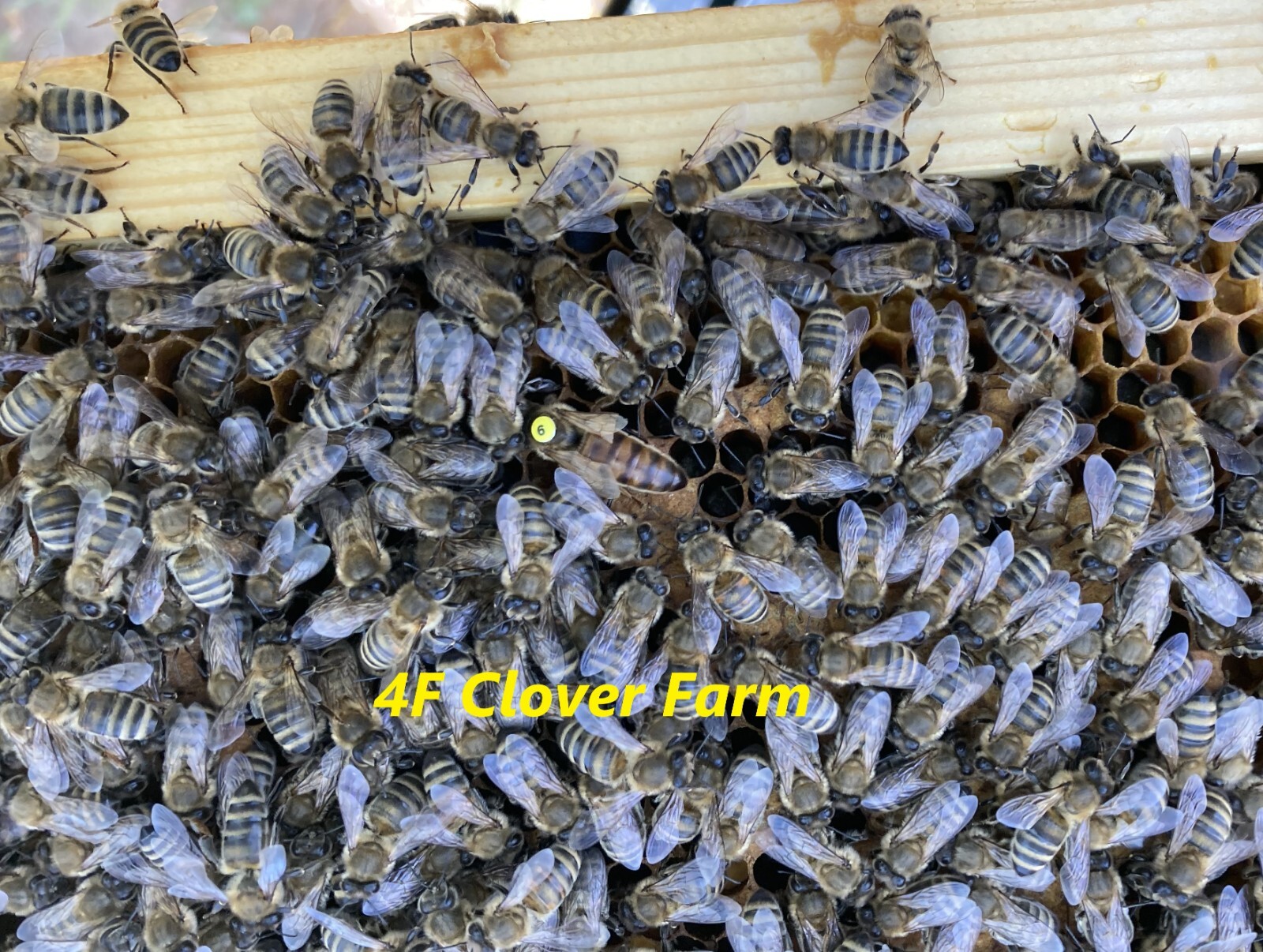
Breeder Queen (Grandmother) is shown on cover (first) picture; she has clipped wing and glued on yellow "6" Dot. She is not up for sale! The Instrumentally Inseminated (aka Artificially Inseminated) Caucasian Breeder Queen obtained fromTwo Rivers Honey Bees. ThisCaucasian linage is from the work of Sue Coby as part of the University of Washington, Pullman Caucasian Breeding Program. The University of Washington is the only entity that has the permit to bring in Caucasian germplasm from Europe and they have been working diligently to improve the Caucasian genetics in United States. Technical jargon aside that I don't claim to fully understand, I am told purity is somewhere around 85 to 89%. [This pic of her also examples her daughters - the dark gals!]Since Drones have no father, their purity will be the same as the queens. If you want to learn more about why add Caucasian genetics other than for genetic diversity and hybrid vigor, I suggest Bob Binnie a commercial beekeeper (~2000 Colonies I believe) on YouTube. He has obtained Breeder Queens from Sue Coby (and most recently fromTwo Rivers Honey Bees) and goes into great technical detail why he decided to do so and how they are performing.
The next eleven pictures taken this year are examples of nominal 50% Caucasian queens marked White (2026 Color) toexample expected color variation of the mated queens up for sale.[I do my marking using 60+ year old hands; so don't expect perfect round dots.
Next three pictures are examples of typical mating nucs used; all mating nucs are three deep to five medium frames. No mini-mating nucs are used!!! I actually use these nucs to keep young laying queens I raise throughout the summer in reserve as needed for quick re-queening. Limiting their laying space (similar to managing a Breeder Queen) increases their longevity since queens are sperm storage limited; then they are ready to turn up egg production quickly when needed.
Next six pictures are of medium frames pulled from mating nucs while evaluating and marking queens.
Next two pictures (Queen and her Brood Frame) were taken early while grafting from the thrice over-wintered Caucasian Breeder Queen. Note black drones and combination of light and dark worker bees.
Last photo is of our Farm Sign in Northeast Tennessee located in the Holston River Valley of the Appalachian Mountains.
...and since I sell other items on (primarily vintage Yu-Gi-Oh cards), I must state that this sale cannot be combined with other sales (cards) I may have listed on .