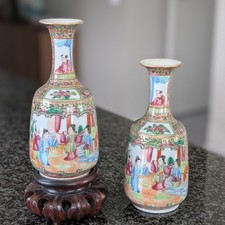
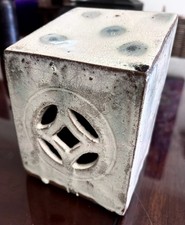
When you click on links to various merchants on this site and make a purchase, this can result in this site earning a commission. Affiliate programs and affiliations include, but are not limited to, the eBay Partner Network.
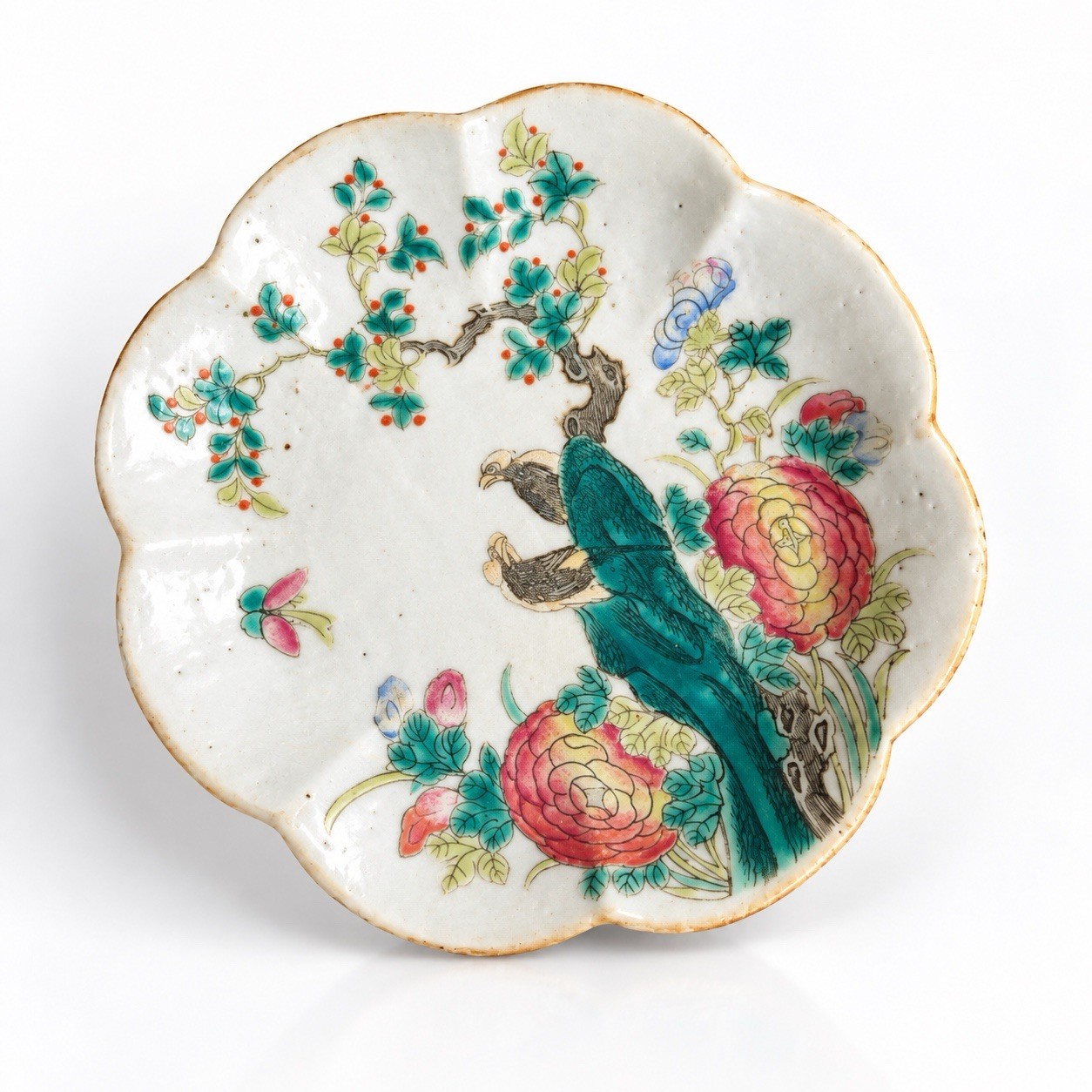
China, late Qing dynasty, probably late 19th century, circa 1870–1900. Polychrome enamelled porcelain dish of foliated form, decorated with a bird, peonies, flowering branches and butterfly. The base bearing an iron-red four-character seal mark reading 同治年製 (Tongzhi Nian Zhi, “Made during the Tongzhi reign”). The mark may be of the period or a later continuation/commemorative use; attribution to the actual Tongzhi reign cannot be established from photographs alone.
Condition- no defects or restoration signs , just traces of aging
With the most skeptical approach, I would not automatically treat the red mark as proof that the dish was actually produced during the Tongzhi reign (1862–1874). Based on the photographs, the object does appear old and, in my assessment, is quite plausibly late Qing, but its dating should remain broader than 1862–1874.
Reading and translation of the mark
The most probable reading of the four-character mark is:
同治年製 — Tóngzhì nián zhì
It is read in vertical columns from right to left:
同治 — Tongzhi
年製 — “made during the reign/years”
Therefore, the literal meaning is:
“Made during the Tongzhi reign.”
This four-character formula is well documented on Chinese porcelain. The Tongzhi Emperor reigned from 1862 to 1874.
Confidence in the reading of the mark: approximately 90–95%.
However, this distinction is essential:
The mark is not, by itself, proof of the manufacturing date.
Tongzhi reign marks continued to be used on some porcelain after the actual Tongzhi period. Dated reference material includes pieces from 1901–1902 carrying red stamped Tongzhi Nian Zhi marks. Therefore, the inscription can be read confidently as Tongzhi while the object itself may be later.
What the physical appearance suggests
Several characteristics visible in the photographs are encouraging as signs of genuinely older manufacture: the relatively coarse unglazed footrim with naturally irregular ceramic body; small inclusions and kiln debris; slight irregularity of the foliated form; numerous small firing imperfections and glaze pits; somewhat irregular hand-painted decoration; and visible surface wear.
Taken together, these characteristics appear considerably more convincing than what I would normally expect from a recent decorative reproduction.
At the same time, the workmanship does not appear imperial in quality. The painting is relatively spontaneous and occasionally coarse, the porcelain body is not exceptionally refined, and the form is somewhat irregular.
I would therefore regard it more plausibly as commercial or export-oriented late Qing porcelain, rather than Imperial ware.
Palette and decoration
The palette is somewhat mixed. I would not describe it as classical Kangxi-period famille verte in the strict sense. Pink, turquoise and other enamels point toward a later polychrome tradition.
For a careful catalogue description, wording such as:
“Chinese polychrome enamelled porcelain dish, decorated in a famille verte/famille rose palette”
would be safer than presenting it simply as early famille verte.
The principal decoration consists of a bird, flowering branches, large peony-like blossoms and a butterfly, painted within a distinctive foliated/scalloped form.
The most important issue: the mark versus the date
The square iron-red mark appears more likely to have been stamped or seal-applied than freely written with a brush.
Marks of this general Tongzhi type continued to occur after the end of the Tongzhi reign. Consequently, reading 同治年製 does not establish that the dish is necessarily a genuine 1862–1874 mark-and-period object.
This is why a broad attribution such as:
Late Qing Dynasty – possibly extending into the early Republic period
is defensible, although I would currently place the most likely production period somewhat earlier.
My working attribution
My preferred cautious catalogue attribution would be:
China, late Qing dynasty, probably late 19th century, circa 1870–1900. Polychrome enamelled porcelain dish of foliated form, decorated with a bird, peonies, flowering branches and butterfly. The base bearing an iron-red four-character seal mark reading 同治年製 (Tongzhi Nian Zhi, “Made during the Tongzhi reign”). The mark may be of the period or a later continuation/commemorative use; attribution to the actual Tongzhi reign cannot be established from photographs alone.
Based solely on the photographs, my approximate confidence distribution would be:
Conclusion
The most important distinction is:
Mark: very probably 同治年製 — Tongzhi Nian Zhi — “Made during the Tongzhi reign.”
Actual date: not necessarily Tongzhi.
Most likely working date: late Qing dynasty, approximately 1870–1900, with the Guangxu period (1875–1908) remaining a particularly plausible possibility.
Modern reproduction: in my present assessment, substantially less likely than genuine late-19th-century manufacture.
A physical examination—including the enamels, glaze, footrim, wear, firing characteristics and ideally UV inspection—would be required before upgrading the attribution to “Tongzhi period, 1862–1874, mark and period.”