When you click on links to various merchants on this site and make a purchase, this can result in this site earning a commission. Affiliate programs and affiliations include, but are not limited to, the eBay Partner Network.
Click here to see all products in our store!
* International Buyers - Please Note:
Import Duties & Taxes Policy
United States
All shipments to the U.S. are sent DDP (Delivered Duty Paid). Import duty, taxes and brokerage are prepaid — no extra payment at delivery.
Other Countries
Unless duties/taxes are already collected by at checkout, shipments are sent DDU (Delivered Duty Unpaid) and the buyer is responsible for import VAT/GST, duty, and carrier fees on delivery.
*Description
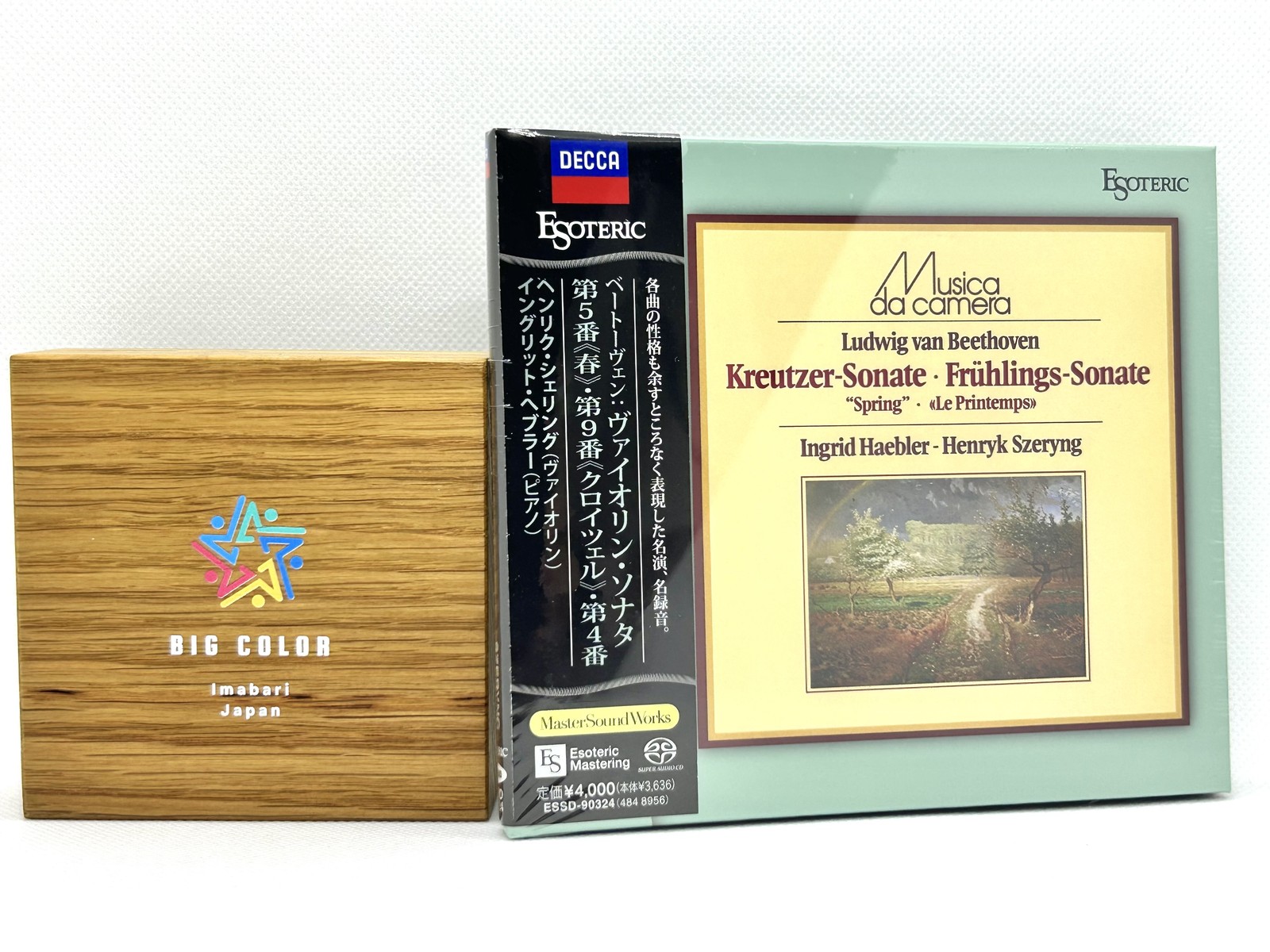
With its rich, orthodox interpretation and the superb quality of analog recordings at their peak, this collection of Beethoven’s violin sonatas serves as a benchmark in every sense.
It was selected as a “Special Selection” in the monthly reviews of *Record Geijutsu* upon its initial release and won the “Recording Category” at the 18th Record Academy Awards in 1980; it is an unquestionably outstanding work in both performance and sound quality.
[Track List]
Ludwig van Beethoven:
Violin Sonata No. 5 in F Major, Op. 24, “Spring”
[1] Movement 1: Allegro
[2] Movement 2: Adagio molto espressivo
[3] Movement 3: Scherzo (Allegro molto)
[4] Movement 4: Rondo (Allegro ma non troppo)
Violin Sonata No. 4 in A minor, Op. 23
[5] Movement 1: Presto
[6] Movement 2: Andante scherzoso. piu allegretto
[7] Movement 3: Allegro molto
Violin Sonata No. 9 in A Major, Op. 47 “Kreutzer”
[8] Movement 1: Adagio sostenuto - Presto
[9] Movement 2: Andante con variazioni
[10] Movement 3: Finale Schering (violin)
Ingrid Hebrer (piano)
[Recording] January 5–14, 1978 (No. 4), January 2–10, 1978 (No. 5),
December 15–19, 1979 (No. 9), La Chaux-de-Fonds, Switzerland
Henrik Schering (1918–88) was a musical genius.
He began learning piano from his mother at the age of five, and his extraordinary talent for the violin, which he took up at age seven, was recognized early on.
Leaving Poland, he went to Berlin at the age of 10 to hone his violin skills. By the age of 15, he had made his debut in Warsaw, Berlin, and Paris, and by his late teens, he had developed the skill to perform Beethoven’s concertos with Bruno Walter.
Schering’s life, which had been shaped by his extensive studies prior to his professional career, was turned upside down by the outbreak of World War II following the Nazi invasion of Poland in September 1939.
Fluent in seven languages, he traveled to countries in Central and South America as a staff member of the Polish government-in-exile, accompanying the prime minister in search of resettlement destinations for refugees. In 1946, after the war, he went to Mexico, which had accepted 4,000 refugees, and was asked by local composers Carlos Chávez and Manuel Ponce to teach at a university in Mexico City. He obtained citizenship and continued his teaching and performing activities there.
It was the Polish-born maestro Arthur Rubinstein who introduced Scheling, who was still relatively unknown internationally at the time, to the world.
After visiting Mexico in 1954 and being deeply moved by Scheling’s performance of Bach, Rubinstein encouraged him to perform in various locations; Scheling first gained worldwide attention with his 1955 recording in Paris of Bach’s complete unaccompanied sonatas and partitas.
From 1958 through the 1960s, after recording Beethoven’s Symphonies Nos. 5, 8, and 9 and the complete Brahms Violin Sonatas with Rubinstein for the RCA label, he went on to build his reputation and establish himself on the world stage from the 1960s onward, recording a wide repertoire of concertos and chamber music ranging from Baroque to contemporary works, primarily for the former Philips (now Decca) label.
Among Schering’s numerous recordings, it was his 1967 re-recording of Bach’s complete unaccompanied sonatas and partitas that cemented his reputation. He continued to build on this success through the 1970s with recordings such as a collection of Bach’s violin sonatas with Helmut Walcha, Pierre Fournier on Schubert, Schumann, and Brahms piano trios, and with Ingrid Hebler on Mozart’s violin sonatas and variations—the list goes on and on.
These three Beethoven violin sonatas, released for the first time on a Super Audio CD hybrid disc, are selections from the complete Beethoven sonata cycle that concluded a series of chamber music recordings made in the 1970s—a period that can be considered the peak of Schering’s career.
His collaborator, Hebler (1929–2023), was born in Vienna and raised in Poland.
He studied piano with his mother and, at the age of 10 in 1939, moved to Salzburg following the outbreak of World War II. He studied at the Mozarteum and the Vienna Conservatory, then at the Geneva Conservatory, winning second prize at the Geneva International Competition in 1952 and 1953 and the first prize at the Munich International Competition in 1954, which marked his debut.
From that year until 1987, he appeared at the Salzburg Festival almost every year. From the 1960s onward, he gained a reputation as a leading Mozart interpreter while also performing worldwide with a repertoire centered on Bach, the Viennese Classical period, the German Romantic era from Schubert to Brahms, and Chopin.
He was a pioneer who engaged in chamber music with artists such as Schering, Grumiaux, and Schwalbe, as well as in period instrument performance.
Schering and Hebler, both leading stars of the Dutch Philips label, began a deep friendship following their huge success at the 1970 Salzburg Festival, which was followed by the recording of Mozart’s Violin Sonatas in 1971.
Having won the trust of record fans with their Mozart performances, the two continued to perform together on several occasions, leading to this Beethoven recording in the very final years of the analog era.
Schering, who possessed both highly advanced technique and a sense of style and expressive power, caused a sensation by reviving and making the first recording of Paganini’s concerto—which had been buried until 1971—for the first time in 138 years. However, I believe this Beethoven recording represents the pinnacle of his artistry during the 1970s, when he reached the peak of his maturity.
This first Beethoven recording in the complete set garnered attention even before its release.
Here are three selections from that complete set.
Although the complete Beethoven sonata set by Schering and Hebler, released in 1980, is a masterpiece, it has remained surprisingly obscure, perhaps overshadowed by the CD boom that began in 1982.
It is a masterful performance that fully captures the character of each piece from Beethoven’s early to middle periods. True to its reputation as “Phillips of Chamber Music,” the natural and flowing timbre of the instruments, the atmospheric quality of the scenes they evoke—all have been brought back to life here with a clarity that transcends time.
As evidenced by its win in the recording category at the 1980 Record Academy Awards, this is a masterpiece that represents the pinnacle of analog recording.
The ability to fully appreciate the excellence of both the performance and the recording is a unique charm of this hybrid release.
*Shipping
We ship using FedEx, DHL and UPS or Japan Post.
*Payment
We usually ship within 3〜7 business days of receiving cleared payment.