When you click on links to various merchants on this site and make a purchase, this can result in this site earning a commission. Affiliate programs and affiliations include, but are not limited to, the eBay Partner Network.
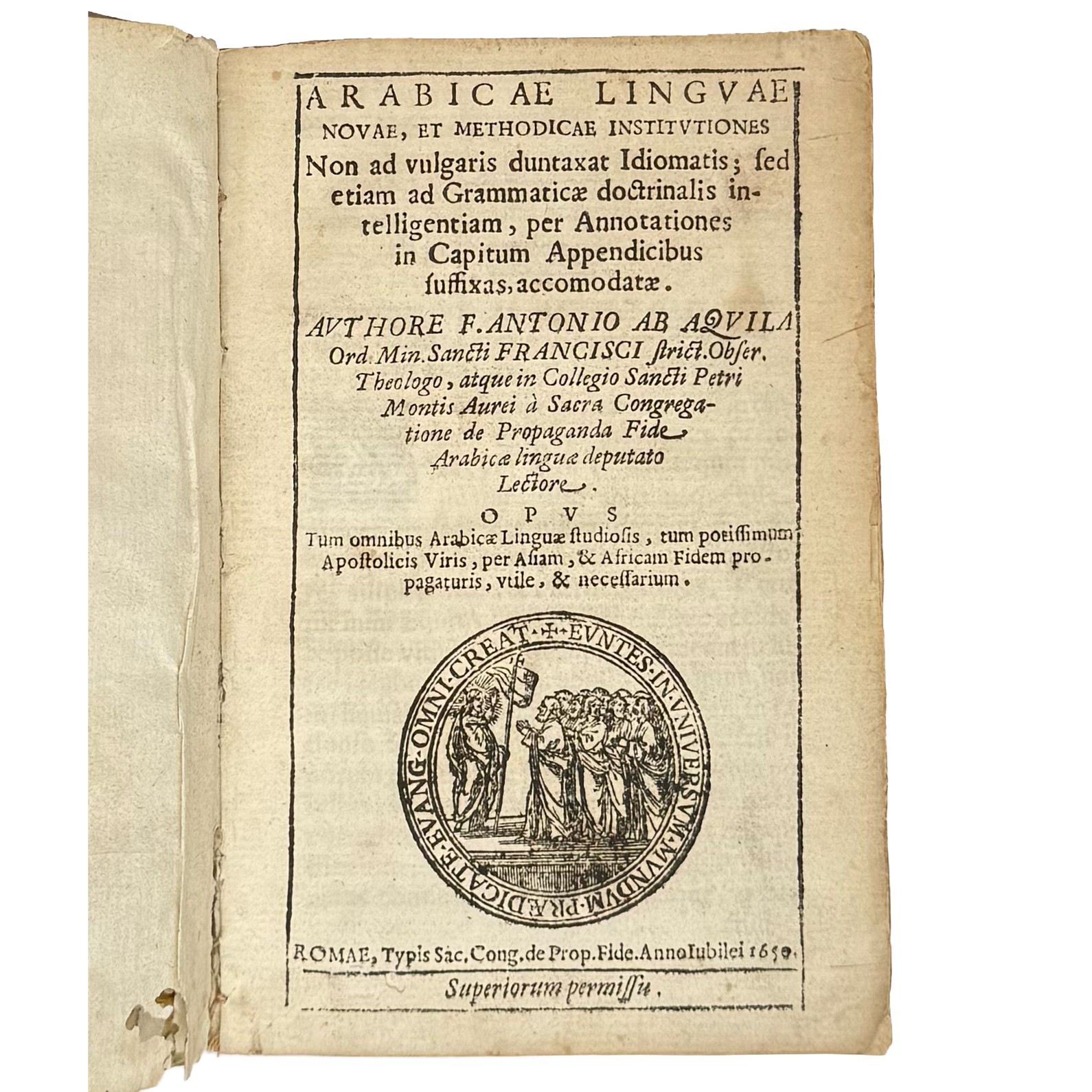
Da L\'Aquila, Antonio — Arabicae linguae novaeNon ad vulgaris duntaxat Idiomatis; sed etiam ad Grammaticae doctrinalis intelligentiam, per Annotationes in Capitum Appendicibus suffixas, accomodatae.Romae (Rome), Propaganda Fide, 1650. First Edition.First edition of an important contribution to the study of Arabic in seventeenth-century Europe. Arabicae Linguae Novae served the varied but closely related needs of missionary training, Roman Oriental scholarship, and the practical acquisition of Arabic in the Levant. This substantial grammar was designed not merely for the vulgar idiom but also for the understanding of doctrinal Arabic, as its title declares.Its author, Antonio ab Aquila (also known as Antonio dall\'Aquila), was a Franciscan of the Strict Observance whose career lends the work particular authority. He departed for Egypt in 1630, served first as superior of the Alexandrian residence, then as commissary of the mission and guardian at Aleppo. After a decade in the Levant, he was recalled to Rome to teach Arabic at the Franciscan College of San Pietro in Montorio, where the Congregation for the Propagation of the Faith (Propaganda Fide) had appointed him lector of Arabic.The grammar is divided into three parts, following the classical tripartite structure of Latin grammars adapted to Arabic morphology: Orthography (the Arabic alphabet, with a full tabular \"Alphabetum Arabicum\"), Etymology (verb conjugation across twenty-five chapters covering the ten Arabic verb measures, plus nouns, pronouns and particles), and Syntax. The work concludes with graded exercises for four classes of students, reading exercises in Arabic and Latin, a vocabulary index, and a catechetical summary of Christian doctrine in Arabic. A chapter on Garshuni (Arabic written in Syriac script) reflects the real linguistic landscape missionaries encountered among Maronite, Melkite, and Jacobite communities.