When you click on links to various merchants on this site and make a purchase, this can result in this site earning a commission. Affiliate programs and affiliations include, but are not limited to, the eBay Partner Network.
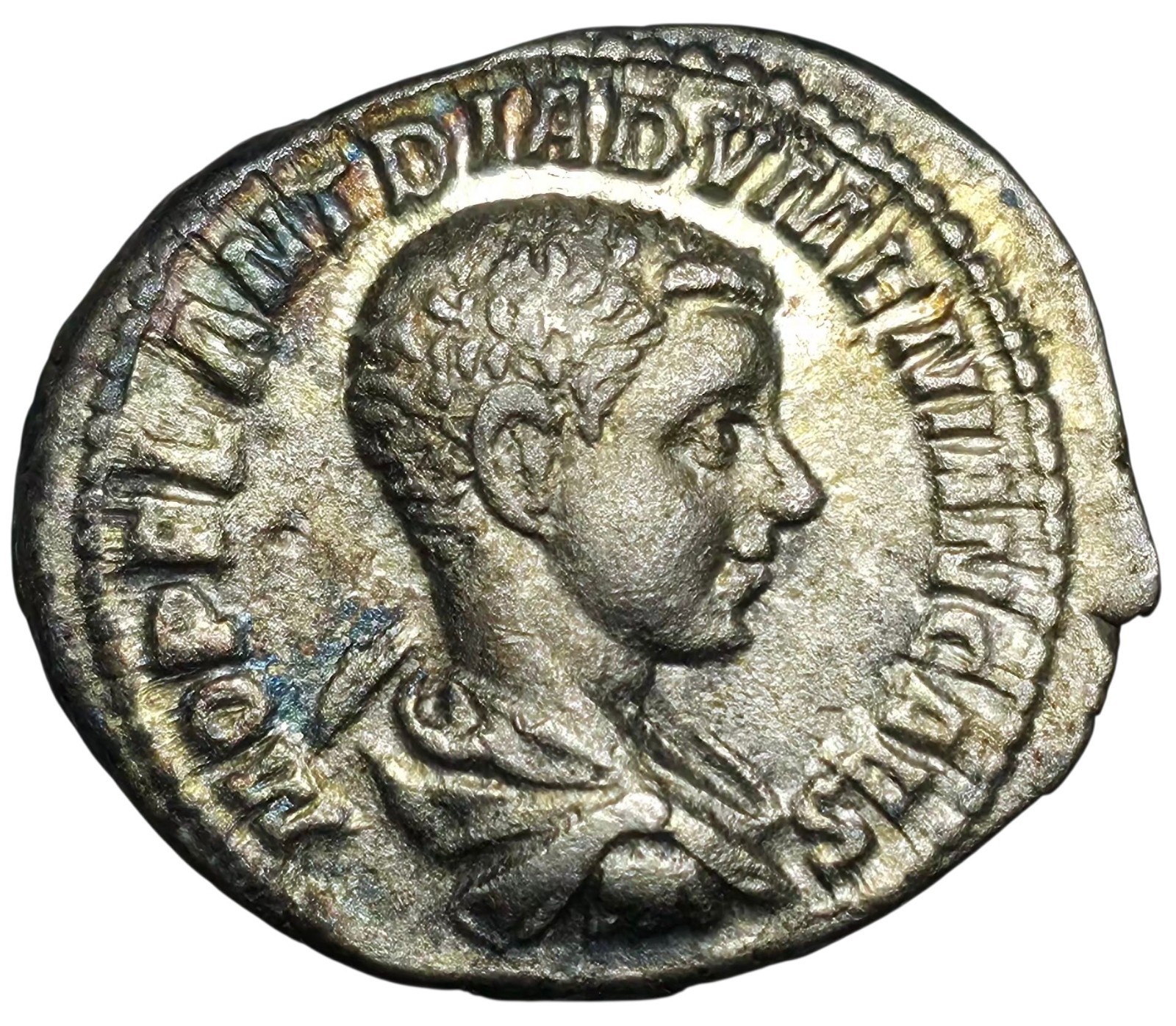
DIADUMENIAN as Caesar (AD 217-218)
AR Denarius (17.5 × 21mm, 3.60g, 3h)
Rome, 3rd Emission of Macrinus, 218 ADobverse: M OPEL ANT DIADVMENIAN CAES, bare-headed, draped and cuirassed bust of Diadumenian right, seen from behind.reverse: SPE-S PVBLICA, Spes advancing left, holding flower and raising hem of skirt.References:
RIC IV 117 (Macrinus); RSC 21bCondition:
Exquisite cabinet toning complements the original ancient fabric, where moderately oxidized and slightly crystallized surfaces still retain abundant mint brilliance and delicate iridescence throughout this stunning, virtually as-struck specimen.
The high-relief portrait is exceptionally fresh, boasting sharply articulated facial features, cuirass, and drapery, while the finest surviving details remain remarkably crisp. Any subtle softness is confined principally to the ear and remnants of the hair curls, where the available metal on the flan was simply insufficient to fully reach the deepest recesses of the freshly engraved dies. Virtually no circulation wear is evident across the highest points; most tellingly, Diadumenian\'s cheek retains its nearly perfect sculptural roundness, providing compelling evidence that the portrait\'s principal high points remain completely untouched.
The reverse is equally impressive, featuring a boldly rendered Spes whose flowing drapery, posture, raised skirt, and flower are exceptionally well-defined and pristine.Historical Background:
Diadumenian was the young son of Emperor Macrinus and was elevated to Caesar in AD 217, receiving the rank of Augustus only shortly before the regime collapsed in AD 218. His reign effectively ended with the defeat and death of Macrinus, and Diadumenian himself was killed while still a teenager. His extremely brief political career explains the scarcity of his coinage, particularly in exceptional preservation.
SPĒS PVBLICA, “Public Hope,” was an especially appropriate imperial message for a young Caesar: Spes advances confidently into the future, lifting her garment while carrying the flower traditionally associated with hope.Collector\'s Note:
A particularly desirable combination of rarity, unusually complete portraiture, and virtually untouched surfaces. The broad, slightly irregular flan accommodates an exceptional amount of the design, and the weight of 3.6g gives the piece a substantial presence.
The moderate oxidation and crystallization at the surface level complement this coin’s originality rather than detract from it. Far from a flaw, this natural microscopic reaction is a \"fingerprint of time\", and a feature that cannot be replicated by modern fakes. It serves as a testament to the coin\'s ancient fabric, acting as a natural certificate of authenticity.While the remaining mint luster is excellent, technical flatness on certain focal points often leads third-party grading services to assign a conservative XF (Extremely Fine) or AU (About Uncirculated) holder grade. A frequent occurrence in ancient numismatics due to weak strikes or worn dies. Upon closer examination, however, an experienced collector can easily differentiate this production-era flatness from actual circulation wear, placing the coin\'s true condition firmly in a much higher tier