When you click on links to various merchants on this site and make a purchase, this can result in this site earning a commission. Affiliate programs and affiliations include, but are not limited to, the eBay Partner Network.
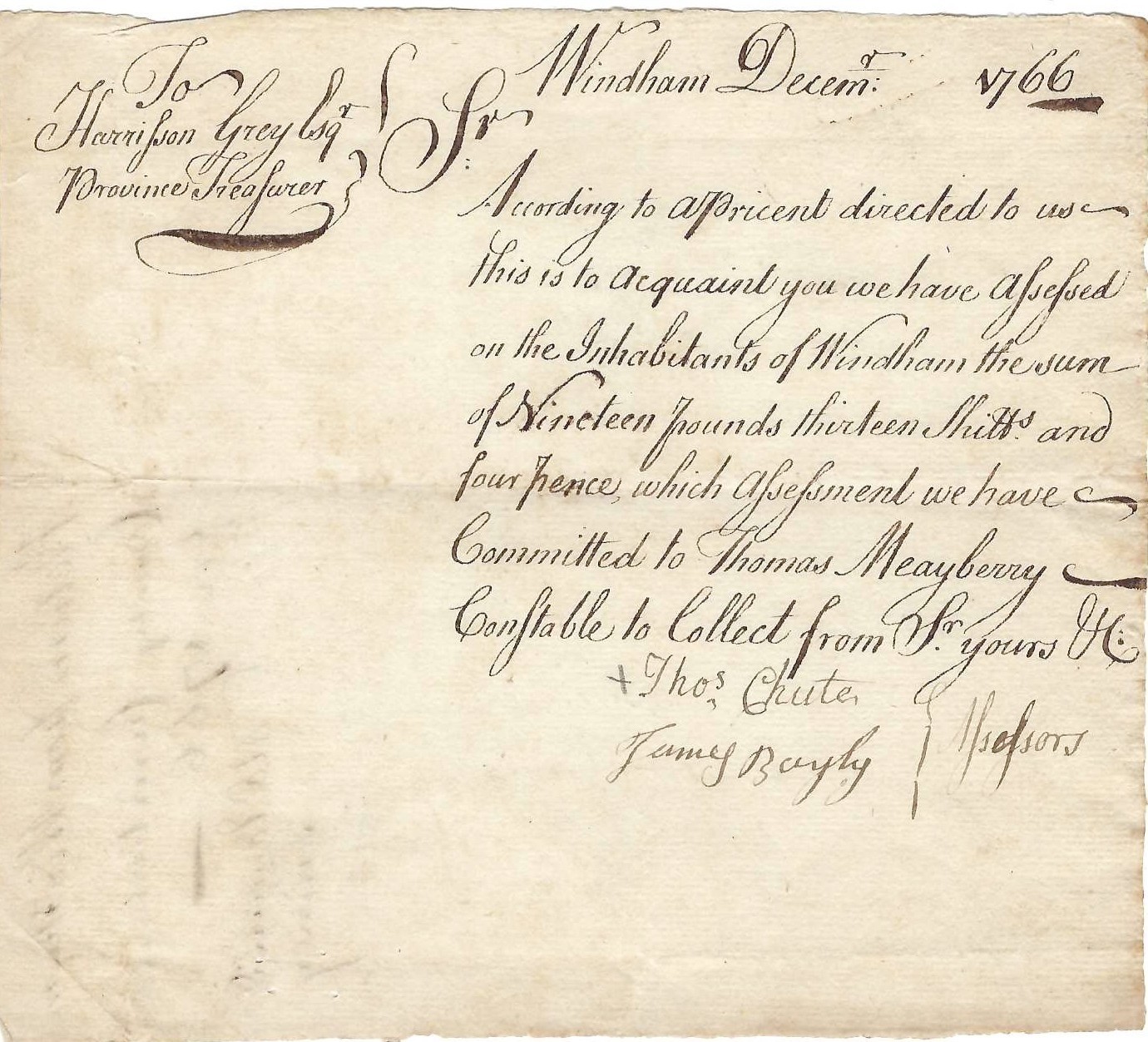
Offering a 6 x 6 7/8 single page colonial tax assessment signed by or directed to several notables in the height of political tensions resulting from the Stamp Act crisis. One was forced to flee New England for his role as a Loyalist. Another was involved in the important Siege of Boston. And another was the very first founder and settler of Windham County.
“To Harrison Grey, Esq., Province Treasurer, Windham, December 1766.
“Sir
“...This is to acquaint you we have assessed on the Inhabitants of Windham the sum of Nineteen pounds thirteen shillings and four pence which assessment we have committed to Thomas Meayberry, Constable to Collect from yours...Thos Chute, James Bayly, Assessors”
Verso notes “Return from Windham County, Cumberland for 1766, Edmund Finney”
1766 was a period of intense colonial resistance following the Stamp Act crisis of 1765. Local town assessors were caught in the middle trying to maintain standard local legal order under British law, just years before the outbreak of the American Revolution.
HARRISON GRAY served as Treasurer and Receiver-General for the Province of Massachusetts Bay from 1753 until the outbreak of the American Revolution in 1774. Because he remained a Loyalist, he was forced to flee Boston when the war broke out. THOMAS CHUTE (1690-1771) was the founder and first settler of Windham. When Windham was officially incorporated as a town in 1762, Chute was elected its first Town Clerk. He also served as town Selectman and Assessor. JAMES BAGLY was another prominent early settler of Windham. Like Chute, he was involved in local governance and defensive militias during the French and Indian Wars, eventually taking on administrative duties as an assessor to manage the town’s fiscal obligations to the Crown.
EDMUND FINNEY was one of the largest landowners and most influential citizens in Cumberland County. He frequently conducted business and held layout rights across town borders in Windham. Finney (also spelled Phinney) was a celebrated patriot. He commanded the 18th Continental Regiment, which marched to the relief of Boston during the Siege of 1775 and later took part in the critical defense of Fort Ticonderoga. THOMAS MEAYBERRY (also spelled Mayberry) was a blacksmith, and an extensive landowner. He served in many civic roles, including Selectman and Overseer of the Poor. Like his neighbor Edmund Finney, the Meayberry family became deeply embedded in the Patriot cause just a decade later. Several of his brothers fought as “Minute Men” in the Revolutionary War. Meayberry was required to go door-to-door to collect funds for the King’s Treasury. He had the authority to seize property from those who didn’t pay and even arrest them.
A wonderful early American tax document fulfilling the obligations established by the Crown in the middle of intense historic conditions that led to the Revolutionary War.
One horizontal fold. Light toning.
Everything we sell is guaranteed authentic forever to the original buyer. We also offer a 30-day return policy. If you discover a problem or are dissatisfied with an item, please contact us immediately. Our goal is to please every customer. We are pleased to be members of The Manuscript Society, Universal Autograph Collectors Club, The Ephemera Society, the Southern New England Antiquarian Booksellers and the Preferred Autograph Dealers and sale Houses [COL 107]