When you click on links to various merchants on this site and make a purchase, this can result in this site earning a commission. Affiliate programs and affiliations include, but are not limited to, the eBay Partner Network.
HIS STORY TREASURES PRESENTS
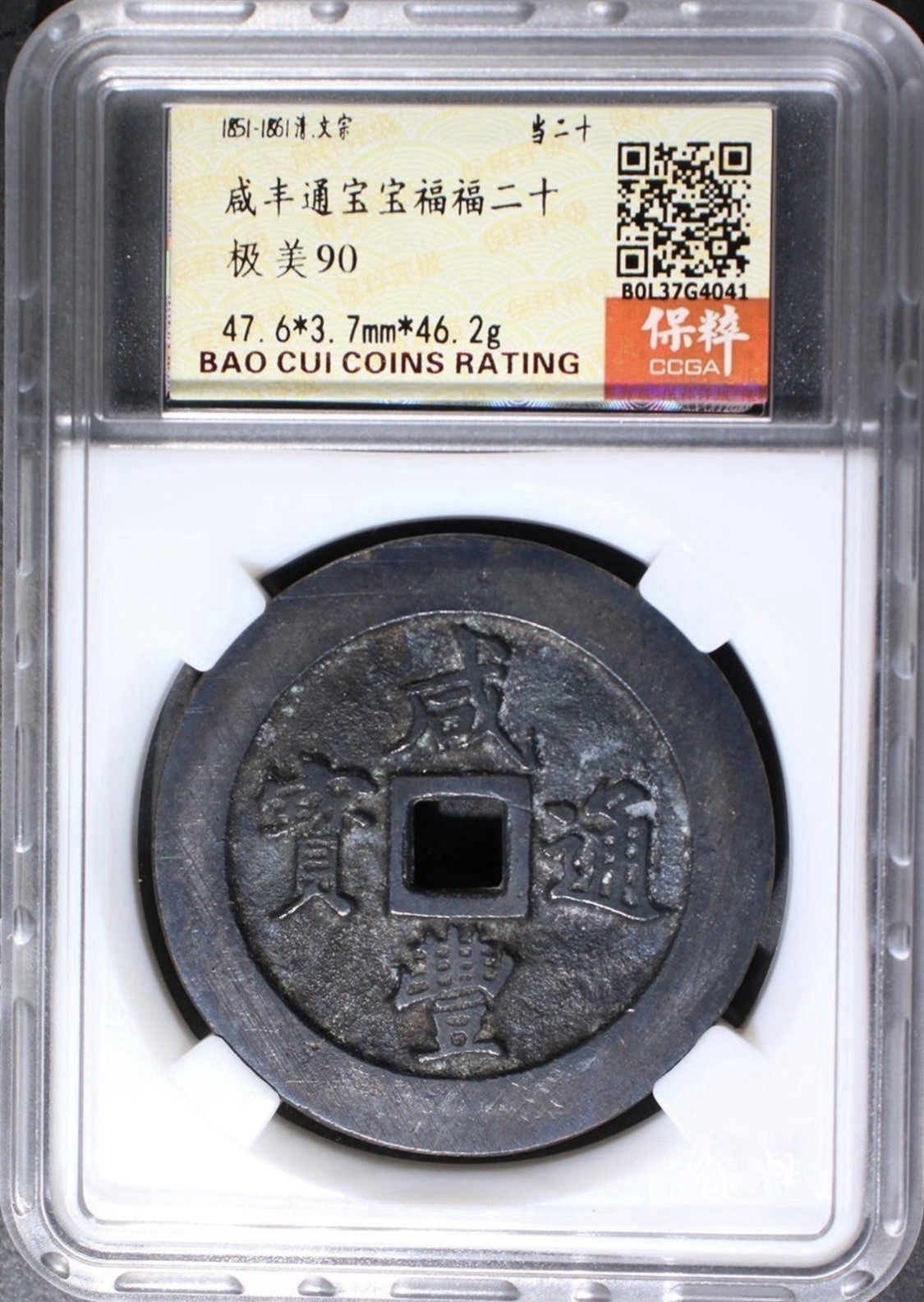
1851–1861 QING DYNASTY XIANFENG TONGBAO
BAO FU MINT • DENOMINATION 20 CASH
Bao Cui Certified 极美90
47.6 mm • 3.7 mm • 46.2 g
Certificate No. BOL37G4041
A massive provincial cash coin cast during one of the most turbulent decades in imperial Chinese history—a time when rebellion, foreign war, copper shortages, and financial crisis forced the Qing government to redefine the meaning of money.
The exact certified coin shown in the photographs is the specimen the buyer will receive.
THE STORY
In 1851, the twenty-year-old Aisin-Gioro Yizhu ascended the Dragon Throne as the Xianfeng Emperor.
He inherited an empire already showing deep fractures.
Population growth had placed pressure on land and food supplies. Corruption weakened administration. The imperial treasury struggled to meet mounting expenses. Foreign powers pressed against China’s borders and ports. Most dangerously, the Taiping Rebellion erupted across southern China and quickly became one of the largest and most destructive civil conflicts in human history.
The young emperor faced a crisis that could not be answered by ceremony alone. Armies had to be raised, transported, equipped, and paid. Provincial governments needed funds. Grain had to be purchased. Fortifications had to be maintained. Yet the traditional monetary system—based upon silver for major payments and small copper-alloy cash for ordinary commerce—could not easily supply the enormous sums required.
The Qing court responded with one of the most dramatic monetary experiments in the history of the dynasty: the large-denomination cash coin, or daqian.
This Xianfeng Tongbao from the Bao Fu Mint in Fujian was part of that emergency response.
Its stated value was twenty ordinary cash. Its physical presence announced that value immediately. Measuring 47.6 millimeters and weighing an imposing 46.2 grams, this was not the small coin a shopper might casually pass across a market stall. It was a substantial object, created during a moment when the survival of the dynasty was being contested in battlefields, treasuries, provincial offices, and marketplaces throughout the empire.
A COIN FROM AN EMPIRE UNDER PRESSURE
For centuries, Chinese cash coins had followed a familiar form: round on the outside, square at the center, with four characters arranged around the opening.
The circle was traditionally associated with Heaven, while the square recalled the ordered earth and the practical need to string coins together. The form endured because it was recognizable, useful, and deeply embedded in Chinese commercial life.
Under the Xianfeng Emperor, however, the scale changed dramatically.
Copper supplies were disrupted at the same moment military expenditures were increasing. The Taiping armies captured extensive territory and threatened major economic centers. Transportation routes became dangerous or unusable. Revenue collection weakened while the cost of defending the empire continued to rise.
The government introduced large-denomination coins intended to circulate at values far above the ordinary single cash coin. Different mints cast denominations including five, ten, twenty, fifty, one hundred, and still larger values.
These coins represented more than additional denominations. They reflected a government attempting to convert official authority into purchasing power.
If the state declared that a large coin represented twenty cash, its success depended upon the willingness—or obligation—of soldiers, merchants, officials, and families to accept it at that value. Every transaction therefore became a small test of confidence in the monetary system.
This Bao Fu twenty-cash coin survives from that uncertain world.
THE HUMAN STORY
Imagine this coin in Fujian during the middle of the nineteenth century.
It may have entered circulation through a government payment, military account, provincial treasury, merchant transaction, or the wages of someone supplying the state. Its size and weight would have made it immediately different from the small cash coins used in everyday purchases.
A shopkeeper receiving it would have examined its inscription and mint marks. A merchant might have weighed its official value against the amount of metal it contained. A soldier paid in high-denomination currency would have wondered how readily it could be exchanged for food. A household saving cash would have watched the changing relationship between copper coins, silver, grain, and daily necessities.
Behind every monetary reform were people attempting to live within it.
The Xianfeng coinage belongs to an era when imperial policy reached directly into the market basket, the pay envelope, and the family savings of ordinary people. Its story is therefore not only about an emperor or a mint. It is about the millions of individuals whose lives were shaped by decisions made in distant government offices.
THE BAO FU MINT
The Bao Fu Mint served Fujian Province from Fuzhou, an important coastal and administrative center in southeastern China.
The reverse mint designation identifies this specimen with Bao Fu and connects it to the regional monetary response to the Xianfeng crisis. Provincial mints did not always produce large-denomination cash to identical standards. Size, weight, calligraphy, metal composition, and denomination markings could vary significantly from one mint to another.
Bao Fu issues developed distinctive regional characteristics and are an important specialty within the broader Xianfeng series.
This specimen is especially imposing. At 47.6 millimeters and 46.2 grams, it possesses the physical presence collectors seek in large Xianfeng cash. Its broad flan, heavy construction, square opening, and strong inscriptions distinguish it immediately from ordinary Qing one-cash coins.
THE OBVERSE: 咸豐通寶
The obverse bears the four-character inscription:
咸豐通寶
XIANFENG TONGBAO
“CIRCULATING TREASURE OF THE XIANFENG ERA”
The characters are arranged around the square central hole in the traditional reading order:
Top: 咸
Bottom: 豐
Right: 通
Left: 寶
The words “Tongbao,” commonly translated as “circulating treasure,” had appeared on Chinese cash coins for centuries. By retaining this familiar language, the Qing government connected its emergency currency with the legitimacy of China’s established monetary tradition.
Yet the enormous size of the piece communicates something new. This was traditional cash coinage transformed for the demands of wartime finance.
THE REVERSE: BAO FU AND TWENTY CASH
The reverse identifies the issuing mint and records the denomination of twenty cash.
The Bao Fu designation associates the coin with the Fujian provincial mint at Fuzhou. The denomination marking establishes its official value as twenty ordinary cash coins.
These reverse elements served practical purposes. In an era when numerous provincial and metropolitan mints produced coins of different values, the mint and denomination marks helped merchants and officials identify what the government intended each piece to represent.
They also give modern collectors a direct geographical connection to the coin’s place of issue.
This is not merely a Xianfeng coin from somewhere within the Qing Empire. It is a monetary artifact associated specifically with Fujian Province and the Bao Fu Mint.
A MONUMENT IN COPPER ALLOY
At 47.6 millimeters, this coin is nearly twice the diameter of many ordinary Qing cash coins. Its recorded weight of 46.2 grams reinforces its impressive scale.
The wide outer rim frames the central inscription and gives the piece a medal-like presence. The square hole remains the visual center, preserving the ancient Chinese cash form even as the denomination and dimensions expanded.
The surfaces display deep charcoal, dark brown, and gunmetal coloration. Lighter highlights remain on portions of the raised inscriptions, allowing the characters to stand visibly against the darker fields.
Casting texture, localized deposits, minor surface irregularities, and variations around the rim are consistent with the production and survival of a nineteenth-century cast coin. These characteristics should be considered part of the artifact’s individual history rather than compared with the mechanically uniform surfaces of modern struck coins.
WHY THE XIANFENG ERA MATTERS
The Xianfeng reign, lasting from 1851 to 1861, coincided with extraordinary pressures upon Qing China.
The Taiping Rebellion spread across vast regions of the empire. Other rebellions and regional conflicts added to the instability. The Second Opium War brought renewed confrontation with Britain and France. In 1860, foreign forces entered Beijing and destroyed the Old Summer Palace.
The Xianfeng Emperor fled the capital and died the following year at the imperial retreat in Chengde. He was only thirty years old.
His reign left behind a remarkably complex coinage—one that records the Qing government’s efforts to finance survival through a mixture of ordinary cash, large-denomination coins, silver-based instruments, and paper currency.
For collectors, Xianfeng coins function almost like documents. Their mint names, denomination marks, weights, and varieties preserve evidence of how different parts of the empire responded to a common emergency.
This Bao Fu twenty-cash coin is one such document, written not on paper but in metal.
WHY THIS COIN MATTERS
This specimen brings together several compelling areas of collecting:
• Qing dynasty history
• The reign of the Xianfeng Emperor
• Provincial Chinese mints
• Large-denomination daqian coinage
• The Taiping Rebellion era
• Nineteenth-century wartime finance
• Traditional Chinese cast-coin technology
• Manchu and Chinese mint identification
• Heavy-format cash coins
• Certified Chinese numismatics
Its value as a historical object lies not only in age or size, but in what it represents: a government attempting to maintain armies, commerce, and imperial authority while the political and economic foundations beneath it were under severe pressure.
COIN SPECIFICATIONS
Country: China
Dynasty: Qing Dynasty
Emperor: Xianfeng Emperor
Temple Name: Emperor Wenzong
Reign Period: 1851–1861
Coin Type: Xianfeng Tongbao
Chinese Inscription: 咸豐通寶
Mint: Bao Fu Mint
Mint Location: Fuzhou, Fujian Province
Denomination: Twenty Cash
Chinese Denomination: 當二十
Category: Large-Denomination Cash / Daqian
Composition: Copper alloy
Manufacturing Method: Cast
Diameter: 47.6 mm
Thickness: 3.7 mm
Weight: 46.2 g
Grade Shown: 极美90
Certification Service: Bao Cui Coins Rating / 保粹评级
Certificate Number: BOL37G4041
Online Verification: 有证链 record shown
Obverse: 咸豐通寶
Reverse: Bao Fu mint attribution and twenty-cash denomination
Period: Mid-nineteenth century China
HISTORICAL TIMELINE
1850 — The Taiping movement enters open rebellion against the Qing government.
1851 — The Xianfeng Emperor begins his reign.
1851–1853 — Rebellion expands rapidly, placing increasing pressure on Qing finances and transportation networks.
1853 — The Taiping forces capture Nanjing and establish it as their capital. The Qing government expands its use of large-denomination cash and paper currency.
1856 — The Second Opium War begins.
1858 — The Treaties of Tianjin intensify foreign pressure upon the Qing state.
1860 — Anglo-French forces enter Beijing; the Old Summer Palace is destroyed.
1861 — The Xianfeng Emperor dies at Chengde. His young son succeeds as the Tongzhi Emperor.
Today — This Bao Fu twenty-cash coin survives as a certified witness to that decade of rebellion, war, and monetary transformation.
CONDITION
The coin displays substantial remaining definition across the principal obverse and reverse characters. The square central opening is complete, the broad outer rim remains prominent, and the large flan presents strongly within the holder.
The surfaces show dark, naturally aged coloration with lighter highlights across portions of the inscriptions. Casting texture, surface deposits, patination, edge variation, and minor irregularities are expected characteristics of historical cast coinage.
Please examine all photographs carefully. The images form an essential part of the description, and color may vary slightly because of lighting, photography, and screen settings.
CERTIFICATION AND AUTHENTICITY
The coin is encapsulated by Bao Cui Coins Rating and assigned the grade 极美90 under certificate number BOL37G4041.
The 极美90 designation is the opinion of Bao Cui and should not automatically be converted to the numerical grading standards used by PCGS, NGC, or other services. Grading systems and market acceptance may differ among companies.
His Story Treasures has not altered the grade or attribution shown on the holder. Buyers should consider the certification record together with the photographs and their own research.
The exact certified coin and holder pictured are included in this sale.
HIS STORY TREASURES LIFETIME AUTHENTICITY GUARANTEE
This coin is offered as an authentic Qing dynasty Xianfeng Tongbao, Bao Fu Mint twenty-cash issue based upon the third-party attribution and certification shown.
It is covered by the His Story Treasures Lifetime Authenticity Guarantee. This guarantee concerns authenticity and does not guarantee future grading results, resale value, investment performance, or agreement between different grading services.
WHY COLLECT THIS COIN?
• Large 47.6 mm Xianfeng-era cash coin
• Heavy recorded weight of 46.2 grams
• Provincial Bao Fu Mint attribution
• Historical connection to Fujian Province
• Official denomination of twenty cash
• Certified 极美90 by Bao Cui
• Strong, clearly visible inscriptions
• Impressive dark surface character
• Connected to the Taiping Rebellion and Qing financial crisis
• Excellent display presence
• Exact certified specimen pictured
IDEAL FOR
• Qing dynasty coin collectors
• Xianfeng specialists
• Collectors of Chinese provincial mints
• Daqian and large-cash collectors
• Taiping Rebellion historians
• Collectors of wartime and emergency currency
• Students of Chinese economic history
• Museum-style historical displays
• Meaningful gifts for collectors of Asian history
SHIPPING AND RETURNS
This substantial certified coin will be professionally packed and protected for shipment.
High-value orders may be shipped with Priority service, tracking, insurance, and signature confirmation. Handling time is stated in the listing, although orders are normally prepared as promptly as possible.
Returns are accepted within 14 days according to the listing terms. The certified holder must remain unopened, intact, and unaltered.
PRESERVING HISTORY
At His Story Treasures, every artifact is selected for the story it carries.
We do not simply offer coins. We preserve tangible witnesses to the rulers, conflicts, reforms, beliefs, and ordinary lives that shaped civilization.
A portion of our net profit is dedicated to charitable and community causes. Your purchase helps preserve history, share its stories, and give each artifact a meaningful new home.
This Xianfeng coin was created when an empire was struggling to survive. It passed through a world of rebellion, foreign war, disrupted trade, and profound monetary change.
Today, it is no longer merely an instrument of payment. It is a historical record—and its next owner becomes the next guardian of its story.
Own the Story. Preserve the Legacy.
His Story Treasures
Preserving History. Sharing Stories. Inspiring Generations.
Every Coin Tells a Story. Every Story Connects Generations.