When you click on links to various merchants on this site and make a purchase, this can result in this site earning a commission. Affiliate programs and affiliations include, but are not limited to, the eBay Partner Network.
HIS STORY TREASURES PRESENTS
TAIPING HEAVENLY KINGDOM 太平天國
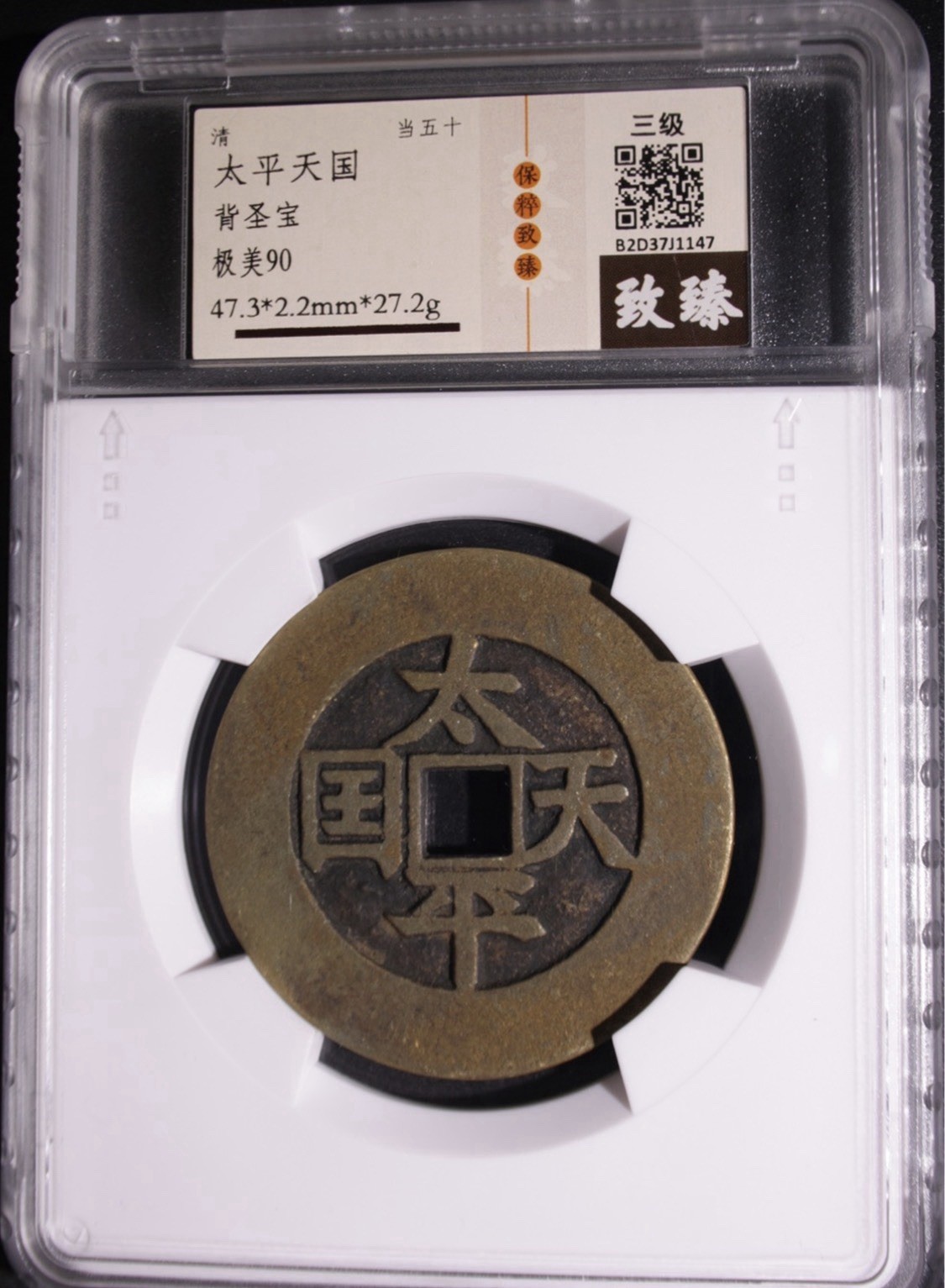
LARGE 50 CASH 当五十
REVERSE: SHENG BAO 聖寶 — “SACRED TREASURE”
MID-19TH CENTURY CHINA
CERTIFIED 极美90
47.3 MM • 27.2 G
A COIN FROM ONE OF THE MOST TURBULENT CHAPTERS
IN 19TH-CENTURY CHINESE HISTORY
THE STORY
In the middle of the 19th century, China was shaken by a conflict that
would transform the Qing Empire.
It was the era of the Taiping Heavenly Kingdom.
Beginning in the early 1850s under Hong Xiuquan, the Taiping movement
established its own government, controlled extensive territory, captured
Nanjing and renamed it Tianjing — the “Heavenly Capital.”
It did something else that proclaimed political authority in a very
tangible way:
It issued its own money.
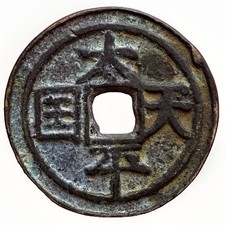
This remarkable large-format cash coin carries the name of that state:
太平天國
TAIPING TIAN GUO
“TAIPING HEAVENLY KINGDOM”
On the reverse appears:
聖寶
SHENG BAO
“SACRED TREASURE”
More than simply a monetary inscription, those characters belonged to
the distinctive political and religious vocabulary of the Taiping state.
This was money created not by the ruling Qing government, but by a
movement attempting to establish an alternative order within China.
The coin therefore survives as a tangible artifact from one of the
great upheavals of 19th-century Chinese history.
THE TAIPING HEAVENLY KINGDOM
The Taiping Heavenly Kingdom emerged during a period of profound
political, economic and social instability in Qing China.
Its leader, Hong Xiuquan, developed an unusual religious movement
influenced by Christianity but transformed through his own distinctive
theology and interpretation.
The movement grew into an enormous rebellion against Qing rule.
By 1853, Taiping forces had captured Nanjing.
The city became Tianjing 天京 — the “Heavenly Capital” — and served as
the political center of the Taiping regime.
For years, large areas of China became contested between the Qing
government and Taiping forces.
Within the territories it controlled, the Taiping government developed
institutions of state authority.
Among the most tangible surviving evidence of that authority is its
coinage.
MONEY AS A DECLARATION OF AUTHORITY
Throughout Chinese history, issuing coinage was closely connected with
political authority.
An emperor's reign title could appear on millions of cash coins,
circulating throughout the empire and reinforcing the legitimacy of the
ruling dynasty.
The Taiping leadership adopted this same powerful concept.
But instead of placing a Qing emperor's reign title on its money, the
Taiping regime used its own ideological language.
On this coin:
太平天國
announces the name of the Taiping Heavenly Kingdom.
And on the reverse:
聖寶
means “Sacred Treasure” or “Holy Treasure.”
The result was currency that functioned not only economically, but also
symbolically.
Every coin bearing these inscriptions represented an alternative claim
to political authority.
太平天國 — TAIPING HEAVENLY KINGDOM
The four large characters on the obverse read:
太 — TAI
平 — PING
天 — TIAN
國 — GUO
Together:
太平天國
TAIPING TIAN GUO
The name is commonly translated as:
“TAIPING HEAVENLY KINGDOM”
or
“HEAVENLY KINGDOM OF GREAT PEACE.”
The inscription immediately distinguishes the piece from conventional
Qing Dynasty cash coinage.
Instead of the familiar reign-title formula used on Qing imperial cash,
the coin declares the identity of the Taiping state itself.
聖寶 — SACRED TREASURE
The reverse carries two large characters:
聖寶
SHENG BAO
which can be translated as:
“SACRED TREASURE”
or
“HOLY TREASURE.”
This terminology reflects the distinctive religious character of the
Taiping regime.
Chinese cash coins traditionally employed monetary terms such as
通寶 — Tong Bao, “Circulating Treasure,”
重寶 — Zhong Bao, “Heavy Treasure,”
and
元寶 — Yuan Bao, “Primary Treasure.”
The Taiping use of:
聖寶 — SHENG BAO
gave its currency a strikingly different ideological identity.
It is one of the features that makes Taiping coinage immediately
recognizable to collectors of Chinese history.
A LARGE 50-CASH ATTRIBUTION
This is an imposing piece.
According to the third-party certification record, the coin is
attributed as:
当五十
DANG WU SHI
50 CASH
The certified measurements are:
Diameter: 47.3 mm
Thickness: 2.2 mm
Weight: 27.2 g
At nearly 47.3 millimeters across, this is dramatically larger than an
ordinary Chinese one-cash coin.
Its substantial size gives the inscription exceptional visual impact.
The broad outer rim surrounds the deeply defined central characters,
while the traditional square opening preserves a monetary design
tradition that had existed in China for more than two millennia.
Because Taiping cash coinage exists in numerous sizes, inscriptions and
varieties, His Story Treasures presents the 50-cash denomination
according to the attribution shown on the third-party certification.
THE SQUARE HOLE — AN ANCIENT FORM WITH A NEW MESSAGE
Although the political message of the coin was revolutionary, its
physical form was deeply traditional.
Round Chinese cash coins with square central holes had existed for
centuries.
The square opening allowed cash coins to be strung together for
counting, storage and transportation.
The Taiping government retained this ancient monetary form while
replacing Qing imperial inscriptions with its own political and
religious vocabulary.
That contrast makes Taiping coinage particularly fascinating:
An ancient Chinese monetary form carrying the message of a radically
different political movement.
1853 — TIANJING AND THE BEGINNING OF TAIPING COINAGE
The third-party certification information accompanying this piece notes
that Taiping coinage began to be cast in 1853.
That year was enormously important.
Taiping forces captured Nanjing and transformed it into Tianjing, their
“Heavenly Capital.”
From this new center of power, the movement attempted to establish the
institutions necessary to govern the territory under its control.
Coinage became part of that process.
The Taiping monetary system ultimately produced numerous inscription
styles and denominations.
For this reason, this piece is best described as a mid-19th-century
Taiping issue rather than assigning the individual coin specifically
to the year 1853.
CHINA DIVIDED
Imagine the world in which this coin existed.
The Qing Dynasty still ruled China.
Yet another government controlled substantial territory and issued
money bearing an entirely different political identity.
In one part of the country, Qing cash circulated carrying imperial
reign titles.
Within Taiping-controlled areas, coins proclaimed:
太平天國
TAIPING HEAVENLY KINGDOM
and:
聖寶
SACRED TREASURE
Money had become part of the struggle over who possessed legitimate
authority.
This is what gives Taiping coinage such extraordinary historical power.
It was not created centuries after the rebellion to commemorate it.
It belonged to the rebellion itself.
THE TAIPING REBELLION
The conflict between the Taiping Heavenly Kingdom and the Qing Dynasty
developed into one of the defining wars of 19th-century China.
Large armies moved across central and eastern China.
Cities changed hands.
Trade and agriculture were disrupted.
Communities were devastated.
The conflict continued until 1864, when Qing forces recaptured Nanjing
and the Taiping state effectively collapsed.
The political experiment of the Taiping Heavenly Kingdom had ended.
Its coins remained.
Today they are among the most tangible surviving artifacts of the
movement.
A SURVIVING WITNESS TO CIVIL WAR
Historical events are often preserved through books.
Wars survive in military records.
Rulers survive in portraits.
Political movements survive through documents.
But coins provide something different.
They were physical objects created by the governments themselves.
They passed through the hands of people who actually lived through
those events.
We cannot know who possessed this particular coin.
Perhaps it passed through a market.
Perhaps it was stored as savings.
Perhaps it traveled with a merchant, soldier or family.
Its individual journey has been lost.
But the object survived.
More than a century and a half later, the characters:
太平天國
and
聖寶
remain clearly visible.
They preserve the name and ideology of a state that existed for only a
brief but extraordinary period in Chinese history.
COIN DETAILS
Issuing Authority:
Taiping Heavenly Kingdom
太平天國
Historical Period:
Qing Dynasty Era / Taiping Rebellion
Date:
Mid-19th Century
Coinage:
Taiping Tianguo 太平天國
Reverse:
Sheng Bao 聖寶
“Sacred Treasure / Holy Treasure”
Denomination Attribution:
当五十 — 50 Cash
Per third-party certification
Material:
Copper Alloy / Brass-type cash coin
Form:
Round cash coin with square central opening
Diameter:
47.3 mm
Thickness:
2.2 mm
Weight:
27.2 g
Grade:
极美90
Certification Number:
B2D37J1147
CERTIFICATION & AUTHENTICITY
This coin has been encapsulated by a Chinese third-party grading service
and is accompanied by an online certification record.
The certification information shown for this specimen identifies:
Certificate No.:
B2D37J1147
Name:
太平天國
Period:
清 — Qing
Denomination:
当五十 — 50 Cash
Grade:
极美90
Variety:
背聖寶 — Reverse Sheng Bao
Dimensions:
47.3 × 2.2 mm
Weight:
27.2 g
The information visible on the holder corresponds with the online
certification record supplied with this listing.
Buyers are encouraged to review all photographs and independently
verify the certification information before purchase.
IMPORTANT NUMISMATIC NOTE
Taiping Heavenly Kingdom coinage is complex.
Numerous inscription arrangements, sizes and denomination
classifications are known, and surviving examples can vary
considerably in diameter and weight.
For this reason, His Story Treasures presents this specimen's
当五十 — 50 Cash attribution according to the information provided by
the third-party certification service.
No claim is made that the coin is a vault-protector issue.
The photographs show the actual certified coin offered and should be
considered an important part of the description.
WHY THIS COIN IS SPECIAL
This piece brings together several compelling areas of collecting:
TAIPING HEAVENLY KINGDOM
QING DYNASTY HISTORY
TAIPING REBELLION
19TH-CENTURY CHINA
CHINESE REBEL COINAGE
LARGE-FORMAT CASH COINAGE
RELIGIOUS HISTORY
CHINESE NUMISMATICS
At 47.3 mm, it also possesses a physical presence that ordinary cash
coins simply do not have.
Most importantly, however, it represents a government that attempted
to replace the Qing political order and created its own currency while
doing so.
The Taiping Heavenly Kingdom disappeared in 1864.
Its currency did not.
This coin survived.
HIS STORY TREASURES
At His Story Treasures, we believe historical coins are more than
collectibles.
They are surviving witnesses to civilizations, rulers, economies,
religions, wars, trade networks and the lives of ordinary people.
Our goal is to reconnect historical objects with the human stories
behind them, allowing collectors to appreciate not only what an
artifact is, but also the world through which it once traveled.
A portion of proceeds from His Story Treasures is donated to charitable
causes.
IMPORTANT COLLECTOR NOTE
Historical cast coins may exhibit natural variations in manufacture,
surface, patina, dimensions and preservation.
Please examine all photographs carefully.
The photographs show the actual certified coin being offered.
Thank you for visiting His Story Treasures.
Preserve the object.
Discover the story.
Carry history forward.