When you click on links to various merchants on this site and make a purchase, this can result in this site earning a commission. Affiliate programs and affiliations include, but are not limited to, the eBay Partner Network.
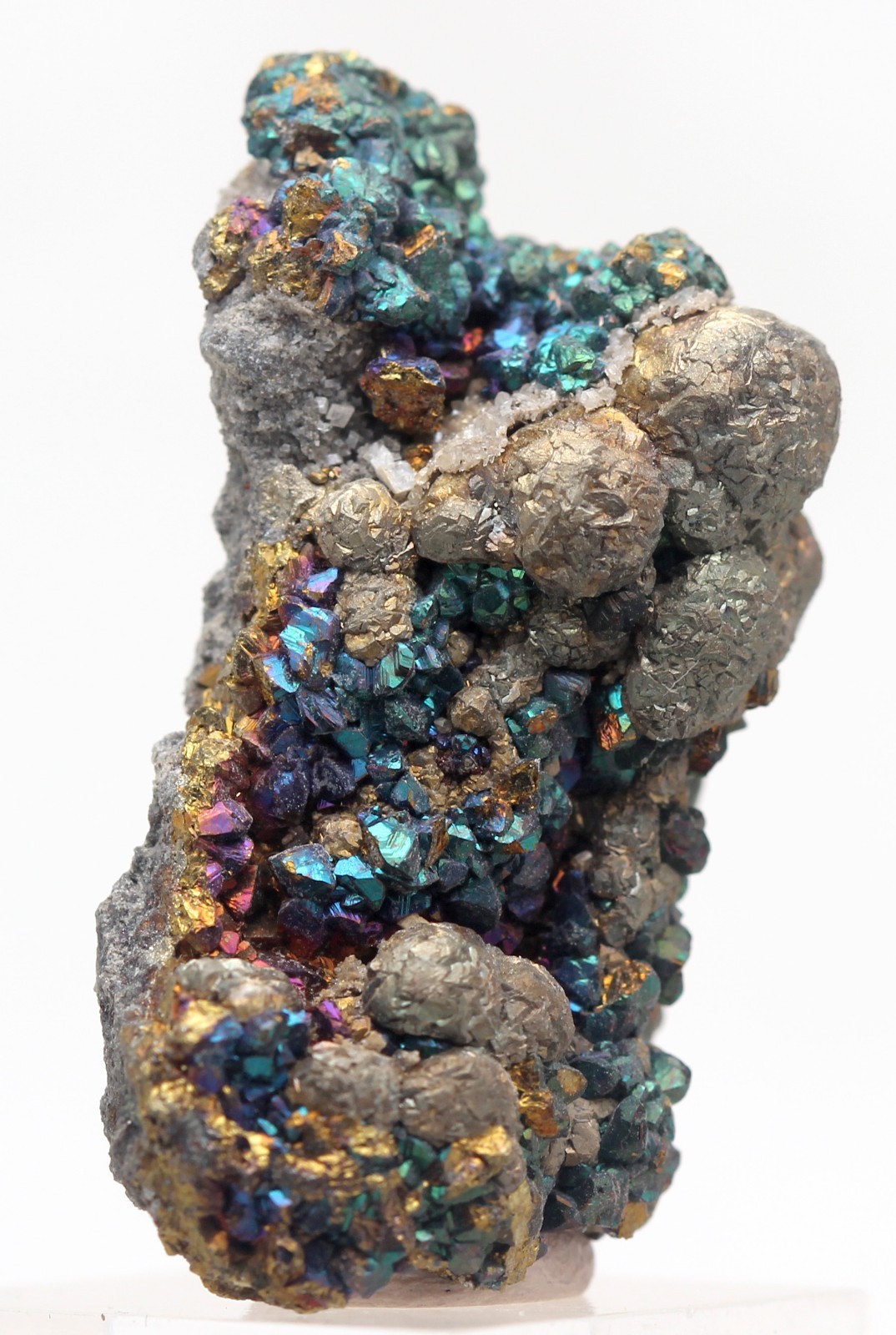
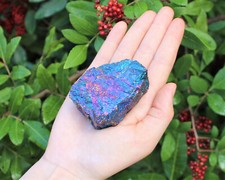
This amazing specimen measures 43 mm by 22 mm by 20 mm. It weighs 24.36 grams.
Chalcopyrite and dolomite crystal cluster mineral specimen from Sweetwater Mine, Ellington, Reynolds Co., Missouri..
I got this fromthe Tucson Gem and Mineral Show and purchased it directly from the miner who collected itfrom the famous Sweetwater Mine in Missouri.
This piece is highly desirable andwould be an excellent addition to any rock and mineral collection.I combine shipping on multiple orders so please check out my store.
I have added some information about this mineral and how it was formed form Wikipedia below.
I offer a money back guarantee on every item I sell.
If you are not 100% happy with your purchase just send me a message to let me know
and I will buy back the item for your full purchase price.
Chalcopyrite
From Wikipedia, the free Sulfide mineral
Formula CuFeS2
IMA symbol Ccp[1]
Strunz classification 2.CB.10a
Crystal system Tetragonal
Crystal class Scalenohedral (42m)
H-M symbol: (4 2m)
Space group I42d
Unit cell a = 5.289 Å,
c = 10.423 Å; Z = 4
Identification
Formula mass 183.54 g/mol
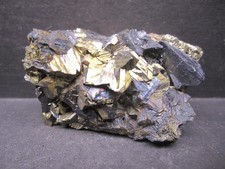
Color Brass yellow, may have iridescent purplish tarnish.
Crystal habit Predominantly the disphenoid and resembles a tetrahedron, commonly massive, and sometimes botryoidal.
Twinning Penetration twins
Cleavage Indistinct on {011}
Fracture Irregular to uneven
Tenacity Brittle
Mohs scale hardness 3.5–4
Luster Metallic
Streak Greenish black
Diaphaneity Opaque
Specific gravity 4.1–4.3
Optical properties Opaque
Solubility Soluble in HNO3
Other characteristics magnetic on heating
Chalcopyrite (/ˌkælkəˈpaɪˌraɪt, -koʊ-/[7][8] KAL-kə-PY-ryte, -koh-) is a copper iron sulfide mineral and the most abundant copper ore mineral. It has the chemical formula CuFeS2 and crystallizes in the tetragonal system. It has a brassy to golden yellow color and a hardness of 3.5 to 4 on the Mohs scale. Its streak is diagnostic as green-tinged black.[9]
On exposure to air, chalcopyrite tarnishes to a variety of oxides, hydroxides, and sulfates. Associated copper minerals include the sulfides bornite (Cu5FeS4), chalcocite (Cu2S), covellite (CuS), digenite (Cu9S5); carbonates such as malachite and azurite, and rarely oxides such as cuprite (Cu2O). It is rarely found in association with native copper. Chalcopyrite is a conductor of can be extracted from chalcopyrite ore using various methods. The two predominant methods are pyrometallurgy and hydrometallurgy, the former being the most commercially name chalcopyrite comes from the Greek words chalkos, which means copper, and pyrites, which means striking fire.[12] It was sometimes historically referred to as \"yellow is often confused with pyrite and gold since all three of these minerals have a yellowish color and a metallic luster. Some important mineral characteristics that help distinguish these minerals are hardness and streak. Chalcopyrite is much softer than pyrite and can be scratched with a knife, whereas pyrite cannot be scratched by a knife.[14] However, chalcopyrite is harder than gold, which, if pure, can be scratched by copper.[15] Additionally, gold is malleable, while chalcopyrite is brittle.[12] Chalcopyrite has a distinctive black streak with green flecks in it. Pyrite has a black streak and gold has a yellow chalcopyrite has no solid solution series with any other sulfide minerals. There is limited substitution of zinc with copper despite chalcopyrite having the same crystal structure as sphalerite.
Minor amounts of elements such as silver, gold, cadmium, cobalt, nickel, lead, tin, and zinc can be measured (at parts per million levels), likely substituting for copper and iron. Selenium, bismuth, tellurium, and arsenic may substitute for sulfur in minor amounts.[17] Chalcopyrite can be oxidized to form malachite, azurite, and is a member of the tetragonal crystal system. Crystallographically the structure of chalcopyrite is closely related to that of zinc blende ZnS (sphalerite).[18] The unit cell is twice as large, reflecting an alternation of Cu+ and Fe3+ ions replacing Zn2+ ions in adjacent cells. In contrast to the pyrite structure chalcopyrite has single S2− sulfide anions rather than disulfide pairs. Another difference is that the iron cation is not diamagnetic low spin Fe(II) as in pyrite.
In the crystal structure, each metal ion is tetrahedrally coordinated to 4 sulfur anions. Each sulfur anion is bonded to two copper atoms and two iron is present with many ore-bearing environments via a variety of ore forming is present in volcanogenic massive sulfide ore deposits and sedimentary exhalative deposits, formed by deposition of copper during hydrothermal circulation. Chalcopyrite is concentrated in this environment via fluid transport. Porphyry copper ore deposits are formed by concentration of copper within a granitic stock during the ascent and crystallisation of a magma. Chalcopyrite in this environment is produced by concentration within a magmatic system.
Chalcopyrite is an accessory mineral in Kambalda type komatiitic nickel ore deposits, formed from an immiscible sulfide liquid in sulfide-saturated ultramafic lavas. In this environment chalcopyrite is formed by a sulfide liquid stripping copper from an immiscible silicate liquid.
Chalcopyrite has been the most important ore of copper since the Bronze though Chalcopyrite does not contain the most copper in its structure relative to other minerals, it is the most important copper ore since it can be found in many localities. Chalcopyrite ore occurs in a variety of ore types, from huge masses as at Timmins, Ontario, to irregular veins and disseminations associated with granitic to dioritic intrusives as in the porphyry copper deposits of Broken Hill, the American Cordillera and the Andes. The largest deposit of nearly pure chalcopyrite ever discovered in Canada was at the southern end of the Temagami Greenstone Belt where Copperfields Mine extracted the high-grade is present in the supergiant Olympic Dam Cu-Au-U deposit in South may also be found in coal seams associated with pyrite nodules, and as disseminations in carbonate sedimentary rocks.[20]