When you click on links to various merchants on this site and make a purchase, this can result in this site earning a commission. Affiliate programs and affiliations include, but are not limited to, the eBay Partner Network.
A Spectacular Victorian Exploration Book in Its Original Pictorial Binding
Few nineteenth-century travel books announce themselves quite like this one.
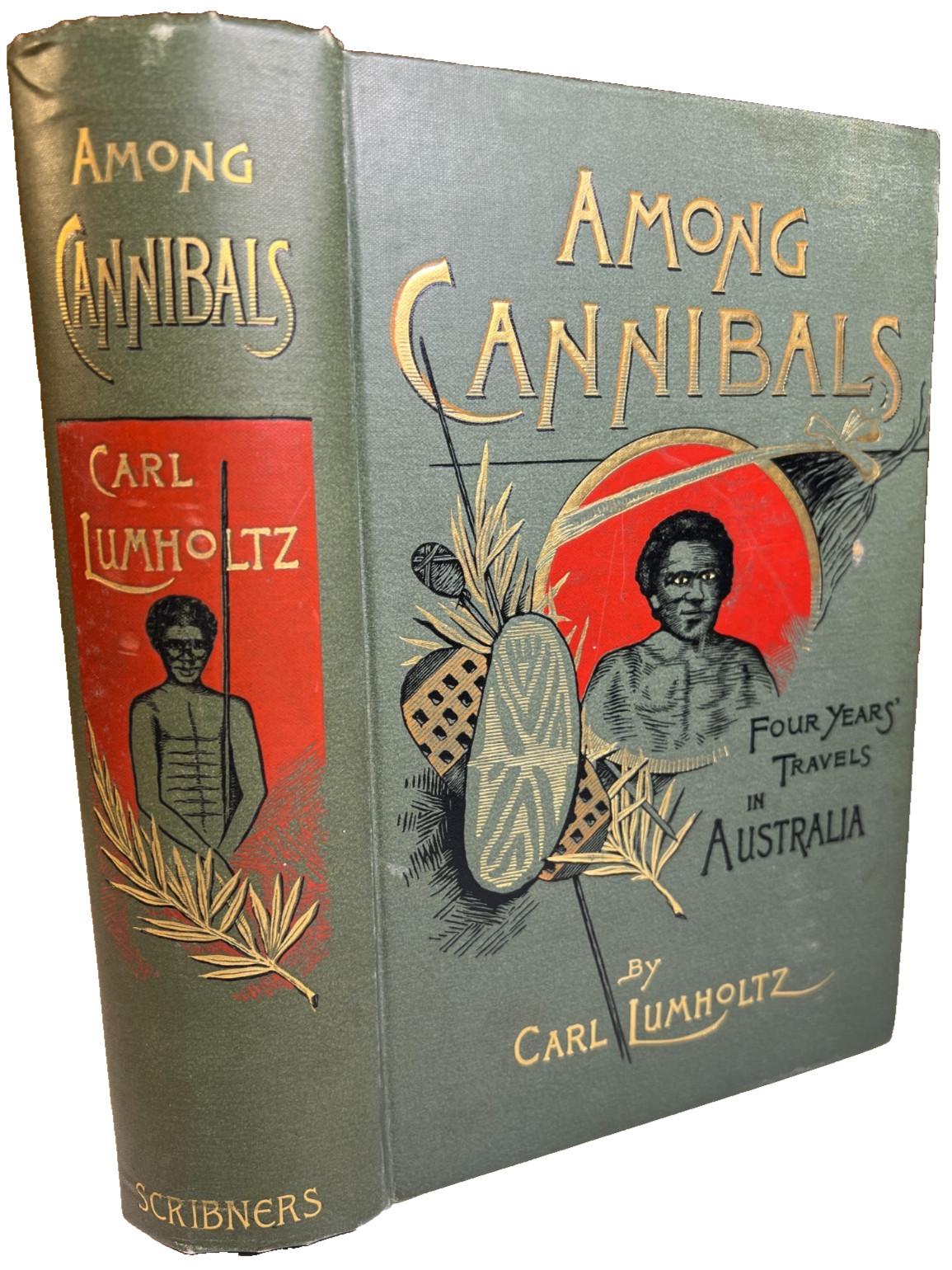
Across the sage-green cloth, brilliant scarlet panels, black linework, and richly stamped gilt create an extraordinary Australian scene: Indigenous figures, shield, spear, club, native foliage, and the author’s name all arranged in a wonderfully theatrical Victorian design. The artwork continues across the spine, making this a genuine shelf-display piece—not merely an old book with an interesting title.
This is the 1889 first American edition of:
Among Cannibals
An Account of Four Years’ Travels in Australia and of Camp Life with the Aborigines of Queensland
By Carl Lumholtz, M.A.
Translated by Rasmus B. Anderson
Published in New York by Charles Scribner’s Sons, 1889
The copyright page also confirms 1889, with printing and binding credited to the Trow Printing and Bookbinding Company of New York.
The Author and His Journey
Carl Sofus Lumholtz was a Norwegian naturalist, explorer, ethnographer, and one of the most remarkable field researchers of the late nineteenth century. He traveled through Australia from 1880 to 1884, initially collecting zoological specimens before turning much of his attention toward the Indigenous peoples of northern Queensland.
Unlike many armchair travel writers of the Victorian period, Lumholtz actually lived and traveled in extremely remote country. His account records tropical forests, mountains, rivers, wildlife, frontier settlements, difficult overland travel, hunting, camp life, and extended encounters with Aboriginal communities.
Although its title and portions of its language reflect outdated—and at times troubling—nineteenth-century European attitudes, the book remains an important historical source. Lumholtz documented people, customs, material culture, foods, ceremonies, tools, weapons, and daily life during a period of enormous disruption caused by colonial expansion.
Today, Lumholtz is remembered as an influential early ethnographic fieldworker. The Australian Lumholtz’s tree-kangaroo was named after him, as was Queensland’s former Lumholtz National Park, now known as Girringun National Park. His later expeditions in Mexico and Borneo further established his reputation as a major explorer.
Lavishly Illustrated
The title page advertises the original edition as containing:
- A portrait of Carl Lumholtz
- Maps
- Four chromolithographs
- Numerous woodcut illustrations
The handsome frontispiece shows Lumholtz in field clothing with his rifle and dog, accompanied by a facsimile signature. Throughout the volume are views of the Australian landscape, settlements, Indigenous life, animals, plants, implements, and scenes encountered during the expedition.
The chromolithographs are especially desirable. Produced by building color through separately printed layers, these plates were considerably more elaborate and expensive than ordinary black-and-white illustrations. They helped bring the unfamiliar landscapes, wildlife, and peoples of Queensland vividly before a Victorian audience.
Please consult all photographs and verify the illustrated contents to your satisfaction. The title page calls for maps, four chromolithographs, a portrait, and woodcuts; the book has not been collated plate by plate.
An Exceptional Victorian Binding
The original publisher’s cloth is the undeniable star of this copy.
The front cover combines:
- Sage-green cloth
- Vivid red color panels
- Black pictorial stamping
- Extensive gilt lettering and decoration
- Images of Indigenous Australians
- A decorated shield and weapons
- Native botanical elements
The elaborate design carries onto the spine, including another Indigenous figure against a scarlet field. The gilt remains remarkably bright, and the red still has terrific visual impact after more than 135 years.
This is precisely the kind of elaborate late-Victorian binding sought by collectors of decorative books, Australian exploration, anthropology, ethnography, and nineteenth-century travel literature.
Bookseller Provenance
The inside front cover retains a small period label reading:
W. B. Clarke & Co.
Booksellers & Stationers
Boston
This is an appealing piece of bookselling history and shows that the volume passed through a prominent Boston bookshop early in its life. It is a bookseller’s label—not a modern price sticker.
Condition
A very attractive, solid-looking antique copy with particularly strong shelf and display appeal.
- Original pictorial publisher’s cloth retained
- Gilt and colored cover decoration remain bright and impressive
- Moderate rubbing, small marks, and age-related surface wear
- Wear, softening, and small losses/fraying at the spine ends
- Corners show rubbing and light bumping
- Small pale spot or rub on the front cover
- Rear cloth has mild discoloration and age-related marks
- Front inner hinge/endpaper area shows some separation and wear near the bottom
- Pages exhibit expected age toning with occasional scattered spots or marks
- Period W. B. Clarke & Co., Boston bookseller label inside the front cover
- No obvious modern rebinding or restoration seen
- No dust jacket, as issued
The binding remains exceptionally photogenic despite its honest wear. The scarce pictorial cloth has survived with unusually strong color, clear artwork, and gleaming gilt.
Because this is a heavily illustrated volume, the buyer should rely on the photographs concerning condition and completeness. As noted above, it has not been individually collated against a bibliographical plate list.
Why This Copy Stands Out
This is more than an antique travel narrative. It combines several highly collectible subjects in one impressive volume:
- Early Australian exploration
- Queensland history
- Aboriginal ethnography
- Natural history
- Victorian anthropology
- Nineteenth-century color printing
- Decorative pictorial bookbinding
- Exploration and adventure literature
The title is unforgettable, the historical content is substantial, and the original binding is a miniature work of commercial art. Displayed face-out, it has enough color and visual drama to command an entire shelf.