When you click on links to various merchants on this site and make a purchase, this can result in this site earning a commission. Affiliate programs and affiliations include, but are not limited to, the eBay Partner Network.
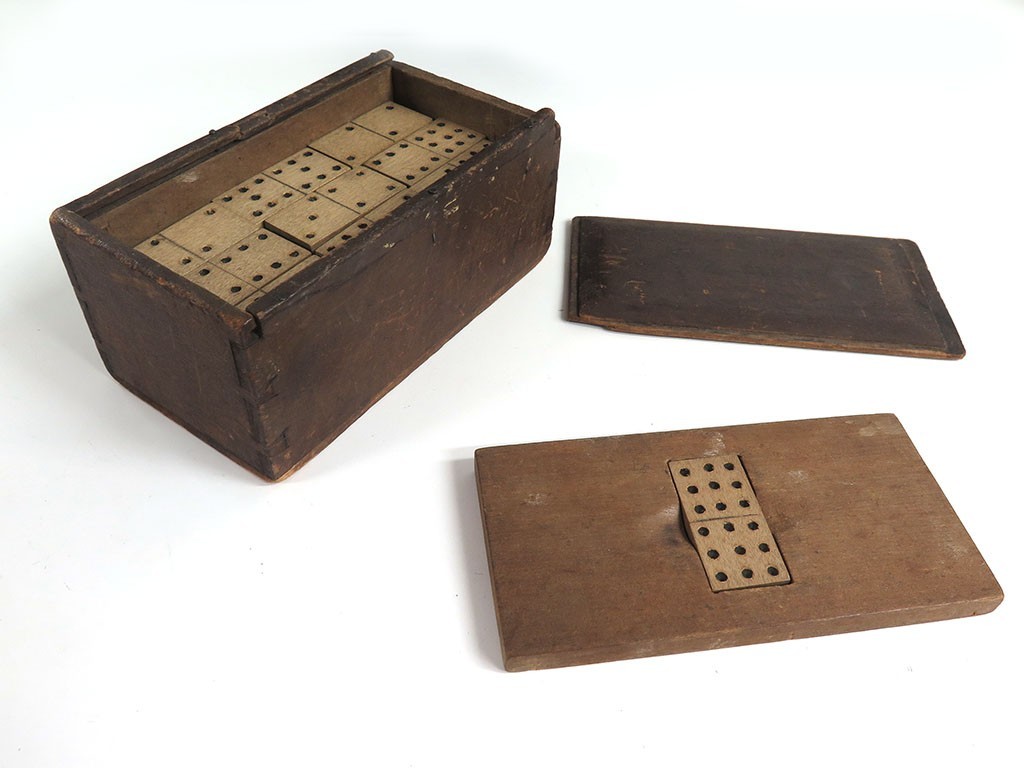
This is a complete set of Double-Nine dominos in an antique era wooden box. The pieces themselves are hand-carved out of a sliding-lid box. The 55th piece sits in an insert in the top of the box. This piece acts as an internal locking wedge so pieces stay tight in transit.
The age of the wood, type of dovetail joinery, nails/pins/hardware. The wood and hardware looks genuinely aged and period authentic, with a rich patina on the wood and oxidation on the fasteners which only can come from serious age. It most likely is from the 1800s period / 19th century - this is not a guarantee but all signs point to this.This was found at the estate of a very serious collector of war memorabilia (truly impressive collection with many high-end antiques and artifacts). It was specifically found among his room where he kept his most precious war artifacts. Unfortunately, the exact provenance is unknown. But it is almost certainly some type of \"trench art\" or \"camp art\" from a soldier with a lot of time to kill. I can\'t say if this has POW provenance specifically, but it is similar to that type of primitive war art. It definitely has a rich history behind it, but the only true information is what you see with your eyes (and the known history of the previous owner being a very serious collector of genuine war items).
The 55th Piece Function: The 55th piece inserted into the top of the box is incredibly clever. In many 19th-century soldier-crafted or travel game boxes, that extra piece was deliberately placed into a channel or slot right beneath the lid. It acts as an internal locking wedge. When the lid is slid completely shut, that specific tile stops the rest of the pieces from shifting around, shifting weight, or accidentally triggering the slide-lock loose while in a soldier\'s knapsack or uniform trunk.
Finding a complete 55-tile wooden set where not a single piece was lost over roughly 100 to 150 years is highly unusual for camp-carved items. Soldiers moved frequently, and small pieces routinely went missing in the dirt.
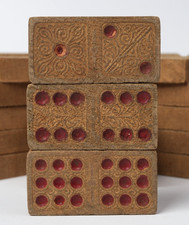
A standard Double-Six set (28 tiles) can be carved relatively quickly. Hand-carving a Double-Nine set requires planning out and executing 55 identical wooden blocks, plus drilling and painting 495 individual pip holes perfectly.
This level of dedication strongly reinforces the \"war memorabilia\" context. It points to someone facing an immense stretch of isolated time—such as a soldier spending a long winter in winter quarters, a blockade sailor on a protracted naval watch, or a prisoner of war in a military prison camp. It is a spectacular piece of functional folk history!