When you click on links to various merchants on this site and make a purchase, this can result in this site earning a commission. Affiliate programs and affiliations include, but are not limited to, the eBay Partner Network.
DESCRIPTIONA Remarkable and Unusual Mid-19th-Century Bronze Devotional Cross
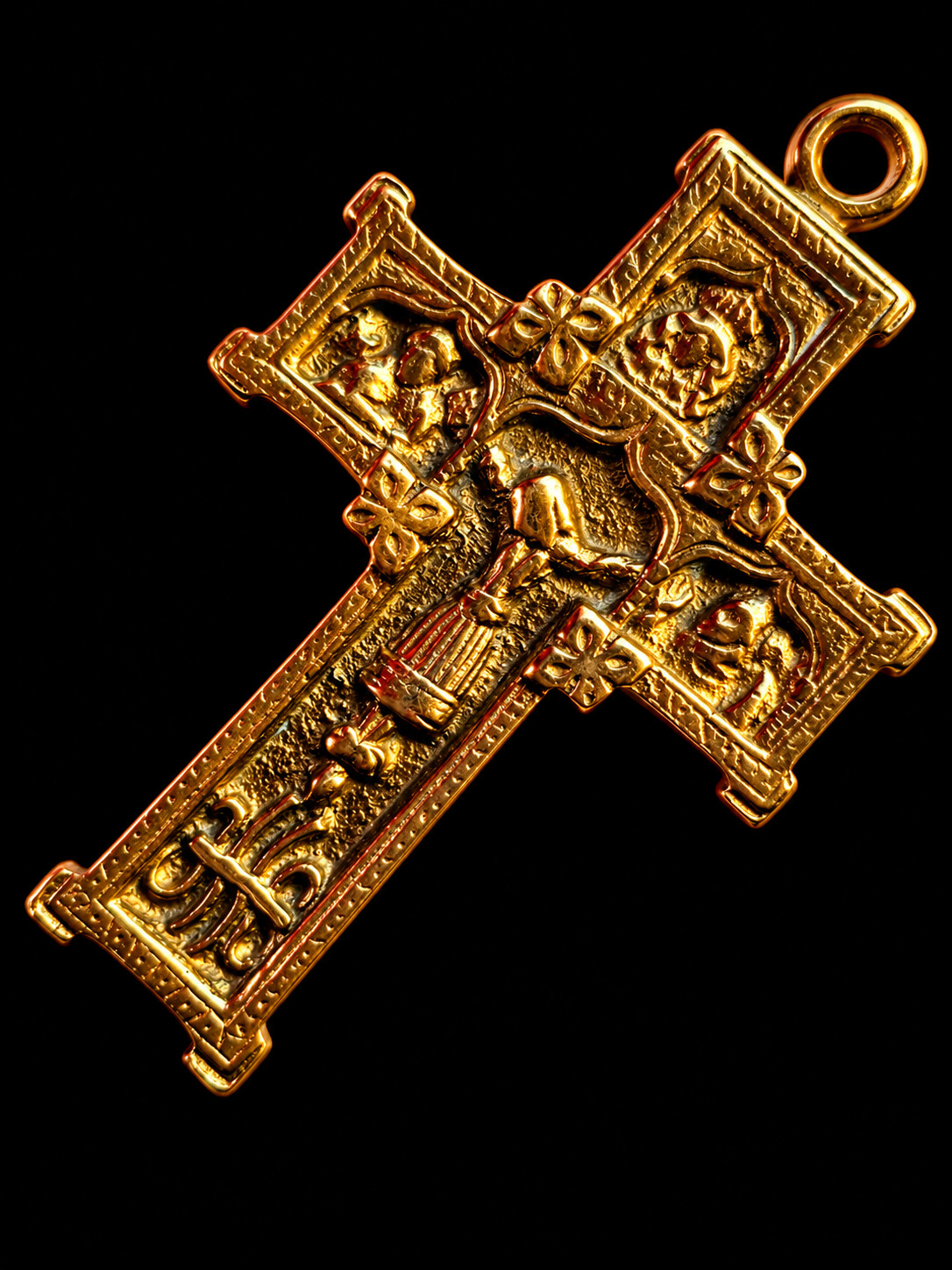
This extraordinary mid-19th-century bronze devotional cross, dating to approximately 1850, is an unusually elaborate example of nineteenth-century Christian religious metalwork. With its substantial proportions, considerable weight, deeply modelled relief and remarkably decorated front and reverse, the piece possesses a character that is immediately distinctive. It is not a simple or minimally ornamented cross, but a highly developed devotional composition in bronze, conceived with an exceptional density of sacred imagery and ornamental detail.
The cross measures approximately 4.72 inches (12 cm) in height and 3.54 inches (9 cm) in width, and has an impressive weight of approximately 5.70 oz (161.54 g). These dimensions give it a particularly substantial presence. It is large enough for its numerous reliefs to remain visually important while still retaining the intimate character of a devotional object intended to be carried, displayed or contemplated at close range.
Its appearance belongs unmistakably to the world of nineteenth-century Eastern Christian and Byzantine-inspired devotional art, where ancient Christian forms continued to exercise a powerful influence upon religious objects. During the nineteenth century, craftsmen frequently looked to earlier Byzantine and Orthodox traditions for visual models, reviving architectural framing, hieratic sacred figures, crucifixion imagery and ornamental systems derived from older ecclesiastical art. This cross reflects that artistic vocabulary with remarkable richness, translating it into a solid bronze object of considerable presence.
The result is a fascinating meeting between religious devotion, historic artistic tradition and the tactile qualities of cast bronze.
The Front — The Crucifixion and a Miniature Sacred Programme
The principal face is dominated by a striking central representation of the Crucifixion of Christ, executed in raised relief. The figure emerges clearly from the heavily textured bronze ground, with the elongated body and extended arms defining the principal axis of the composition.
Rather than attempting a highly naturalistic anatomical rendering, the figure is treated in a deliberately stylised and solemn manner. The proportions and relief modelling give the Crucifixion an almost timeless quality, emphasizing the sacred image itself rather than the physical realism of the human form. The result is deeply contemplative: Christ occupies the centre of the entire object, surrounded by a carefully structured hierarchy of smaller sacred images.
The Crucifixion is enclosed within an architectural arrangement of raised frames, recessed backgrounds and pointed or arched divisions, creating the appearance of a miniature ecclesiastical façade. The central scene is not isolated; it forms the heart of a much broader devotional composition.
Across the horizontal arms, the maker incorporated additional recessed sacred panels containing small relief figures and devotional groups. These images are positioned symmetrically on either side of Christ and are individually framed, giving each its own visual space while allowing the entire cross to read as one coherent iconographic ensemble.
Above the central crossbar rises another substantial sacred compartment. This upper section contains an additional relief image enclosed within multiple raised borders and an arched architectural frame. The composition culminates in the large circular suspension loop, which is itself carefully integrated into the design rather than added as an afterthought.
One of the most distinctive decorative characteristics is the repeated presence of four-petalled quatrefoil-like ornaments at the principal junctions of the cross. These prominent raised elements create a striking contrast with the recessed sacred scenes and provide a sense of rhythm throughout the composition.
The outer borders are particularly elaborate. They are filled with small punched marks, incised lines and geometric ornament, creating countless minute variations in the surface. These details become increasingly visible under directional illumination, revealing the extraordinary amount of work invested in the piece.
The lower section continues the sacred programme with further relief decoration extending along the vertical shaft. The figure and ornament are surrounded by the same architectural framing, producing a unified visual structure from top to bottom.
The entire front therefore reads as a small portable sanctuary in bronze: the Crucifixion at its spiritual centre, additional sacred figures around it, architectural framing providing order, and repeated ornamental motifs binding everything together.
The Reverse — A Second Devotional Composition
The reverse is equally remarkable and is one of the characteristics that makes this piece particularly unusual.
Instead of being left plain or treated merely as the structural back of the object, the reverse has been given its own fully developed sacred composition. It is richly ornamented with recessed panels, raised borders, sacred relief figures and the same distinctive quatrefoil motifs that appear on the principal face.
The vertical centre contains a standing, elongated sacred figure, rendered in relief against a strongly textured background. The figure appears within a narrow architectural compartment, framed by raised borders that emphasise its position as one of the principal elements of the composition.
Above, the transverse section is once again divided into multiple sacred compartments. These contain additional relief representations, arranged within architectural frames and integrated into the larger composition. The careful organisation of these panels creates the impression of a miniature iconographic programme repeated across the reverse.
A further sacred image occupies the elevated upper portion immediately below the suspension loop, continuing the vertical hierarchy of the design.
Throughout the reverse, one encounters the same extraordinary combination of raised relief, deep recesses, geometric framing, punched ornament and projecting quatrefoil details. The continuity of decoration from one face to the other demonstrates that considerable attention was given to the entire object, not merely to the side intended to be seen most often.
This is particularly significant from a collector’s perspective. Many devotional objects have an elaborate principal face but a comparatively plain reverse; here, the reverse remains visually important and contributes substantially to the identity of the cross.
Bronze — Material Presence, Patina and the Passage of Time
The use of bronze is fundamental to the character of this object. Bronze allowed the maker to create substantial relief, strong architectural borders and projecting ornamental details while preserving the physical solidity necessary for a devotional object intended to be handled and transported.
At approximately 161.54 grams / 5.70 ounces, the cross has an unmistakably substantial feel. Its weight is particularly impressive in relation to its dimensions of approximately 12 × 9 cm, confirming the robust character of the casting.
The surface is equally important.
Rather than showing a flat, uniform finish, the bronze preserves a complex combination of golden-brown coloration, darker oxidation, brighter exposed metal and reddish-brown tonal variation. The highest areas of the relief catch the light strongly, while recessed portions remain darker, allowing the imagery to emerge with considerable depth.
There are numerous visible signs of age across the object: small scratches, abrasions, softened edges, minor surface irregularities and variations in patination. These features give the bronze an exceptionally tactile character. The cross appears as an object that has existed physically through time, rather than as something whose surface has been made artificially uniform.
The contrast between polished high points and darker recesses is especially beautiful. It creates a natural form of chiaroscuro, allowing the figures, borders and ornaments to appear almost dramatically illuminated against the darker ground.
The Nineteenth Century — Historical and Artistic Context
Dating from approximately 1850, the cross belongs to a period in which European religious art remained deeply connected with the visual vocabulary of earlier Christian traditions.
The nineteenth century saw extensive interest in historic and ecclesiastical artistic forms. Older Byzantine, medieval and Orthodox visual traditions continued to influence religious objects, particularly where craftsmen sought to preserve or revive established sacred imagery. The architectural divisions, elongated sacred figures, cross-form ornaments and hierarchical composition seen here are entirely compatible with that broader historicist environment.
Yet the object is not interesting simply because of its age.
Its particular fascination lies in the density of its visual language. The maker has attempted to compress an extraordinary amount of sacred imagery into a single piece of bronze. Every section contributes to the whole: the central Crucifixion, the surrounding figures, the upper sacred compartment, the lower standing figure, the repeated floral-quatrefoil ornaments and the elaborate borders all operate together.
This makes the object feel closer to a miniature devotional monument than an ordinary piece of personal jewellery.
A Distinctive and Unusually Elaborate Object
What makes this cross especially compelling is the fact that its character cannot be reduced to a single decorative feature.
Its appeal comes from the combination of scale, weight, material, relief, iconography, architectural structure and age. The object is large enough to display an impressive quantity of detail, heavy enough to possess considerable physical authority, and sufficiently elaborately decorated that both faces invite prolonged examination.
The more closely it is studied, the more details become apparent.
Tiny punched marks appear within the borders. Raised ornament projects from the surface. Recessed areas retain darker patina. The relief figures emerge at different depths. The quatrefoil motifs act as visual anchors around the principal intersections. Architectural frames divide the composition into individual sacred scenes while maintaining the unity of the whole.
There is therefore no single point from which the cross is completely exhausted visually. It rewards examination from different angles and under different lighting conditions, particularly because the irregularities of the aged bronze continually alter the relationship between highlight and shadow.
This quality contributes strongly to the sense that the object is unique in appearance and character. While historical objects can sometimes share broad stylistic traditions, the individual combination of relief modelling, ornament, surface wear, casting characteristics and surviving patina gives each piece its own identity.
A Portable Expression of Faith
Beyond its artistic qualities, the cross retains an important devotional character.
Objects of this nature occupy a special place within Christian material culture because they allow sacred imagery to become physically intimate. Rather than existing solely within the architectural environment of a church, the cross could accompany an individual, remaining close to the wearer and functioning as a continual reminder of Christ, sacrifice, salvation and faith.
Here, the sacred imagery is particularly powerful because the object has been constructed around a clear spiritual centre: the Crucifixion. The surrounding figures and devotional panels create a visual environment around Christ, while the architectural borders provide order and permanence.
The result is both personal and monumental at the same time: personal in its devotional purpose, yet monumental in the seriousness and density of its execution.
Condition and Antique Character
The cross is offered in honest antique condition, with age-related wear, abrasions, scratches, softened relief and naturally varied patination visible throughout the bronze. Some areas of the relief have become less sharply defined with time, while other raised sections retain strong definition and brighter surfaces.
These characteristics are part of the historical appearance of the piece and should not be interpreted as evidence of modern damage or inconsistency. They form the visual record of age and handling that gives antique bronze its particular appeal.
The close-up photographs are especially useful for examining the texture of the metal, the depth of the relief, the condition of the individual figures and the variations in patina across both faces.
Measurements & Specifications
Period: Mid-19th Century, circa 1850Material: BronzeOverall Height: approx. 4.72 in (12 cm)Overall Width: approx. 3.54 in (9 cm)Weight: approx. 5.70 oz (161.54 g)Type: Christian devotional cross / Orthodox-style religious bronzeDecoration: Raised relief, recessed sacred panels, incised and punched ornament, quatrefoil motifs and architectural framingCondition: Antique condition with age-related wear, abrasions, surface marks, softened relief and natural patination
A deeply evocative and unusually elaborate mid-19th-century bronze cross, remarkable not only for its substantial 4.72 × 3.54 inch dimensions and 5.70 oz weight, but for the extraordinary quantity of sacred imagery and ornament incorporated into both of its faces. Its combination of Byzantine-inspired devotional language, monumental relief, architectural framing, naturally aged bronze and intimate religious purpose gives it an exceptional presence for a nineteenth-century object.
A distinctive historical devotional work, rich in symbolism, craftsmanship and the visible passage of time — a cross to be studied closely, appreciated materially, and understood not simply as an ornament, but as a miniature sacred work of art.
PLEASE CHECK BEFORE offerDING
Shipping – Global Shipping Program
This item is shipped using the Global Shipping Program, ensuring a safe and reliable international transaction.
Key advantages:
- Secure international delivery managed by
- Full tracking from dispatch to delivery
- Simplified customs handling
Once the item reaches ’s international hub, they take full responsibility for the delivery process.
Customs & Import Duties
For international buyers, please note:
- Import duties, taxes, and customs charges are not included in the item price
- These fees are determined by your country’s regulations
- Any additional charges are the buyer’s responsibility
We recommend checking your local import policies before purchasing.
Returns Policy
Due to the nature of this item, returns are not accepted.
An exception will only apply if the item received is significantly different from the description.
For clarity, this includes situations such as:
- Receiving a different brand or model than described
- Receiving an item that is not the advertised watch
- Major discrepancies in material (e.g. not solid gold as stated)
Minor variations, normal signs of age, or details clearly visible in the photographs do not qualify as a reason for return.
All items are carefully checked and accurately described to ensure transparency and buyer confidence. Please review all images and details before purchasing.
Additional Information
All measurements, weight, and detailed visual condition are clearly shown in the photographs provided.Please review the images carefully, as they form an essential part of the description.