When you click on links to various merchants on this site and make a purchase, this can result in this site earning a commission. Affiliate programs and affiliations include, but are not limited to, the eBay Partner Network.
A TRUE VICTORIAN ADVENTURE THAT READS LIKE JULES VERNE!
Long before luxury expedition ships, commercial aviation or instant communication, one remarkable family set out to circle the globe aboard its own steam-powered yacht.
The year was 1876, and the magnificent Sunbeam represented the cutting edge of Victorian technology—a graceful private yacht powered by both steam and sail, carrying its passengers into remote seas and distant cultures that most nineteenth-century readers could scarcely imagine.
Lady Annie Brassey was there to record it all.
Her celebrated account follows an approximately 35,000-mile journey around the world. Although completely true, its combination of futuristic machinery, exotic destinations, treacherous waters, erupting volcanoes and globe-spanning exploration gives it the irresistible atmosphere of a Jules Verne adventure brought to life.
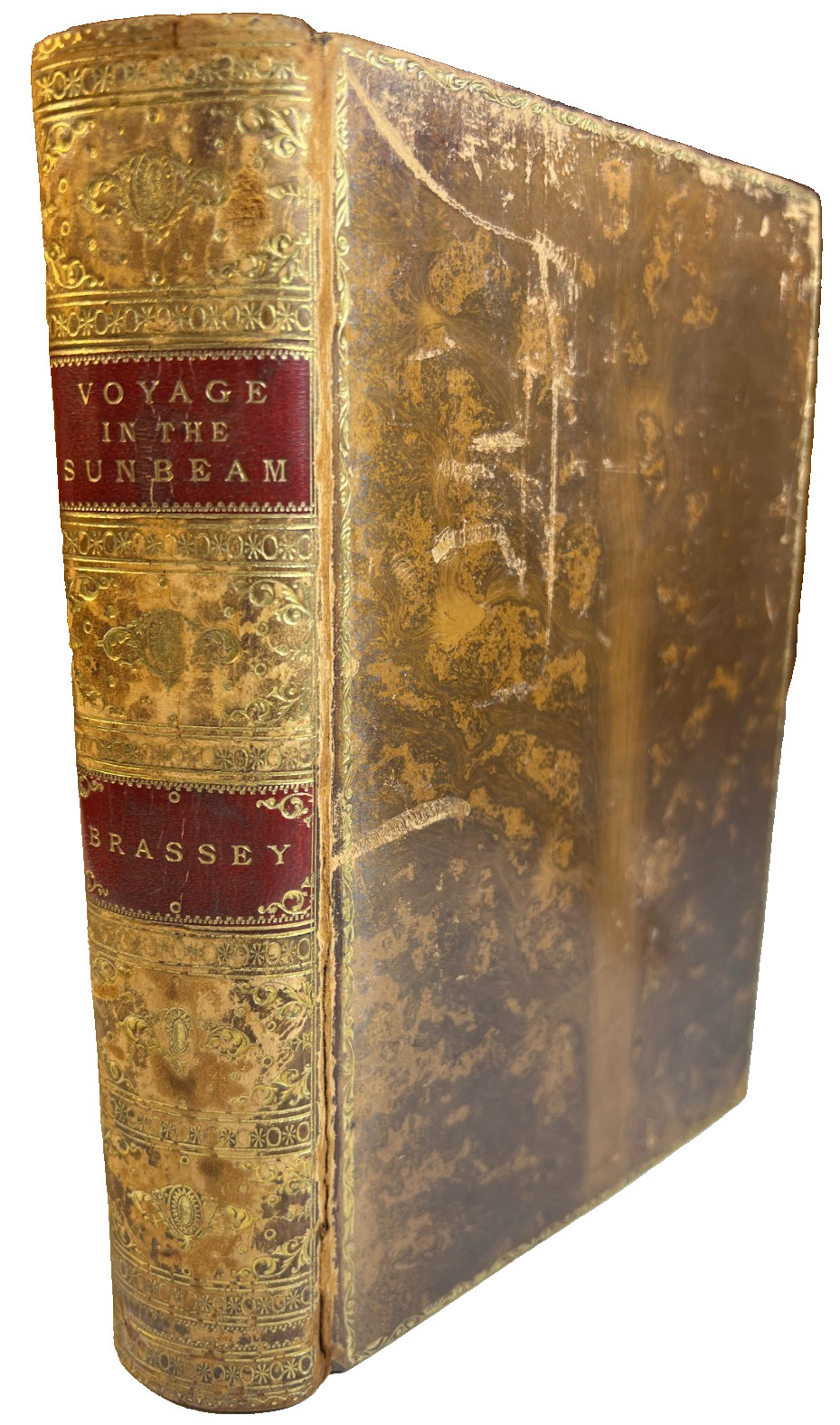
This beautiful 1879 edition presents that story in an exceptionally handsome Victorian leather binding, complete with brilliant gilding, numerous illustrations, a large folding map and a fascinating handwritten Eton College presentation inscription.
THE BOOK
Title: A Voyage in the “Sunbeam”: Our Home on the Ocean for Eleven Months
Author: Mrs. Brassey—later Annie, Lady Brassey
Publisher: Longmans, Green, and Co., London
Date: 1879
Binding: Full calf leather with extensive gilt decoration
Illustrations: Profusely illustrated throughout
Map: Large folding route map remains attached
The book recounts the Brassey family’s pioneering 1876–1877 circumnavigation aboard the steam yacht Sunbeam.
Written in an immediate, diary-like style from Lady Brassey’s letters, it allows the reader to experience the voyage almost day by day—the weather, meals, people, scenery, dangers and extraordinary discoveries encountered along the way.
This is no dry geographical survey. It is Victorian exploration experienced directly from the deck.
IMAGINE SEEING THE WORLD IN 1876
Picture yourself standing aboard the Sunbeam as its steam engine throbs beneath your feet. Coal smoke trails behind the yacht while its sails strain overhead.
There is no radio, radar, satellite navigation or weather forecast waiting ahead—only charts, instruments, experience and the open sea.
After days surrounded by nothing but water, a dark line appears on the horizon. It becomes a volcanic island, then a harbor filled with unfamiliar vessels. Palms move in the warm wind. Boats approach from shore. Beyond them are places most Victorian readers had previously encountered only in atlases.
One moment the family is entertaining guests aboard an elegant yacht; the next, the Sunbeam is fighting difficult seas or approaching a fiery volcanic landscape after dark.
It is this collision of Victorian refinement, powerful machinery and untamed wilderness that makes the story so compelling.
The Sunbeam becomes a floating Victorian home carried into the unknown—a real-world counterpart to the fantastic vehicles imagined by Jules Verne.
A JOURNEY AROUND THE WORLD
The voyage carries the reader through:
- Madeira, Tenerife and the Cape Verde Islands
- Rio de Janeiro and nineteenth-century Brazil
- Horseback travel across the Argentine pampas
- The cold, dangerous waters of the Straits of Magellan
- Santiago, Valparaiso and the coast of Chile
- The immense Pacific crossing to Tahiti
- Coral reefs and island communities of the South Seas
- Hawaii and the spectacular sight of Kilauea by day and by night
- Honolulu and Hawaiian sporting life
- Yokohama and the rapidly changing world of nineteenth-century Japan
- China, Singapore, Ceylon, Aden and the long voyage home
The narrative moves from elegant shipboard dinners to severe weather, unfamiliar cities, remote island settlements and some of the most dramatic natural landscapes on Earth.
A WORLD BEFORE MODERN TOURISM
When this voyage took place, many of these destinations were impossibly remote to the average reader.
There were no passenger jets, cruise terminals or travel documentaries. Photographs of distant places remained uncommon, and a voyage around the world was an undertaking of almost unimaginable expense, preparation and risk.
Lady Brassey brought that world home through unusually vivid writing and extensive illustrations. Victorian readers could follow the Sunbeam around the planet, seeing distant landscapes, ports, architecture, boats and people along the way.
The book became enormously popular because it offered something extraordinary: the experience of traveling around the world from one’s own Victorian parlor.
PROFUSELY ILLUSTRATED
The book is richly illustrated throughout, turning the voyage into a genuine visual adventure.
Its images depict:
- The Sunbeam and other period vessels
- Unfamiliar coastlines and harbors
- Local boats and maritime activity
- Island settlements
- Architecture and street scenes
- Tropical vegetation and landscapes
- People and cultures encountered during the journey
The illustrations give the reader frequent windows into a world that was still mysterious and largely unseen by the original Victorian audience.
LARGE FOLDING ROUTE MAP
The impressive folding map remains attached to the book.
When opened, it allows the reader to trace the yacht’s enormous route around the globe and fully appreciate the scale of the expedition.
The combination of the first-person narrative, period illustrations and large folding map makes this far more immersive than an ordinary nineteenth-century travel book.
EXCEPTIONAL VICTORIAN LEATHER BINDING
The binding is a showpiece in its own right.
- Handsomely bound in rich calf leather
- Raised bands across the spine
- Elaborate gilt decoration within the spine compartments
- Extensive decorative tooling
- Two contrasting red leather spine labels
- Labels read “Voyage in the Sunbeam” and “Brassey”
- Beautifully finished in the tradition of a fine Victorian presentation or prize binding
The combination of warm leather, brilliant gold and deep red title labels is absolutely striking.
Light catches the densely worked gilding and brings out the elaborate spine design, giving the book the grand, romantic appearance of a volume from a Victorian gentleman’s library.
Even before it is opened, this book promises adventure.
ORIGINAL ETON COLLEGE PRESENTATION INSCRIPTION—1880
The front flyleaf carries a large and elegant period presentation inscription:
“Herbert W. Bainbridge
from
Edward Austen Leigh
(Amici causa)
Eton. July 1880”
The Latin phrase “Amici causa” may be translated as “for friendship’s sake.”
Written only about a year after the book was published, this is far more compelling than an unidentified former owner’s signature. It records an identifiable presentation between two notable people within Victorian Eton College life.
THE RECIPIENT—HERBERT WILLIAM BAINBRIDGE
Herbert William Bainbridge was a young Etonian when this book was presented to him. He subsequently became an important figure in English sporting history.
His accomplishments included:
- Captain of the Eton cricket team
- First-class cricketer for Cambridge University, Surrey, MCC and Warwickshire
- Captain of Cambridge University
- Long-serving and influential captain of Warwickshire
- Football player for the Old Etonians in the 1883 FA Cup Final
- One of England’s first three Test cricket selectors for the 1899 Ashes series
- Served as a selector alongside Lord Hawke and the legendary W. G. Grace
This volume therefore survives as a personal possession from Bainbridge’s formative Eton years—before his most significant sporting achievements.
EDWARD COMPTON AUSTEN-LEIGH & THE JANE AUSTEN FAMILY
The inscription is attributable to Edward Compton Austen-Leigh, the distinguished Eton schoolmaster and housemaster.
Edward was the son of the Reverend James Edward Austen-Leigh, Jane Austen’s nephew and the author of the enormously influential 1869 biography A Memoir of Jane Austen.
Edward Compton Austen-Leigh was therefore Jane Austen’s great-nephew.
His association with Eton extended across decades, and his diaries and related papers are preserved within the Eton College archives.
The inscription adds fascinating crossover appeal for collectors of:
- Jane Austen family material
- Eton College history
- English cricket and football
- Victorian exploration
- Maritime and steam-yacht history
- Fine leather bindings
CONDITION
A beautiful and highly presentable copy, particularly considering its age of approximately 147 years.
- Calf leather retains an attractive, warm appearance
- Elaborate gilt spine decoration remains remarkably bright
- Both contrasting red leather title labels remain present
- Large folding map remains attached
- Illustrations remain attractive throughout
- Interior pages are generally attractive and readable
- Some age-appropriate brown spotting and foxing is present, particularly on the blank endpapers
- Both covers remain attached
IMPORTANT CONDITION DISCLOSURE:
The exterior leather joint—where one cover meets the spine—has a crack beginning at the bottom and extending approximately one-third of the book’s vertical length.
The cover remains attached, but this area should be handled gently to prevent further separation. The interior hinge appears intact.
Additional age-related rubbing, marks and minor wear may be present, as expected in a genuinely antique leather-bound volume.
Please examine all photographs carefully, as they form an important part of the condition description.
A REMARKABLE SURVIVOR FROM THE AGE OF EXPLORATION
This is the sort of antique book that draws attention from across a room.
Its glowing gilt spine and rich leather binding give it tremendous display presence, but the true magic begins when it is opened. Inside is an illustrated and map-equipped account of a steam-powered journey around the planet—written when such an achievement still seemed almost futuristic.
Add its original 1880 Eton inscription, connection to a celebrated English sportsman and association with Jane Austen’s family, and the result is a genuinely distinctive cross-collectible volume.
A superb addition to a collection of:
- Victorian travel and exploration
- Jules Verne-era adventure
- Maritime history
- Early steam technology
- Fine leather bindings
- Cricket Austen family material
Beautiful when closed. Fascinating when opened. A true voyage that reads like science fiction—but actually happened.