When you click on links to various merchants on this site and make a purchase, this can result in this site earning a commission. Affiliate programs and affiliations include, but are not limited to, the eBay Partner Network.
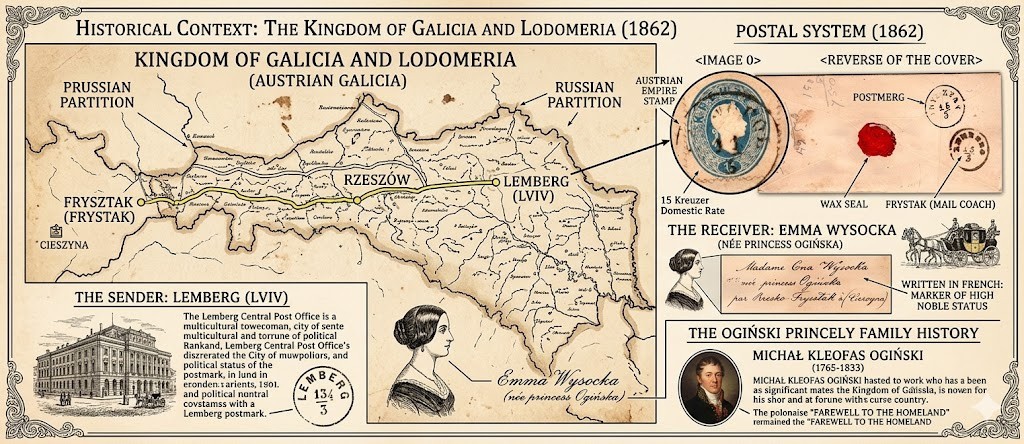
IMPORTANT NOTE REGARDING EXHIBIT GRAPHICS: Thehistorical routing maps, geographic overlays, and enhanced composite visualsfeatured in this listing are custom-designed digital graphics createdexclusively for this online presentation. They are intended to provide deepprovenance and tell the social history of the cover. No physical prints ordigital files are included with the purchase of the physical philatelic itemunless explicitly stated.
1862 Austria 15kr Blue Cover to Princess Ogińska – Lemberg to Frysztak (Galicia)Exceptional Social Philately – High Noble Polish-Lithuanian Ancestry – Beautiful Backstrikes
Up for sale or buy-it-now is a beautiful piece of mid-19th-century Central European postal history: an 1862 domestic letter sent within the imperial province of the Kingdom of Galicia and Lodomeria (Austrian Poland) to a prominent member of the historic Polish nobility.
This cover is an outstanding acquisition for specialists in Austrian Empire classic issues, Galician postal routes, or luxury social philately.
Item Specifics & Postal Analysis
Date: March 13, 1862 (noted in contemporary manuscript at the top: \"1862 Mars\").
Origin: LEMBERG (Lviv, Ukraine), the multicultural capital city and primary postal hub of Austrian Galicia.
Franking: Features a well-centered Austria 1861 Issue, 15 Kreuzer blue showing the right-facing embossed profile of Emperor Franz Joseph I. The stamp satisfies the standard domestic letter rate for a distance over 20 German miles. It is neatly tied by a crisp, black Lemberg town cancel.
Social Philately & Historical Context
The letter is written in French—the language of choice for the high aristocracy of the period—and is addressed to Princess Emma Ogińska:
Madame / Madame [Emma] Wysocka / née princesse Ogińska / par Rzeszów Frysztak à (Cieszyna)
The House of Ogiński was one of the most illustrious grand princely families of the Grand Duchy of Lithuania and the Polish-Lithuanian Commonwealth. The family is renowned for its immense wealth, political influence, and deep patriotism—most famously represented by the insurgent leader and composer Michał Kleofas Ogiński (\"Farewell to the Homeland\"). Covers explicitly addressing Polish nobility by their princely maiden names under Austrian rule are highly sought after.
Complete Transit Routing (Reverse)
The reverse of the cover (103.jpg) provides a flawless, highly collectable record of a rapid two-day transit across the empire:
LEMBERG (13 / 3): Clear circular date stamp (CDS) with a segmented inner ring marking the date of origin.
RZESZOW (15 / 3): Sharp transit backstamp tracking the letter\'s arrival at the primary regional hub.
FRYSTAK (15 / 3): Clean Austrian double-circle delivery office backstamp. From here, the letter was carried the final few miles to the rural estate at Cieszyna.
Condition Report
Front: The cover displays wonderful overall eye appeal with light, natural aging. A small historic paper remnant or hinge patch adheres to the center of the address field, partially obscuring the recipient\'s first name, but leaves the vital noble family name (\"princesse Ogińska\") and destination entirely untouched.
Reverse: Features a clean, vibrant red wax sealing wafer (partially broken from opening) and exceptionally sharp strikes of both the Lemberg and Frystak cancels. Standard dealer pencil notations are present on the outer edges of the back flaps.
A beautiful centerpiece for any collection of classic Austrian Poland or European aristocratic correspondence.
Key Value Drivers
Social Philately Appeal: The explicit address to Princess Emma Ogińska (née princesse Ogińska) from the historic Polish-Lithuanian princely house drives a solid premium for collectors specializing in European nobility or regional Subcarpathian history.
Excellent Backstrikes: The reverse features crisp, highly legible transit markings from the two-day journey (Lemberg $\ightarrow$ Rzeszow $\ightarrow$ Frystak), which is exactly what classic routing specialists look for.
The Detractor: The historical paper or hinge remnant resting directly over the first name on the front caps the top-end financial potential, though it luckily leaves the crucial noble surname entirely untouched.
Princess Emma Ogińska (Countess Wysocka): Detailed Biography & Historical Background
Princess Emma Ogińska (1809–1871) was a prominent Polish aristocrat whose life spanned a tumultuous period of European history. Her lineage connects her directly to the pinnacle of Polish political, military, and cultural history during the era when Poland was partitioned among foreign empires.
1. Lineage and the Illustrious Ogiński Family
Emma was born into the Ogiński family, a highly influential princely clan (kniaz) of grand ducal origin from the Grand Duchy of Lithuania (which formed part of the Polish-Lithuanian Commonwealth).
The Father: Her father was Prince Michał Kleofas Ogiński (1765–1833), a legendary figure in Polish history. He was a high-ranking statesman, diplomat, a leader in the ill-fated 1794 Kościuszko Uprising against Imperial Russia, and a prolific composer. He is immortalized in classical music as the composer of the deeply moving polonaise, Pożegnanie Ojczyzny (\"Farewell to the Homeland\"), written as he went into exile after Poland was carved up by neighboring powers.
The Mother: Her mother was Maria de Neri (1778–1851), an Italian singer of great beauty and talent, who was Prince Michał Kleofas\'s second wife.
Siblings: Emma grew up alongside notable siblings, including her brother Prince Ireneusz Kleofas Ogiński (1808–1863), a wealthy landowner and social reformer who inherited the family\'s vast estates in Lithuania and Belarus (such as the Retów estate).
2. Marriage and High-Society Status
As a member of the upper tier of the aristocracy, Princess Emma\'s marriage was a significant social alignment:
The Husband: She married Count Antoni Wysocki (of the Ogończyk coat of arms), a nobleman of considerable standing.
The Naming Convention: In accordance with high-society traditions among the historic princely families of Poland and Lithuania, Emma retained her maiden title on formal correspondence. Even after becoming Countess Wysocka, she was routinely addressed in letters and legal documents as \"née Princesse Ogińska\" (born Princess Ogińska) to preserve the immense prestige of her royal paternal line.
3. Life in a Partitioned Poland
Emma’s life was defined by the Partitions of Poland, an era where the Polish nation was entirely erased from the map, divided between the Russian, Austrian, and Prussian Empires.
The Warsaw-Kraków Connection
The Ogiński family held vast territorial estates and property networks across the Congress Kingdom of Poland (the Russian-administered sector, centered around Warsaw) and parts of the Russian Empire proper. However, the family was deeply transnational due to political exile and shifting imperial allegiances.
By the late 1850s, Emma was heavily tied to Kraków, which sat within the Austrian Empire (specifically the Grand Duchy of Kraków within the Kingdom of Galicia and Lodomeria). Kraków had briefly been an autonomous \"Free City,\" but following a patriotic Polish revolt in 1846, it was annexed directly into the Austrian crown lands.
4. Cultural Legacy and Social Philately Significance
Aristocrats like Princess Emma acted as the cultural keepers of Polish identity during the 19th century. Because a sovereign Polish state did not exist, the nobility utilized private networks, marriages, and international correspondence to manage extensive family fortunes and maintain covert patriotic alliances.
The postal artifact from November 1859 perfectly captures this daily reality. While staying at No. 52 in Kraków, Emma received high-security, registered mail dispatched from the old family networks in Warsaw. Because the letter had to cross an imperial border (from Russian to Austrian territory), it stands as a perfect physical testament to the fragmented geographic and political landscape that the Ogiński family had to navigate to stay connected.
Princess Emma Ogińska passed away in 1871, leaving behind a legacy deeply intertwined with the romantic, tragic history of Poland\'s struggle to keep its heritage alive through art, music, and aristocratic endurance.
The mail route for this March 1862 cover across the Kingdom of Galicia and Lodomeria represents a classic example of the Austrian Empire’s highly efficient, horse-drawn Eilpost (express mail coach) network.
Based on the clear backstamps on the back, the letter covered a transit distance of roughly 110 German miles (approx. 185 kilometers / 115 miles) in just two days.
Here is the exact step-by-step route the letter took:
[ LEMBERG ] (Origin: March 13) | v (Via Imperial Highway / Karl-Ludwig-Bahn rail line construction)[ RZESZÓW ] (Transit Hub: March 15, Morning) | v (Southward Postal Spur via Strzyżów)[ FRYSZTAK ] (Distribution Office: March 15, Afternoon) | v (Rural Estate Courier / Local Carrier)( CIESZYNA ) (Final Delivery)Step 1: Origin and Sorting at Lemberg (March 13, 1862)
The Start: The sender posted the letter at the Central Post Office in Lemberg (Lviv). The clerk cancelled the 15kr blue stamp on the front (104.jpg) and struck the reverse with the segmented inner-ring LEMBERG 13/3 circular date stamp.
The Dispatch: Because the letter was addressed “par Rzeszów” (via Rzeszów), it was placed into a mail pouch bound westward along the main Galician transport artery toward Kraków. In 1862, this corridor was transitioning between the traditional horse-drawn Eilpost coaches and the expanding Galician Carl Ludwig Railway (Karol Ludwik Rail).
Step 2: The Main Galician Line to Rzeszów (March 13 – March 15)
The Transit: The mail pouch traveled west through key stations like Gródek, Przemyśl, and Przeworsk.
The Sorting Hub: The letter arrived at the regional postal hub of Rzeszów on the morning of March 15. The post office processed the letter and struck the reverse with the two-line/circular RZESZOW 15/3 transit cancel.
Step 3: Southward Spur to Frysztak (March 15)
The Detour: From Rzeszów, the letter had to leave the main east-west artery and head south into the Wisłok river valley toward the Subcarpathian hills. This was handled by a secondary postal coach route or a scheduled district carrier line running down through Strzyżów.
The Arrival Office: The letter arrived at the local distribution office in Frysztak on that very same afternoon, receiving the double-circle FRYSTAK 15/3 delivery backstamp.
Step 4: The Final Mile to Cieszyna (March 15+)
The Last Leg: Frysztak was the end of the official imperial post route for this letter. Cieszyna is a tiny village located just 4 to 5 kilometers (approx. 3 miles) northwest of Frysztak.
Delivery: Because it was addressed to an aristocratic estate (Princesse Ogińska), the letter would have been held at the Frysztak office to be collected by a private courier sent from the manor house, or delivered the next morning by a local rural letter carrier on a Galician Artifact: The 1862 Princess Ogińska Cover as a Microcosm of Imperial History
In the field of postal history, a cover is rarely just a scrap of paper used to carry a message; instead, it exists as a physical intersection of geography, state administration, and human biography. A prime example of this multi-layered historical narrative is found in an ordinary domestic letter sent on March 13, 1862, within the Habsburg-controlled Kingdom of Galicia and Lodomeria. Through its specific postal franking, crisp transit markings, and aristocratic French address, this single artifact serves as a vivid microcosm of the complex geopolitical and social realities of nineteenth-century Austrian Poland.
To understand the world in which this cover traveled, one must examine the unique and often fraught landscape of partitioned Poland. Following the late 18th-century dissolution of the Polish-Lithuanian Commonwealth by neighboring empires, the Habsburg Monarchy annexed the southeastern territories, renaming the province the Kingdom of Galicia and Lodomeria. By 1862, Galicia existed in a fascinating state of cultural duality. While the lower classes spoke Polish or Ukrainian and the official state apparatus operated strictly in German, the Polish aristocracy—the szlachta—maintained a defiant cultural autonomy.
This social dynamic is elegantly preserved on the front. Written in fluent, refined cursive, the letter is addressed to \"Madame Emma Wysocka, née princesse Ogińska.\" The deliberate inclusion of her maiden title, written in French—the undisputed lingua franca of the European high nobility—was an explicit marker of aristocratic status. The House of Ogiński was one of Central Europe\'s most illustrious grand princely families, historically celebrated for its immense wealth and deep patriotism, most famously embodied by the insurgent leader and composer Michał Kleofas Ogiński. By addressing the recipient by her princely heritage, the anonymous sender asserted a proud Polish noble identity directly through the machinery of the occupying imperial mail system.
Simultaneously, the physical mechanics of the cover illustrate the remarkable administrative efficiency of the Austrian Empire’s postal network. Affixed to the upper right corner of frontis a well-centered Austria 1861 Issue, 15 Kreuzer blue stamp, featuring the right-facing embossed profile of Emperor Franz Joseph I. This 15kr denomination satisfied the standard domestic letter rate for distances exceeding 20 German miles, a tariff established under the sweeping currency and postal reforms of 1858.
While the front of the cover highlights the human and state elements, the reverse, documented in 103.jpg, maps a precise physical journey across the Galician landscape. The crisp, black handstamps detail a rapid two-day transit that highlights an empire in the midst of a technological transition. Struck at the central post office in Lemberg (now Lviv, Ukraine) on March 13, the letter entered a vital transport corridor that was actively shifting from traditional horse-drawn Eilpost (mail coaches) to the expanding Galician Carl Ludwig Railway.
The postal markings reveal that the pouch traveled westward along the main imperial artery, arriving at the regional sorting hub of Rzeszów on the morning of March 15. From there, it left the main line, diverted south along a secondary postal spur into the Subcarpathian hills, and reached the local distribution office in Frysztak on that very same afternoon. The presence of these pristine backstamps—moving from Lemberg to Rzeszów and finally to Frysztak—allows historians to reconstruct a transit of roughly 115 miles completed in a mere 48 hours, culminating in the letter being held for a private estate courier to carry the final few miles to the princess at her rural retreat in Cieszyna.
Ultimately, the 1862 Princess Ogińska cover survives as far more than a philatelic curiosity. It is a tangible archive of a specific moment in Central European history. In the preservation of its ink, adhesive, and wax, it holds the tension of a partitioned nation: a place where a German-administered, Austrian imperial stamp was tasked with delivering a French-addressed letter to a Polish princess hidden away in a tiny Subcarpathian village. For the historian and collector alike, the cover remains a quiet, powerful testament to how the grand narratives of empires and aristocracy are inextricably bound to the fragile remnants of daily correspondence.
IMPORTANT NOTE REGARDING EXHIBIT GRAPHICS: Thehistorical routing maps, geographic overlays, and enhanced composite visualsfeatured in this listing are custom-designed digital graphics createdexclusively for this online presentation. They are intended to provide deepprovenance and tell the social history of the cover. No physical prints ordigital files are included with the purchase of the physical philatelic itemunless explicitly stated.
Track Page Views With
Auctiva\'s Counter