When you click on links to various merchants on this site and make a purchase, this can result in this site earning a commission. Affiliate programs and affiliations include, but are not limited to, the eBay Partner Network.
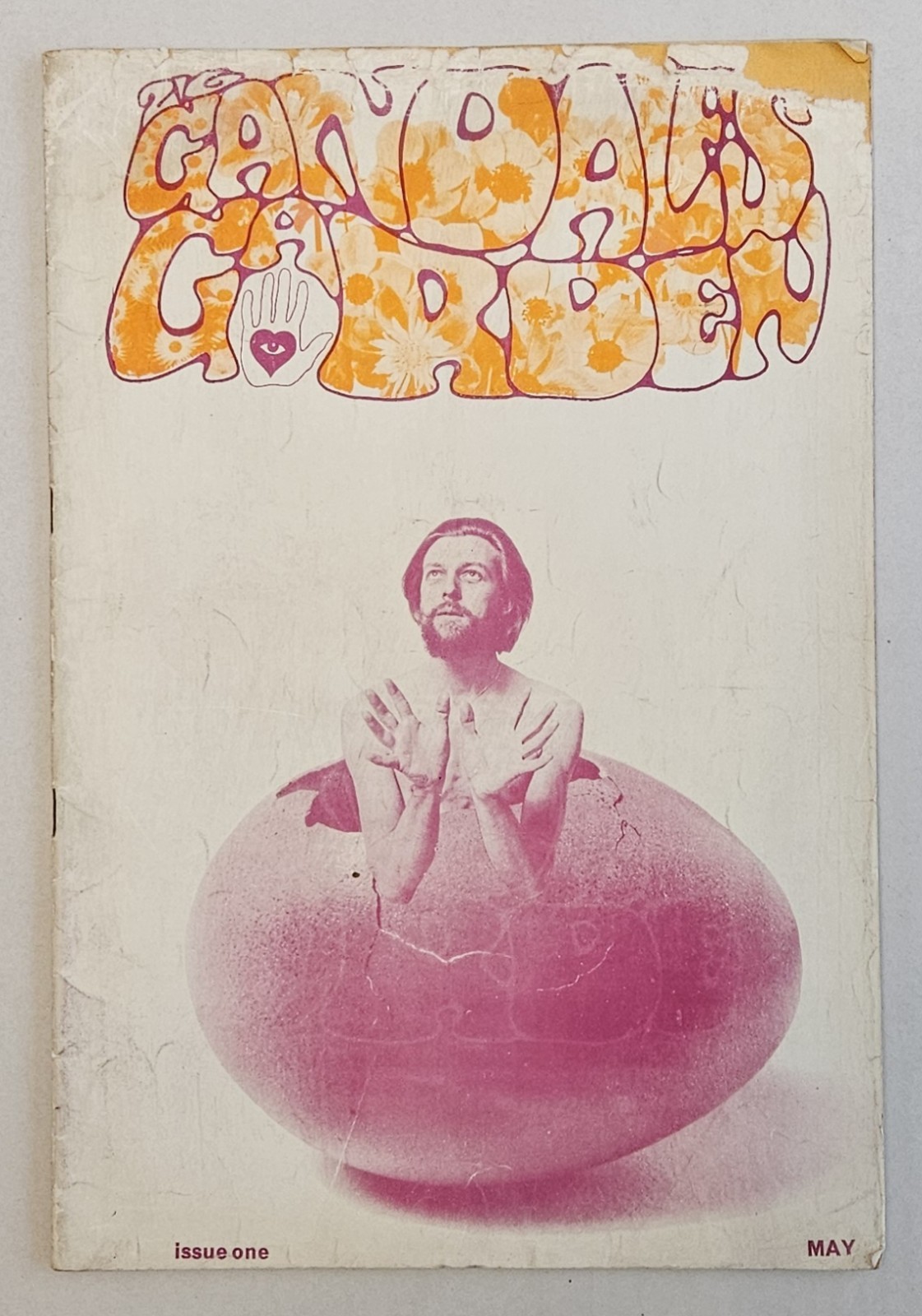
The complete six-issue run of Gandalf’s Garden, one of the more elusive and extraordinary publications to emerge from London’s late-1960s underground. Published irregularly between 1968 and 1969 and edited by Muz Murray, these six issues constitute the magazine’s entire original run.
Gandalf’s Garden was not simply a magazine. It was the printed voice of an actual countercultural community centered around a shop at World’s End in Chelsea, where art, music, meditation, mysticism, tea, communal life, and experiments in alternative ways of living existed under one roof.
The magazine is consequently difficult to categorize, which is much of its charm. Psychedelic illustration and experimental typography spill across changing colored papers and inks, while the contents move freely among music, poetry, Eastern religion, yoga, environmental consciousness, communes, psychedelic experience, mythology, Glastonbury, Atlantis, antiwar thought, mysticism, and the occult.
The inaugural May 1968 issue alone includes a stream-of-consciousness contribution by BBC broadcaster John Peel, an interview with Indian spiritual leader Vinoba Bhave, material on yoga, Swedenborg, Vietnam and Agent Orange, and an interview with Marc Bolan discussing the name of his then-band Tyrannosaurus Rex. Across the complete run appear or are represented figures including Spike Milligan, Robert Wyatt, Herbert Read, Third Ear Band, Quintessence, Donovan, and Timothy Leary.
The circumstances of its production were equally characteristic of the underground press. Gandalf’s Garden operated on such limited resources that a benefit concert was held at London’s legendary Middle Earth club on May 19, 1968 to help finance publication of Issue 2. Third Ear Band, Marc Bolan, and David Bowie were among the performers.
Even the choice of Gandalf as the magazine’s presiding figure was more than decorative Tolkien borrowing. To the Garden, Gandalf represented the possibility of bringing very different people together against destructive forces, an apt emblem for a publication attempting to connect spiritual inquiry, artistic experimentation, environmental consciousness, music, and social change.
The venture was gloriously precarious. Early issues envisioned a monthly publication. Later numbers acknowledged the reality of underground publishing by promising to appear “as often as possible” and, eventually, “when the weather is right.” After six numbers, Gandalf’s Garden disappeared.
Issue No. 1 in this set is the documented purple-title variant of the inaugural issue.
More than half a century later, the complete run remains a remarkably concentrated artifact of a moment when psychedelia, environmentalism, alternative spirituality, experimental art, antiwar thought, communal living, and underground publishing had not yet settled into separate cultural categories.
Complete original runs are difficult to come by. Here, all six issues remain together, preserving the entire short life of one of the British underground’s most distinctive experiments in print.
Details
Title: Gandalf’s Garden
Editor: Muz Murray
Place: London
Publisher: Citadelle Press / Gandalf’s Garden / Overground Free Press
Date: 1968-1969
Edition/Issue: Issues 1-6, complete run; all published. Issue 1 is the purple-title variant.
Format/Binding: Six original illustrated stapled magazines, comprising the complete run. Extensively illustrated and printed in varied colored inks on changing paper stocks. The six issues are housed back-to-back in three archival polyethylene sleeves with black acid-free backing boards.
Pagination: Issue 1, 31 pages; Issue 2, 30 pages; Issue 3, 34 pages; Issue 4, 34 pages; Issue 5, 34 pages; Issue 6, 32 pages.
Dimensions: Approximately 11 3/4 × 8 1/4 inches; Issue 1 slightly larger.
Condition
Complete six-issue run in very good to good vintage condition, with varying degrees of handling and wear consistent with an ephemeral underground publication of this period. Covers show rubbing, creasing, edge wear, scattered spotting and soiling, with small edge losses and other wear visible in the photographs. Issue 5 exhibits more pronounced cover wear, including creasing and loss at the upper corner.
Interiors remain colorful and visually strong, retaining the varied papers, inks, illustrations, and experimental layouts that are such an important part of the publication’s character.
The complete run is housed back-to-back in three archival polyethylene sleeves with black acid-free backing boards and will be sold and shipped in this protective arrangement.
Please review all photographs carefully, as they form an important part of the condition description.
Topic
British underground press; 1960s counterculture; psychedelic art; London underground; Chelsea; hippie movement; alternative spirituality; mysticism; environmental movement; communal living; Tolkien influence; John Peel; Marc Bolan; Tyrannosaurus Rex; David Bowie; Third Ear Band; Quintessence; Timothy Leary; Donovan; experimental publishing
Shipping
Free insured shipping with signature confirmation.