When you click on links to various merchants on this site and make a purchase, this can result in this site earning a commission. Affiliate programs and affiliations include, but are not limited to, the eBay Partner Network.
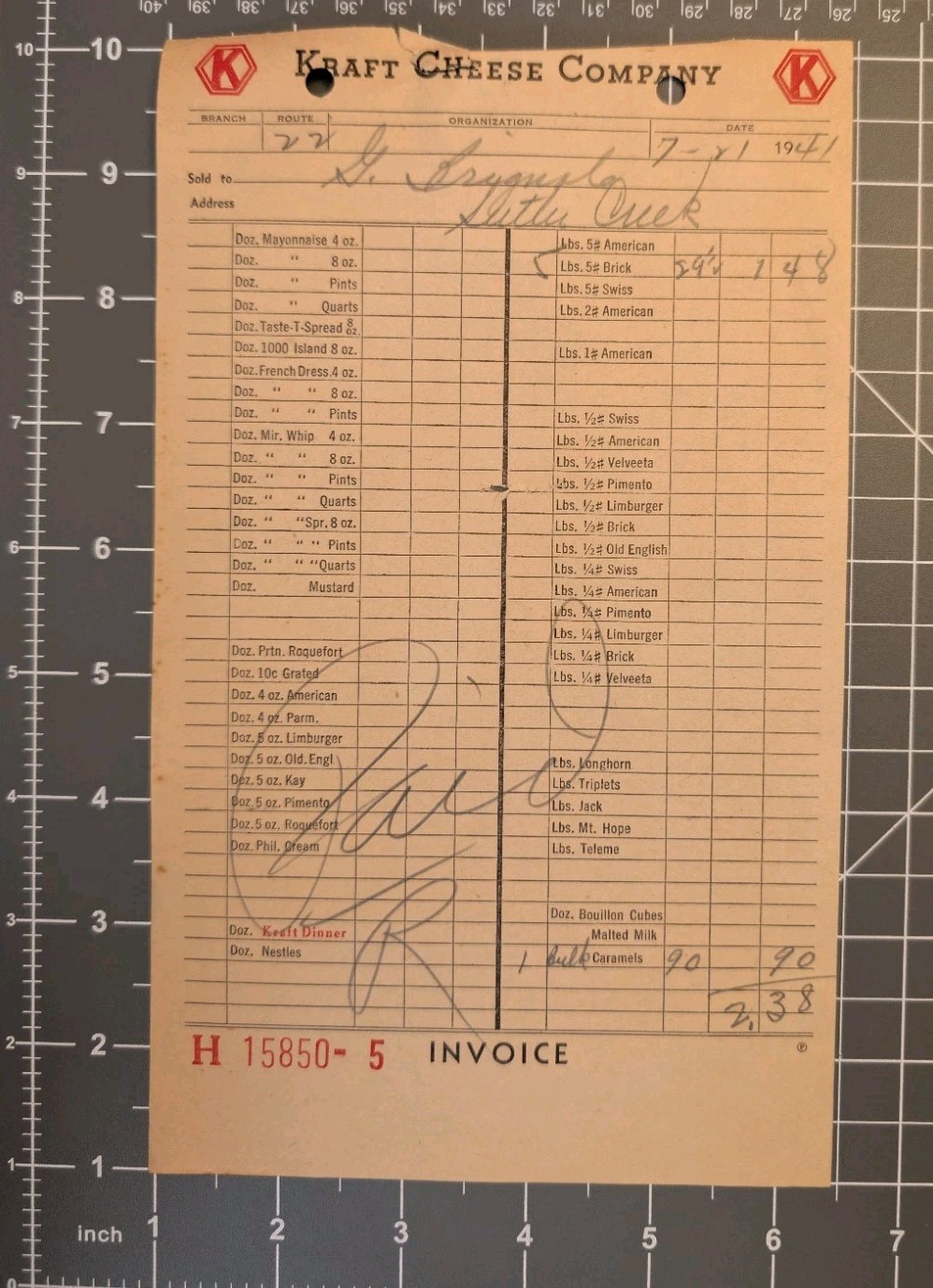
1941 vintage wholesale cheese and dairy invoice issued by Kraft Cheese Company, pre-printed form H 15850-5. Dated July 21, 1941, made out to S. Brignoli in Sutter Creek. Features pre-printed product listings for Kraft mayonnaise, salad dressings, Miracle Whip, grated cheese, various packaged cheeses, and bulk items, with handwritten entries for 5-pound Brick cheese and bulk caramels, calculations totaling $2.38, and a large diagonal \"Paid\" stamp signature. An exceptional piece of mid-20th-century Amador County grocery and dairy ephemera.
Kraft Cheese Company Invoice No. H 15850-5
Route 22, Date: 7-21 1941
Sold to: S. Brignoli, Sutter Creek
Lbs. 5# Brick Cheese | 25 lbs @ 5 1/2 [?] | 1.48
1 Bulk Caramels | .90 | .90
Total: 2.38
[Large handwritten \"Paid\" signature across the form]
Bartolomeo Brignoli (often recorded as Bartolomeo Brignole) was a prominent Italian-American pioneer merchant who helped shape the early commercial landscape of Sutter Creek during the California Gold Rush. and BackgroundOrigins: He was born on June 26, 1826, in Chiavari, Genoa, Liguria, Italy. Like many young men of his generation, he emigrated from Italy to California in the 1850s to seek his fortune following the 1849 Gold Rush. Family Life: He married Josefina Capello. Together, they raised a large family in Amador County, consisting of at least five sons and three daughters, including a daughter named Mary Charlotte. He spent his final days in San Francisco, passing away on February 15, 1897, at the age of 70. He was brought back to Amador County and buried at the Sutter Creek Catholic Cemetery. and Contributions to Sutter CreekThe Molinari Partnership: By the early 1860s, Bartolomeo bought out the store and property of his fellow countryman, Bartolomeo Molinari, who had originally built a small structure on Main Street around 1858?1859. an Empire: Brignoli subsequently acquired the lot next door and expanded the structure dramatically into what is known today as the historic Brignoli Building (now home to the Fine Eye Gallery). He utilized native greenstone limestone and heavy fireproof iron shutters?a hallmark of resilient Gold Rush architecture. Community Staple: He established a thriving grocery and dry goods enterprise inside the building. His store served as a vital community hub for miners, ranchers, and local families. The business was so deeply rooted that his descendants continued to operate it for nearly a century, finally closing its doors in 1944.