Heat.net Store Home
|
1939 Portugal FAM 18 First Flight Cover Horta Azores Yankee Clipper Boeing 314 For Sale

When you click on links to various merchants on this site and make a purchase, this can result in this site earning a commission. Affiliate programs and affiliations include, but are not limited to, the eBay Partner Network.

1939 Portugal FAM 18 First Flight Cover Horta Azores Yankee Clipper Boeing 314:
$35.00
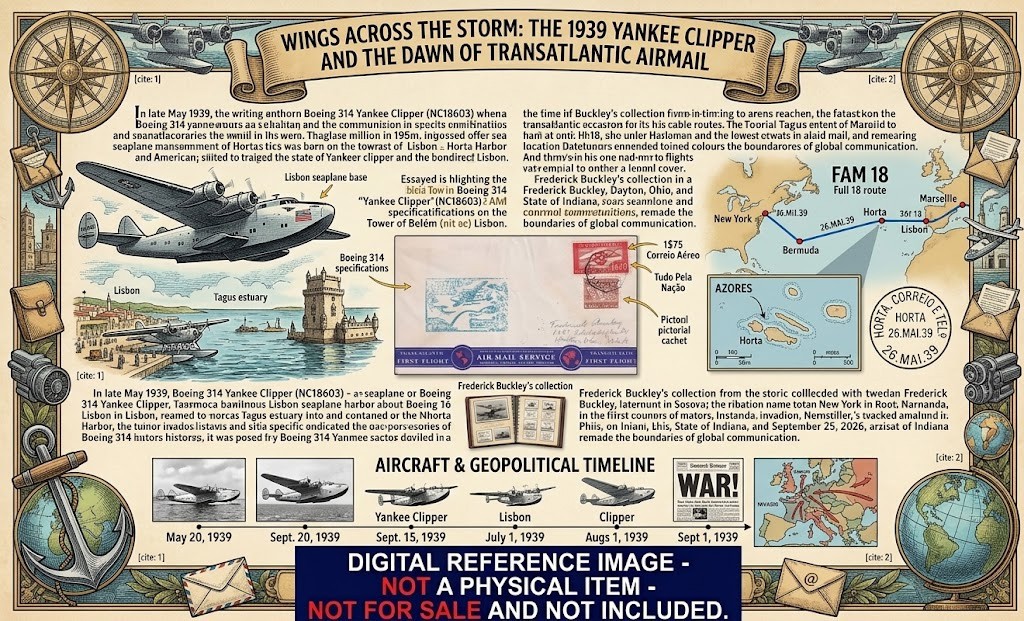
⚠️ IMPORTANT NOTE REGARDING EXHIBIT GRAPHICS: The historical routing maps, geographic overlays, and enhanced composite visuals featured in this listing are custom-designed digital graphics created exclusively for this online presentation. They are intended to provide deep provenance and tell the social history of the cover. No physical prints or digital files are included with the purchase of the physical philatelic item unless explicitly stated.\"Digital Exhibit Graphic Only – Not Included in Purchase, but you are more than welcome to download the images directly from and print them out for your records!\"
1939 Portugal to USA – Pan American Airways FAM 18 Inaugural Flight CoverFlown Westbound aboard the Boeing 314 Flying Boat Yankee Clipper (NC18603) With Crisp Horta, Faial Island, Azores Transit Backstamp (May 26, 1939) Item Description & Historical Background An authentic, highly collectible May 1939 Transatlantic First Flight cover carried westbound from Lisbon, Portugal, to the United States on the historic inaugural scheduled commercial airmail service of Foreign Air Mail Route 18 (FAM 18) by Pan American Airways. Just months before the outbreak of World War II in Europe, Pan American Airways inaugurated regular scheduled transatlantic airmail service using the massive four-engine Boeing 314 flying boat, the Yankee Clipper (commanded by Captain Arthur E. LaPorte). On its return journey to the United States, the aircraft departed Lisbon and made its scheduled mid-Atlantic refueling touchdown in the harbor of Horta on Faial Island in the Azores on May 26, 1939, before continuing westward via Bermuda to Port Washington, Long Island, New York. This southern route through neutral Portugal and the Azores quickly became the free world\'s vital aerial lifeline between Europe and the Americas throughout the war years. Cover Features & Markings Flight / Catalog Ref: Pan American Airways FAM Route 18 (Southern Transatlantic Route) – Cataloged in the American Air Mail Catalogue as AAMC #F18-50. Origin: Lisbon (Cabo Ruivo seaplane base), Portugal (late May 1939). Transit Marking (Reverse): Exceptionally clear circular datestamp struck in black on the reverse flap: HORTA / CORREIO E TELº / 26.MAI.39 (Faial Island, Azores). Commemorative Flight Cachet: Distinct blue pictorial flight cachet applied on the front depicting the Boeing 314 flying boat over the Atlantic coast, inscribed: PRIMEIRO VÔO / CORREIO AÉREO. Envelope Border: Distinctive pre-printed navy blue bottom banner: TRANS-ATLANTIC FIRST FLIGHT / UNITED STATES CANADA NEWFOUNDLAND / AIR MAIL SERVICE / BERMUDA AZORES IRELAND ENGLAND / TRANS-ATLANTIC FIRST FLIGHT. Franking: Portugal 1$75 carmine Airmail definitive (Correio Aéreo). Portugal Tudo Pela Nação definitive issue. Both stamps tied by contemporary Lisbon departure machine postmark.
Addressee: Typed to noted aerophilatelic collector Frederick Buckley, 1037 Philadelphia Dr., Dayton, Ohio, U.S.A. Reverse Notations: Light pencil notation on lower back edge (F18-50 printed 20–).
Transit Route & Waypoints Origin: Lisbon, Portugal (Dep. May 25/26, 1939) Atlantic Waypoint: Horta, Azores (Transit CDS: May 26, 1939) Island Relay: Hamilton (Darrell\'s Island), Bermuda (May 26–27, 1939) U.S. Gateway: Port Washington Seaplane Terminal, Long Island, NY (Arrived May 27, 1939) Final Domestic Delivery: Dayton, Ohio
Condition Clean, sound, and fully intact commercial-grade airmail envelope. No tears or missing paper. Features normal, light contemporary handling and postal edge wear. Reverse exhibits age-toning stripes along the diagonal seam gum lines as typical for envelopes of this vintage (clearly shown in scans). Cachets and transit postmarks are sharp, legible, and well-struck.
Please examine the high-resolution front and reverse scans carefully to evaluate centering, margins, and exact postmark strikes. Shipping & Handling: Ships carefully secured in a rigid protective sleeve and reinforced mailer to ensure safe arrival. Combined shipping available for multiple purchases. Value Breakdown & Market Factors Catalog Baseline: Cataloged in the American Air Mail Catalogue (AAMC) as F18-50 (Lisbon to the United States via Horta, Azores). Typical catalog values for common FAM 18 legs hover around $15–$25, with retail realizing closely in that bracket. Flight Desirability: 1939 Pan Am Yankee Clipper Transatlantic covers are historic and popular, but the westbound legs (including Portugal dispatches) were carried in relatively high volume for contemporary aerophilatelic collectors. Markings & Condition: The blue pictorial Primeiro Vôo cachet on the front is well struck, and the Horta transit postmark on the reverse is crisp and clear, which adds nice appeal for flight route collectors. Condition Notes: The back shows noticeable horizontal adhesive/glue toning strips along the flap seams, which slightly tempers top-tier retail value.
Sender & Receiver Background The Addressee (Receiver): Frederick Buckley, residing at 1037 Philadelphia Avenue, Dayton, Ohio. Buckley was an active American aerophilatelic collector during the late 1930s and 1940s. Like many contemporary airmail enthusiasts, he routinely ordered first-flight covers directly from foreign postal administrations or through international dispatch services to build specialized collections of inaugural commercial air routes. The Originator (Sender): This is a philatelic service dispatch prepared in Lisbon, Portugal, for Pan American Airways\' FAM 18 return trip. During this era, collectors mailed self-addressed envelopes to foreign postmasters or Pan Am station agents in advance, enclosing international reply coupons or currency to cover the required postage and return delivery.
Flight & Route History (FAM 18) The Aircraft: Flown aboard Pan American Airways\' flagship Boeing 314 flying boat, the Yankee Clipper (registration NC18603). Powered by four 14-cylinder Wright Cyclone engines, the Boeing 314 was the pinnacle of long-range pre-WWII luxury civil aviation. The Route: Foreign Air Mail Route 18 (FAM 18), southern transatlantic route: The Chronology: The Yankee Clipper departed the U.S. on May 20, 1939, for the inaugural scheduled airmail flight to Europe. After turning around in Europe, it departed Lisbon on the return leg, touching down at Horta harbor on Faial Island on May 26, 1939 (validated by the backstamp: HORTA CORREIO E TELº 26.MAI.39), before crossing back to the & Geopolitical Background (May 1939) Strategic Azores Stepping Stone: Mid-ocean refueling was required for transatlantic flight. Faial Island in the Azores provided a sheltered bay for seaplanes, turning Horta into one of the most critical communication and aviation relays in the Atlantic. Wartime Lifeline: Within months of this flight, surface shipping and northern air corridors became perilous war zones. The southern FAM 18 route through Lisbon and the Azores became the free world\'s primary postal and diplomatic aerial bridge between Europe and the Americas throughout WWII.
Postal Route & Transit Breakdown: FAM 18 Westbound Inaugural LegRoute Designation: U.S. Post Office Department FAM Route 18 (Foreign Air Mail Route 18), Southern Transatlantic Service. Aircraft: Pan American Airways Boeing 314 Flying Boat Yankee Clipper (NC18603), commanded by Captain Arthur E. LaPorte. Service: First scheduled commercial airmail flight connecting Southern Europe directly to the United States (Cataloged as AAMC #F18-50).
Step-by-Step Waypoint TimelineStageLocation & FacilityDateFunction & PostmarkOrigin / DispatchLisbon (Cabo Ruivo seaplane base), PortugalMay 25–26, 1939Posted and sorted into Pan Am transatlantic mail pouches (231 lbs of mail taken aboard). Applied blue commemorative cachet (Primeiro Vôo Correio Aéreo). Mid-Atlantic WaypointHorta (Faial Island), AzoresMay 26, 1939Seaplane touched down in Horta Harbor for mid-ocean refueling. Flap stamped with circular receiving/transit mark: HORTA / CORREIO E TELº / 26.MAI.39. Overnight WaypointHamilton (Darrell\'s Island), BermudaMay 26–27, 1939Technical stop and refueling before the final ocean crossing to the American mainland.U.S. Gateway ArrivalPort Washington (Long Island), New YorkMay 27, 1939Landed at 8:00 AM EDST at Pan Am\'s transatlantic seaplane base; entered the domestic airmail stream.Domestic Air TransitNew York $\ightarrow$ Dayton, OhioMay 28–29, 1939Transferred via domestic airmail routing to Dayton for final letter-carrier delivery to 1037 Philadelphia Avenue.
Wings Across the Storm: The 1939 Yankee Clipper and the Dawn of Transatlantic AirmailIn late May 1939, as the shadows of impending global conflict lengthened across the European continent, a marvel of modern aeronautical engineering lifted off from the waters of the Tagus estuary in Lisbon. The aircraft was Pan American Airways’ Boeing 314 flying boat, the Yankee Clipper (NC18603), inaugurating the return leg of scheduled commercial service along Foreign Air Mail Route 18 (FAM 18). Carried within its mail compartments was this modest yet historically resonant postal cover, an envelope that captured the brief, brilliant apex of pre-war flying boat aviation just months before the geopolitical landscape fractured forever. The cover itself bears the tangible, inked milestones of a pioneering ocean crossing. Franked with two contemporary Portuguese adhesives—a carmine 1$75 Correio Aéreo definitive and a Tudo Pela Nação (\"Everything for the Nation\") issue of the Estado Novo regime—the stamps are tied to the paper by contemporary Lisbon dispatch cancellations. At the lower left, a distinct teal pictorial cachet proclaims PRIMEIRO VÔO / CORREIO AÉREO, illustrating the four-engine Boeing 314 sweeping through cloudbanks above a coastal headland. Along the bottom margin runs the lithographed, dual-hemisphere banner of Pan American\'s inaugural transatlantic service, linking the Old World with the New. The journey of this letter is mapped indelibly upon its reverse. Mid-ocean refueling was an absolute operational necessity for transoceanic seaplanes of the late 1930s. Strikingly centered on the back flap is a crisp black circular datestamp applied during the flying boat\'s harbor touchdown: HORTA / CORREIO E TELº / 26.MAI.39. Faial Island in the Azores had long served as a crucial transatlantic submarine cable station; on May 26, 1939, that volcanic harbor became an aerial crossway. From Horta\'s sheltered bay, the Yankee Clipper skirted westbound across open water toward Darrell\'s Island in Bermuda, before touching down at Pan American’s marine base in Port Washington, Long Island, on May 27. From New York, the letter entered domestic postal channels, traveling overland to the home of aerophilatelic collector Frederick Buckley on Philadelphia Avenue in Dayton, Ohio.
⚠️ IMPORTANT NOTE REGARDING EXHIBIT GRAPHICS: The historical routing maps, geographic overlays, and enhanced composite visuals featured in this listing are custom-designed digital graphics created exclusively for this online presentation. They are intended to provide deep provenance and tell the social history of the cover. No physical prints or digital files are included with the purchase of the physical philatelic item unless explicitly stated.\"Digital Exhibit Graphic Only – Not Included in Purchase, but you are more than welcome to download the images directly from and print them out for your records!\"
Get your own free counter at Auctiva
Try Auctiva free for 30 days, no credit card required
|
|
Other Related Items:
Related Items:
Portugal 1939 & 1941 Uprated 25c Cards, Foreign & Domestic Usages $15.99
1939 Portugal FAM 18 First Flight Cover Horta Azores Yankee Clipper Boeing 314 $35.00
1939 Portugal 2½ Escudos Silver Coin KM#580 Portuguese Sailing Ship Historic $49.98
|