When you click on links to various merchants on this site and make a purchase, this can result in this site earning a commission. Affiliate programs and affiliations include, but are not limited to, the eBay Partner Network.
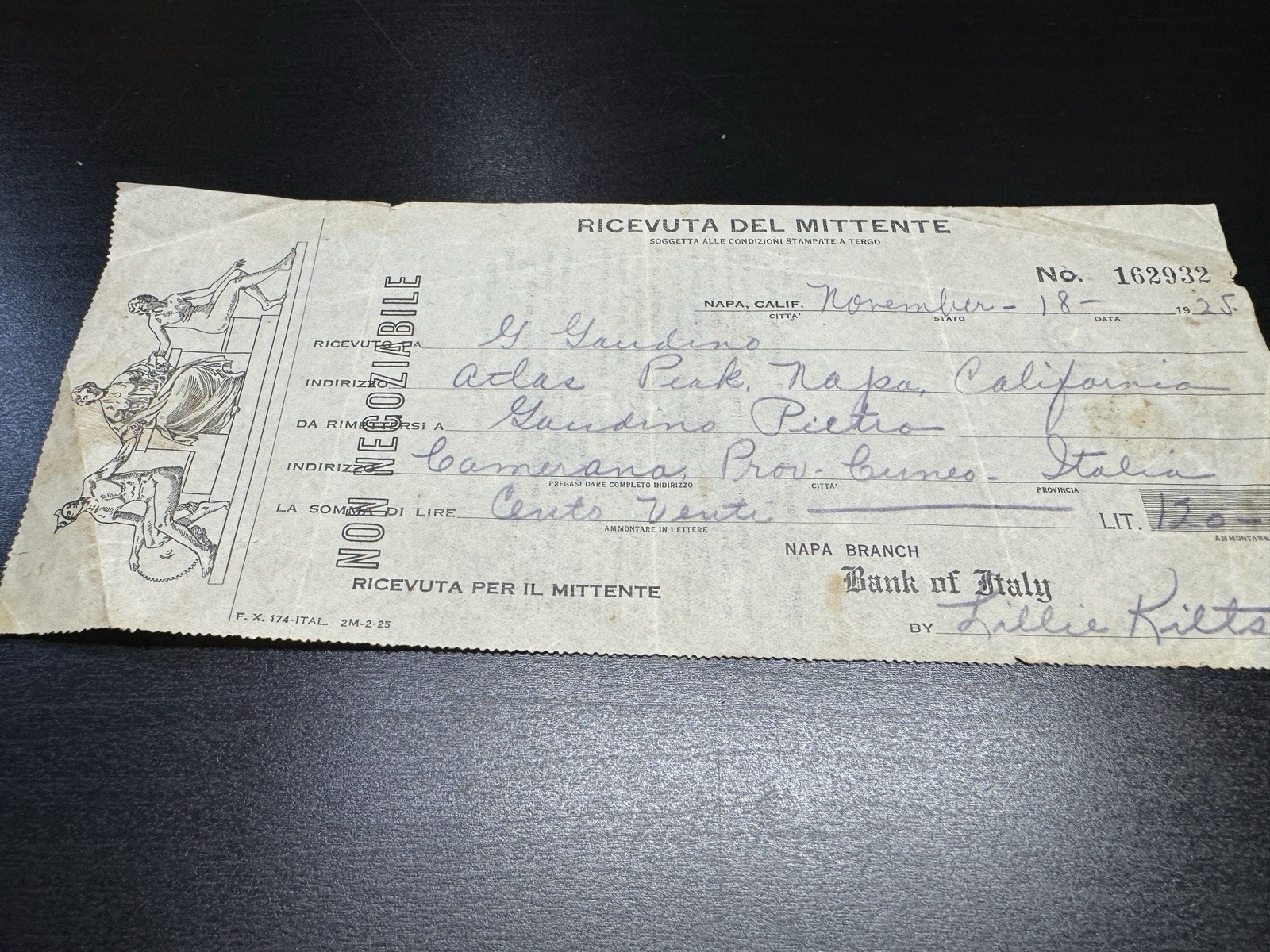
Scarce original 1925 Italian-language remittance receipt issued by the Napa Branch of the Bank of Italy in California.
Document No. 162932, dated 1925, records a remittance of 120 Italian lire. The receipt is marked “RICEVUTA DEL MITTENTE” (Sender’s Receipt) and prominently stamped/printed “NON NEGOZIABILE” (Not Negotiable).
This is an original period financial document, not a reproduction or modern copy.
A particularly attractive feature is the detailed allegorical illustration at the top, depicting three classical figures. Combined with the Italian-language banking text, handwritten entries, serial number, and Napa Branch identification, it gives the document strong visual and historical character.
The reverse contains the bank’s original printed Italian-language terms governing remittances, providing additional historical context.
This type of surviving Bank of Italy remittance ephemera appears to be uncommon. An exact example with this design and Napa Branch identification was not readily found in current online marketplace searches, making it an interesting piece for collectors of early California banking and Italian-American history.
The Bank of Italy name, Napa, California origin, Italian-language format, and international remittance purpose make this an especially interesting artifact of the financial connections between California’s Italian-American community and Italy during the 1920s.
Condition: Original antique condition with visible age and handling wear. Multiple folds and creases, toning, scattered staining/spotting, edge wear, and small edge tears or losses are present. Handwritten period notations appear on both sides. Please examine all photographs carefully for exact condition.
A distinctive collectible for Bank of Italy, Napa Valley, California banking, Italian-American immigration, financial history, and antique ephemera collectors.
Photos are part of the description.