When you click on links to various merchants on this site and make a purchase, this can result in this site earning a commission. Affiliate programs and affiliations include, but are not limited to, the eBay Partner Network.
Rare transatlantic \"Social Philately\" artifact documenting post-WWI Hungarian migration to New York City.
Item Overview
Type: Real Photo Postcard (RPPC) with scalloped edges.
Origin: Budapest, Hungary (Postmarked Dec 22, 1921).
Subject: Beautiful colorized view of Margaret Bridge (Margit híd) looking toward Buda.
Philatelic Details
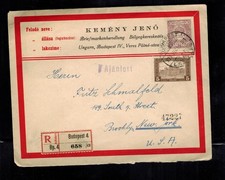
Franking: Features a tri-strip of 10 Korona \"Parliament\" series stamps (Magyar Kir. Posta).
Postal History: Mailed just five days after the formal peace treaty between the U.S. and Hungary (Dec 17, 1921). The 30 Korona rate reflects the early inflationary period in the Kingdom of Hungary.
Postmarks: Clear circular date stamps (CDS) from BP. 62 (Budapest) dated 21 DEC 22.
Historical Significance
This card is a prime example of Social Philately, capturing the \"lifeline\" correspondence between a wounded Hungary (post-Treaty of Trianon) and the thriving Hungarian enclave in Yorkville. The recipient, Jözsi Wagner, lived in a historic immigrant tenement district just as the 1921 Emergency Quota Act began to restrict Central European immigration to the U.S.
Message: Handwritten in Hungarian, featuring a personal family note signed by \"Margit\" and \"Mama.\"
Condition: Excellent vintage condition with minor corner wear consistent with a 100-year-old transatlantic journey. Scalloped edges are intact.
Why This Item?
Perfect for collectors of Hungarian Postal History, New York City Judaica/Immigrant History, or Transatlantic Steamship Mail. The specific Yorkville destination adds significant value to collectors of \"Little Hungary\" memorabilia.
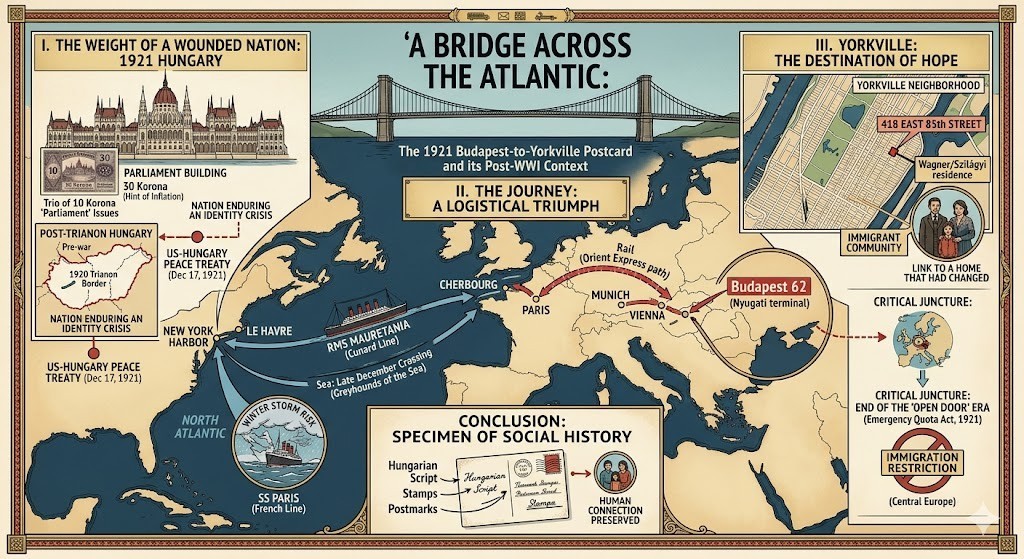
A Bridge Across the Atlantic: The 1921 Budapest-to-Yorkville Postcard
The study of social philately is, at its core, the study of human connection preserved through paper and ink. This postcard, mailed from Budapest on December 22, 1921, serves as a poignant artifact of a world in the throes of post-war reconstruction. It captures the intersection of a nation struggling to redefine itself, an immigrant community flourishing in Manhattan, and a postal system successfully navigating a fractured landscape.
I. The Weight of a Wounded Nation: 1921 Hungary
By late 1921, Hungary was a nation enduring a profound identity crisis. The Treaty of Trianon (1920) had stripped the country of more than two-thirds of its territory, leaving a population traumatized and economically isolated. The stamps on this card—a trio of 10 Korona \"Parliament\" issues—tell the story of this era. While the image of the majestic Parliament building symbolized national pride and continuity, the 30 Korona total required for international postage hinted at the burgeoning inflation that would soon plague the Kingdom.
This card was mailed during a week of significant diplomatic thawing; the United States and Hungary had finalized their separate peace treaty just five days prior. For the family in Budapest, this message was likely more than a holiday greeting; it was a reach toward stability in a time of radical uncertainty.
II. The Journey: A Logistical Triumph
The mail route of this card is a testament to the resilience of international logistics. Originating at the Budapest 62 railway post office at the Nyugati terminal, the card entered the \"primary artery\" of Central European mail. Despite the new borders and political tensions of the region, the rail networks—largely following the historic path of the Orient Express—remained operational.
The journey followed a westward arc:
Rail: Budapest to Vienna, then across Germany to the French Atlantic ports of Cherbourg or Le Havre.
Sea: In the late December winter, the card likely boarded a premier ocean liner, such as the RMS Mauretania or the newly commissioned SS Paris. These \"Greyhounds of the Sea\" battled the North Atlantic’s notorious winter storms to maintain the postal \"conveyor belt\" to America.
Final Mile: Arriving in New York Harbor around the turn of the year, the card moved through the Morgan General Post Office and finally into the hands of a local carrier in Yorkville.
III. Yorkville: The Destination of Hope
The recipient, Jözsi Wagner, resided at 418 East 85th Street, located in the heart of Yorkville on Manhattan’s Upper East Side. During this period, Yorkville was the cultural epicenter for New York’s Hungarian and German populations. For an immigrant in 1921, receiving a card from \"Mama\" and \"Margit\" back in Budapest was a vital link to a home that had changed beyond recognition.
This delivery occurred at a critical juncture in American history. The Emergency Quota Act of 1921 had recently been enacted, marking the end of the \"Open Door\" era and significantly restricting further immigration from Central Europe. As the Wagner family read the personal message—recounting dreams of being together—the reality was that the legal and physical distance between Budapest and New York had never been greater.
Conclusion
This postcard is a remarkable specimen of social history. It documents the exact moment when the \"Old World\" of the Austro-Hungarian past was being replaced by a modern, albeit divided, international order. Through its stamps, postmarks, and the intimate Hungarian script, we see a family maintaining its bonds across thousands of miles of ocean and the complex wreckage of a world war. It stands as a silent witness to the enduring human drive to stay connected, regardless of the barriers imposed by geography or geopolitics.
The mail route for this December 1921 postcard highlights the complex logistical recovery of post-WWI Europe. With the peace treaty between the U.S. and Hungary having just been finalized days earlier (December 17), this card moved through a system that was only beginning to stabilize.
1. Origin & Rail Transit (Budapest to Port)
The card was postmarked at Budapest 62 (the main railway station post office, Nyugati pályaudvar) at 10 AM on December 22, 1921.
The Rail Path: In late 1921, international mail from Budapest was typically routed westward via the Orient Express path. Despite the territorial losses of the Treaty of Trianon, the rail connection to Vienna remained the primary artery.
Route: Budapest $\ightarrow$ Vienna $\ightarrow$ Munich $\ightarrow$ Paris $\ightarrow$ Cherbourg or Le Havre.
Alternative: Some Central European mail was routed through Hamburg or Bremen, but for a postcard destined for New York, the French Atlantic ports were the fastest \"conveyor belts\" to the U.S. during this season.
2. The Transatlantic Crossing (Ocean Mail)
By late December, the Atlantic was notorious for winter storms, which often added 2–3 days to a crossing.
Potential Steamers: Based on North Atlantic schedules for late December 1921, the card likely caught one of the \"Greyhounds\" of the sea. Prominent candidates include:
RMS Mauretania (Cunard Line): A frequent carrier for European mail.
SS Paris (French Line): Which had just entered service in June 1921 and was a primary mail carrier from Le Havre.
SS Olympic (White Star Line): The \"Old Reliable\" often carried massive quantities of holiday mail.
Estimated Arrival: Crossing usually took 6 to 9 days. Given the December 22 departure, the card likely arrived in New York Harbor between December 30, 1921, and January 2, 1922.
3. Final Destination (New York City)
Upon arrival at the Port of New York, the mail bags were offloaded and sent to the Morgan General Post Office (near Penn Station).
Local Sorting: From the main hub, it was dispatched to the local station serving the Yorkville neighborhood (likely the Gracie Station or a similar local branch).
The Final Mile: A mail carrier would have walked the card to 418 East 85th Street, delivering it to the Wagner/Szilágyi residence just after the New Year holiday.
Track Page Views With
Auctiva\'s Counter