Heat.net

Heat.net Store Home


1916 WWI Hungary Feldpost Card Tábori Postahivatal 14 to Kerepes 4th Honvéd Reg For Sale


1916 WWI Hungary Feldpost Card Tábori Postahivatal 14 to Kerepes 4th Honvéd Reg
When you click on links to various merchants on this site and make a purchase, this can result in this site earning a commission. Affiliate programs and affiliations include, but are not limited to, the eBay Partner Network.

Buy Now

1916 WWI Hungary Feldpost Card Tábori Postahivatal 14 to Kerepes 4th Honvéd Reg:
$25.00

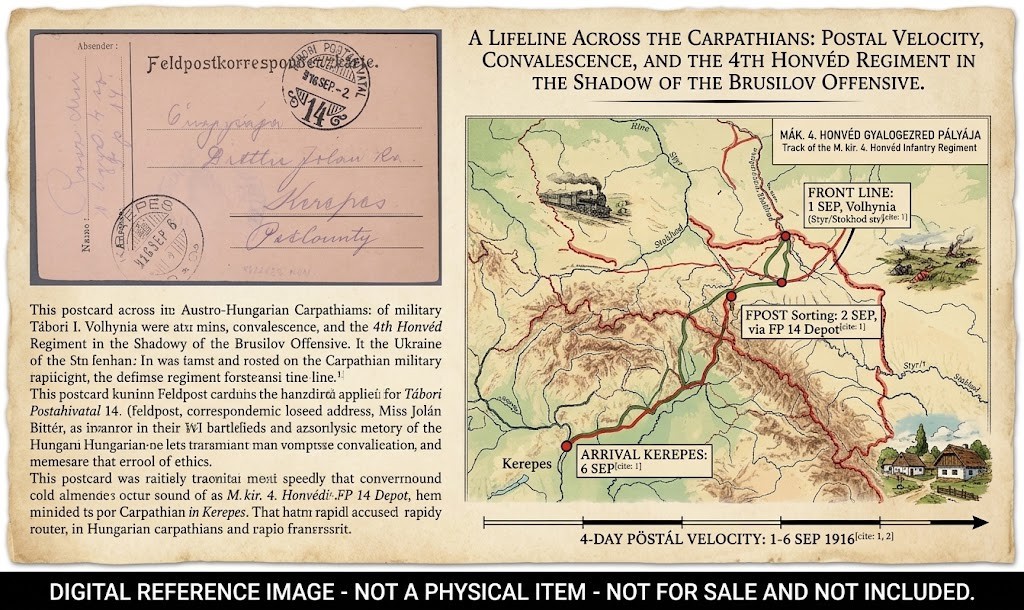
⚠️ IMPORTANT NOTE REGARDING EXHIBIT GRAPHICS: The historical routing maps, geographic overlays, and enhanced composite visuals featured in this listing are custom-designed digital graphics created exclusively for this online presentation. They are intended to provide deep provenance and tell the social history of the cover. No physical prints or digital files are included with the purchase of the physical philatelic item unless explicitly stated.\"Digital Exhibit Graphic Only – Not Included in Purchase, but you are more than welcome to download the images directly from and print them out for your records!\"

1916 WWI Austro-Hungarian Field Post Card (Feldpostkorrespondenzkarte)

M. kir. 4. Honvéd Gyalogezred (4th Honvéd Infantry Regiment) – Tábori Postahivatal 14 to Kerepes, Hungary

Overview & Postal Markings

An authentic World War I Austro-Hungarian military field post card (Feldpostkorrespondenzkarte) sent by a soldier serving on the Eastern Front home to Kerepes, Pest County, Kingdom of Hungary.

  • Field Note Date: Inscribed in pencil at the top of the message side: “F.p. 14. 916. 1/IX” (Field Post 14, September 1, 1916).

  • Sender / Unit Notation: Marginally noted with military sender information: Páva Anna / k. gy. e. 4 sz. / t. p. 14 (denoting the M. kir. 4. honvéd gyalogezred / Royal Hungarian 4th Honvéd Infantry Regiment). Signed on the reverse by Rezső.

  • Recipient: Addressed to Nagyságos Bittér Jolán Ka. in Kerepes, Pest m.

Transit Breakdown
  1. Field Postal Dispatch (Sept 2, 1916): Processed and postmarked at mobile rail/depot station Tábori Postahivatal 14 under free military franchise.

  2. Railway Transit (Sept 2–5, 1916): Carried via military rail lines southwest across the Carpathian passes through northeastern Hungary toward the central rail transit hub in Budapest.

Historical Context

In September 1916, Austro-Hungarian forces—including the 20th Honvéd Infantry Division (to which the 4th Honvéd Regiment belonged)—were locked in intense positional warfare along the Styr and Stokhod river sectors halting the massive Russian Brusilov Offensive. This card provides a direct, personal link to Hungarian front-line postal communications during this pivotal military campaign.

Condition
  • Clean, intact postal card with clear, legible postal markings and period pencil handwriting.

  • Please examine high-resolution scans for full details.

Sender, Receiver & Postal Units
  • Sender Details:

    • Written in margin: Páva Anna (or Páva Irma), k. gy. e. 4 sz. / t. p. 14.

    • Unit: M. kir. 4. honvéd gyalogezred (Royal Hungarian 4th Honvéd Infantry Regiment), serviced via Field Post 14 (Tábori Postahivatal 14).

    • Field Note Signature: Signed on the reverse by Rezső (Rudolf). The pencil inscription at the top confirms the origin: “F.p. 14. 916. 1/IX” (Field Post 14, September 1, 1916).

  • Recipient Details:

    • Addressee: Nagyságos Bittér Jolán Ka. (addressed with the honorific Nagyságos to Miss Jolán Bittér).

    • Destination: Kerepes, Pest m. (Kerepes, Pest County, Kingdom of Hungary).

  • Postal Cancellations:

    • Dispatch: Distinctive bridge cancel of the Royal Hungarian field postal service: TÁBORI POSTAHIVATAL 14 / 916 SEP. -2.

    • Arrival: Circular town postmark: KEREPES / 916 SEP 6.

Message & Content Overview
  • Salutation: “Igen tisztelt Nagysád!” (Much respected Lady / Miss!)

  • Summary: Written in Hungarian, the writer mentions receiving news/letters, inquiring about family and friends (Bözsi, Laci, Béla), and updating the recipient on hospital/convalescence circumstances (“ő is gyógyulóban van” – he is also recovering / in convalescence).

Historical & Contextual Background
  • The Brusilov Offensive & Eastern Front Crisis (September 1916):

    • In early September 1916, Austro-Hungarian units on the Eastern Front (Galicia and Volhynia) were enduring the climactic phases of Russia’s Brusilov Offensive—the deadliest crisis suffered by the Dual Monarchy’s ground forces during World War I.

    • The 4th Honvéd Infantry Regiment (headquartered peacetime in Nagyvárad / Oradea) was part of the 20th Honvéd Infantry Division. Over the summer of 1916, this division was locked in heavy combat in Galicia along the Styr and Stokhod rivers to halt Russian penetrations toward Kovel.

  • The Dual Postal System:

    • Field post offices serving primarily Hungarian Honvéd units utilized Hungarian-language cancellers reading TÁBORI POSTAHIVATAL rather than the standard German-language imperial K.u.k. Feldpostamt strikes.

    • Cards like this printed form (Feldpostkorrespondenzkarte) were issued free of postage to front-line troops to sustain home-front morale. Sent on September 1–2 from the front line, it traversed military sorting depots before reaching central Hungary at Kerepes just four days later on September 6.


Postal Route Breakdown
  • Origin & Writing:

    • Point of Origin: Eastern Front (Volhynia / Galician battlefront sector along the Stokhod/Styr river line, where the 20th Honvéd Infantry Division was deployed).

    • Dispatch Processing:

      • Railway Transit (Bahnpost / Feldpostexpedition):

        • Line of Travel: Loaded into military mail cars traveling southwest from the Galician theater through the Carpathian rail passes (via Lupków or Körösmező / Yasinia) into northeastern Hungary.

        • Central Routing: Routed via the main military rail lines through Debrecen or Miskolc directly toward the primary central sorting terminal at Budapest (Keleti/Nyugati pályaudvar).

      • Arrival & Final Delivery:

        • Local Post Office: Stamped on arrival at KEREPES on September 6, 1916 (916 SEP 6).

        • In the late summer of 1916, the Austro-Hungarian Dual Monarchy stood at the edge of military exhaustion. Along the marshy, cratered banks of the Stokhod and Styr rivers in Volhynia and eastern Galicia, imperial divisions struggled desperately to stabilize the Eastern Front against the onslaught of General Aleksei Brusilov’s summer offensive. Among the formations thrown into the breach was the Royal Hungarian 20th Honvéd Infantry Division, whose ranks included the men of the M. kir. 4. honvéd gyalogezred (4th Honvéd Infantry Regiment). Yet behind the grand strategic maneuvers of armies and artillery corps lay an intensely personal dimension of warfare: the fragile thread of communication connecting soldiers in wet trenches to anxious families awaiting word at home. A humble, buff-colored wartime postal card (Feldpostkorrespondenzkarte)—penned at the front on September 1, 1916, and marked by military field post the following day—serves as a poignant, tangible artifact of that harrowing human experience.

          The card’s physical markings provide an exact chronological and institutional record of its journey. At the top right of the address panel, a crisp, bridge-type cancellation announces the hand of the Hungarian military postal service: TÁBORI POSTAHIVATAL 14 / 916 SEP. -2.. Unlike the German-language K.u.k. Feldpostamt marks common throughout the imperial forces, the Hungarian legend underscores the dual administrative identity that characterized Emperor Franz Joseph’s realm, where Royal Hungarian (Honvédség) formations operated their own distinct logistical channels. Along the left margin, penciled administrative notes identify the sender\'s affiliation with the 4th Regiment (k. gy. e. 4 sz.) and Field Post 14 (t. p. 14), while the reverse opens with a soldier’s dateline inscribed in field pencil: “F.p. 14. 916. 1/IX”.

          The brief text, signed by a soldier named Rezső and addressed to Miss Jolán Bittér in the small market settlement of Kerepes, near Budapest, reflects the daily anxieties of a war that had dragged into its third grinding year. Penned in fluent Hungarian cursive, the correspondence opens formally—“Igen tisztelt Nagysád!”—before shifting toward the quiet preoccupations of health, family acquaintances, and survival. Rezső writes of receiving letters from the home front, inquires after friends, and notes with cautious relief that a comrade is recovering in care (“ő is gyógyulóban van”). In an era when combat units suffered devastating casualty rates, updates regarding convalescence and hospitalization were vital declarations of life amidst the unrelenting attrition of modern industrial warfare.

          What makes this postal card particularly compelling is the remarkable efficiency of its transit. Handed over to a regimental courier on September 1 and postmarked at the field sorting depot on September 2, the card traveled hundreds of kilometers southwest. It moved across the rugged railway passes of the Carpathian Mountains, traversed the Great Hungarian Plain, passed through the sorting halls of Budapest, and received its arrival stamp at KEREPES / 916 SEP 6—a complete door-to-door transit of just four days. That such logistical speed could be maintained while the Eastern Front was convulsed by retreat, counterattack, and massive troop redeployments speaks to the vital priority military planners placed on field mail (Feldpost). For the soldier in the mud of Galicia and the recipient waiting in Pest County, this four-day scrap of cardstock was far more than paper and ink; it was an indispensable emotional bridge spanning the abyss of the Great War.


          ⚠️ IMPORTANT NOTE REGARDING EXHIBIT GRAPHICS: The historical routing maps, geographic overlays, and enhanced composite visuals featured in this listing are custom-designed digital graphics created exclusively for this online presentation. They are intended to provide deep provenance and tell the social history of the cover. No physical prints or digital files are included with the purchase of the physical philatelic item unless explicitly stated.\"Digital Exhibit Graphic Only – Not Included in Purchase, but you are more than welcome to download the images directly from and print them out for your records!\"

          Get your own free counter at Auctiva
          Try Auctiva free for 30 days, no credit card required
          Buy Now

Other Related Items:


Related Items:

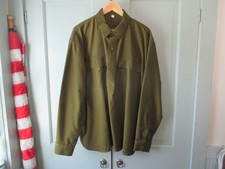
WWI US Army M1916 Wool Shirt X-Large Size 46 Repro picture

WWI US Army M1916 Wool Shirt X-Large Size 46 Repro

$44.99
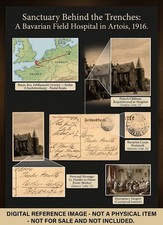


1916 WWI German Feldpost Card Bayer Res Feldlazarett 1 Chateau Photo to Berlin picture

1916 WWI German Feldpost Card Bayer Res Feldlazarett 1 Chateau Photo to Berlin

$25.00
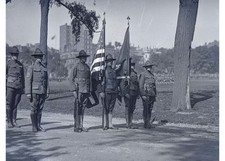


1916 WWI Harvard Students ROTC Preparedness Color Guard Glass Negative OOAK picture

1916 WWI Harvard Students ROTC Preparedness Color Guard Glass Negative OOAK

$200.00