When you click on links to various merchants on this site and make a purchase, this can result in this site earning a commission. Affiliate programs and affiliations include, but are not limited to, the eBay Partner Network.
J. B. ROBINSON’S 1896 CORRESPONDENCEJameson Raid and Transvaal CrisisRobinson Mining Interests and J. W. S. Langerman416 Consecutively Numbered Pages
ROBINSON, Sir Joseph Benjamin; LANGERMAN, Sir Jan Willem Stuckeris; and others. Correspondence 1896. A contemporary bound office correspondence volume containing retained typed copies of letters, cables, reports, and instructions relating to J. B. Robinson’s South African mining organization and the political crisis immediately following the Jameson Raid. 1896.
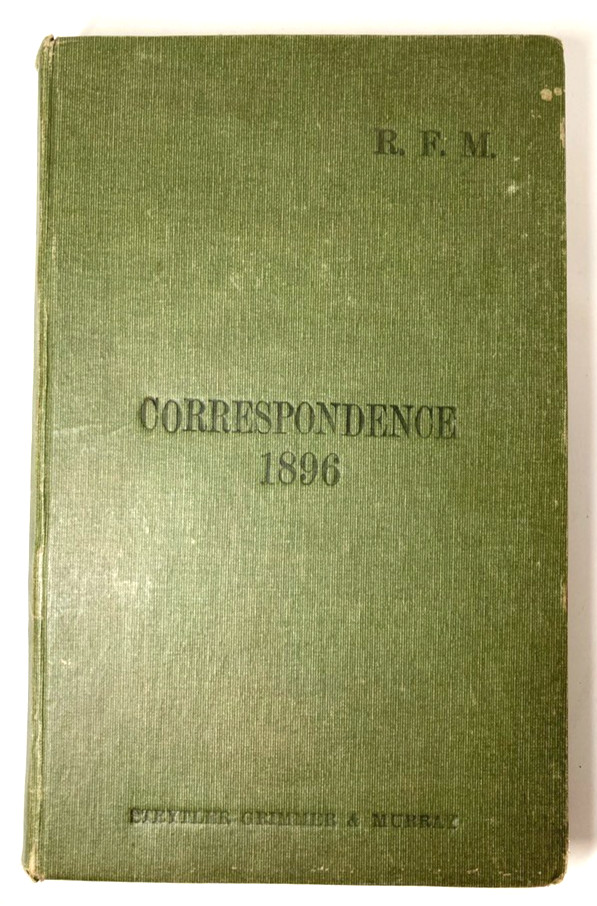
One substantial green-cloth letterbook, indexed and paginated from 333 through 748, an inclusive span of approximately 416 consecutively numbered pages.
The upper cover is titled:
R.F.M.
CORRESPONDENCE
1896
with “Everett, Chater & Richards” stamped at the foot.
An Apparently Unpublished Primary-Source Archive
A substantial contemporary office record associated with Sir Joseph Benjamin Robinson, one of the principal figures in the development of South Africa’s diamond and gold-mining industries.
The correspondence is principally directed to J. W. S. Langerman in Johannesburg. Langerman, later Sir Jan Willem Stuckeris Langerman, served as Robinson’s general manager in South Africa and subsequently became managing director of the Robinson Group and Randfontein Estates.
The volume documents the management of Robinson’s mining interests during 1896 while also preserving a significant group of letters written in the immediate aftermath of the Jameson Raid of December 1895–January 1896.
Its importance lies in the intersection of two subjects: the everyday operation of a major international mining concern and Robinson’s private response to one of the defining political crises preceding the South African War.
Robinson’s Private Response to the Jameson Raid
The most historically important correspondence dates from January 1896, immediately after Leander Starr Jameson’s failed armed incursion into the South African Republic.
Robinson acknowledges Uitlander grievances but condemns the use of armed force, distinguishing his own constitutional approach from the strategy pursued by Jameson and the Chartered Company.
3 January 1896
A letter discusses the grave political situation in the Transvaal and incorporates or refers to cables exchanged as the crisis developed during the closing days of December 1895.
9 January 1896
Langerman is instructed that he:
“must assist to bring about amicable solution.”
16 January 1896
In a lengthy letter concerning the entry of the Chartered Company’s force into the Transvaal, Robinson calls it:
“a most scandalous thing”
that an armed force should have entered:
“a peaceful country like the Transvaal.”
He questions whether the mining industry would have benefited under a Chartered Company regime and characterizes the invasion as an:
“outrage.”
29 January 1896
Robinson states that his preferred method of obtaining redress for Uitlander grievances was:
“on constitutional lines, and not by pointing a pistol at the President’s head.”
These contemporary private statements provide an unusually direct anti-Raid perspective from within the Rand mining-financial community. They show Robinson attempting to protect his companies, influence his Johannesburg representative, and distance his organization from armed intervention while political conditions remained unsettled.
South African Mining and Corporate Content
The political letters form part of a much broader record of Robinson’s business organization. Subjects represented include:
- Robinson Diamond Mining Company
- Robinson-controlled gold-mining properties
- Langlaagte Estate
- Langlaagte Star Gold Mining Company
- Randfontein
- Johannesburg and the Witwatersrand
- Mine development and future operations
- Machinery and equipment
- Production and output reports
- Diamond cutting and assessments of stone quality
- Dividends and distributions
- Annual and company meetings
- Internal financial arrangements
- Reports from South African properties
- Confidential instructions
- Cables and delayed communications
- Tati Blue Jacket Syndicate
- Tati Blue Jacket Syndicate and Exploration Company Limited
The volume records information moving between Robinson and his South African executives: reports from individual properties, instructions concerning machinery and production, financial decisions, proposed developments, dividends, corporate meetings, and reactions to delayed cable communications.
It consequently provides evidence not only of political opinion but also of the administrative machinery behind a major late-Victorian mining enterprise.
Sir Joseph Benjamin Robinson
Joseph Benjamin Robinson was a leading South African mining magnate whose interests extended from the Kimberley diamond fields to important gold properties on the Witwatersrand, including Langlaagte and Randfontein.
Unlike figures closely aligned with Cecil Rhodes and the military intervention, Robinson opposed the Jameson Raid. The letters preserved here appear to record that opposition as the crisis unfolded, rather than as a later retrospective defense.
Sir J. W. S. Langerman
Sir Jan Willem Stuckeris Langerman was Robinson’s general manager in South Africa and later a prominent mining industrialist and politician. He became managing director of the Robinson Group of Mines and Randfontein Estates Gold Mining Company and served in the Transvaal and Union parliaments.
His position as Robinson’s chief South African executive makes the January 1896 instructions particularly revealing: they show how Robinson attempted to guide his Johannesburg organization through the political and commercial aftermath of the Raid.
Archival Format
This is a retained office correspondence volume, not a collection of separately signed autograph letters.
The volume includes:
- retained typed copies of outgoing correspondence;
- cable and telegram texts;
- reports and business instructions;
- a typed index;
- consecutive office pagination;
- occasional manuscript corrections;
- check marks and office annotations;
- references to enclosures and annexures;
- typed signatures, initials, and “sgd.” indications.
Typed or reproduced signatures are not represented as original manuscript signatures.
Because the visible pagination begins at page 333, this was evidently one volume within a larger office series. No claim is made that it contains Robinson’s complete correspondence for 1896.
The initials “R.F.M.” on the cover have not been conclusively expanded and are retained without attribution.
Physical Description
One bound volume. Green cloth over boards, titled in black on the upper cover. Typed correspondence on both sides of thin office paper. Typed index at the beginning. Visible pagination from 333 through 748.
Condition
Good archival condition overall.
The green cloth shows general rubbing, surface marking, and light soiling. The corners are bumped and worn, with additional edge wear and wear at the head and foot of the spine. Small areas of discoloration and spotting are visible on the covers.
The text block remains sound and usable. The leaves show expected age-toning, handling marks, occasional creasing, and some marginal wear. Because the correspondence is typed on relatively thin paper, there is considerable show-through from the reverse of many leaves.
Pencil and ink page numbers, ticks, corrections, and other contemporary office markings occur throughout. These annotations are integral evidence of the volume’s use as a working business record.
Please examine all photographs carefully, as they form an important part of the condition description.
Cataloguing Clarification
This volume is offered as a contemporary retained typed correspondence book and office archive.
It is not described as:
- a manuscript ledger;
- a collection of individually signed autograph letters;
- Robinson’s complete correspondence for 1896;
- the complete Robinson business archive;
- an official Reform Committee record;
- a volume wholly devoted to the Jameson Raid;
- correspondence with a Reform Committee member imprisoned for the Raid.
Its historical importance lies in its extensive contemporary mining correspondence and the politically significant letters written during the immediate aftermath of the Raid.
Institutional and Collector Interest
A significant primary-source volume for research into:
- the Jameson Raid;
- the South African Republic and Transvaal crisis;
- the origins of the South African War;
- South African gold and diamond mining;
- Johannesburg and the Witwatersrand;
- J. B. Robinson and his mining organization;
- J. W. S. Langerman;
- Cecil Rhodes and the British South Africa Company;
- President Paul Kruger;
- Uitlander politics;
- British imperial and colonial history;
- mining capitalism and corporate administration;
- nineteenth-century business archives.
An unusually extensive and apparently unpublished office record documenting both the management of a major South African mining organization and Robinson’s private response to the Jameson Raid.



![The Choates In America. 1643-1896 1896 By E. O. Jameson [Leather Bound] picture](/store/img/g/7N8AAeSwnx1od3T6/s-l225/The-Choates-In-America-1643-1896-1896-By-E-O-James.jpg)