When you click on links to various merchants on this site and make a purchase, this can result in this site earning a commission. Affiliate programs and affiliations include, but are not limited to, the eBay Partner Network.
Book Details
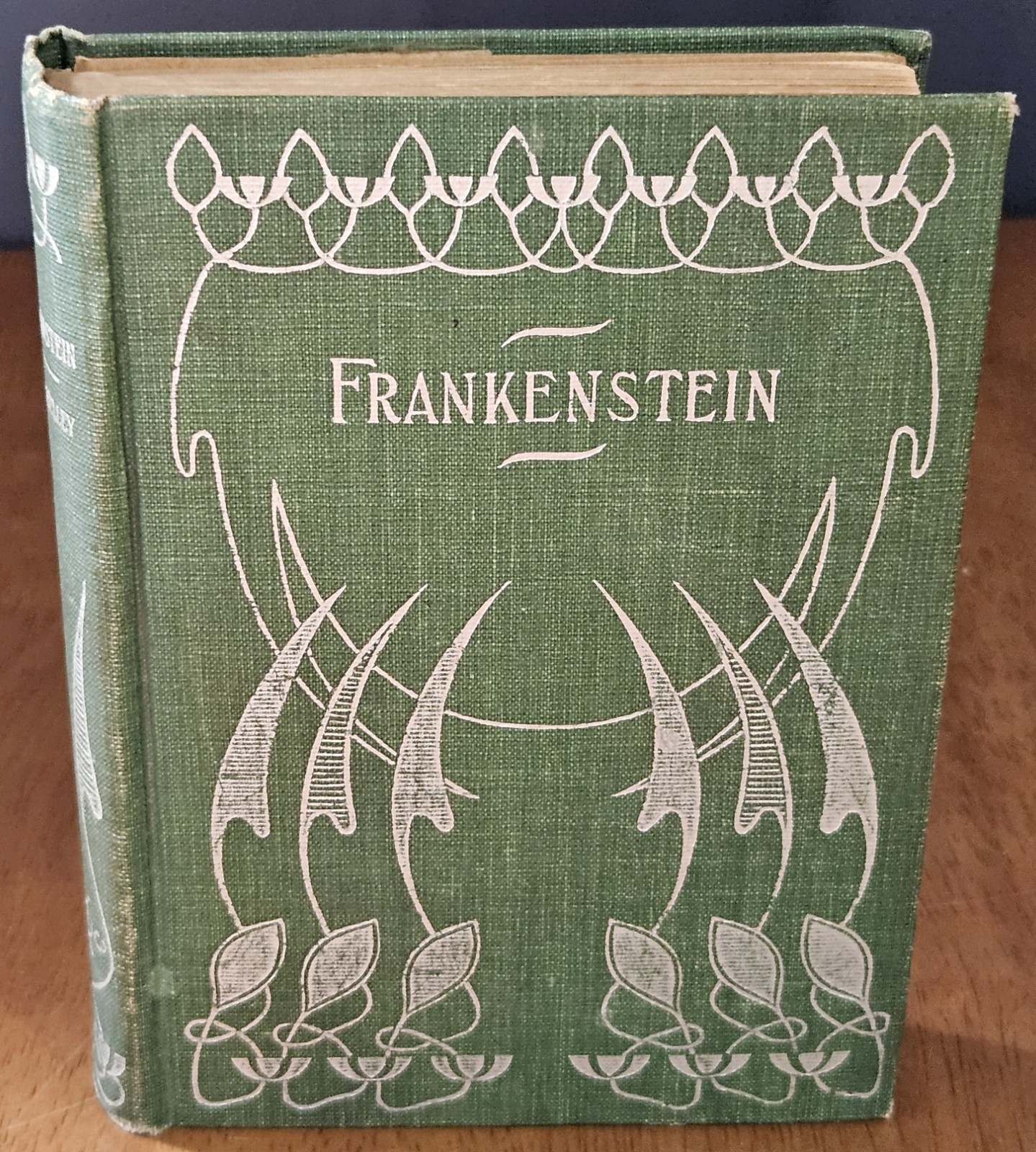
Frankenstein by Mrs. Shelley (Mary Shelley 1797-1851) was published by Donohue, Henneberry & Co. circa 1895. Antique Victorian Compact Edition.Author Background
Mary Wollstonecraft Shelley\'s professional literary career included novels, travel writing, short fiction, essays, biography and editorial work. Frankenstein, published in 1818 when she was just twenty-one years old, was her first novel and became the work upon which her international literary reputation was initially built. But Mary\'s life was far more productive than many readers realize. Although Frankenstein eventually overshadowed her other writings, she produced additional novels, biographies, essays, travel books, and short stories. From 1823 to 1837, she wrote Valperga, The Last Man, The Fortunes of Perkin Warbeck andLodore and Falkner. The Last Man in particular has attracted modern attention because it imagines a future global plague that devastates humanity, making it one of the most remarkable early examples of post-apocalyptic fiction. 186 years after Frankenstein was published, Mary was recognized with a posthumous induction into the Science Fiction Hall of Fame in 2004.Story Outside The Story
Mary was born into one of the most extraordinary intellectual families in England. Her father was the political philosopher William Godwin and her mother was Mary Wollstonecraft, a pioneering advocate for women’s rights who died only eleven days after Mary’s birth. She grew up knowing her mother only through her writings, reputation, and the stories told about her, while her father’s visitors exposed her to writers, philosophers and reformers providing an education unusual for a young woman of her time. A major turning point came in 1814 when she met Percy Bysshe Shelley. Percy was already married to young Harriet Westbrook and was an admirer and financial supporter of William Godwin. Mary and Percy quickly formed a powerful intellectual bond and fell in love. When Mary was only sixteen, she ran away with the still-married Percy to continental Europe. The scandal shocked English society and brought the couple financial hardship, family conflict and social rejection.
In the summer of 1816, Mary joined Percy, Claire Clairmont, Lord Byron, and John Polidori near Lake Geneva. Because of unusual cold and rainy weather, the group was confined to the house for days. During one rainy day, Lord Byron said \"We will each write a ghost story.\" Mary struggled initially to find an idea but during a sleepless night she experienced a frightening vision (see collectible notes) and that vision gave birth to Frankenstein.Following Harriet Westbrook\'s death in late 1816, Percy and Mary married but their lives were marked by both creativity and repeated tragedy. Their first child died shortly after birth and several additional children died during infancy or early childhood. Mary was devastated by these losses. At the same time Percy produced many of his greatest works. The deaths of her children became one of the most significant emotional experiences of her life and influenced themes of loss, creation, mortality, and grief that appear throughout her work. She experienced another devasting loss in 1822 when Percy drowned in a storm off the coast of Italy at age twenty-nine. Mary was only twenty-four years old.Suddenly a widow with a young son, she faced financial concerns and family responsibilities within the strict social constraints of Victorian England. She devoted herself to securing the future of her son, the only one of their five children to reach adulthood, while spending decades organizing, promoting and defending Percy’s work. Her editorial notes and prefaces became important sources for understanding his poetry, despite a difficult relationship with her father-in-law Sir Timothy Shelley, whose financial support dictated how Percy’s life and writings were presented publicly. Many scholars believe that Mary’s efforts were instrumental in securing Percy Shelley’s place in literary history. In her later years she suffered from recurring health problems, including severe headaches and neurological symptoms that became increasingly debilitating. Her health declined steadily during the 1840s and Mary died in 1851 at age fifty-three. After her death, family members discovered keepsakes she had preserved for decades, including locks of hair, notebooks, and relics associated with Percy. These discoveries reinforced a relationship that became one of the most famous literary partnerships in history.Today Mary Shelley is remembered not only as the author of Frankenstein but as a pioneering novelist, editor, biographer, literary executor, and one of the most influential women in literary history. She survived tragic family loss, public scandal, financial hardship, widowhood, and chronic illness while creating a work that remains one of the most enduring novels ever written. More than two centuries after its publication, Frankenstein continues to influence literature, film, science fiction, horror, ethics, medicine, and popular culture around the world.Collectible Notes
This antique edition with its sage-green cloth binding stamped in silver with a unique design is part of Donohue, Henneberry\'s 1895 Handy Volume Classics, a series that consisted of standard works by major authors intentionally produced in small-format editions in multiple binding colors. In the documented publication history of Frankenstein, Romantic Circles calls this the 1895 Chicago edition. And the inscription on the front endpaper by a prior owner dated July 5, 1900 places this book directly in the hands of a Victorian reader. Inside is a section titled The Preface to the Last London Edition where Mary explains in her own words how Frankenstein was created. She talks about the Lake Geneva gathering, the ghost story proposal and her initial inability to think of an idea, and the long discussions between Lord Byron and Percy about the nature and creation of life, galvanism and the possibility of reanimating a corpse. She describes in detail her sleepless night and waking vision of a pale student of unhallowed arts kneeling beside the creature he had assembled and her terror at what she imagined. And the realization that what frightened her could frighten other people. Then Mary\'s announcement the following morning: \"I have found it! What terrified me will terrify others; and I need only describe the specter which had haunted my midnight pillow.\"Condition
Very Good antique condition. Green cloth boards are very clean with three minor white spots on the back cover. Silver-gilt stamped lettering and designs on the front cover and spine remain bright and shiny. Book edges and corners have minor bends with very little rubbing from shelf wear. The spine ends are lightly rubbed and have softened over time. Endpapers are clean and age-toned and the front endpaper has an inscription by a prior owner written in pencil dated July 5, 1900. Back endpaper has mild foxing and smudging and the last blank page has a slight tear in the middle due to the acid pulp paper used. Binding is lightly cracked in the seams of the front and back endpapers but remains fully intact throughout the book. 294 pages are deeply age-toned with mild smudging and are free from markups, creases, tears and stains.Carefully packaged and shipped with care from our smoke-free home. Now available to readers and collectors around the world through International Shipping. This small Victorian edition measures 6\" long, 4.25\" wide and .75\" deep. Weighs 7.5 oz.