When you click on links to various merchants on this site and make a purchase, this can result in this site earning a commission. Affiliate programs and affiliations include, but are not limited to, the eBay Partner Network.
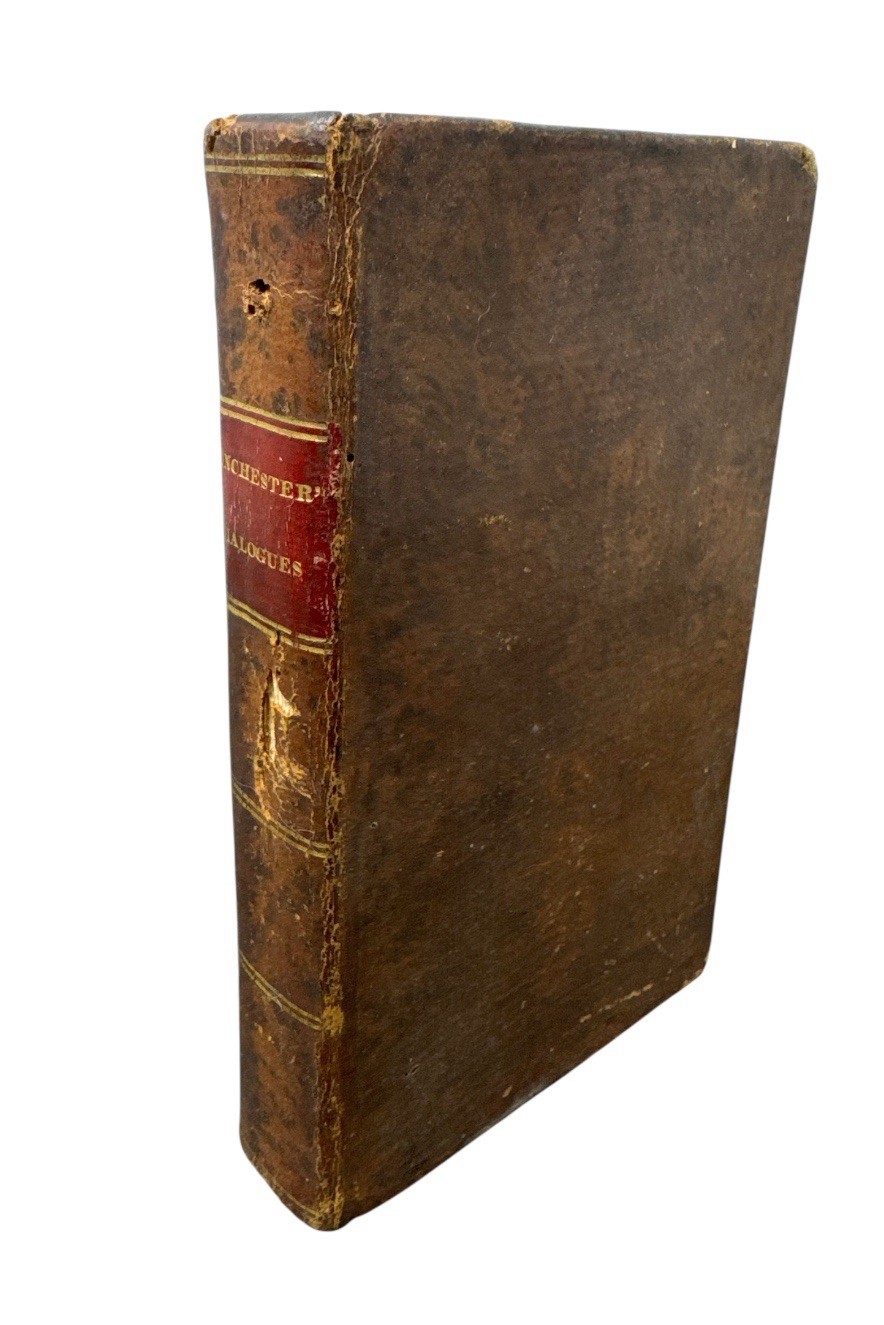
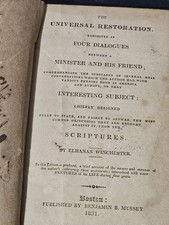
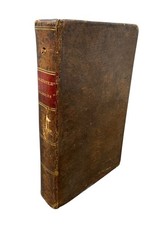
The product is a rare book titled The Universal Restoration Exhibited in Four Dialogues between a Minister & his Friend Comprehending the Substance of Several Real Conversations Which The Author Had With Various Persons Both in America & Europe on that Interesting Subject Chiefly Designed Fully to State & Fairly To Answer The Most Common Objections That Are Brought Against It From The Scriptures by Elhanan Winchester. Yes, really, that’s the fully title. This antiquarian and collectible book delves into the topic of restoration in a unique and informative manner through a series of dialogues. It provides a thought-provoking and historical perspective on the subject matter, making it a valuable addition to any collector's library.
All items are sold as is. This has some minor damage but overall is in good shape for its age. Please see photos for condition and feel free to message me with any questions. Check out the other stuff in my store! I’m always willing to make a deal on multiple items & combine shipping!
Elhanan Winchester (September 30, 1751 – April 18, 1797) was an American theologian who explored numerous theological paths before becoming an advocate for universal restoration. As a result, Winchester is considered among the early leaders of American Universalism.
Winchester, at the age of 19, married his first wife, Alice Rogers, in the fall of 1769. In that same year, he joined the Brookline New Lights Church and began his ministerial career preaching at the church.
Winchester's ministerial career was fluid. It was not uncommon for him to fully embrace one theological principle only to abandon it, seemingly capriciously, and then embrace a completely contradictory set of theological tenets.
His unsettled theological pursuits were resolved in 1778 when he read The Everlasting Gospel. Written under the pseudonym of Paul Siegvolck, Georg Klein-Nicolai published a German edition in 1705. Winchester credits reading an English edition in 1778 for his acceptance of the universal reconciliation of all souls with their Creator.[3] He remained committed to universal reconciliation until his death in 1797.
Winchester reflected many of the ideas in the Everlasting Gospel in his 1788 work Elhanan Winchester: Dialogues on Universal Restoration. He reasoned that errors in biblical scholarship incorrectly condemned souls to perpetual damnation. In particular, he noted the translation of the Hebrew words adon olam and the Greek word aion did not mean "eternal." The correct translation, he argued, was only a reference to a limited unit of time. Similarly, he argued that sin was finite, not infinite, and therefore could not incur the wrath of endless punishment. Underscoring the value Winchester placed in Klein-Nicolai's Everlasting Gospel, he published another edition in London in 1792.
Brookline Congregational Separate preaching career at the Brookline Separate Church was short-lived when a maid of his father became pregnant and named Elhanan as the father.[4] Only one primary historical account was found of this event in Isaac Backus's History of New England with Particular Attention to the Denomination Called Baptists. However, subsequent actions in Winchester's life appear to support Backus's observation.
Canterbury Free Will Baptist Church (1771)
edit
Two years after he began preaching in his father's church, Winchester left Brookline in 1771 and undertook a 60-mile journey to Canterbury, Connecticut. There he visited the Free Will Baptist Church of Elder Ebenezer Lyon.
Established in 1711, the Congregational church in Canterbury was not immune to the influences of the First Great Awakening revivalist movement. In 1745, a separate church of Canterbury was formed on New Light principles and renounced fellowship with the established churches in the Standing Order. Despite its renunciation, the taxation system still compelled the Separates to fund the operation of the Standing Order churches. Under this financial strain and the stress of operating a church outside the community's religious norms, the Separate church floundered.
Winchester's visit coincided with the Baptist minister, Ebenezer Lyon, gathering Separates and others from the Congregational church into a shared community. Lyon offered this community open communion. Allowing all, regardless of baptismal ritual, infant sprinkling or adult immersion, to come to the Lord's Table.[5] Ebenezer Lyon received the young Winchester into this Baptist church and baptized him, via immersion.[6]
Winchester's conversion from a Separate Congregational New Light to a Separate Baptist church was not uncommon. Both Congregational and Baptist Separates, influenced by the First Great Awakening, shared a common desire for a more biblical and simpler form of worship.
Rehoboth Baptist Church (1771–1772)
edit
After leaving Connecticut in the spring of 1771, Winchester and his wife settled in Rehoboth, Massachusetts. Rehoboth and nearby Swansea had long been centers of Baptist activity.
Winchester was likely drawn to Rehoboth by the presence of established Baptist churches and a religious revival sweeping the area. The Baptist churches in Swansea and Rehoboth had recently added several hundred members.[7] The twenty-year-old Winchester assisted the Rehoboth church's 59-year-old minister, John Hicks. The church ordained Hicks in 1762, but a few years later, the church witnessed a severe drop in membership when many immigrated to Nova Scotia. An effort was now underway to rebuild the church membership.
Hicks began that rebuilding effort in 1771. He baptized 40 people before falling ill. Winchester stepped in, baptizing 20 more people.[8] With renewed membership, Ebenezer Lyon traveled from Canterbury and ordained Winchester on September 4, 1771.
A noted Congregational minister and later president of Yale College, Ezra Stiles, recorded Winchester's ordination in his September 19–20 diary entry. The entry also revealed the disdain that orthodox Congregational ministers had for the Separate Baptists. It must be noted that the term "separate" was frequently applied to both Congregational and Baptist churches denoting them as not adhering to the dogma of either the Congregational Standing Order or within an established Baptist association. Stiles wrote (text corrected to modern English), "A New Light Baptist Elder from about Pomfret (near Canterbury) was the only Elder present & performed the Ordination in a boisterous if not blasphemous manner."[9] Stiles continued, "These New Lights Baptist Teachers go about ordaining many that are by no means fit for the sacred Office, some that are fitter for Confinement in a Madhouse a few months, then for the pulpit."
Winchester, now the minister of the Rehoboth church, adopted Lyon's open communion policy, also known as mixed communion.
It is unknown if Winchester was fully aware of the controversy the open communion policy engendered among Baptists. Infant baptism had been a tradition that signified the inclusion of an infant into a church community. Once included, the infant would be nurtured into the faith. The First Great Awakening questioned the validity of passive infant baptism. The revivalist fervor demanded that an intentional new birth event was necessary to enter the faith. This regeneration was expressed by a personal profession of faith in Jesus Christ. This emphasis on a new birth experience led many Baptists to abandon passive infant baptism and adopt an intentional baptism, also known as believer baptism, through immersion as the only acceptable form.
Winchester's open communion policy was short-lived. A 1772 church council questioning this communion policy split the church between those favoring open and those favoring closed communion. The closed communion adherents organized a new church selecting Jacob Hicks, the eldest son of the former pastor, as their minister.[10] The open communion members stayed with the established church and continued with Winchester as their minister.
Another crisis over Winchester's communion policy erupted eight months later. After senior Baptist ministers approached the young Winchester and discussed his communion policy, he changed his position. Winchester abandoned open communion and declared a church policy of closed communion. Church members claiming Winchester had broken his covenant with them removed his preaching privileges. Winchester defended his reversal by calling another council of Baptist churches. That council rebuked him and advised him to confess his imprudence. He was encouraged to seek membership in another church. The church in Bellingham Massachusetts received Winchester into their membership.[11]
Bellingham (1772–1776)
edit
The Bellingham First Baptist Church, organized in 1750, had called Elder Noah Alden as its second minister in 1766.[12] Elder Alden described the church's Calvinist doctrine as "holding the Doctrine of Original sin, Universal Depravity, Absolute, Eternal, Unconditional, Personal Election."
Just 21 years old and shaken by the outcome of his first ministerial experience, Winchester appeared susceptible to the Calvinist rigors of the Bellingham church. He renounced his Arminian sentiments and embraced sterner views consistent with [hyper-Calvinism]. Years later, Winchester reflecting on this time, described himself as "one of the most thorough Calvinists upon the Continent."[13]
Winchester remained a member of the Bellingham church until March 1776, when the church released him from their membership roll so he could join the Welch Neck Pee Dee River Baptist Church in South Carolina.
Grafton and elsewhere (1772–1774)
edit
Most likely, at the urging of Elder Alden, Winchester moved to the nearby town of Grafton. Elder Noah Alden had been involved in organizing the Grafton church in 1767. Winchester preached at Grafton but did not serve as its minister.[14] He spent the next two years preaching in the neighboring towns of Northridge and Upton. He even spent some time preaching in Hull, located on a peninsular point in Boston Harbor.
Welch Neck (1775–1779)
edit
In the fall of 1774, Winchester traveled to Charleston, South Carolina. It is not known what arrangements Winchester made before traveling to South Carolina. It is a reasonable assumption that upon his arrival in South Carolina, Rev. Oliver Hart, the minister of the Charleston Baptist Church since 1750, greeted Winchester. Hart had also been instrumental in organizing the Charleston Baptist Association in 1751. The founding churches of that Association included Ashley River, Euhaw, and Welch Neck.[15] It is assumed that Hart brokered Winchester's settlement at Welch Neck.
Nearly 40 years earlier, in 1737, Baptists from the Welch Tract in Delaware moved to South Carolina and settled near the Pee Dee River. They named their new home Welch Neck in remembrance of their former residence.
The Welch Neck elders affirmed to Winchester the church's devotion to Calvinism in a March 12, 1775 letter.
The Church of Christ at Welch Tract, Pee Dee in South Carolina, holding the Doctrine of Election, particular addressed to Redemption; final perseverance; believes baptism, &c to the Revd. Elhanan Winchester sendeth greeting.[16]
This Particular Baptist society aligned with Winchester's Calvinist beliefs that he adopted in Bellingham. He remained their minister until 1779.
His Welch Neck ministry had many successes, including baptizing many new members, both white and black. By the time Winchester departed in September 1779, the church rolls reflected over 220 white members.[17] A year earlier, Winchester had also opened baptism to "servants" (i.e., slaves) of church members. No total of the considerable number of black members, constituted in a separate church district, appears in the church records.
Shortly after the death of his third wife in the fall of 1779, Winchester departed Welch Neck for an extended trip to New England. The church elders then scrutinized Winchester's newly added members and declared many of them deficient. "A great many of those baptized by Mr. Winchester have been excommunicated, both white and black; but the greater number of blacks; many of the latter upon examination, appeared to be very Ignorant of the nature of true religion".[17]
A comment in the September 1779 meeting minutes, apparently written sometime after Winchester's departure, alludes to Winchester's faltering Calvinist bona fides. "Soon after Mr. Winchester left Pee Dee, he fell into the error of universal restoration, which he first published in Philadelphia, where after baptizing a great many, he was the means of dividing the Baptist Church in that city."
Philadelphia First Baptist Church (1780–1781)
edit
The ministry of the historic First Baptist Church of Philadelphia, established in 1698, was severely impacted by the American Revolutionary War (1775-1783), with many prominent members and ministers engaged in the war effort.
A 1779 self-assessment revealed the bleak condition of the church. "We have been for a long time as sheep having no shepherd, and the consequence has been that we have strayed one from another."[18] The church elders sought to rectify this situation by hiring a minister. Taking advantage of his travel back to Welch Neck, Winchester was in Philadelphia as a representative of the New England Warren Baptist Association, attending the annual meeting of the Philadelphia Baptist Association. At that meeting, the elders offered Winchester the church pulpit in October 1780.
Winchester was known to the elders. In 1775, following the resignation of their then-minister, Rev. William Rodgers, the church unsuccessfully attempted to secure Winchester's services, who was then attending the Philadelphia Baptist Association's annual meeting as a representative of the South Carolina Charleston Baptist Association.[19]
In accepting this recent call, Winchester artfully deflected his obligation to his Welch Neck church, indicating that before his departure he had secured the services of another minister for his South Carolina society if he should fail to return.
Winchester's ministry at the First Baptist Church was an instant success. He preached to large crowds at the church and then moved to larger facilities to accommodate the ever-increasing number of people coming to hear him. Five months later, in March 1781, everything changed.