When you click on links to various merchants on this site and make a purchase, this can result in this site earning a commission. Affiliate programs and affiliations include, but are not limited to, the eBay Partner Network.
GEORGE GRAVES — THE NATURALIST’S POCKET-BOOK; OR, TOURIST’S COMPANION
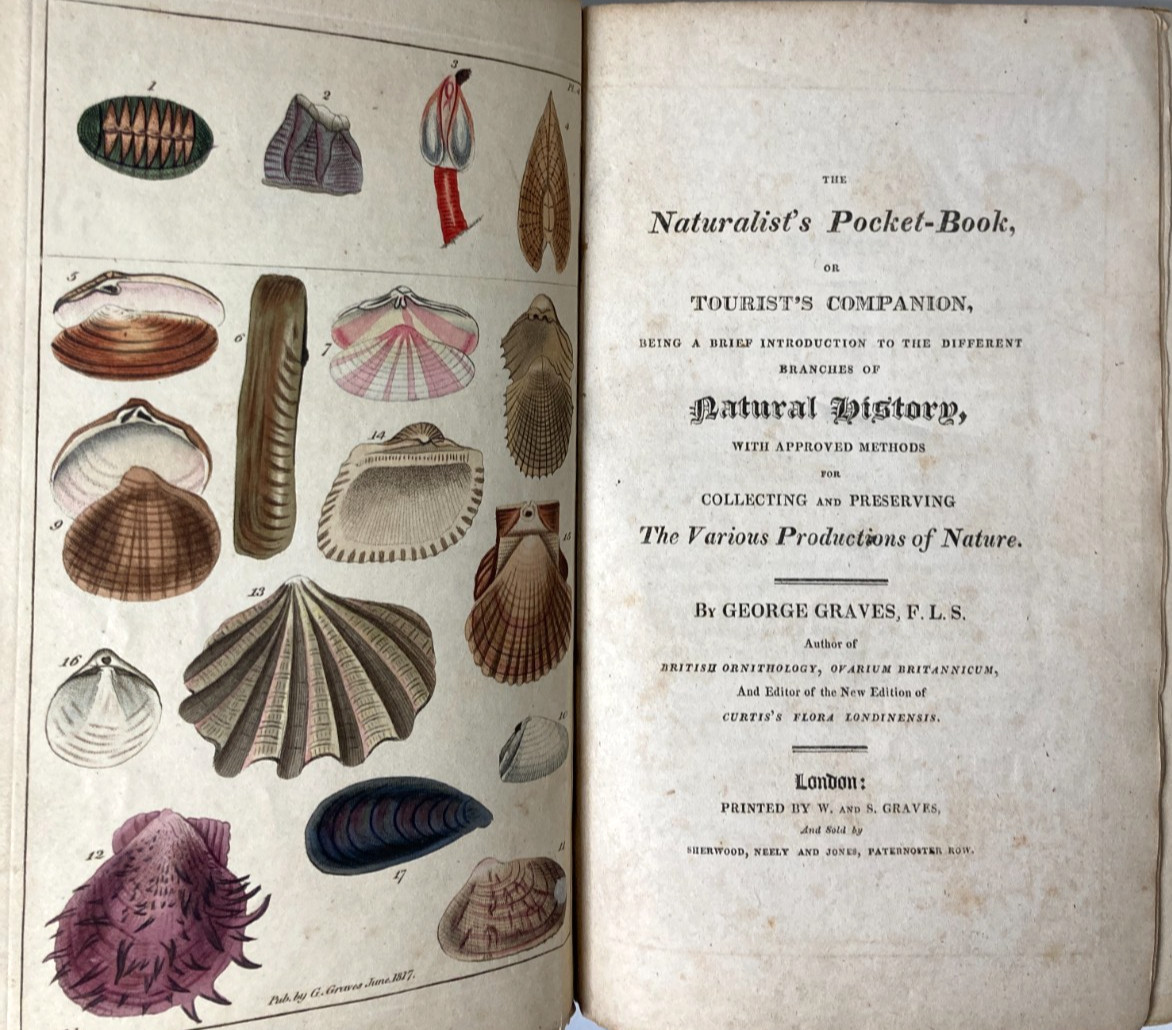
London: Printed by W. and S. Graves and sold by Sherwood, Neely and Jones, 1817.
First Edition | Eight Engraved Plates | Five Hand-Colored | Early Field-Naturalist’s Manual | Work Later Owned by Charles Darwin | Tipped-In 1912 Note Concerning Its Rarity
A handsome and unusually appealing copy of George Graves’s The Naturalist’s Pocket-Book; or, Tourist’s Companion, one of the most interesting practical natural-history manuals of the Regency period.
This is the scarce first edition, issued in London by W. and S. Graves in 1817, preceding the more frequently encountered Longman issue dated 1818. Complete with all eight engraved plates, including the five zoological and natural-history plates issued with hand-coloring.
Unlike conventional natural histories devoted primarily to classification and description, Graves’s book was intended to accompany the naturalist into the field. It provides practical instruction for observing, collecting, preparing, preserving, labeling and recording specimens across the principal branches of natural history.
The Work
Graves presents a compact introduction to zoology, ornithology, entomology, conchology, ichthyology, botany and mineralogy, together with detailed advice concerning the equipment and techniques required by the working naturalist.
Among the subjects discussed are:
Collecting and preserving insects
Preparing birds and quadrupeds
Collecting shells, fish and reptiles
Gathering and drying botanical specimens
Identifying and arranging minerals
Constructing and using collecting equipment
Labeling specimens and maintaining accurate records
Recording habitat, behavior and circumstances of discovery
The book is particularly notable for its treatment of the field notebook. Graves recommends a ruled system of columns and headings through which the collector could document the physical characteristics, habits, locality and circumstances associated with each specimen.
This emphasis on disciplined observation and record-keeping places the work in the formative history of modern field science. The naturalist is encouraged not merely to accumulate curiosities, but to preserve the information that gives scientific meaning to a specimen.
The Plates
The volume contains eight engraved plates, complete:
Five hand-colored natural-history plates
Three uncolored plates illustrating collecting and preservation equipment
The colored plates include zoological and conchological subjects and retain attractive period coloring. The three plain plates show the specialized apparatus associated with practical Regency natural history.
Together, the plates give the book considerable decorative appeal while illustrating the close relationship between scientific observation and the material techniques of collecting.
The Darwin Connection
This work has a genuine and important connection with the early scientific education of Charles Darwin.
Darwin purchased the later 1824 revision of Graves’s manual, issued under the title The Naturalist’s Companion, in August 1825, shortly before beginning his studies at Edinburgh. During this period, Darwin and his brother Erasmus walked along the shores of the Firth of Forth collecting marine specimens and recording their discoveries.
This is not Darwin’s personal copy, and it is the original 1817 first edition rather than Darwin’s 1824 revision. It is, however, the first edition of the practical collecting manual that Darwin later acquired during the formative period of his natural-history training.
The association makes the book especially relevant to collectors interested in Darwin, the development of field observation and the intellectual culture from which nineteenth-century evolutionary science emerged.
The 1912 Rarity Note
Tipped into this copy is a manuscript note dated 1912 and signed “E. Greenwood.”
The writer records having searched booksellers’ and sale catalogues extending over several decades without locating another copy beyond the example then recorded at the British Museum.
Modern institutional catalogues reveal that additional copies survive, but the note remains a remarkable piece of evidence concerning the book’s historical reputation. It shows that, by the early twentieth century, the work was already regarded by an informed owner or member of the book trade as notably elusive.
Its presence gives this copy an additional layer of bibliographical and collecting history not normally encountered.
Bibliographical Details
Author: George Graves, F.L.S.
Title: The Naturalist’s Pocket-Book; or, Tourist’s Companion: Being a Brief Introduction to the Different Branches of Natural History, with Approved Methods for Collecting and Preserving the Various Productions of Nature
Place: London
Printer and publisher: W. and S. Graves
Bookseller: Sherwood, Neely and Jones
Date: 1817
Edition: First edition, 1817 issue
Format: Octavo
Pagination: viii, 335 pages
Illustrations: Eight engraved plates, five hand-colored and three uncolored
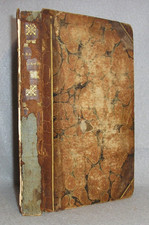
Binding: Later half leather over marbled boards, with gilt-lettered spine and date
Additional material: Tipped-in manuscript note dated 1912 and signed E. Greenwood
Condition
Very good overall and handsomely presented.
The later half-leather binding over marbled boards is sound, attractive and well suited to the volume. The spine is lettered and dated in gilt. The text block remains secure and stable.
The contents show light general toning and occasional minor spotting consistent with a book of this age. There is a minor closed tear to page 37, not affecting the printed text. The engraved plates remain sharp and attractive, and the five colored plates retain strong, appealing color.
The tipped-in 1912 Greenwood note is well preserved.
Please examine the photographs carefully, as they form an important part of the condition description.
Collector Interest
A particularly desirable book for collectors of:
Early natural history
Charles Darwin and Darwiniana
History of science
Regency scientific books
Field guides and collecting manuals
Scientific notebooks and observational practice
Conchology and entomology
Taxidermy and specimen preparation
Hand-colored natural-history illustration
Linnean Society authors
A scarce and visually attractive first edition of an important practical guide to the world of the early nineteenth-century field naturalist, distinguished by its complete suite of plates, authentic Darwin association and remarkable 1912 manuscript note concerning the book’s rarity.