When you click on links to various merchants on this site and make a purchase, this can result in this site earning a commission. Affiliate programs and affiliations include, but are not limited to, the eBay Partner Network.
Johann Georg ZimmermannSolitude Considered with Respect to Its Influence Upon the Mind and the HeartLondon, 1792Transparent Vellum Binding Attributable to Edwards of HalifaxPainted Stag and Fox MedallionsHidden Sporting Fore-Edge PaintingEarly Yorkshire Provenance
ZIMMERMANN, Johann Georg. Solitude Considered with Respect to Its Influence Upon the Mind and the Heart. Written Originally in German by M. Zimmermann, Aulic Counsellor and Physician to His Britannic Majesty at Hanover. Translated from the French of J. B. Mercier.
London: Printed for C. Dilly, in the Poultry, 1792.
Second edition. Octavo, approximately 204 × 126 mm, or 8 × 5 inches. xii, 370, [2] pages. Complete with the engraved frontispiece by Thomas Holloway, published by C. Dilly on February 23, 1792.
A remarkably attractive late-eighteenth-century copy of Zimmermann’s celebrated philosophical study of solitude, preserved in a fine transparent vellum binding confidently attributable to the Edwards family of Halifax, with painted decoration beneath the vellum and an additional concealed sporting fore-edge painting beneath the gilt edge.
The Edwards family of Halifax was among the most innovative and celebrated English bookbinding workshops of the Georgian period. James Edwards patented in 1785 a process for rendering vellum translucent, allowing painted or printed decoration placed beneath the surface to remain visible while being protected by the vellum itself. Surviving bindings employing this technique are among the most distinctive luxury bookbindings of the late eighteenth century.
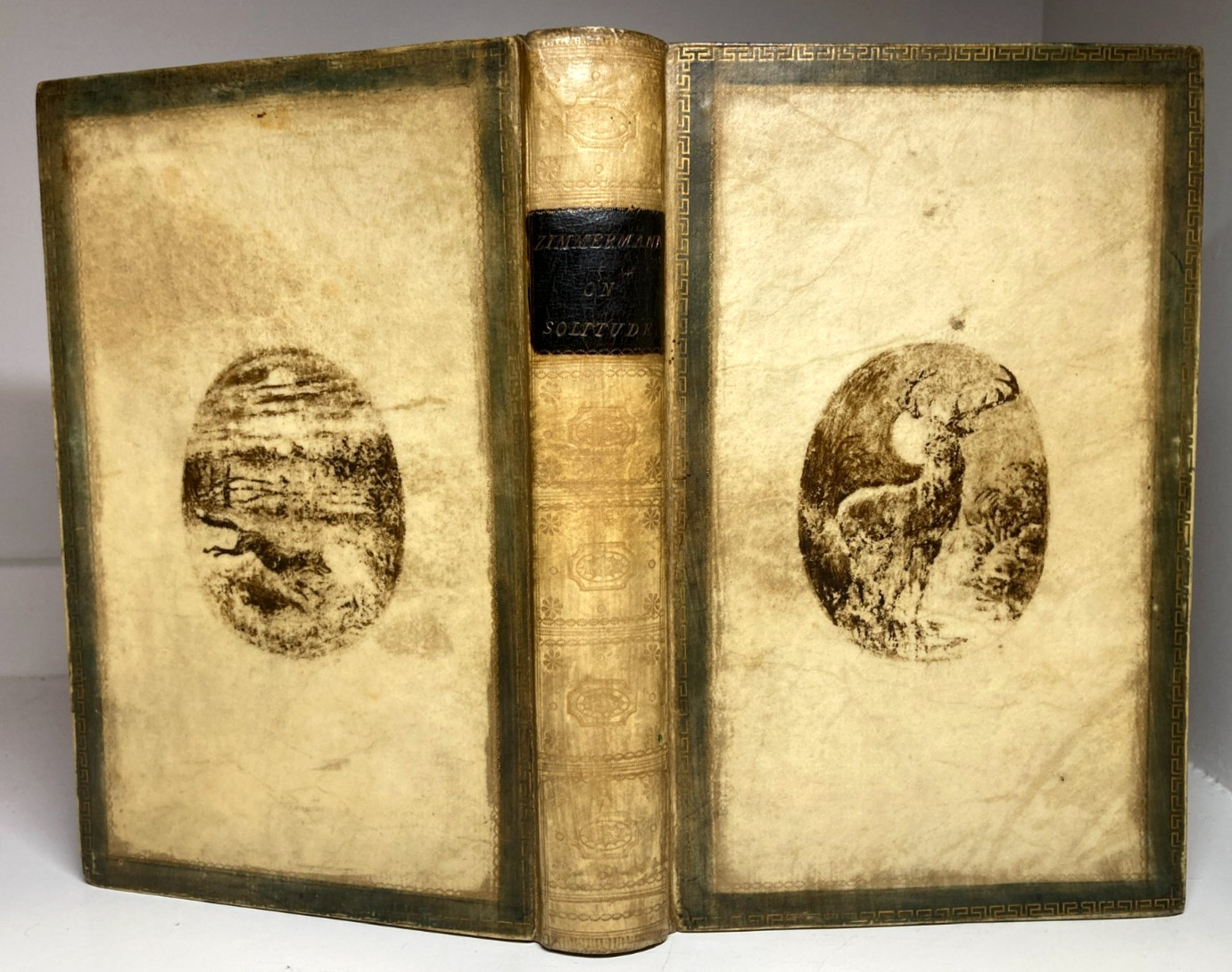
This volume exhibits a particularly persuasive group of features associated with the Edwards workshop: translucent cream vellum over a pale ground; painted decoration beneath the vellum; blue-grey washed borders; sharply impressed gilt Greek-key frames; characteristic neoclassical spine tooling; a dark morocco leather title label; and richly marbled endpapers.
The attribution applies to the binding and its under-vellum decoration. The concealed fore-edge painting is unsigned and is discussed separately below; no claim is made that the fore-edge painting itself was executed by Edwards of Halifax.
The transparent vellum binding
Bound in contemporary full transparent vellum over pale boards.
Each cover is framed by a blue-grey wash border set between gilt rules and decorated with a crisply impressed Greek-key roll.
The upper cover contains an oval sepia-wash medallion depicting a stag standing alert amid vegetation. The lower cover bears a corresponding oval scene of a fox in a rustic landscape.
The painted scenes lie beneath the translucent vellum rather than upon its exposed surface, producing the softly diffused appearance characteristic of Edwards transparent-vellum work while protecting the decoration from direct handling.
The smooth spine is divided into six ornamental compartments with repeated gilt neoclassical metope-style devices, floral ornaments, and decorative rolls. The original dark morocco leather label is lettered in original pink, tan, green, and black marbled endpapers are retained.
Taken as a whole, the materials, decorative vocabulary, technical construction, and under-vellum painting make the attribution to Edwards of Halifax especially strong.
Hidden sporting fore-edge painting
Beneath the gilt fore-edge is a concealed watercolor painting visible only when the leaves are carefully fanned.
The scene depicts a wildfowler standing among tall river reeds and firing across the water. A puff of smoke issues from the muzzle of his gun as ducks rise and scatter over the river. The hunter wears a terracotta-colored coat, while the surrounding reeds, water, and landscape are rendered in greens, browns, blues, and warm earth tones.
The painting remains vivid and highly legible, with considerable detail despite the narrow and technically demanding surface.
Importantly, the fore-edge painting is unsigned and independently unattributed. Its precise date is likewise uncertain. It may be contemporary with the binding or may have been added somewhat later. While its sporting subject harmonizes beautifully with the stag and fox painted beneath the vellum covers, there is presently no documentary basis for assigning the fore-edge painting itself to Edwards of Halifax.
That distinction is worth preserving: the Edwards attribution rests on the binding, while the fore-edge should be appreciated as a separate and exceptionally appealing element of the book’s history.
An exceptional combination of book arts
The volume brings together three unusually desirable decorative features:
A late-Georgian transparent vellum binding attributable to Edwards of Halifax
Painted animal medallions beneath the vellum on both covers
A concealed watercolor sporting scene beneath the gilt fore-edge
Fore-edge paintings were created by fanning and securing the leaves, painting the stepped edge in watercolor, and gilding the closed edge so that the image disappeared when the book was at rest. The most successful examples transform the book itself into a kind of optical object: restrained and formal when closed, unexpectedly pictorial when opened and fanned.
The present volume is especially satisfying because the imagery forms a coherent sporting and pastoral program. The solitary stag and fox on the covers are complemented by the secluded river landscape hidden along the fore-edge.
The text
Johann Georg Zimmermann was a Swiss physician, philosopher, and author whose writings on solitude enjoyed wide European circulation. He later served as physician at Hanover to George III.
Solitude examines both the intellectual benefits and the psychological dangers of withdrawal from society. Zimmermann argues that deliberate retirement may encourage moral reflection, self-knowledge, intellectual independence, and emotional clarity, while excessive or prolonged isolation may become destructive.
The subject of the text has an unusually pleasing relationship with the visual decoration of the binding: solitary animals inhabit the cover medallions, while a lone sportsman occupies the secluded river landscape concealed along the fore-edge.
Provenance
The front flyleaf bears an early ink ownership inscription:
“Mary Lambert, Chapelthorpe, 1818.”
Chapelthorpe lies near Wakefield in West Yorkshire, within the same broader regional setting as Halifax. The inscription does not establish a direct purchase from the Edwards firm, but it provides appealing early Yorkshire provenance for a binding attributable to one of the region’s most famous bookbinding workshops.
The front pastedown also bears an older pencil annotation identifying the volume as a fore-edge painting in an Edwards binding, together with earlier bookseller or collector codes.
Protective case
The volume is accompanied by a marbled-paper chemise and matching slipcase. These are later protective additions and have helped preserve the vulnerable vellum surface, painted decoration, and bright spine gilding.
Condition
Very good overall for a late-eighteenth-century transparent-vellum binding of this type.
The vellum remains comparatively bright and the boards are substantially flat. The under-vellum paintings are softly defined through the translucent material, as expected, but remain clearly visible. The blue-grey border washes and gilt Greek-key tooling are attractive and well preserved.
The spine is particularly handsome, with the gilt ornaments and original morocco leather label remaining bright and legible. The joints are intact. Minor age-toning, light rubbing, surface marks, and natural variation to the vellum are present.
Internally, the text is generally clean and crisp. There is some offsetting from the engraved frontispiece onto the title page, occasional light foxing, minor marginal toning, and ordinary signs of age and use.
The gilt fore-edge shows some surface wear, but the concealed painting remains vivid when correctly fanned.
The marbled-paper chemise and slipcase show rubbing, abrasions, edge wear, and some structural wear but remain functional as protective enclosures.
Please examine all photographs carefully. The fore-edge should be fanned gently and supported properly; repeated or forceful fanning is not recommended.
Collector’s summary
London, 1792
Second edition
Complete with engraved frontispiece by Thomas Holloway
Contemporary transparent vellum binding attributable to Edwards of Halifax
Painted stag medallion beneath the vellum on the upper cover
Painted fox medallion beneath the vellum on the lower cover
Gilt Greek-key borders
Bright neoclassical gilt spine
Original morocco leather title label
Original marbled endpapers
Hidden watercolor duck-hunting fore-edge painting
Fore-edge unsigned and independently unattributed
Early Yorkshire ownership inscription dated 1818
Later marbled-paper chemise and slipcase
A striking combination of Georgian binding, under-vellum painting, and concealed fore-edge art
A distinctive and unusually well-preserved example of late-Georgian English bookbinding, with a strong Edwards of Halifax attribution for the transparent-vellum binding itself and an especially attractive separately unattributed sporting fore-edge painting hidden beneath the gilt edge.