When you click on links to various merchants on this site and make a purchase, this can result in this site earning a commission. Affiliate programs and affiliations include, but are not limited to, the eBay Partner Network.
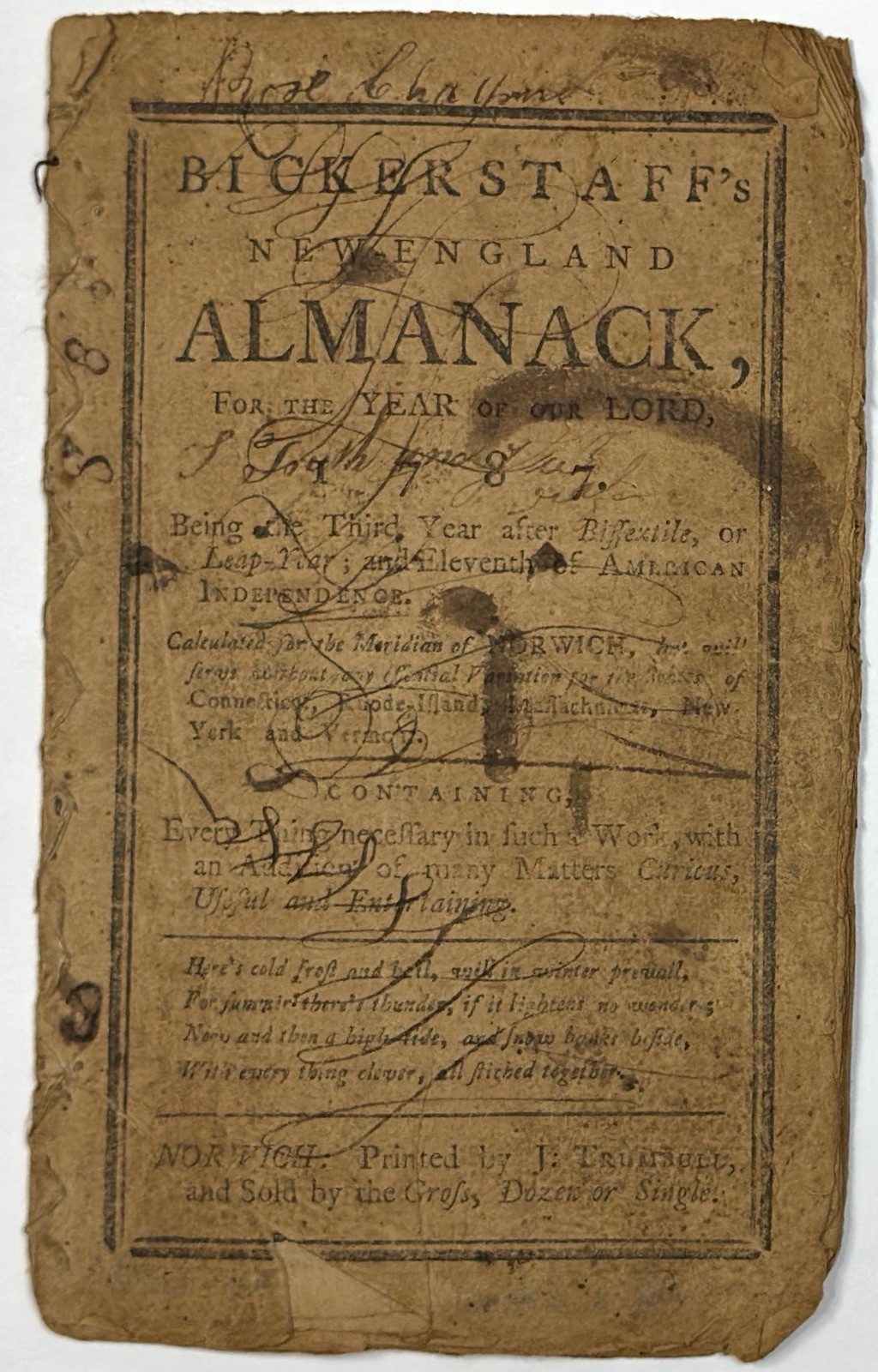
1787 BICKERSTAFF\'S NEW-ENGLAND ALMANACK WEST NORWICH CONNECTICUT TRUMBULL TAVERN
Author:Bickerstaff; attributed to Benjamin West
Publisher:J. Trumbull, Norwich, Connecticut
Publication Date:1787 almanac year; imprint undated
Edition:1787 Norwich annual issue
Today we are pleased to offer an eighteenth-century copy of Bickerstaff’s New-England Almanack, For the Year of our Lord, 1787, printed by J. Trumbull in Norwich, Connecticut. This small, sewn paper almanac was calculated for the meridian of Norwich and intended for use in Connecticut and neighboring states. The title identifies the year as the eleventh of American independence, and the Norwich Bickerstaff series is bibliographically attributed to Benjamin West. All twelve monthly calendar pages, January through December, are present. The volume is nevertheless incomplete, lacking the final two leaves containing the four-page narrative The Life of Sauney Beane.
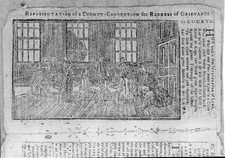
The calendar pages combine lunar phases, sunrise and sunset calculations, zodiacal symbols, weather prognostications, seasonal observations, and verses. October and November retain their monthly tables and accompanying poetry, completing the full annual calendar sequence. The opening matter includes eclipse predictions, A Geographical Description of the World, and an explanation of the correction of the Julian calendar. Humorous reading includes The Felon and his Wedge of Gold, The Lawyer and Countryman, A Cobler and a Gentleman, The Judge and Felon, and assorted witty jests. Handwritten names, pen flourishes, and scattered annotations distinguish this particular copy.
A two-page Concise Calender for Young Farmers and Gardeners supplies month-by-month directions for work around the farm, orchard, and garden. Its subjects include repairing stone walls and fences, sowing flax, planting corn and vegetables, tending bees, gathering seeds, making cider, storing root crops, and preparing for winter. Additional practical contents include Connecticut and Massachusetts court schedules, a table of interest at six percent, and dates for Connecticut freemen’s meetings. Together, these sections document the agricultural, commercial, and civic information incorporated into a late-eighteenth-century household reference.
The road directory lists routes from Norwich toward Boston, Hartford, New Haven, and New York, giving intermediate mileages and the names of tavern keepers. A separate middle route to Boston passes through such places as Pomfret, Uxbridge, Holliston, and Dedham. Beneath the directory, the Norwich printing office advertises books, schoolbooks, and legal blanks, together with an offer to exchange books for cotton and linen rags. These surviving details give the almanac particular interest for collectors of Connecticut printing, historic travel routes, taverns, rural life, and the early American book trade.
The title page and road-directory page form the present outer surfaces. Both are heavily browned and soiled, with scattered dark spotting and extensive ink writing. A broad curved stain crosses the title page, and numerous pen strokes overlap the printed wording. The edges are irregular and worn, with small chips, short tears, creases, and softened, rounded corners. Several corners are folded, and the opening leaf has a torn, creased flap and paper loss at its lower edge. The narrow spine has exposed sewing holes, surviving thread, and wear around the folds. The worn outer leaves and projecting paper edges require careful handling. The large ALMANACK lettering still makes a stunning display.
The interior is browned throughout, with scattered foxing, darker stains, fingermarking, ink spots, and occasional ink transfer. Numerous leaves have creases, turned corners, small edge losses, and short tears. A deeply folded upper corner in the court listings covers part of the printed text, and damage at the foot of the opening leaf affects the lower printed area. Some impressions are light or rubbed, and manuscript additions cross portions of several entries. The October and November pages have toning, scattered spotting, creases, and worn margins, with their calendar tables retained. There are 12 leaves, or 24 unnumbered pages, present out of the 14 leaves, or 28 pages, recorded for this issue. The final two leaves containing The Life of Sauney Beane are lacking; the January–December calendar sequence is complete. Much of the retained text and tabular information remains readable. The legible farming calendar is a first-chop record of seasonal work.
Make sure to see the photos above for complete details.
24 of 28 unnumbered pages present; all twelve monthly calendar pages included; lacking the final two leaves, comprising four pages of text. Printed tables and astronomical symbols.
This measures approximately 6 1/2 inches tall by 4 inches wide.
_gsrx_vers_1737 (GS 9.9.6 (1737))