When you click on links to various merchants on this site and make a purchase, this can result in this site earning a commission. Affiliate programs and affiliations include, but are not limited to, the eBay Partner Network.
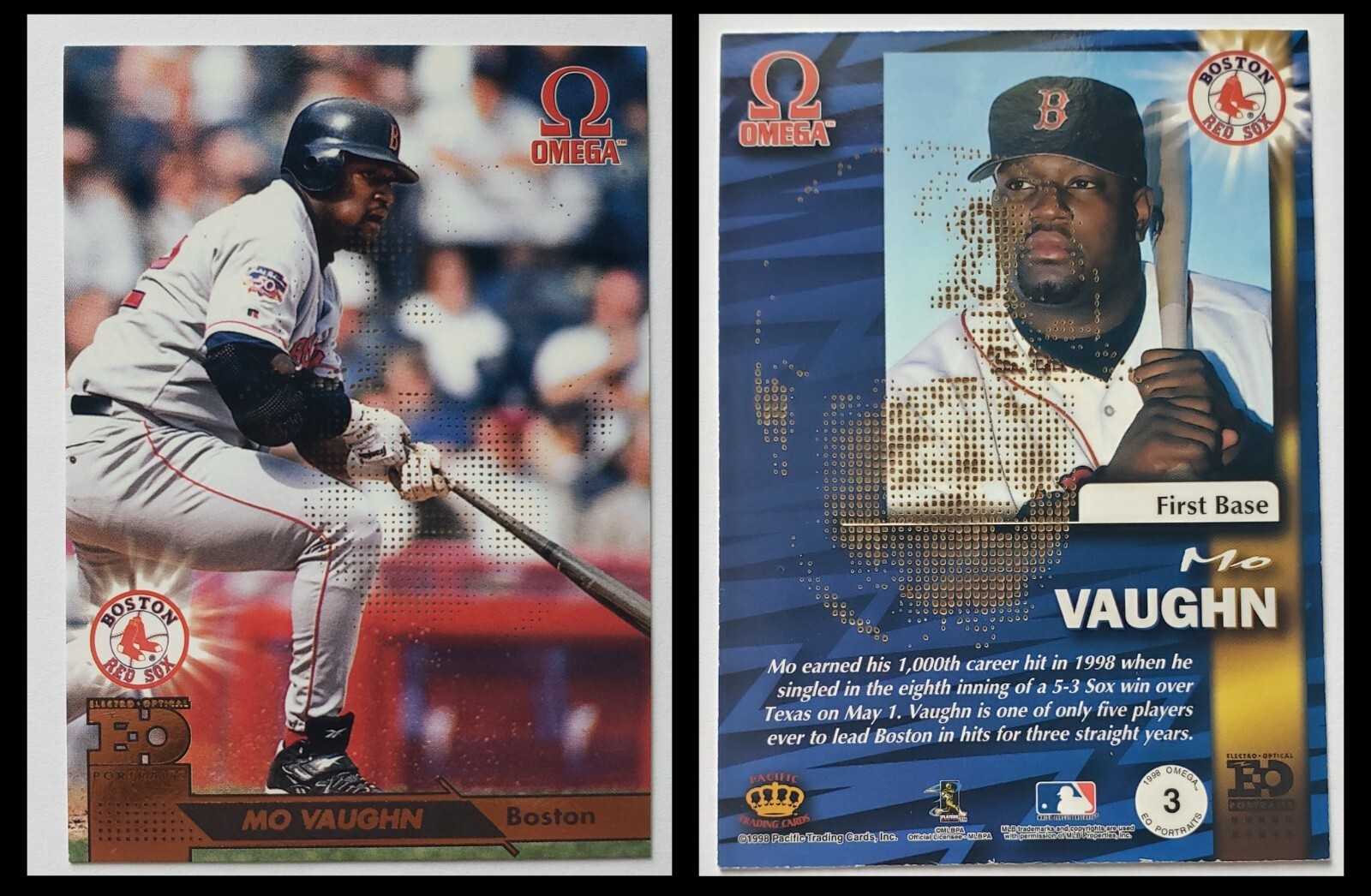
Vintage 1998 Pacific Omega MO VAUGHN #3 Baseball Card
EO Portraits
Boston Red Sox MLBStandard baseball card stock size 3.5\" x 2.5\"Near mint to mint condition. Please see pictures for details. Thanks for shopping Blue Streak Collectibles!
Maurice Samuel Vaughn (born December 15, 1967), nicknamed \"the Hit Dog\", is an American former Major League Baseball first baseman who played for the Boston Red Sox, Anaheim Angels, and New York Mets from 1991 to 2003. He was a three-time All-Star selection and won the American League MVP award in 1995 with Boston.
Early life and education
Vaughn with the Wareham Gatemen in 1988
Vaughn attended New Canaan Country School in New Canaan, Connecticut.[1] He played baseball for Trinity-Pawling School in Pawling, New York.[2][3]
Vaughn played college baseball at Seton Hall for head coach Mike Sheppard. While there he set the school record for home runs with 28. In his three years at Seton Hall he hit a total of 57 home runs and 218 RBIs, both team records.[4] His teammates included seven-time All-Star and Hall of Famer Craig Biggio, Red Sox teammate John Valentin, and Kevin Morton. Vaughn earned the Jack Kaiser Award as MVP of the 1987 Big East Conference baseball tournament while keying the Pirates\' championship run.[5]
While at Seton Hall, Vaughn played collegiate summer baseball for two years (1987–88) with the Wareham Gatemen of the Cape Cod Baseball League (CCBL), and in 2000 was named a member of the inaugural class of the CCBL Hall of Fame.[6]
At Seton Hall, his brothers in Omega Psi Phi gave him the nickname \"Hit Dog.\"[7]
Professional career
Boston Red Sox
Vaughn became the centerpiece of the Red Sox\'s line-up in 1993, hitting 29 home runs and contributing 101 RBIs. In 1995, he established a reputation as one of the most feared hitters in the American League when he hit 39 home runs with 126 RBIs and a .300 average. He also garnered 11 stolen bases. His efforts, which led the Red Sox to the playoffs (only to lose to the Cleveland Indians in the American League Division Series), were rewarded with the American League MVP award.
Vaughn had his career year with the Red Sox in 1996, playing in 161 games with a batting average of .326 and a career-high 44 home runs, 143 RBIs, 207 hits and 118 runs scored. On September 24, 1996, he hit three home runs against the Orioles, going 4–5 with five RBI in a 13–8 win. On April 15, 1997, MLB retired the number 42 to honour Jackie Robinson, but Vaughn was one of multiple players who were allowed to continue wearing the number for the rest of their careers. In a May 30, 1997, game against the Yankees, Vaughn went 4-for-4 with three solo homers in the Red Sox\'s 10–4 win.[2]
Vaughn continued to improve over the next several seasons, batting .315 or higher from 1996 to 1998 and averaging 40 home runs and 118 RBIs. The Red Sox lost in the American League Division Series in 1998, once again to the Cleveland Indians, although Vaughn played well, hitting two home runs and driving in seven runs in game one.
He was noted for \"crowding the plate\"; his stance was such that his front elbow often appeared to be hovering in the strike zone, which intimidated pitchers into throwing outside pitches.
Last season with the Sox
Though Vaughn\'s powerful personality and extensive charity work made him a popular figure in Boston, he had many issues with the Red Sox management and local media; his disagreements with Boston Globe sports columnist Will McDonough and Red Sox general manager Dan Duquette were particularly acute. As an outspoken clubhouse leader, Vaughn repeatedly stated that the concerned Sox administration did not want him around. Incidents in which he allegedly punched a man in the mouth outside of a nightclub and crashed his truck while returning home from a strip club in Providence led to further rifts with the administration.
Vaughn hit a walk-off grand slam in the ninth inning of Opening Day at Fenway Park against the Seattle Mariners in 1998. Vaughn was one half of a formidable middle of the lineup with shortstop Nomar Garciaparra. The two combined for 75 home runs in 1998, Vaughn\'s final year with the club. After the Cleveland Indians knocked Boston out of the playoffs in the first round, Vaughn became a free agent. Almost immediately, he signed a six-year, $80-million deal with the Anaheim Angels,[8] the highest contract in the game at that time.
Anaheim Angels
While he hit well for Anaheim when he played—he hit 30-plus home runs and knocked in over 100 runs in both 1999 and 2000—Vaughn was plagued by injuries in 1999 and didn\'t play a single game in the 2001 season. He started his Anaheim career by falling down the visitor\'s dugout steps on his first play of his first game, badly spraining his ankle. Vaughn was nevertheless seen as a viable middle of the line-up producer before the 2002 season and was traded to the New York Mets for Kevin Appier on December 27, 2001.
Following Vaughn\'s departure from Anaheim, Angels closer Troy Percival took a shot at him, saying \"We may miss Mo\'s bat, but we won\'t miss his leadership. Darin Erstad is our leader.\" This prompted the normally mild-mannered Vaughn to go off on a profanity-laced tirade.[9][10]
New York Mets
With the Mets, Vaughn was counted upon to be a key catalyst in a revamped lineup that featured imports Roger Cedeño, Jeromy Burnitz, and Roberto Alomar. Vaughn got off to a slow start in 2002, and he was ridiculed in local sports columns and on sports talk radio shows for being out of shape; he weighed 268 pounds during his first season in New York. However, he hit his 300th career home run on April 3 against Pittsburgh Pirates starting pitcher Kip Wells and a game winning three-run home run in the 8th inning of a game on June 16 that gave the Mets a 3–2 win over the Yankees. He hit a memorable 505-foot home run at Shea Stadium (in the middle of the \"Bud\" sign on the Shea scoreboard) on June 26, and he finished the season with 26 home runs and 72 RBI.[11]
In 2003, he played less than a month before knee problems ended the season for him. In January 2004, he announced that his knee problems would not allow him to play in the upcoming season. Vaughn\'s agent said that Vaughn was not announcing his retirement, but Vaughn acknowledged that he was unlikely to ever play again.[12]At the time of his retirement, Vaughn was one of the two final players to wear the number 42, the other being Mariano Rivera (who retired in 2013).
Career statistics
Over 12 seasons, Vaughn was in 1512 games played, compiling a .293 batting average (1620–5532) with 861 runs, 270 doubles, 328 home runs, 1064 RBI, 725 bases on balls, .383 on-base percentage and .523 slugging percentage. He had five consecutive seasons with a batting average greater than .300 (1994–98). In seven post-season games, he hit .226 (7–31) with 4 runs, 2 home runs and 7 RBI. His career fielding percentage was .988 as a first baseman.[2]
Personal life
In July 1995, Vaughn suffered an eye injury as a result of a fight at a Boston nightclub which caused him to miss two games. No charges were filed or arrests made.[13]
In January 1998, Vaughn was arrested and charged with drunk driving after crashing into a disabled car on the side of the road and struggling with field sobriety tests in Norwood, Massachusetts.[14] He was ultimately acquitted after a jury trial in March.[15]
Vaughn is a managing director of OMNI New YorK, LLC, along with Eugene Schneur, which has bought and rehabilitated 1,142 units of distressed housing in the New York metropolitan area. The company also manages these properties to provide low cost housing using government tax credits. He purchased the Noble Drew Ali Plaza in Brownsville, Brooklyn for $21 million, and plans to add massive security upgrades and renovate it.[16] He has also been involved in refurbishing the Whitney Young Manor in Yonkers, New York, a development first constructed by a company owned by his hero Jackie Robinson. Besides the New York metropolitan area, his company is also involved in projects in Cheyenne, Miami and Las Vegas and has expressed an interest in Boston.[17]
In January 2009, it had been reported by WCVB-TV in Boston that Vaughn had recently committed to investing \"$6 million in improvements to the 168-unit Sycamore Village complex that will include new appliances and exterior renovations. Vaughn said his company does not tolerate guns, drugs and criminal behavior. Planning Director Michael Sweeney said Omni\'s purchase is a \'major reinvestment\' in the city\" of Lawrence, Massachusetts.[This quote needs a citation]
Vaughn lived[when?] in Gates Mills, Ohio,[18] and was the president of a trucking company (Mo Vaughn Transport) in Solon.[19] Vaughn sold the company in 2018.
On April 18, 2013, Vaughn bought an advertisement section of The Boston Globe and used it to salute those involved in helping the victims of the April 15, 2013 Patriots Day Bombing in Boston. \"You are all heroes in my eyes\", wrote Vaughn, \"Boston will march on.\"[This quote needs a citation]
Vaughn became eligible for the National Baseball Hall of Fame in 2009. 75% of the vote was necessary for induction, and 5% was necessary to stay on the ballot. He received 1.1% of the vote and dropped off the ballot.
Performance-enhancing drugs
It was revealed on December 13, 2007, in the report by Senator George J. Mitchell that Vaughn had purchased steroids or other performance-enhancing drugs from Kirk Radomski, who said he delivered the drugs to him personally. Radomski produced three checks, one for $2,200 and two more for $3,200, from Vaughn, one of the latter dated June 1, 2001, and another dated June 19, 2001. Radomski said that the higher checks were for two kits of HGH, while the lower one was for one and a half kits. Vaughn\'s name, address and telephone number were listed in an address book seized from Radomski\'s house by federal agents. Vaughn\'s trainer instructed him to take HGH in attempt to recover from injury.
Mitchell requested a meeting with Vaughn in order to provide Vaughn with the information about these allegations and to give him an opportunity to respond, but Vaughn never agreed to set a meeting.Pacific Trading Cards, Inc. was an American trading card company founded in 1980 by Mike Cramer and known for its brightly colored, die cut cards.[1] The company invented the nine-card plastic sheets collectors use to store trading cards.[2] The company also produced memorabilia such as bobbleheads and the Ken Griffey Jr. chocolate bar.[1] The company was purchased by Playoff in 2004. In 2021, a Tom Brady rookie card produced by Pacific sold for $117,000 .[1]
Company history
Early years
Mike Cramer, the founder of Pacific Trading Cards, began collecting baseball cards at nine years old.[1] His first card was a Babe Ruth card from a nickel pack of Fleer 1960 All-Time Greats cards.[1] He began selling soda bottles and mowing lawns so that he could buy more cards, collecting over 11,000 cards by the time he was eleven years old.[1] By the time he was fifteen, Cramer had collected more than 500,000 cards.[1] He ran ads, buying and selling cards from his family home in Arizona.[1] Beginning in 1969, Cramer spent ten seasons Alaskan king crab fishing, earning and saving money which he later used to purchase his first home and found Pacific Trading Cards.[1] He married his wife, Cheryl, in 1973 in Dutch Harbor, Alaska, and she began helping him with his trading cards business, even helping him move boxes trading cards onto his boat on their wedding night.[1][2][3] In 1977, Cramer entered into a deal with Topps and purchased all of their closeout cases of cards.[1] Cramer stored truckloads of trading cards in a storage unit.[1] Cramer began running a mail-order catalog from his home in Edmonds, Washington, and began buying and selling cards full-time.[1]
1980s
In 1980, Cramer opened a trading cards store in the Perrinville neighborhood of Edmonds.[1] There was a warehouse factory across the street that began producing trading cards for the Triple-A Pacific Coast League.[1][2] Pacific was the first company to begin making plastic sheets to put trading cards in binders.[2] As the company began making cards, Cramer shot many of the card photos himself.[3]
In 1989, Cramer built a manufacturing plant in Lynnwood, Washington, which produced the company\'s cards.[1] At its height, the factory employed 230 people.[1] The company released a Ken Griffey Jr. chocolate bar in 1989 after converting one of their card-wrapping machines to wrap chocolate bars, selling almost one million bars.[1][3][4]
1990s
By 1990, Pacific was manufacturing and distributing ten lines of trading cards including Major Indoor Soccer League, Baseball Legend, and Senior Baseball League.[4] Following the success of the Ken Griffey Jr. candy bar in the year prior, Pacific also released two collector\'s candy bars named for baseball players Tony Gwynn and Wade Boggs.[4]
In 1991, Pacific received a license to produce a limited edition set of 550 NFL trading cards.[5] That year, Pacific also released a set of 110 Desert Storm trading cards featuring leaders, weapons, and soldiers involved in Operation Desert Shield.[6] Pacific released sets of non-sports trading cards for I Love Lucy[2] and the 30th anniversary of The Andy Griffith Show.[7]
In 1993, Pacific finally received its first Major League Baseball license and began producing MLB cards in the Spanish language.[2] While other companies had done bilingual French and English hockey cards, Pacific was the first company to make bilingual baseball cards in Spanish.[8]
In 1999, Pacific released the first-ever Kurt Warner and Tom Brady rookie cards.[9][3] While Cramer was in Northern California for the annual East-West Shrine Bowl, he shot dozens of photos of Brady, who was a quarterback at Michigan at the time.[3] Brady was not invited to the 2000 NFLPA Rookie Photo Shoot because he was a sixth-round pick, but Cramer used the photos he had shot and put Brady in Pacific\'s 2000 NFL sets. Pacific released its first set in May 2000, making Pacific\'s #403 Brady card the first NFL trading card ever produced of Brady.[3] The company also signed Brady to an autograph deal, getting a total of 700 cards signed.[3] In 2021, one of Tom Brady\'s Pacific rookie cards sold for $117,000.[1]
2000s
In 2000, Pacific Trading Cards released a Manny Ramirez baseball card featuring a corked bat, causing controversy.[1] Many people thought that releasing a card featuring a corked bat was a publicity stunt, but employees from Pacific claim that is not the case.[2] Cramer claims the bats were sourced from the teams and then sent away to be cut up.[2] The pieces of the bats were then sent to Great Western Press, where the baseball cards were printed.[2] The cards were finally sent back to Lynnwood and were packaged at Pacific\'s headquarters.[2] They later found out that a card with a piece of cork was sent to a dealer and Pacific immediately stopped production and went through the cards, finding a few more which were not released.[2]
In 2003, Pacific lost its NFL license.[9] The National Football League Players Association pulled Pacific\'s license after sports card shop owners complained that there were too many card brands and products.[9] By 2004, the only major license Pacific held was for the National Hockey League.[2] When the 2004–05 NHL lockout started, Cramer decided to retire and sold Pacific Trading Cards to Playoff.[1][9] Playoff was later sold to Panini Group, which continued Pacific\'s Prism line under the slightly altered name \"Prizm\".[9]
Products
Sports trading cards
Baseball
Pacific Eight Men OutPacific Legends (1985-1990)Pacific Senior League (1989-1990)Pacific Tom Seaver \"Tom Terrific\" (1991)Nolan Ryan Texas Express Series II (1991)Pacific Jugadoes Calientes (1993)Pacific Prisms (-1996Pacific Mariners (1995)Pacific Harvey Riebe (1995)Pacific Advil Nolan Ryan (1996)Pacific Marlins (1997)Aurora (1998-2000)Pacific Omega Baseball (1998)Pacific Home Run Heroes (1998)Pacific Home Run History (1998)Crown Royale Baseball (1998-2000)Revolution (1998-2000)Pacific Nestle (1998)Paramount (1998-2000)Pacific Crown Collection (1999-2000)Private Stock (1999)Pacific Vanguard (2000)Paramount Update (2000)
Football
NFL Football (1991-2003)NFL Steve Largent (1988)
Ice Hockey
NHL Hockey (-2004)
Soccer
Major Indoor Soccer League
Softball
Pacific Baerga Softball (1996-1997)
Nonsports trading cards
Wizard of Oz (1990)Operation Desert Shield (1991)I Love Lucy (1991)The Andy Griffith Show (1991)Saved By the Bell (1992)”Saved by the Bell Collage Years (1994)Rad Dudes(1991)”Leave it to Beaver”(1983)”World War II (1992)”Total Recall (1990)”Gunsmoke (1992)”Where are They” (1992)”Eight Men Out” (1988)”Garfield” (2000)”Bingo Movie” (1991)”Pukey-mon” (2000)
Chocolate bars
Chocolate bars came with a limited edition baseball card.
Ken Griffey Jr. (1989)[4]Tony Gwynn (1990)[4]Wade Boggs (1990)[4]
Memorabilia
Heads Up Bobbleheads
NHL Mini Sweaters
Memoir
In October 2023, Cramer\'s book, Cramer\'s Choice: Memoir of a Baseball Card Collector Turned Manufacturer was published by McFarland & Company.[1] Cramer began writing the book a few years prior, after he was diagnosed with a rare form of lymphoma, intending to document his life for his children and grandchildren.[1][2] Bob Uecker had originally given Cramer the idea for the book.[2] He wrote 117,000 words on an iPad, letter by letter, and later sent it to McFarland, which immediately accepted the manuscript.[1] The final product is about 90,000 words.[1]* Please note that Blue Streak Collectibles does not offer combined handling/shipping discounts for multi items. Unless noted as FREE SHIPPING, we offer a flat rate standard handling/shipping per item and utilize USPS First Class postage (or equivalent) with delivery Confirmation/Tracking (tracking numbers provided to all customers with winning offers/purchase). Many trading cards and similar items with a lesser value will be shipped via First Class postage in a standard envelope with or without tracking when possible. We may determine it is best to combine shipments based on the logistical ability to deliver quickly from time to time but do not offer discounts for doing this. Thanks for shopping B.S.C.!