When you click on links to various merchants on this site and make a purchase, this can result in this site earning a commission. Affiliate programs and affiliations include, but are not limited to, the eBay Partner Network.
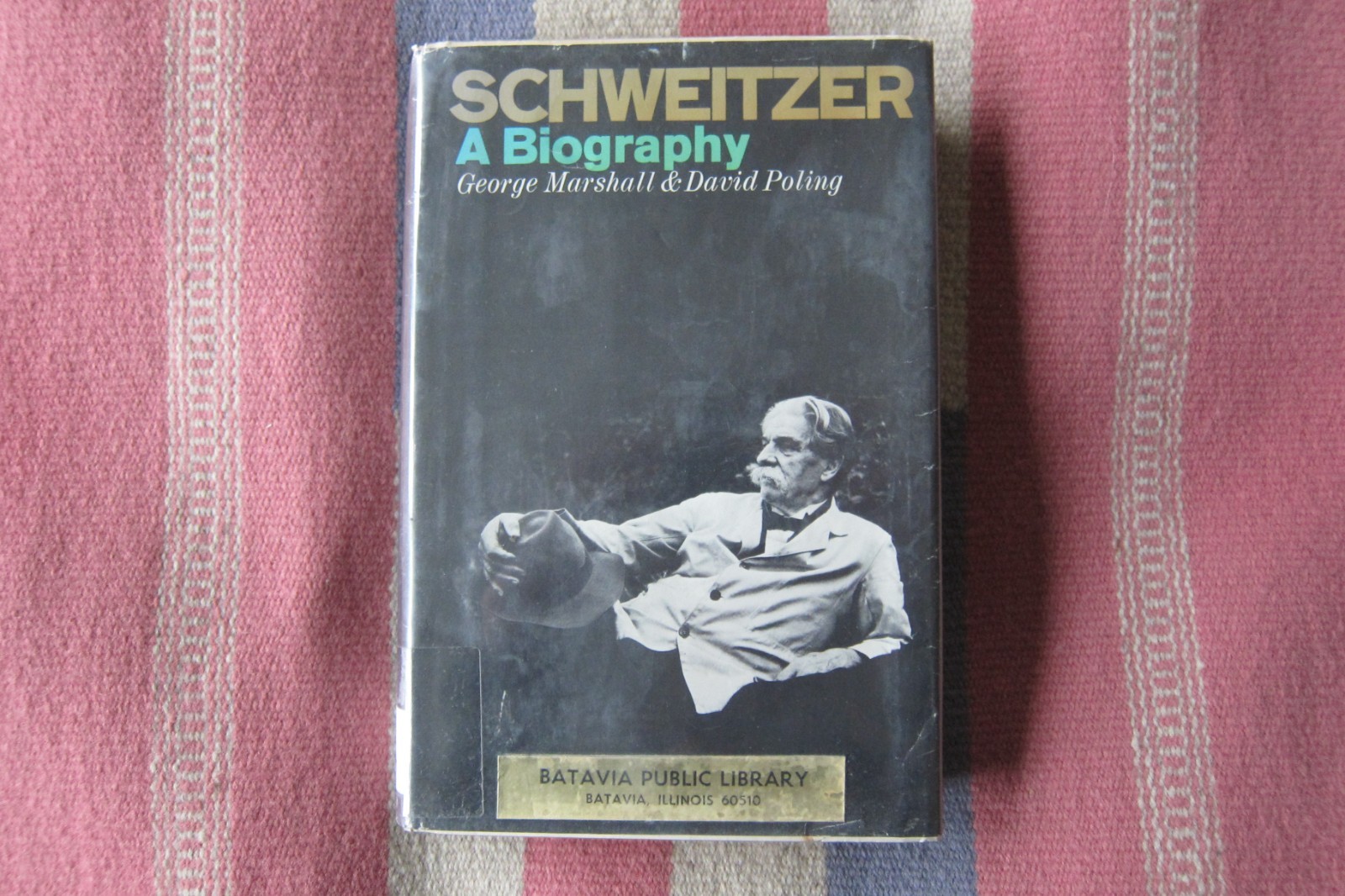
Ludwig Philipp Albert 14 January 1875– 4 September 1965) was a GermanpolymathfromAlsace. He was a theologian, organist, musicologist, writer, humanitarian, philosopher, and physician. As aLutheran minister, Schweitzer challenged both the secular view of thehistorical Jesusas depicted by thehistorical-critical methodcurrent at this time, as well as the traditionalChristian view. His contributions to the interpretation ofPauline Christianityconcern the role ofPaul'smysticismof "being in Christ" as primary and the doctrine ofjustification by faithas secondary.
He received the 1952Nobel Peace Prizefor his philosophy of "Reverence for Life",[1]becoming the eighth Frenchman to be awarded that prize. His philosophy was expressed in many ways, but most famously in founding and sustaining theHôpital Albert SchweitzerinLambaréné,French Equatorial Africa(nowGabon). As a music scholar and organist, he studied the music of German composerJohann Sebastian Bachand influenced theOrgan Reform Movement(Orgelbewegung).
Early yearsAlbert Schweitzer's birthplace inKaysersberg, now inAlsacein FranceSchweitzer in 1912. Oil on canvas painting byÉmile Schneider,Strasbourg Museum of Modern and Contemporary Art
Schweitzer was born on 14 January 1875 inKaysersbergin Alsace, in what had less than four years previously become theImperial Territory of Alsace-Lorrainein theGerman Empire. He later became a citizen of France after World War I, when Alsace became French territory again. He was the son of Adèle (née Schillinger) and Louis Théophile Schweitzer.[2][3]He spent his childhood inGunsbach, also in Alsace, where his father, the localLutheran-Evangelicalpastor of theEPCAAL, taught him how to play music.[4]The tiny village would become home to theAssociation Internationale Albert Schweitzer(AIAS).[5]
The medieval parish church of Gunsbach was shared by the Protestant and Catholic congregations, which held their prayers in different areas at different times on Sundays. This compromise arose after theProtestant Reformationand theThirty Years' War. Schweitzer, the pastor's son, grew up in this exceptional environment of religious tolerance, and developed the belief that true Christianity should always work towards a unity of faith and purpose.[6]
Schweitzer's first language was theAlsatian dialectof German. At theMulhousegymnasiumhe received his "Abitur" (the certificate at the end of secondary education) in 1893. He studied organ in Mulhouse from 1885 to 1893 with Eugène Munch, organist at the Protestant cathedral, who inspired Schweitzer with his enthusiasm for the music of German composerRichard Wagner.[7]In 1893, he played for the French organistCharles-Marie Widor(atSaint-Sulpice, Paris), for whomJohann Sebastian Bach's organ music contained a mystic sense of the eternal. Widor, deeply impressed, agreed to teach Schweitzer without fee, and a great and influential friendship thus began.[8]
From 1893 Schweitzer studiedProtestant theologyat theKaiser Wilhelm UniversityinStrasbourg. There he also received instruction in piano andcounterpointfrom professor Gustav Jacobsthal, and associated closely with Ernest Munch, the brother of his former teacher, organist of St William church, who was also a passionate admirer of J. S. Bach's music.[9]Schweitzer served his one-year compulsory military service in 1894. Schweitzer saw many operas of Richard Wagner in Strasbourg underOtto Lohse, and in 1896 he managed to afford a visit to threuth Festivalto see Wagner'sDer Ring des NibelungenandParsifal, both of which impressed him.[10]
In 1898, he returned to Paris to write a PhD dissertation onThe Religious Philosophy ofKantat theSorbonne, and to study in earnest with Widor. Here he often met with the elderlyAristide Cavaillé-Coll. He also studied piano at that time withMarie Jaëll.[10]In 1899, Schweitzer spent the summer semester at theUniversity of Berlinand eventually obtained his theology degree at theUniversity of Strasbourg.[11][12][13][14]He published his PhD thesis at theUniversity of Tübingenin 1899.[15]
In 1905, Schweitzer began his study of medicine at the University of Strasbourg, culminating in the degree of M.D. in 1913.[11][14]
Music
Schweitzer rapidly gained prominence as a musical scholar and organist, dedicated also to the rescue, restoration and study of historicpipe organs. With theological insight, he interpreted the use of pictorial and symbolical representation inJ. S. Bach'sreligious music. In 1899, he astonished Widor by explaining figures and motifs in Bach'sChorale Preludesas painter-like tonal and rhythmic imagery illustrating themes from the words of the hymns on which they were based. They were works of devotional contemplation in which the musical design corresponded to literary ideas, conceived visually. Widor had not grown up with knowledge of the oldLutheranhymns.[16]
The exposition of these ideas, encouraged by Widor and Munch, became Schweitzer's last task, and appeared in the masterly studyJ. S. Bach: Le Musicien-Poète, written in French and published in 1905. There was great demand for a German edition, but, instead of translating it, he decided to rewrite it.[17]The result was two volumes (J. S. Bach), which were published in 1908 and translated into English byErnest Newmanin 1911.[18]Ernst Cassirer, a contemporaneous German philosopher, called it "one of the best interpretations" of Bach.[19]
During its preparation, Schweitzer became a friend ofCosima Wagner, then resident in Strasbourg, with whom he had many theological and musical conversations, exploring his view of Bach's descriptive music, and playing the major Chorale Preludes for her at theTemple Neuf.[20]Schweitzer's interpretative approach greatly influenced the modern understanding of Bach's music. He became a welcome guest at the Wagners' home,Wahnfried.[21]He also corresponded with composerClara Faisst, who became a good friend.[22]
The Choir Organ atSt Thomas' Church, Strasbourg, designed in 1905 on principles defined by Schweitzer
His 1906 pamphlet "The Art of Organ Building and Organ Playing in Germany and France",[23]republished with an appendix on the state of the organ-building industry in 1927, effectively launched the 20th-centuryOrgelbewegung, which turned away from romantic extremes and rediscovered baroque principles—although this sweeping reform movement in organ building eventually went further than Schweitzer had intended. In 1909, he addressed theThird Congress of the International Society of MusicatViennaon the subject. Having circulated a questionnaire among players and organ-builders in several European countries, he produced a very considered report.[24]
This provided the basis for theInternational Regulations for Organ Building. He envisaged instruments in which the French late-romantic full-organ sound should work integrally with the English and German romanticreed pipes, and with the classical AlsaceSilbermannorgan resources and baroqueflue pipes, all in registers regulated (bystops) to access distinct voices infugueorcounterpointcapable of combination without loss of distinctness: different voices singing the same music together.
Schweitzer also studied piano underIsidor Philipp, head of the piano department at theParis Conservatory.
In 1905, Widor and Schweitzer were among the six musicians who founded theParis Bach Society, a choir dedicated to performingJ. S. Bach's music, for whose concerts Schweitzer took the organ part regularly until 1913. He was also appointed organist for the Bach Concerts of the Orféo Català atBarcelona, Spain, and often travelled there for that purpose.[16]He and Widor collaborated on a new edition ofBach's organ works, with detailed analysis of each work in English, French, and German. Schweitzer, who insisted that the score should show Bach's notation with no additional markings, wrote the commentaries for the Preludes and Fugues, and Widor those for the Sonatas and Concertos: six volumes were published in 1912–14. Three more, to contain the Chorale Preludes with Schweitzer's analyses, were to be worked on inAfrica, but these were never completed, perhaps because for him they were inseparable from his evolving theological thought.[25]
On departure for Lambaréné in 1913, he was presented with apedal piano, a piano with pedal attachments to operate like an organ pedal-keyboard.[26]Built especially for the tropics, it was delivered by river in a huge dug-out canoe to Lambaréné, packed in a zinc-lined case. At first, he regarded his new life as a renunciation of his art, and fell out of practice, but after some time he resolved to study and learn by heart the works of Bach,Mendelssohn, Widor,César Franck, andMax Regersystematically.[27]It became his custom to play during the lunch hour and on Sunday afternoons. Schweitzer's pedal piano was still in use at Lambaréné in 1946.[28]According to a visitor, Dr. Gaine Cannon, of Balsam Grove, N.C., the old, dilapidated piano-organ was still being played by Dr. Schweitzer in 1962, and stories told that "his fingers were still lively" on the old instrument at 88 years of age.
SirDonald Toveydedicated his conjectural completion of Bach'sThe Art of Fugueto Schweitzer.[citation needed]
Schweitzer's recordings of organ music, and his innovative recording technique, are describedbelow.
One of his pupils was conductor and composerHans Münch.[citation needed]