When you click on links to various merchants on this site and make a purchase, this can result in this site earning a commission. Affiliate programs and affiliations include, but are not limited to, the eBay Partner Network.
🚂 What Did It Feel Like to Bet on the Iron Horse in the Middle of a World War?🎖️
There\'s a particular kind of American optimism baked into a railroad bond — the belief that steel rails, steam power, and a signature on heavy cream paper could outlast wars, depressions, and the passage of decades. Somewhere between the coal fields of Pennsylvania and the stockyards of Chicago, an investor once held a certificate exactly like this one and trusted that a company running freight through five states would still be good for its word thirty years later.That\'s the story locked into this piece — not just a financial instrument, but a snapshot of mid-century faith in the American railroad at the very moment the nation needed its trains most.
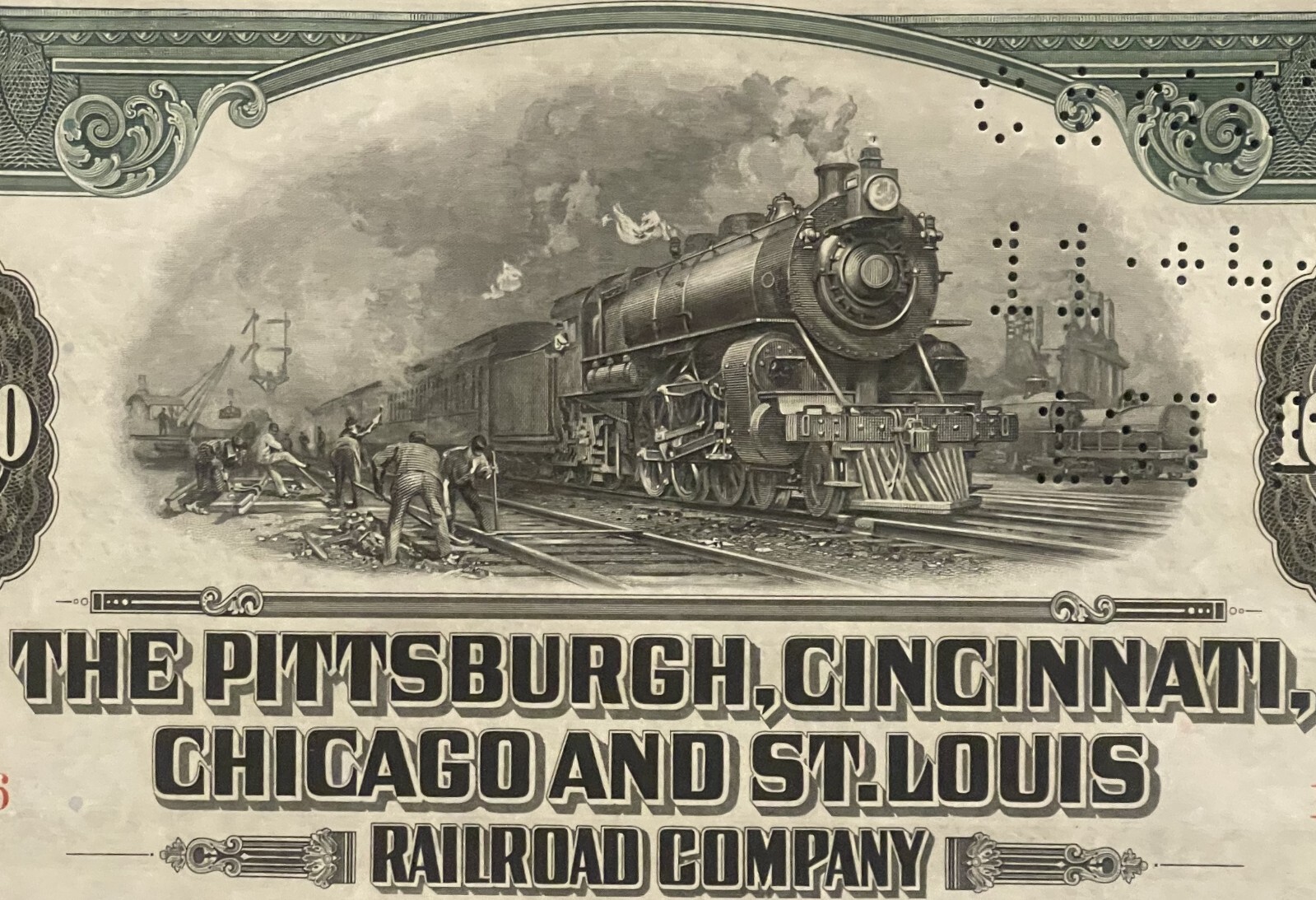
This is The Pittsburgh, Cincinnati, Chicago and St. Louis Railroad Company\'s General Mortgage 3-3/8% Bond, Series E, issued in the $1,000 denomination and carrying a printed dateline of 1944, with a stated maturity of October 1, 1975.The certificate names the City of Philadelphia, Pennsylvania, and the Borough of Manhattan, City of New York, as its offices of payment, with The Union Trust Company of Pittsburgh standing as Trustee over the mortgage. It measures a substantial 15 x 10 inches (38 x 25 cm) — genuinely oversized as far as paper Americana goes, closer in scale to a small poster than a modern document.The artwork is steel-engraved intaglio work in green and black ink against cream stock, with the certificate number rendered in red. Along the top runs an ornate, foliate green border in the finest bank-note tradition, framing a dramatic central vignette: a steam locomotive charging forward past track workers laboring along the rail bed, smoke billowing back across an industrial skyline.Dense legal paragraphs in tight black type fill the lower two-thirds of the certificate, flanked by scrollwork medallions bearing the $1,000 denomination in each upper corner. Collectors will notice the neat punch-cancellation running through the piece — the trustee\'s formal mark retiring the bond, a common and expected feature on surviving certificates of this kind, and part of why so many of these handsome engravings have come down to us intact for today\'s collectors rather than being lost entirely.
🛤️ The Panhandle Route: Pennsylvania Railroad\'s Western Backbone
Railroad old-timers and scripophily collectors alike know this company by its nickname long before they know its formal name: the Panhandle Route.The name came from geography, plain and simple — the railroad\'s main line ran west out of Pittsburgh, sliced through the narrow northern panhandle of West Virginia (a sliver of land barely ten miles wide), and pushed on into Ohio. From there the route split in two: one line running north toward Chicago, the other swinging south through Indianapolis to East St.Louis. Together those lines stitched together some of the most important industrial centers of the American Midwest — coal country, steel country, and the grain and stockyard economy of the Illinois prairie — into a single continuous ribbon of track under Pennsylvania Railroad control.
By the time this bond was printed, the Panhandle wasn\'t a modest regional line — it was one of the largest operating components of the entire Pennsylvania Railroad system west of Pittsburgh.Federal valuation surveys conducted by the Interstate Commerce Commission recorded the company owning and operating roughly 2,600 miles of standard-gauge, steam-operated track across Pennsylvania, West Virginia, Ohio, Indiana, and Illinois, with several hundred additional miles used but not owned outright.The main stem between Pittsburgh and Chicago carried double track — in places triple and quadruple track near the terminals — a clear sign of just how much freight and passenger traffic this artery was built to absorb. This was not a sleepy branch line; it was one of the busiest corridors feeding America\'s industrial heartland.
🏗️ From Scattered Pioneer Lines to a Trunk Line West
The company on this bond didn\'t spring up overnight — it was decades in the making, built from a tangle of smaller nineteenth-century railroads knitted together by the Pennsylvania Railroad\'s westward ambitions.Its earliest building blocks — the Pittsburgh and Steubenville, the Steubenville and Indiana, and the Hollidays Cove Railroad — go back to the 1840s through 1860s. Legend among railroad historians holds that Virginia was reluctant to let a Pennsylvania line cross its narrow northern panhandle at all, which is exactly why the Hollidays Cove Railroad was separately chartered in 1860 just to carry the route across that seven-mile strip of land.A new bridge over the Ohio River in 1865 finally tied the pieces together into a through-route from Pittsburgh to Columbus, and by 1868 those component lines had merged into the Pittsburgh, Cincinnati and St. Louis Railway.
The westward expansion continued through 1869 and 1870, when leases and completions extended the line all the way to East St.Louis via Indianapolis. A larger 1890 consolidation folded in the Cincinnati and Richmond Railroad and the Jeffersonville, Madison and Indianapolis Railroad, forming the Pittsburgh, Cincinnati, Chicago and St. Louis Railway — note the word \"Railway.\" The company that actually issued this bond came later still: a December 1916 merger (effective January 1, 1917) combining that Railway with the Vandalia Railroad, the Pittsburgh, Wheeling and Kentucky Railroad, the Anderson Belt Railway, and the Chicago, Indiana and Eastern Railway, forming the Pittsburgh, Cincinnati, Chicago and St.Louis Railroad. That distinction between \"Railway\" and \"Railroad\" matters to a careful collector — the corporation on this certificate is the 1917 \"Railroad\" entity, consistent with a bond dated nearly three decades later in 1944.
🎖️ Wartime Iron, Wartime Money
By 1921 the Pittsburgh, Cincinnati, Chicago and St.Louis Railroad had been formally leased to the Pennsylvania Railroad, folding its operations into the larger PRR system while retaining its own corporate identity and its own mortgage obligations — this bond among them. That structure explains a detail worth noting for collectors: bonds in this series carry a guarantee from The Pennsylvania Railroad Company itself, meaning the credit strength behind this Series E issue rested on the parent PRR system as much as on the Panhandle name printed across the top.When this bond\'s series was dated in 1944, America was deep into the Second World War, and railroads across the country were running at capacities not seen since. Coal, steel, troops, and mail all moved by rail in volumes that strained aging infrastructure, and companies like the Panhandle turned to general mortgage bonds precisely like this one to raise the capital for bridges, yards, locomotives, and track improvements — the unglamorous backbone work that kept trains moving for a home front and a war effort that depended on them completely.An investor who purchased a bond like this wasn\'t simply banking on a company; they were banking on the railroad\'s near-total indispensability to the nation, semi-annual interest payable every April 1 and October 1 for three and a quarter decades to come.
🖋️ The Engraver\'s Hand and the Trustee\'s Seal
The artistry on this bond comes from the American Bank Note Company, long regarded as one of the most prolific and skilled security engravers in American history.Firms like American Bank Note built their reputation on exactly this kind of steel-engraved intaglio work — dense, hand-cut vignettes and elaborate borderwork originally designed to defeat counterfeiters, which is precisely why bonds and stock certificates from this era so often double as genuine works of graphic art. The locomotive vignette on this piece, with its plume of engine smoke and its line of track workers laboring in the foreground, is a wonderful example of that engraving tradition at its finest — dramatic, detailed, and built to be admired as much as trusted.
Overseeing the mortgage itself was The Union Trust Company of Pittsburgh, named on the certificate as Trustee — the fiduciary institution standing between the railroad company and its bondholders, certifying that this bond was one of a properly authorized series secured under the underlying mortgage.That kind of layered structure — issuer, trustee, and guarantor all named plainly on a single sheet of paper — is part of what makes these old railroad bonds such satisfying reading for anyone curious about how American infrastructure was actually financed in the pre-computer age.
📉 Merger, Penn Central, and the Panhandle Trail Today
The Panhandle\'s independent corporate life came to a formal close on April 2, 1956, when the Pittsburgh, Cincinnati, Chicago and St.Louis Railroad was merged into the Pennsylvania Railroad\'s Philadelphia, Baltimore and Washington Railroad — a full nineteen years before this bond\'s stated 1975 maturity. That\'s part of the intrigue of holding a piece like this today: the obligation on the paper outlived the company whose name it bears. The broader PRR system itself didn\'t fare much better in the long run.In the late 1960s the Pennsylvania Railroad merged with the New York Central to form the short-lived and famously troubled Penn Central, which collapsed within a few years, prompting the federal government to organize Conrail in the mid-1970s to keep freight moving across the industrial Northeast and Midwest. Conrail eventually judged large stretches of the old Panhandle route redundant to its needs and abandoned them.
Today, a real and rideable legacy survives: the Panhandle Trail, a recreational path for cyclists and walkers in the Pittsburgh area, follows a stretch of this very railroad\'s former right-of-way.It\'s a fitting afterlife for a line that once carried coal, steel, soldiers, and mail — the roadbed still tracing the same path west out of Pittsburgh, just at a much gentler pace than the locomotive charging across this certificate\'s vignette.
🖼️ Display Ideas
- 🖼️ Framed on its own in a simple black or wood frame — the green borderwork and locomotive vignette carry a wall beautifully without any additional matting
- 🚂 Paired with vintage railroad timetables, station photographs, or ticket stubs for a themed train-room gallery wall
- 🏢 Displayed in a home office or den alongside other pieces of financial Americana — stock certificates, ledgers, or antique currency
- 🎁 Given as a one-of-a-kind gift for a railroad enthusiast, history buff, or anyone with ties to Pittsburgh, Ohio, or the industrial Midwest
- 🍺 Hung in a bar, workshop, or man cave as instant conversation-starting wall art with genuine historical weight behind it
🎁 Who Collects These
Railroad bonds like this one sit at a genuinely fun crossroads of collecting interests. Scripophily collectors — people who collect antique stock and bond certificates as a hobby in their own right — prize a $1,000 denomination general mortgage bond from a named Pennsylvania Railroad subsidiary as a solid, well-documented mid-century issue. Railroad history buffs want a direct paper artifact connecting them to the Panhandle Route and the cities that grew up along it — Pittsburgh, Steubenville, Columbus, Indianapolis, Chicago. Americana and ephemera collectors are drawn simply to the engraving itself — the steam locomotive vignette is the kind of imagery that stands entirely on its own as vintage industrial design, whether or not the buyer knows a single fact about mortgage bonds.And for anyone building a themed gift around trains, Pittsburgh heritage, or wartime American history, a piece like this offers a story with real depth behind it rather than a generic decoration.
❓ FAQWhat exactly is a \"general mortgage bond\"?
It\'s a corporate debt instrument secured by a mortgage against the company\'s physical property — in this case, the Panhandle\'s rail lines, yards, and equipment.The company promised to repay the $1,000 principal at maturity and pay semi-annual interest in the meantime, with the Trustee (Union Trust Company of Pittsburgh) overseeing the arrangement on bondholders\' behalf.
Is this an active, redeemable bond?
No — the issuing railroad merged into the Pennsylvania Railroad system in 1956, and the bond\'s stated maturity of October 1, 1975, has long since passed.Today this certificate exists purely as a collectible historical artifact, not a financial instrument with any remaining monetary claim.
What does \"Panhandle Route\" actually refer to?
It\'s the railroad\'s own popular nickname, earned because its main line crossed the narrow northern panhandle of West Virginia between Pittsburgh and Ohio.Railfans and old-timers used the name so consistently that it\'s still how most people refer to this company today, even more than its full formal name.
Why does the certificate mention both Philadelphia and New York?
The bond was payable, at the bondholder\'s option, either at the railroad\'s office in Philadelphia, Pennsylvania, or at its agency in the Borough of Manhattan, City of New York — standard practice for giving investors flexibility on where to collect principal and interest.
What does the punch-cancellation mean?
It\'s the trustee\'s formal mark retiring the bond from active status — a routine and expected feature on surviving bonds from this era, not a defect or alteration.
How does this connect to the Pennsylvania Railroad?
The Pittsburgh, Cincinnati, Chicago and St.Louis Railroad was leased to the Pennsylvania Railroad starting in 1921 and operated as a PRR-controlled subsidiary from that point forward, with this bond series guaranteed by the Pennsylvania Railroad Company itself.
Is any part of the original railroad still around today?
Yes — a portion of the old right-of-way near Pittsburgh now forms the Panhandle Trail, a recreational path for cyclists and pedestrians tracing the same route the locomotives once ran.
These are issued instruments rather than blanks. Bonds and debentures of this type were registered to a holder, authenticated by the trustee, and punch- or cut-cancelled when they were finally redeemed. Expect financial writings, markings, stamps, hole punches and staple holes as part of the life of the instrument: endorsements and signatures, trustee and registrar stamps, revenue or documentary tax stamps, cancellation punches, staple holes from being bound into a transfer book, pencil ledger notations. That is the paper trail of a security that actually did its job, and it is what separates a document that lived from a blank that never did. No two are alike: holder details, serial numbers, dates, signatures, stamps and punch patterns vary from example to example, so the photographs show the type rather than the exact sheet that ships.