When you click on links to various merchants on this site and make a purchase, this can result in this site earning a commission. Affiliate programs and affiliations include, but are not limited to, the eBay Partner Network.
What Would It Feel Like to Hold a Century-Long Promise, Written in Gold? 🚂
There's a particular kind of weight to paper like this — not physical weight, though at 15 x 10 inches it's a substantial sheet, but historical weight. This is a document that once stood behind real capital, real risk, and real faith in the biggest, richest, most consequential industrial machine 19th-century America ever built: the railroad empire of Cornelius Vanderbilt. Unfold one of these and you're looking at a promise that was, quite literally, payable in gold coin of the United States — a promise the New York Central and Hudson River Railroad Company made to its bondholders on February 4, 1898, with a maturity date so far out (1998) that whoever bought it in 1898 knew they were buying something meant to outlive them.
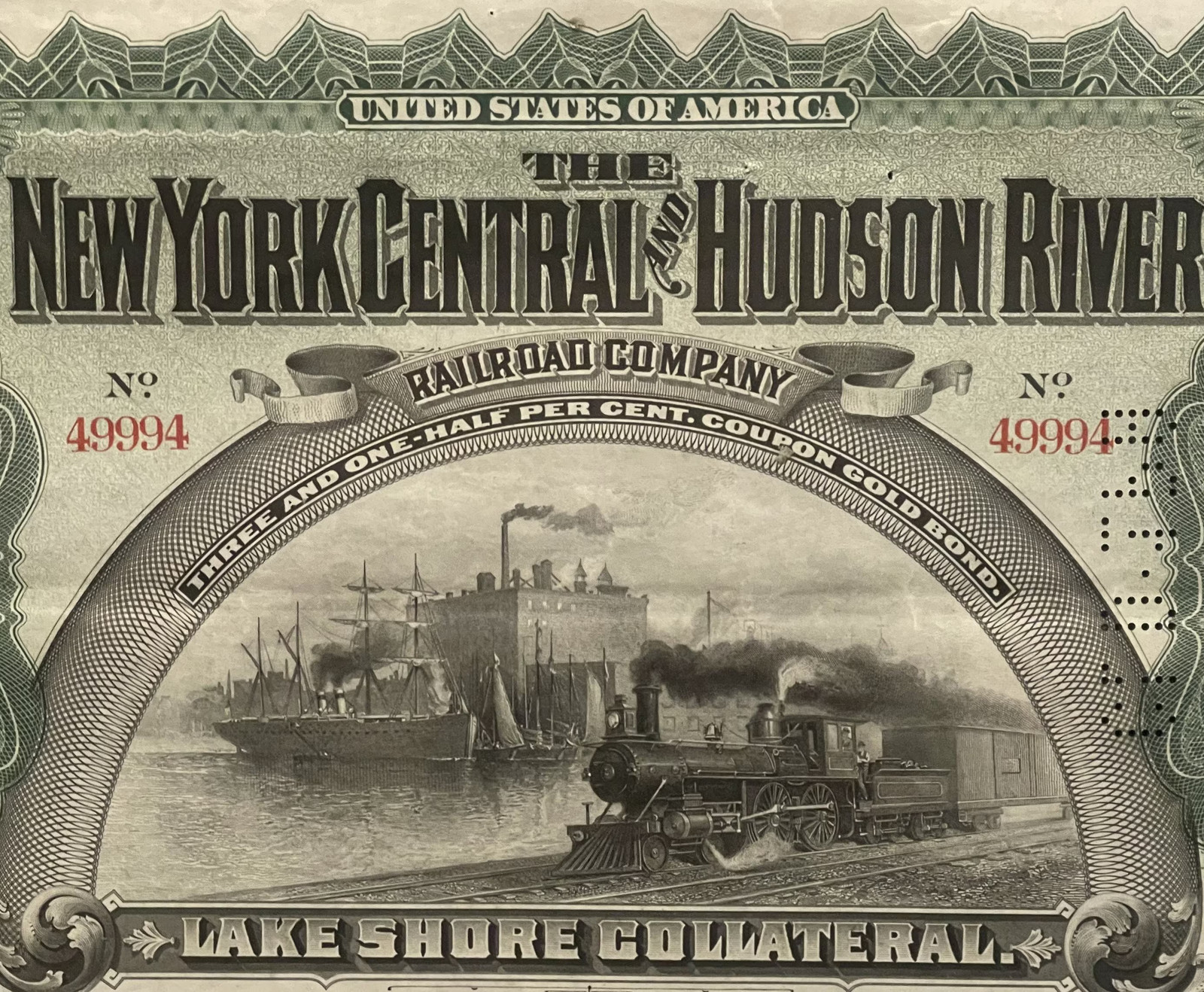
This is a $1,000 gold bond certificate issued by The New York Central and Hudson River Railroad Company of New York City — part of a "Three and One-Half Per Cent. Coupon Gold Bond" issue known formally as the Lake Shore Collateral series, with the indenture printed to February 4, 1898. Certificates in this series measure 15 x 10 inches and carry the long, uncut sheet of attached semi-annual gold coupons — small tear-off promises of interest, each one dated for its own future redemption day decades out. The engraving, executed by the American Bank Note Company of New York, centers on an arched vignette of a wood-burning locomotive and boxcar rolling past a bustling harbor of steamships and sailing vessels beside a smoke-stacked warehouse — a deliberate pairing of rail and water traffic, since this railroad's entire identity was built on running its rails alongside a navigable river. The image sits inside elaborate green-and-black lathework borders and dense ornamental script lettering, with the issue's identifying numbers picked out in red — the hallmark of a security document produced by one of the finest bank note engravers of the age.
🚂 The Vanderbilt Railroad Behind the Bond
The corporate name on this certificate — "New York Central and Hudson River Railroad Company" — is itself a piece of merger history. The lineage traces back to the Mohawk and Hudson Railroad, chartered in 1826 and opened in 1831 to let travelers bypass the slow, lock-heavy Erie Canal between Schenectady and Albany. In 1853, Albany businessman and mayor Erastus Corning consolidated ten separate New York State railroads into a single New York Central line running Albany to Buffalo. Cornelius Vanderbilt — who had built his fortune and earned the nickname "Commodore" running the largest schooner on the Hudson River decades before he ever touched a railroad — took control of that Central line in 1867, and on November 1, 1869, merged it with his own Hudson River Railroad to form exactly the company named on this bond: the New York Central and Hudson River Railroad.
That same legislative act folded in Vanderbilt's Midwestern holdings too — the Lake Shore and Michigan Southern Railway, the Canada Southern, and the Michigan Central — setting up the very transaction this 1898 bond exists to document. According to the railroad's own annual report, the Board authorized on February 4, 1898 the purchase of all $50,000,000 of Lake Shore & Michigan Southern capital stock, to be paid for with $100,000,000 in these gold bonds, maturing a full century later on February 1, 1998, at 3½% interest payable each February and August — with the acquired Lake Shore stock itself pledged as collateral security to the Guaranty Trust Company of New York as trustee. That's the "Lake Shore Collateral" printed on the certificate: this bond isn't generic railroad paper, it's the actual instrument by which the New York Central absorbed its longtime Midwestern partner outright, one $1,000 bond for every five shares of Lake Shore stock.
1898 turned out to be a genuine turning point in the boardroom, too. The same year this bond was issued, Samuel R. Callaway — president of the very Lake Shore & Michigan Southern being absorbed — succeeded Chauncey Depew as president of the New York Central. And Cornelius Vanderbilt II, grandson of the Commodore, stepped down from the chairmanship that same year, having been sidelined by a paralytic stroke in 1896; he would die the following year. So this bond was signed into existence at the exact moment the Vanderbilt family itself was handing off day-to-day control of the empire it had built.
🪙 Why "Gold," Specifically
The word "gold" stamped across this certificate wasn't decoration — it was a pointed financial promise. Five years earlier, the Panic of 1893 had been driven in large part by overleveraged American railroads and a Treasury gold reserve that dipped below $100 million, sparking real fear the country might be forced off the gold standard altogether. By 1898, with that crisis still fresh in investors' memory, a railroad explicitly promising to pay both principal and interest "in gold coin of the United States, of the standard existing February 1, 1898, without deduction for taxes" was making a very deliberate, very of-the-moment reassurance to the bondholders — American and foreign alike — who were being asked to trust their capital to this company for the next hundred years.
🗺️ The Water Level Route
The "Hudson River" half of the company's name describes real, celebrated engineering. In 1847, civil engineer John B. Jervis surveyed a line from Lower Manhattan up the east bank of the Hudson — a route later engineers would call the only water-level break in the entire Appalachian mountain chain, and one still regarded as one of America's finest pieces of track structure. It opened in stages between 1849 and 1851, and Vanderbilt's own railroad bridge across the Hudson at Albany, completed in 1866, finally made the line profitable enough to justify his 1867 takeover. The resulting corridor — running the Hudson, the Mohawk Valley, and the shores of the Great Lakes — earned the New York Central its famous nickname across the whole industry: the "Water Level Route," prized for gentle grades under half a percent while rivals like the Pennsylvania Railroad and Baltimore & Ohio were blasting tunnels and climbing horseshoe curves through the mountains. It's easy to imagine why the engraver chose to put a locomotive rolling past tall-masted ships in a harbor at the top of this very certificate — rail and river traffic really did run side by side down this whole corridor.
✒️ The Engraver's Own Story
The American Bank Note Company, credited with this certificate's engraving, was itself born of crisis: seven rival New York engraving firms merged in 1858 in the aftermath of the Panic of 1857, largely to jointly combat the rampant counterfeiting plaguing the young republic's patchwork of bank-issued currency. By 1898, the firm operated out of its Trinity Place plant in Lower Manhattan's financial district — the New York Stock Exchange itself required that certificates be engraved by a "responsible" security printer, and American Bank Note was chief among the firms that rule was built around. This is also the very company credited with patenting the green ink used on the backs of Civil War–era United States Notes, the origin of the enduring nickname "greenbacks" — a small but genuine thread connecting the same engraving house behind this certificate to the visual DNA of American paper money itself.
📉 What Became of the Line
The New York Central remained one of the two dominant railroads of the Northeast for decades, but postwar competition from automobiles and airlines eventually forced it into a 1968 merger with its old rival, the Pennsylvania Railroad, forming Penn Central. That merger proved disastrous, and in June 1970 Penn Central filed what was then the largest corporate bankruptcy in American history — a collapse the federal government answered by creating Conrail in 1976. It's a genuinely striking coincidence that this very bond series was written to mature in 1998 — decades after the railroad that issued it had already ceased to exist under its own name. Lore passed down among railroad-paper collectors holds that very few of these long-dated gold bonds were ever actually redeemed for gold as printed, since the country left the gold standard for domestic transactions in 1933 — meaning documents like this one outlived not just the promise of gold payment, but the company that made it.
🖼️ Display Ideas
- 🖼️ Framed under glass alongside a magnifying glass, so the engraved lathework and coupon detail can really be studied
- 🚉 Displayed in a home office, den, or railroad-themed room as a centerpiece of American industrial history
- 🏛️ Featured in a depot museum, historical society, or local railroad heritage display
- 🎓 Used as a teaching piece for lessons on the Gilded Age, the gold standard, or the rise of American rail
- 🎁 Given as a milestone gift to a railroad enthusiast, history buff, or finance-minded collector
- 📚 Paired with other Vanderbilt-era or Water Level Route ephemera in a curated scripophily collection
🎁 Who Collects These
Scripophily collectors — those who collect historic stock and bond certificates for their artistry and history rather than any remaining monetary value — are the natural home for a piece like this. So are railroad historians and Vanderbilt-era enthusiasts, engraving and bank-note-history buffs drawn to American Bank Note Company's craftsmanship, Hudson Valley history lovers with a connection to the Water Level Route corridor, and anyone furnishing a depot museum, rail-themed office, or den who wants a genuine piece of 19th-century American industrial finance on the wall rather than a reproduction.
❓ FAQIs this a real, historically issued bond?
Yes — this is a genuine certificate from the New York Central and Hudson River Railroad Company's 1898 gold bond issue, engraved by the American Bank Note Company, tied to the documented 1898 acquisition of the Lake Shore & Michigan Southern Railway.
Does it still have any monetary/redemption value as a bond?
No — these are collected today purely as historical Americana and scripophily, not as negotiable financial instruments.
Are the coupons attached?
Certificates in this issue include their long sheet of semi-annual gold interest coupons, printed with their own future payment dates.
Coupons were made to be clipped away, and most bonds of this age lost theirs one payment at a time until only the certificate was left, so a sheet that came through the decades still attached is the exception rather than the rule. When a road went under, holders commonly taped the last coupon back onto the bond and held on in hope of collecting what they were owed, so a bond that still carries that taped final coupon is the better one to end up with. The coupon count can run a few more or a few fewer than what is pictured.
An issued certificate picks up the marks of its working life: endorsements and signatures on the reverse, transfer-agent and registrar stamps, revenue or documentary tax stamps, punch or cut cancellations at redemption, staple holes from being bound into a transfer book, and pencil ledger notations. Those marks are the paper trail of a financial instrument that actually did its job.
What does "Lake Shore Collateral" mean?
It refers to the fact that this bond issue was secured by New York Central's own holding of Lake Shore & Michigan Southern Railway stock, pledged to a trustee as collateral — the exact mechanism by which the Lake Shore line was absorbed into the New York Central system in 1898.
How big is the certificate?
It measures 15 x 10 inches (approximately 38 x 25 cm).
Who engraved it?
The American Bank Note Company of New York, one of the leading security printers of the era and the firm credited with introducing the green ink that gave "greenbacks" their name.
Is this connected to the modern Penn Central or Amtrak?
The New York Central eventually merged into Penn Central in 1968, which collapsed into bankruptcy in 1970 and was absorbed into Conrail in 1976 — this certificate predates all of that by seven decades and documents the railroad in its original, independent Vanderbilt-era form.