When you click on links to various merchants on this site and make a purchase, this can result in this site earning a commission. Affiliate programs and affiliations include, but are not limited to, the eBay Partner Network.
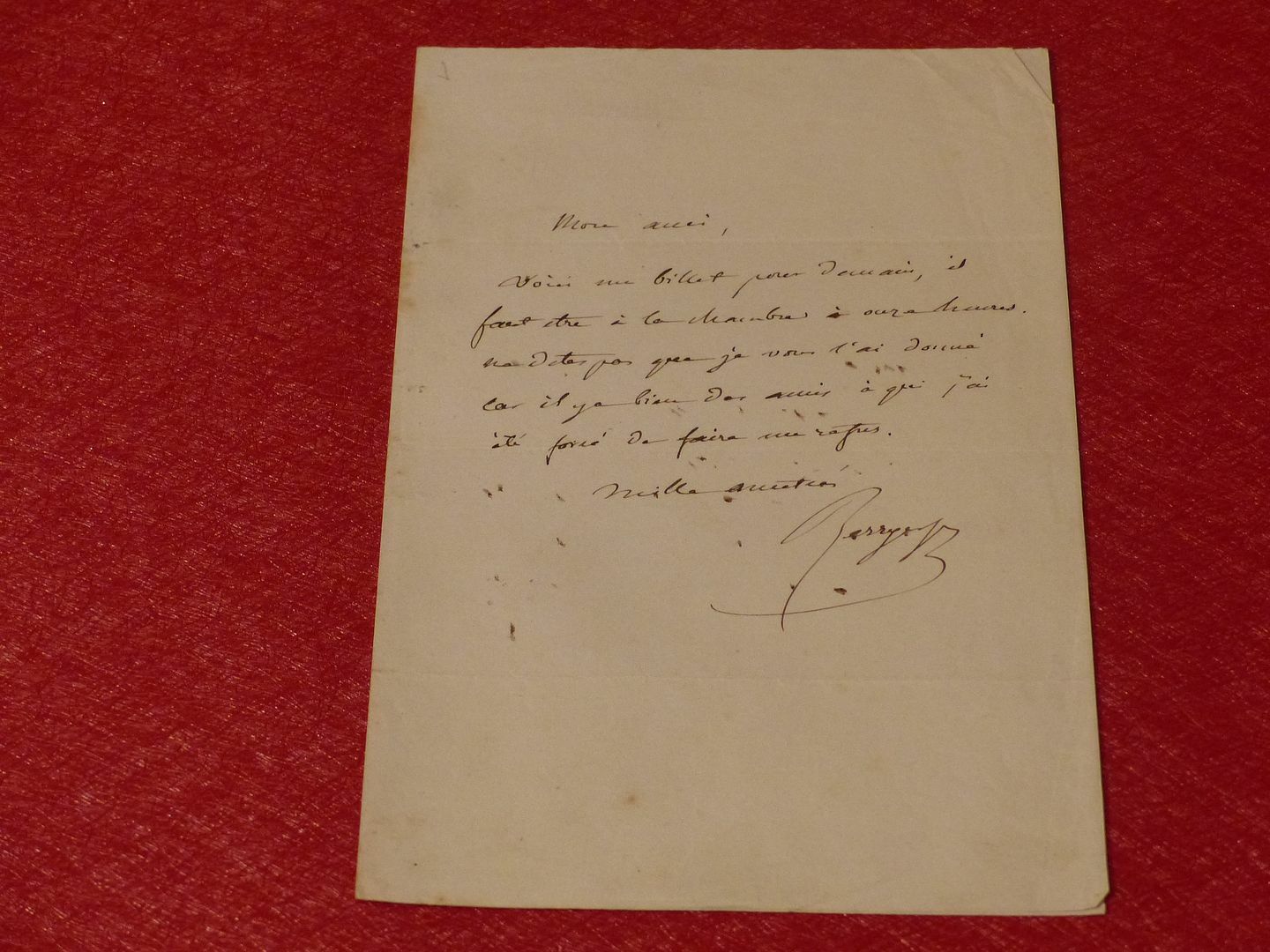
[AUTOGRAPHED LETTER - FRENCH POLITICIAN 19th C. - LAWYER]
-
1 sheet of white paper
\"Here is a ticket for tomorrow, you have to be in the Chamber at 11 a.m.; don\'t say that I gave it to you, because there are many friends to whom I was forced to Berryer
Member of Parliament for Bouches-du-RhôneMay 31, 1863 - November 29, 1868
PresidentParis Bar Association1852-1854
Chairman of the supervisory commission of the Caisse des Dépôts et Consignations1849-1852
Member of Parliament for Bouches-du-RhôneJune 21, 1834 - December 2, 1851
Deputy for Haute-LoireJanuary 26, 1830 - May 25, 1834
Armchair 4 of the French Academy
Politician, lawyerOwner of Augerville CastlePolitical party: LegitimismMember of: Ebroician AcademyCommission on Public Assistance and WelfareFrench Society for the Abolition of Slavery
Master: William of BonnemantArchives kept by National Archives
Pierre-Antoine Berryer, known as “Berry son”, born January 4, 1790 in Paris and died November 29, 1868 in Augerville-la-Rivière, is a French lawyer and politician. He is buried in from the Berryer family, Pierre-Antoine is the son of the lawyer Pierre-Nicolas Berryer (1757-1841) and brother of General Hippolite-Nicolas Berryer, Pierre-Antoine Berryer was a fairly mediocre student among the oratorians of the college of Juilly. He was destined for the ecclesiastical state, but his father, who had recognized in him the qualities of an orator, thwarted his vocation and made him study law. His tutor was Guillaume de Bonnemant (1747-1820), a lawyer in Arles and ex-member of the Constituent Assembly, and studied the procedure with a lawyer named Normand. While still a student, on December 10, 1811, he married Caroline Gauthier, daughter of the administrator of military provisions of the Paris division. Around the same time, he published a pamphlet of verses in which he enthusiastically celebrated the entry into Paris of Napoleon I and Marie-Louise, and started at the bar shortly after.
A brilliant career as a lawyerContrary to his father\'s expectations, his beginnings were lackluster. From 1812, he began to display royalist opinions; the military disasters of the end of Napoleon\'s reign finally attached him definitively to the legitimist opinions that he defended throughout his life. In 1815 he joined the royal volunteers and made, it is said, the journey to Ghent during the Hundred Days.
Under the Second Restoration, he established his reputation by defending personalities of the Empire. He was deputy to his father and to the elder Dupin to defend Marshal Ney before the court of peers, condemned and executed on December 7, 1815. The following year, he pleaded in favor of Generals Debelle and Cambronne, whom he escaped the death penalty.
He pleaded in numerous press cases, defending the newspapers Le Drapeau blanc, le Journal des Débats, and La Quotidienne. He defended Generals Canuel and Donnadieu, accused of excessive violence during the repression of the insurrections in Lyon (1817) and Grenoble (May 4, 1816) respectively. During the trial of General Donnadieu, he completely separated himself from the ministry and published a very violent memoir against Decazes in which he accused the government of having fomented the insurrection. He also represented the interests of Chedel, illegally imprisoned by the prefect of police Jules Anglès, of Nérac, of Séguin against Ouvrard. He also defended before the Paris Assize Court Dr Edme-Samuel Castaing, accused of the murder of Hippolyte and Auguste Ballet (1823).
In 1826, he represented Lamennais, prosecuted for the ultramontanism of his essay entitled On religion considered in its relations with the political and social order. The following year, he published a pamphlet against the ordinance submitting the minor seminaries to the inspection of the University.
Under the July Monarchy, he defended Chateaubriand (1833), imprisoned for having campaigned for the release of the Duchess of Berry, and was part of the defense council of Prince Louis Napoleon Bonaparte tried before the Chamber of Peers (September 26-October 6, 1840) after the Boulogne-sur-Mer expedition. He advocated for the Gazette de France, La Quotidienne, Le Rénovateur, etc. But his political career made him neglect the bar to the point that he had to put up for sale, on August 6, 1836, his property in Augerville-la-Rivière, which was bought back by subscription and returned to him.
Re-elected under the Second Republic, he sits on the assistance commission and public welfare chaired by Thiers.
Under the Second Empire, he left political life and returned to the bar which appointed him president in 1854. He pleaded in the cases of Célestine Boudet, Mme de Caumont La Force (1855) and Jeufosse (1857) and defended Montalembert (1858).
A defender of the elder branch of the Bourbon
Vice-president of the electoral college of the 2nd arrondissement of the Seine since 1822, Berryer did not delay to enter politics. After the death of Georges Marcelin Chabron de Solilhac (1769-1829), deputy for Haute-Loire, the legitimist party thought of him to replace him; he was just of the required age (40 years), but it was necessary to help him so that he could prove his eligibility: with the help of his friends, he bought the land of Augerville-la-Rivière (Loiret) and was, on January 26, 1830, elected by a large majority by the Haute-Loire departmental college.
He approached the platform of the Chamber of Deputies for the first time on March 9, 1830, in the discussion of the address of 221 against the Polignac ministry. Amid the applause of the right and the cries and interruptions of the left, he heartily defended the crown and attacked very strongly the Lorgeril amendment:
“I am not surprised,” he concluded, “that, in their difficult work, the drafters of the project said that they felt condemned to use such language to the king; and I too, more concerned with the cares of the future than with the resentments of the past, I feel that if I adhered to such an address, my vote would weigh forever on my conscience like a desolate condemnation...\"“This is a power,” Royer-Collard is said to have said at the end of this session, speaking of the speaker. Berryer declined the offer made to him of a ministerial portfolio in the Polignac cabinet, was re-elected on July 5 by the 3rd electoral district of Haute-Loire.
A leader of French legitimism
After the July Revolution, Berryer became one of the main opposition speakers. On August 7, 1830, he protested in the Chamber of Deputies against the events and contested that the deputies had the authority to deliberate on the vacancy of the throne and elect a new king. He nevertheless took the oath of loyalty required by the charter of 1830, but began a fierce war against the July Monarchy. It opened with the discussion relating to the indictment of the former ministers of Charles X and continued, from then on, on all occasions.
Skillfully taking advantage, in the interest of his cause, of the revolutionary origins of the new monarchy, Berryer undertook to push it to the extreme consequences of popular sovereignty and demanded, as opposition deputy, the application of the jury to press offenses, the appointment of mayors by the municipalities, the abolition of the census. He did, however, support the hereditary nature of the peerage.
When the Duchess of Berry came to France to organize a royalist insurrection in Vendée in 1832, the leaders of the legitimist party sent Berryer to try to dissuade her. He met her on an isolated farm and had a long conversation with her in which he used his eloquence in vain. The duchess persisted in her plans which ended in complete defeat. Berryer himself was arrested, taken to Nantes from brigade to brigade and held incommunicado. He was going to be brought before a military commission when the protest of the bar association, through the voice of its president, François Mauguin, caused him to be referred to the Loir-et-Cher assizes which acquitted him after a one-minute deliberation. Bravos greeted the reading of the verdict. When the accused entered the courtroom, the lawyers took off their hats and the jurors bowed before him.
Once free, Berryer supported the petitions in favor of the release of the Duchess of Berry and continued his struggle with power, to the great happiness of the two oppositions, republican and legitimist, whose interests often met and who sometimes made common cause. He was re-elected on June 21, 1834 in three electoral colleges (Marseille, Toulouse, Yssingeaux). He opted for Marseille where he received an enthusiastic welcome and was re-elected in 1837 and 1839 in Marseille and Hazebrouck, and in Marseille only on March 2, 1834 and August 1, 1846.
He traveled to Germany, and in 1835 visited Charles X and the dauphin in Prague, and was received by the Emperor of Austria. Returning to France in 1836, he learned of the death of Charles The government strongly attacked him and wanted the Chamber to “denounce” this attitude. In the very lively debate which followed, Berryer, blamed by the Chamber, ended up resigning and was re-elected, in the middle of the legislature, in 1844.
Berryer systematically defended the abolition of slavery under the July Monarchy.
The Revolution of 1848, to which Berryer had contributed quite a bit, caused him neither pain nor surprise. Once the July Monarchy was overthrown, the Legitimists remained in opposition and fought their former republican allies. While a minority of legitimists, around the Marquis de La Rochejaquelein, wanted to appeal to universal suffrage and await the return of the king of the will of the people, Berryer opined, with the majority of his friends and with the \"Count of Chambord\" himself, that it was necessary to act within the National Constituent Assembly against the Republic and for the parliamentary recognition of divine right. With this aim in mind, he sought to bring about the union of the royalists. From December 1850, he was part, alongside Alexis de Tocqueville, of the circle which met every week at Place de la Concorde at the home of the Marquis de Pastoret to defend the interests of the monarchy.
He was elected to the Constituent Assembly on April 23, 1848 by the department of Bouches-du-Rhône. He sat on the right of the Assembly and separated from it to vote, on August 9, against the reinstatement of the guarantee for newspapers and, on August 26, against the prosecution of Louis Blanc; he opined with her against the abolition of the death penalty, against the Grévy amendment on the presidency of the Republic, against the suppression of military replacement, for the Rateau proposal, for the ban on clubs, for the expedition to Rome and against the amnesty of those transported. On November 4, 1848, he voted against the entire Constitution.
He was re-elected by the department of Bouches-du-Rhône on May 13, 1849 within the Legislative Assembly and continued to campaign with the right for the monarchist idea, but without favoring the actions of Louis-Napoléon Bonaparte. He was president of the Supervisory Commission of the Caisse des Dépôts et Consignations from 1849 to 1851. During the coup d\'état of December 2, 1851, he was among the representatives who, meeting at the town hall of the 10th arrondissement of Paris, voted for the dismissal of the Prince-President. Arrested, he was taken to the Quai d\'Orsay barracks and, from there, to the Château de Vincennes.
Released, he then withdrew from political life and refused to stand for election to the Legislative Body: “In taking this resolution,” he wrote to a friend on February 5, 1852, “I am not obeying the resentment of the events of December 2. But what would I do in the new Legislative Body from which political life is entirely withdrawn, where I would find neither public action nor independence than the revolutions of 1830 and 1848? hadn\'t delighted us? »
He was elected a member of the French Academy in 1852 but was not admitted until 1855. On this occasion, he wrote to Jean-François Mocquard, the Emperor\'s chief of staff and his \"former colleague\", to be exempted from the obligatory visit to the Head of State: \"I believe I acquired, fifteen years ago, the right to abstain today from a formality the accomplishment of which would not be painful for me alone. » Mocquard replied that the Emperor regretted “that in Mr. Berryer, the inspirations of the politician prevailed over the duties of the academician […] Mr. Berryer is perfectly free to obey what custom prescribes to him or what his repugnances advise him. »
Since 1851, Berryer had only touched politics through his participation in attempts at fusion between the two branches of the House of Bourbon. On June 1, 1863, he accepted, thanks to the liberal evolution of the Second Empire, returning some power to the Legislative Body, to be nominated as an opposition candidate in the legislative elections in the 1st constituency of Bouches-du-Rhône (Marseille), and he was elected. He often spoke in the Chamber and knew how to make himself listened to. On November 27, 1863, he spoke against the mismanagement of public finances and spoke out against the increase in the budget deficit. In 1865, he was invited across the Channel by his English colleagues, notably Lord Brougham, and at a banquet given in his honor in London, he celebrated the benefits of the monarchy. On May 6, 1865, he supported the request for disarmament presented by the opposition, adding that France was paying dearly for its glory and that it was time to give it back its freedom. In June of the same year, he spoke against the law on checks, \"contrary to French commercial habits.\" On July 23, 1867, he judged the government\'s attitude in the matter of Mexican loans to be disloyal.
In 1868, he supported his JEUNE colleague at the bar Jules Ferry, who had denounced in a series of virulent articles published in the newspaper Le Temps, the destruction of old Paris by the prefect of the Seine, Baron Haussmann. The same year, he joined the Baudin subscription and died on November 29, 1868 in his land of Augerville where he had retired, feeling ill. A few days earlier (November 18), a letter he addressed to the “Count of Chambord” testified to his unalterable loyalty to the legitimist cause:
O Monsignor,O my King, I am told that I am approaching my last hour.I die with the pain of not having seen the triumph of your hereditary rights, consecrating the development of the freedoms that France needs. I take this wish to Heaven for Your Majesty, for Her Majesty the Queen, for our dear France.To make it less unworthy to be heard by God, I leave life armed with all the aid of our Holy Religion.Farewell Sire, may God protect you and save France.Your faithful and devoted subject,Berryer
His funeral took place in Augerville with great solemnity, among deputations from the bodies to which he had belonged. The French Academy, despite its rule not to take part in ceremonies of this nature which take place outside the capital, was represented there. A subscription opened to erect a monument to him produced 100,000 francs in a few days. -
1 sheet of white paper, folded in 2 forming 4pp.1 handwritten page
folded: about 18.5x12cm
No location, no dateProbably around 1850/60 -
[Provenance from Georges or Louis Boulay]
-
Good general condition, various minor creases
cf. visuals...
-
Very Rare
As always, combined shipping costs in case of multiple purchases...
Since 1851, Berryer had only touched politics through his participation in attempts at fusion between the two branches of the House of Bourbon. On June 1, 1863, he accepted, thanks to the liberal evolution of the Second Empire, returning some power to the Legislative Body, to be nominated as an opposition candidate in the legislative elections in the 1st constituency of Bouches-du-Rhône (Marseille), and he was elected. He often spoke in the Chamber and knew how to make himself listened to. On November 27, 1863, he spoke against the mismanagement of public finances and spoke out against the increase in the budget deficit. In 1865, he was invited across the Channel by his English colleagues, notably Lord Brougham, and at a banquet given in his honor in London, he celebrated the benefits of t Recommended products Provided by Signed Autographed Ticket Georges Bonnefous (Politics) 1926 League Of Patriots View product Signed Autograph Marius Plateau Politics 1921 Action Française Germaine Berton View product Signed Autograph Letter Count Pierre Denis De Peyronnet (Politician Lawyer) 1843 View product Signed Autograph Binet-Valmer (Politics) 1920 Rare Header League Chiefs Section View product Signed Autographed Ticket Emile Baumann (Writer) Circa 1925 2pp. Léon Bloy View product [COLLEC. ADOLPHE THIERS] RARE AUTOGRAPHE SIGNE Ca 1839 CHARLES MIRBEL Botaniste View product [COLLEC. AD. THIERS] Rare Autograph Signed Ca 1840 Prof. Achille Valenciennes View product Signed Autographed Ticket Louis Madelin (Historian) 1919 2pp. View product