When you click on links to various merchants on this site and make a purchase, this can result in this site earning a commission. Affiliate programs and affiliations include, but are not limited to, the eBay Partner Network.
Greek Coin of the Satraps of Caria
Hecatomus (circa 392 BC - 377 BC), Satrap under King Artaxerxes II (404–358 BC)Struckcirca 392 - 377 BCat an uncertain mint of Caria
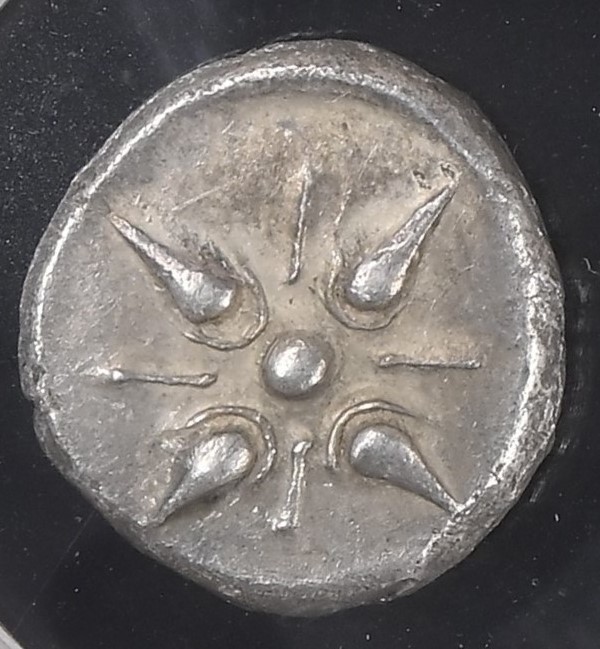
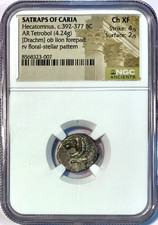
Silver AR Tetrobol or Drachm - 16 mm, 4.19 grams
Reference:SNG Copenhagen 588-589
Certification:NGC Choice VF8568338-002
Obverse:EKA,Head of roaring lion facing left, with outstretched foreleg, EKA above
Reverse:Stellate pattern within incuse circleSee theGenuine HistoryCollection
Hecatomnusof Mylasa orHekatomnos(Greek: Ἑκατόμνως, Carian: 𐊴𐊭𐊪𐊵𐊫 *k̂tmno*, “under-son, descendant”) was an early 4th-century BC ruler of Caria. He served as satrap (governor) for the Persian King Artaxerxes II (404–358 BC) and founded the hereditary Hecatomnid dynasty, succeeding the earlier Lygdamid dynasty (520–450 BC).
He was the son of Hyssaldomus, dynastic ruler of Mylasa, and may have served under Tissaphernes before being appointed satrap. After 395 BC, Hecatomnus became the first satrap of Caria, which had previously been part of Lydia, following Artaxerxes II’s reorganization of western Anatolia. He likely assumed office around 394 BC, commanding Persian naval forces against Evagoras I of Cyprus, and was still ruling in 380 BC. Scholars place his death in 377/376 BC.
Hecatomnus had three sons—Mausolus, Idrieus, Pixodarus—and two daughters—Artemisia and Ada—who married their brothers and succeeded him as rulers.
Some sources (Diodorus, Isocrates) claim Hecatomnus secretly supported Evagoras with funds and troops, possibly implying disloyalty to Persia. Modern scholarship, however, doubts these reports, suggesting the rumors may have originated from Evagoras to serve political purposes.
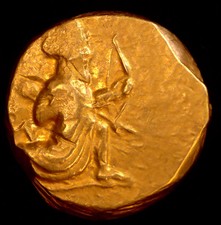
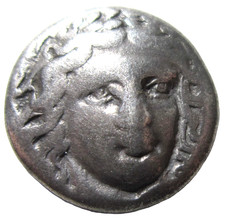
Coinage: Hecatomnus issued coins from Mylasa, often featuring his effigy or symbols such as **Zeus Labrandenos** walking with a labrys, referencing the famous local temple. His coins reflect both Persian influence and local Carian identity.
Tomb: In 2010, looters were found digging at what is believed to be Hecatomnus’ tomb, where a marble sarcophagus and frescoes were discovered. Many artifacts had already been removed, but the site provided important insight into Carian art and architecture, serving as a predecessor to the Mausoleum at Halicarnassus. A stolen golden crown from the tomb has since been identified and is slated for return to Turkey.
Fresco of the Tomb of Hekatomnos
Cariawas settled by Greek immigrants in the Early Iron Age. Their presence is attested by protogeometric pottery which appears in the area around 1100 BC, along with other markers of Greek material culture.
The coast of Caria was part of the Doric hexapolis (\"six-cities\").
An account also cited that Aristotle claimed Caria, as a naval empire, occupied Epidaurus and Hermione and that this was confirmed when the Athenians discovered the graves of the dead from Delos. Half of it were identified as Carians based on the characteristics of the weapons they were buried with.
The expansionism of Lydia under Croesus (560–546 BC) incorporated Caria briefly into Lydia before it fell before the Achaemenid advance.
Caria was then incorporated into the Persian Achaemenid Empire as a satrapy (province) in 545 BC. The most important town was Halicarnassus, from where its sovereigns, the tyrants of the Lygdamid dynasty (c. 520–450 BC), reigned. Other major towns were Latmus, refounded as Heracleia under Latmus, Antiochia, Myndus, Laodicea, Alinda and Alabanda. Caria participated in the Ionian Revolt (499–493 BC) against the Persian rule.
During the Second Persian invasion of Greece (480–479 BC), the cities of Caria were allies of Xerxes I and they fought at the Battle of Artemisium and the Battle of Salamis, where the Queen of Halicarnassus Artemisia commanded the contingent of 70 Carian ships. Themistocles, before the battles of Artemisium and Salamis, tried to split the Ionians and Carians from the Persian coalition. He told them to come and be on his side or not to participate at the battles, but if they were bound down by too strong a compulsion to be able to make revolt, when the battles begin, to be purposely slack. Plutarch in his work *The Parallel Lives*, at *The Life of Themistocles* wrote that: \"Phanias (Greek: Φαινίας), writes that the mother of Themistocles was not a Thracian, but a Carian woman and her name was Euterpe (Ευτέρπη), and Neanthes (Νεάνθης) adds that she was from Halicarnassus in Caria.\"
After the unsuccessful Persian invasion of Greece in 479 BC, the cities of Caria became members of the Athenian-led Delian League, but then returned to Achaemenid rule for about one century, from around 428 BC. Under Achaemenid rule, the Carian dynast Mausolus took control of neighbouring Lycia, a territory which was still held by Pixodarus as shown by the Xanthos trilingual inscription.
Halicarnassus was the location of the famed Mausoleum dedicated to Mausolus, a satrap of Caria between 377–353 BC, by his wife, Artemisia II of Caria. The monument became one of the Seven Wonders of the Ancient World, and from which the Romans named any grand tomb a mausoleum.
The Carians were incorporated into the Macedonian Empire following the conquests of Alexander the Great and the Siege of Halicarnassus in 334 BC.
Caria was conquered by Alexander III of Macedon in 334 BC with the help of the former queen of the land Ada of Caria who had been dethroned by the Persian Empire and actively helped Alexander in his conquest of Caria on condition of being reinstated as queen. After their capture of Caria, she declared Alexander as her heir.
As part of the Roman Empire the name of Caria was still used for the geographic region. The territory administratively belonged to the province of Asia. During the administrative reforms of the 4th century this province was abolished and divided into smaller units. Caria became a separate province as part of the Diocese of Asia.
Christianity was on the whole slow to take hold in Caria. The region was not visited by St. Paul, and the only early churches seem to be those of Laodicea and Colossae (Chonae) on the extreme inland fringe of the country, which itself pursued its pagan customs. It appears that it was not until Christianity was officially adopted in Constantinople that the new religion made any real headway in Caria.
The Temple of Zeus Lepsinos at Euromus was built on the site of an earlier Carian temple in the 2nd century AD during the reign of the emperor Hadrian.
In the 7th century, Byzantine provinces were abolished and the new military theme system was introduced. The region corresponding to ancient Caria was captured by the Turks under the Menteşe Dynasty in the early 13th century.
There are only indirect clues regarding the population structure under the Menteşe and the parts played in it by Turkish migration from inland regions and by local conversions. The first Ottoman Empire census records indicate, in a situation not atypical for the region as a whole, a large Muslim (practically exclusively Turkish) majority reaching as high as 99% and a non-Muslim minority (practically exclusively Carian supplemented with a small Jewish community in Milas) as low as one per cent. One of the first acts of the Ottomans after their takeover was to transfer the administrative center of the region from its millenary seat in Milas to the then much smaller Muğla, which was nevertheless better suited for controlling the southern fringes of the province. Still named Menteşe until the early decades of the 20th century, the kazas corresponding to ancient Caria are recorded by sources such as G. Sotiriadis (1918) and S. Anagiostopoulou (1997) as having a Greek population averaging at around ten per cent of the total, ranging somewhere between twelve and eighteen thousand, many of them reportedly recent immigrants from the islands. Most chose to leave in 1919, before the population exchange.
Artemisia, Queen of Halicarnassus, and commander of the Carian contingent, at the Battle of Salamis, 480 BC. Wilhelm von Kaulbach