When you click on links to various merchants on this site and make a purchase, this can result in this site earning a commission. Affiliate programs and affiliations include, but are not limited to, the eBay Partner Network.
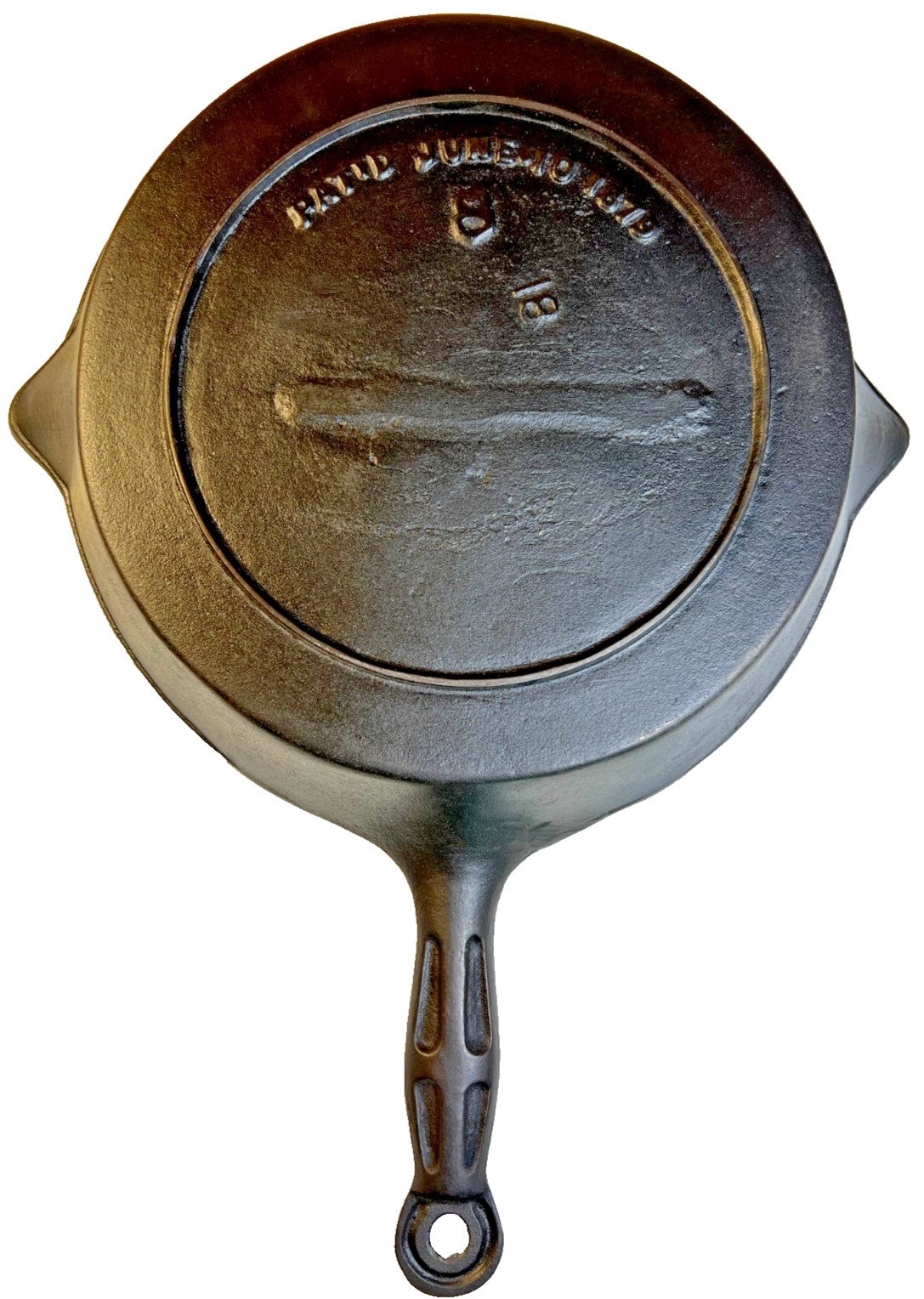
An unusually early and mechanically fascinating American cast-iron skillet, prominently marked:
PAT’D JUNE 10, 1879
8
18
The patent date identifies this as the patented “Improvement in Spiders” designed by Josiah M. Read of Boston, Massachusetts. Read received U.S. Patent No. 216,346 on June 10, 1879, specifically for the skillet’s remarkable hollow, ventilated and ergonomically shaped handle.
Unlike the flat, solid handles commonly used on 19th-century cookware, Read’s handle swells outward in both its horizontal and vertical dimensions. Four deeply recessed openings allow air to circulate through the hollow interior, reducing weight and helping the handle remain comparatively cooler. Read also intended its rounded three-dimensional shape to fit the hand securely and resist twisting while the skillet was being lifted. It was a clever Victorian solution to a very real kitchen problem—and it gives this skillet tremendous visual character today. See the original J.M. Read patent.
The skillet retains numerous desirable characteristics of early American cast iron:
- Antique No. 8 size
- Raised June 10, 1879 patent date
- Early underside gate mark
- Full continuous outer heat ring
- Two pouring spouts
- Thin sidewalls approximately equal to the thickness of a U.S. nickel
- Remarkably light weight of approximately 3.15 pounds
- Sculptural hollow and slotted patented handle
- Secondary raised “18” foundry or pattern identifier
- Cleaned and restored finish
The combination of its gate-marked construction, thin casting, raised patent information and unmistakable ventilated handle makes this far more interesting than a typical unmarked late-19th-century skillet. It is essentially a surviving production example of Read’s patented 1879 design.
Measurements
- Diameter: approximately 10.25 inches
- Height: just under 2 inches
- Weight: approximately 3.15 pounds
- Size marking: No. 8
- Sidewall thickness: approximately equal to a U.S. nickel
Condition
Cleaned and restored, with an attractive dark finish that displays the casting details beautifully.
The skillet has a very slight wobble equivalent to approximately one business card. The cooking surface shows a faint stress shunt/line, along with scattered age-related casting texture and minor surface irregularities. Please examine the close photographs carefully for the exact appearance and extent of this area.
No modern repairs are apparent from the supplied photographs. The raised patent date, size number, secondary “18” marking, continuous heat ring and extraordinary handle remain well defined.
Dating and Attribution
I would date it circa 1879–1890, likely produced relatively soon after the patent was issued. The patent belonged to Josiah M. Read of Boston.