When you click on links to various merchants on this site and make a purchase, this can result in this site earning a commission. Affiliate programs and affiliations include, but are not limited to, the eBay Partner Network.
His Story Collections PresentsQing Dynasty Tiger-Head Bell虎头铃铛 | Chinese Folk Protective Art | Certified 美88
Carry History With You
Look directly into its face.
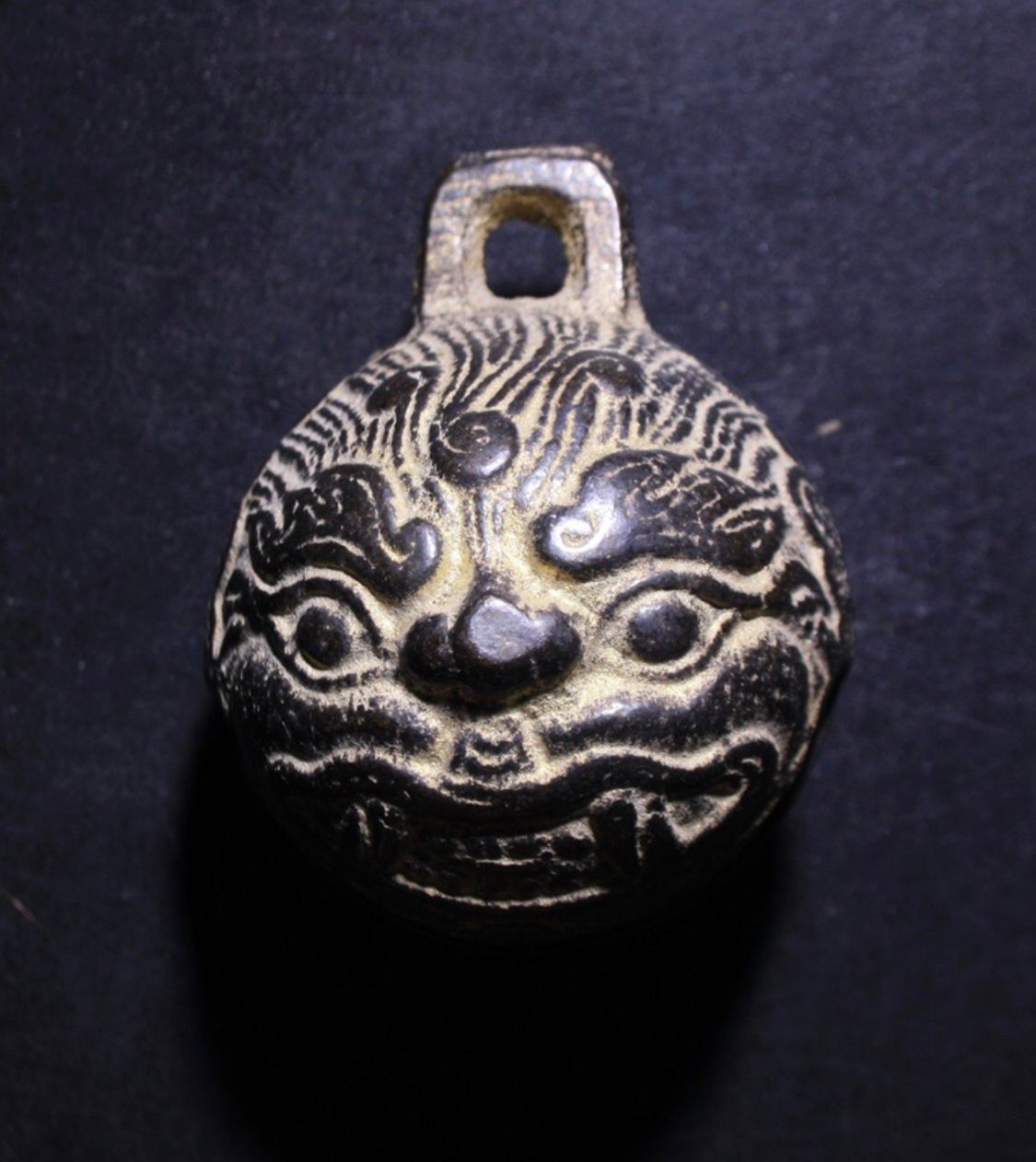
Wide eyes stare outward. Heavy brows sweep across the forehead. Bold stripes frame a powerful nose, while the mouth below forms an almost theatrical expression.
This was not an animal chosen at random.
It is the tiger—one of the most immediately recognizable creatures in the visual culture of China.
According to the accompanying certification, this small metal artifact is attributed to the Qing Dynasty (1644–1912) and identified as a 虎头铃铛 — Tiger-Head Bell.
Small enough to fit in the palm of your hand, it brings together three elements deeply rooted in traditional Chinese material culture:
sound, symbolism and protection.
The Story — The Tiger That Watches
For thousands of years, the tiger occupied a special place in the Chinese imagination.
Its importance went far beyond admiration for a powerful wild animal.
The tiger became associated with strength, courage and protection against harmful forces.
This helps explain why fierce animal faces appeared repeatedly on objects associated with protection, architecture, clothing and everyday life.
The tiger was something to fear.
But symbolically, that very ferocity could be turned outward.
The frightening creature became the guardian.
This tradition of representing powerful tiger forms in Chinese metalwork reaches far back into antiquity. The Smithsonian's National Museum of Asian Art, for example, holds Western Zhou bronze tiger sculptures with prominently rendered eyes, fangs and striped bodies. Postal Museum
This bell belongs to a much later folk-art tradition, but the visual idea remains immediately recognizable:
a fierce face looking outward at the world.
A Face Made to Be Seen
The craftsmanship of this particular piece is remarkably expressive for an object measuring only approximately 46 mm.
The face is constructed almost architecturally.
The eyebrows rise dramatically over two circular eyes.
Curving lines across the forehead suggest the tiger's characteristic stripes.
The nose projects prominently from the center.
Below it sits the stylized mouth and muzzle, creating an expression somewhere between fierce and fantastic.
At the top is an integral pierced suspension loop.
That detail reminds us that this was conceived not merely as a miniature sculpture, but as an object intended to be suspended.
And when suspended, a bell could do something a sculpture could not.
It could announce its presence through sound.
Sound, Movement and Protection
Bells have an exceptionally long history within Chinese material culture, ranging from monumental ritual instruments to small functional bells.
At the highest level of society, bells could be sophisticated ceremonial instruments. Surviving Qing imperial bells demonstrate how important bells remained within formal ritual culture; the Asian Art Museum, for example, preserves a gilt-bronze ritual bell dating to 1715 during the Kangxi reign. Search Collection
This little tiger-head bell belongs to an entirely different scale and cultural context.
It should therefore not be confused with an imperial ritual bell.
Its significance is more intimate.
It represents the world of small objects—things made to be handled, suspended, heard and seen.
That is precisely the kind of object that fascinates us at His Story Collections.
The Qing Dynasty
The accompanying certification attributes the piece broadly to the Qing Dynasty, China's final imperial dynasty.
The Qing ruled from 1644 until 1912.
Those centuries witnessed enormous transformations: the expansion and consolidation of the Qing empire, extraordinary artistic production, increasingly intense contact with Europe and eventually the upheavals that brought China's imperial political system to an end.
Yet history was not experienced only in imperial palaces.
Beyond official portraits, monumental porcelain and imperial bronzes existed an enormous material world of smaller objects used by ordinary utensils.
Coins.
Objects such as this allow us to approach history at a different level.
Not the history of an emperor—
but the history of daily life.
Certified Attribution
The artifact is accompanied by its certification/display holder.
Certification attribution: 清 虎头铃铛
English: Qing Dynasty Tiger-Head Bell
Grade: 美88
Dimensions: approximately 46.0 × 33.9 mm
Weight: approximately 36.3 g
Certification No.: B002060306
Please note that the Qing Dynasty attribution above reflects the information stated on the accompanying certification label.
His Story Collections has not independently metallurgically tested or scientifically dated the artifact.
I strongly recommend retaining that sentence. It protects you from turning a third-party attribution into your own unconditional archaeological/authenticity claim.
Condition
The piece exhibits surface coloration, patination, wear and irregularities visible in the photographs.
Raised areas of the tiger's face contrast strongly against the darker recessed surfaces, emphasizing the sculptural design.
Please carefully examine all photographs for the exact condition of the artifact.
The item pictured is the exact piece the buyer will receive.
Why We Chose This Piece
At His Story Collections, we believe that an historical artifact does not need to be monumental to tell an important story.
Sometimes the smallest objects bring us closest to the people who lived before us.
This little tiger has survived while dynasties disappeared.
Whatever its precise original context, its maker chose one of China's most enduring visual symbols and transformed it into an object that could be suspended, carried and heard.
Today, it no longer needs to perform its original function.
Its purpose has changed.
It has become a witness to another age.
Carry History With You.
His Story Collections