When you click on links to various merchants on this site and make a purchase, this can result in this site earning a commission. Affiliate programs and affiliations include, but are not limited to, the eBay Partner Network.
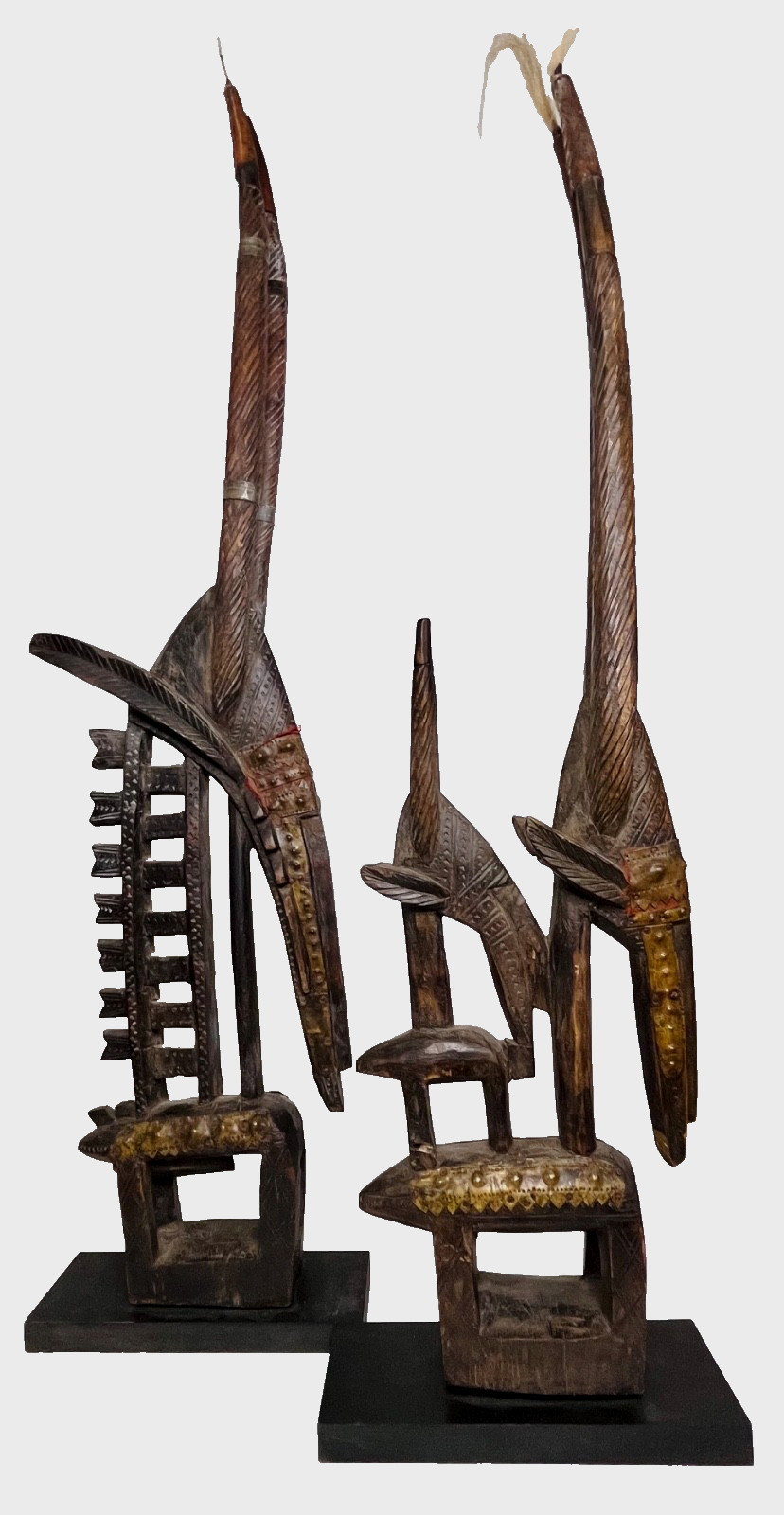
Ci Wara HeaddressChiwara, Chi Wara, Tyi WaraBamana PeoplesMaliWest AfricaMid 20th Century
Collected in the 1980’s.38\" tall x 12\" wide x 4” deep
Male Ci Wara. Carved Wood with Textile Remnant.Securely Mounted to wooden base.Some signs of wear present in this vintage piece.
Paired Male & Female with Child Chi Wara.
description of this iconic form from the Metropolitan Museum of Art :
\"Among the Bamana, oral traditions credit a mythical being named Ci Wara, a divine being half mortal and half animal, with the introduction of agriculture to the Bamana. Bamana society is primarily an agricultural one; even today the majority of Bamana peoples are subsistence farmers. These headdresses, also called ci wara, are carved to honor that original mythical being. Under Ci Wara\'s guidance, humans first learned to cultivate the land and became prosperous and able farmers. When humans gradually became careless and wasteful, however, Ci Wara is said to have buried himself in the earth. To honor Ci Wara\'s memory, the Bamana created a boli, a power object in which his spirit could reside, and carved headdresses such as these to represent him. Ci wara headdresses combine antelope features with those of other animals that are significant within Bamana culture, such as the earth-digging aardvark or the armored pangolin. The animals are observed in nature to excel in actions that are also critical to the success of the farming effort and, therefore, Bamana life. The elegant and tapered heads of the sculptures, along with the neck, ears, and horns, are modeled on antelope forms. The lower part of the sculpture refers to the aardvark. These headdresses are also characterized by decoration with pierced openwork designs, which create an interplay between positive and negative space, and finely incised geometric patterns, which add to their texture.
Ci wara performances encourage Bamana farmers as they work in the fields and praise their efforts after they have returned to the village when the work is complete. The performances always feature a pair of headdresses, one male and one female, worn by two skilled young male dancers. The male and female ci wara serve as multifaceted metaphors for the elemental forces upon which all humanity depends. The infant on the female\'s back has been interpreted as the embodiment of humanity and as a visual treatise on the relationship between the powerful Sun (the male) and the gentle, nurturing Earth (the female). It has also been suggested that the openwork zigzag carving of the male figure\'s neck and mane invokes the sun\'s corona and its radiance. The performers\' costumes are made of long raffia fibers that stretch from the base of the headdress to the ground and have been darkly dyed. The raffia fibers sway and bounce as the skilled performer executes his choreographed movements, which are intended to mimic those of the antelope. The undulations of the raffia costume are also a subtle reference to water and add to the overall metaphor of the performance as a convergence of the elemental forces of sun, earth, and water. The masquerade performances begin outside the village in the fields and gradually travel to the village center. Women also play an integral part during the masquerading ceremonies by singing songs of praise for Ci Wara and the hard-working farmers.
The ci wara tradition remains one of the most widely recognized forms in all of African art. Throughout the years, the sculptures, costumes, songs, and all the other elements that compose this living art form have grown and changed along with Bamana culture itself. Different regions within Bamana society display unique sculptural variations of ci wara iconography—the vertically dominated form seen here is prevalent in the east. These elegant sculptures have not only served as inspiration in their region of origin, but also in the West for early twentieth-century artists such as Constantin Brancusi and Ferdinand Léger, who were impressed by their juxtaposition of negative and positive space and two-dimensional sculptural design.\"
Purchase Price Includes Excellent Service with Free and Fast Shipping.
Great Earth LLCCarbondale, ColoradoRepresenting the Eli Weiss Collection of African Art. A lifetime of travel, passion, activism, philanthropy and genuine humanity lead to the accumulation of these wonderful objects spanning a great breadth of the African continent. A vast collection of Significant works of Art & ‘Of Culture’ craft works made to be Sold. I am proud to share this extraordinary group of Artworks. Please message me with any concerns or questions.Steven is an Artist, Educator and Dealer with an excellent reputation and 25 years of professional experience.