When you click on links to various merchants on this site and make a purchase, this can result in this site earning a commission. Affiliate programs and affiliations include, but are not limited to, the eBay Partner Network.
I WILL SHIP INTERNATIONALLY
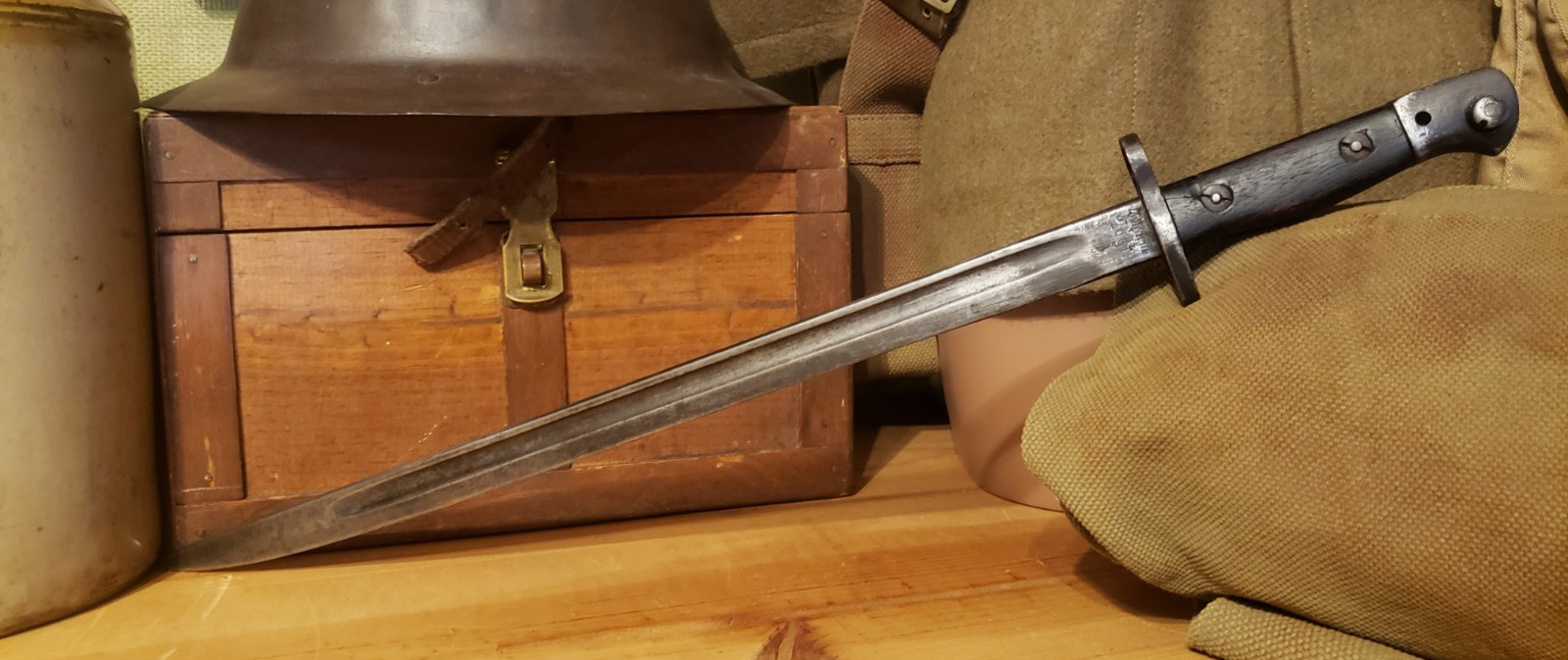
Beautiful Original British WW1 1907 Bayonet for the Enfield SMLE Rifle. Unit marked to the Royal Welch Fusilliers.
This weapon is in excellent condition. The metal retains an good amount of it\'s original finish and the is marked with the King\'s Crown and GR underneath, as well as 1907, the model year, and Wilkinson the manufacturer. There is a broad head arrow on the opposite and several other unknown markings. It does not look to have been excessively sharpened, nor does it have any big dings or defects.
The hilt is where this bayonet really becomes special. Marked \"T. 5. R.W.F.\" this bayonet saw service with the famous Welsh regiment, the Royal Welch Fusiliers. This unit was easily identified by the Black bow they wore on the back of the SD Jacket Collars as distinctive Unit Insignia. The unit also had several famous writers as members, please see below.
The scabbard is in very good condition, there are two spots where the finish has come off, but can easily be remedied. I see no markings on the scabbard.
This was a really exciting bayonet to find, and I am very tempted to add it to my personal collection, but I don\'t need to start collecting yet another regiment (I\'m a big into the Gordon Highlanders and Royal Ulsters) I really hope this goes to a good home and is well taken care of. Happy offerding and please feel free to ask any questions you may have
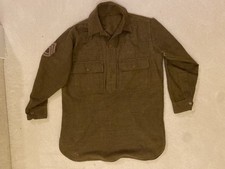
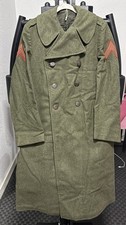
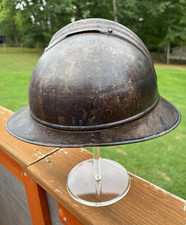
The sale is only for the RWF unit marked bayonet and scabbard. Items in picture other than bayonet and scabbard are not for sale including Helmet, Chest, Pack, Uniform, P-08 Webbing, or any other props; They are not included in the sale.
-Of Note, Members of the RWF during the Great War include:
-Captain Robert Graves the famous author and poet. Born to a famous Irish Poet, Graves wrote Good-bye to All That an Autobiography of his time as an Officer in trenches. He also publishedOver the Brazier a collection of his war time poetry. Seriously Wounded by a shell fragment at the Somme, he spent months recovering. Becoming well enough to be posted to a Garrison Battalion, he soon fell ill with Spanish Flu. Lucky guy.
-Captain Sigfreid Sassoon, author of Memoirs of an Infantry Officer
Born to a Jewish Father and Catholic Mother and Growing up in Kent, Sassoon volunteered to serve his King and Country on the day War was declared with Germany. Initially serving as an private soldier in the Sussex Yeomanry, he was commissioned into the Royal Welsh in 1915 and was sent to France where he met Graves. His younger brother was Killed in the Gallipoli Campaign during this timeframe. While Serving as a 2nd Lt, Sassoon was awarded the Military Medal, and was recommended for the Distinguished Service Order and Victoria Cross. Robert Graves described Sassoon as regularly engaging in suicidal feats of Bravery.
Sassoon later ran into trouble for his growing anti-war sentiment. Facing a court marshal, the Under-Secretary of State for War, Ian MacPherson, decided him unfit for service, excusing his actions as a result of Neurasthenia (Shell Shock) and had him sent to Craiglockhart War Hospital near Edinburgh Scotland for Treatment. While at this hospital in the Scottish Highlands, he met Wilfred Owen, another notable War Poet.
Lieutenant Wilfred Owen volunteered to serve with the Artists Rifles, and was later commissioned to the Manchester Regiment. Wounded and sent to Craiglockhart, Owen met and became very close to Sassoon. After Recovering from his wounds, Owen would return to France, where he would be killed one week before the Armistice on Nov. 4th 1918 at Sambre-Oise Canal.
Siegfried Sassoon is also a notable member of the LGBT community of that Era. Despite marrying and having a child, Sassoon maintained multiple homosexual relationships during his his life.
Sassoon and Graves rapidly developed a very close friendship; united by their shared love of poetry, they spent much time reading and discussing each other\'s works.Both men spent the winter of 1916 & 1917 together at the Ladies\' Sommerville College at Oxford while recovering at the Army hospital there, and there is speculation that their relationship went beyond friendship.
There is also evidence to suggest Sassoon and Owen were engaged in a romantic relationship. Sassoon was deeply devistated by Owens death, and mourned him the rest of his life, so also an interesting bit of gay history, giving a view into a different time.