When you click on links to various merchants on this site and make a purchase, this can result in this site earning a commission. Affiliate programs and affiliations include, but are not limited to, the eBay Partner Network.
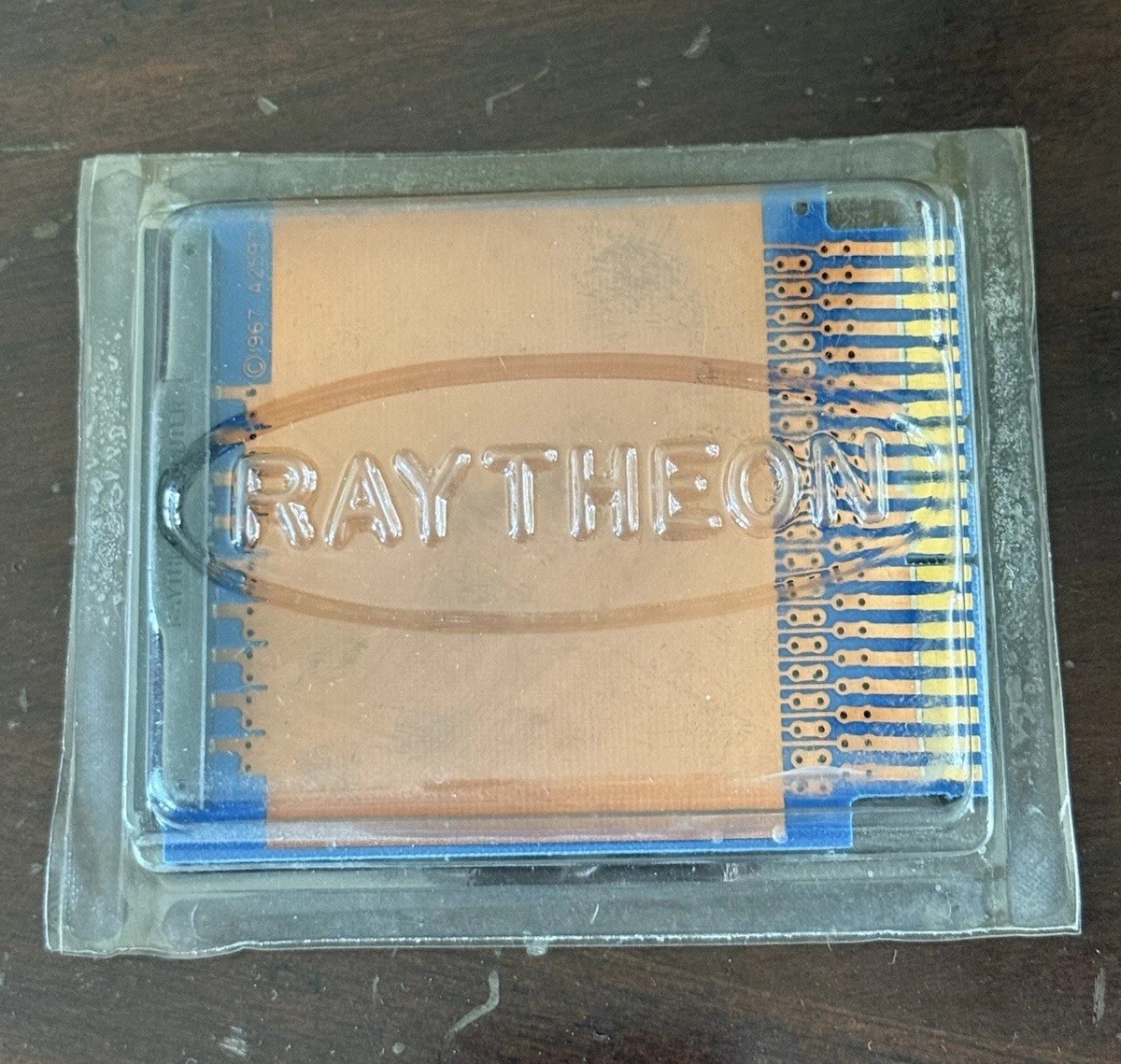
NOS Vtg 1967 RAYTHEON COMPUTER Integrated Circuit Board #278236 001B A2597B
ESTATE FIND ~ AND THIS IS THE VERY LAST ONE I OWN!
From a computer nerd’s estate comes a great vintage find: a 1967 copper circuit board which measures about 3 x 3 1/2“.
NEW OLD STOCK - STILL FACTORY SEALED IN PLASTIC! I have no idea what computer this went to, please have a good look and decide for yourself.
I did some research and learned that in the 1960s, Raytheon acquired Packard-Bell’s computer operations and continued work in computers, including manufacturing the Apollo Guidance Computer (designed with MIT) for NASA’s Apollo program (introduced around 1966). They also had activities in data systems, terminals, and related electronics. THEREFORE, ITS POSSIBLE THIS IS FROM A SPACE PROJECT! Read more history at the bottom of this description.
A cool collectible to display in your office, man cave, or computer room.
Vintage preowned condition. Sold as-is with no returns, so kindly ask any questions prior to offerding.
Careful packing and fast shipping with 25 years experience. Thanks, God bless, and have a great day! ;0)
Some history on Raytheon Comouter:
Raytheon (founded in 1922 as the American Appliance Company, later Raytheon Manufacturing Company, and then Raytheon Company) was never primarily a standalone “computer company,” but it had significant involvement in computers and related technologies from the late 1940s through the 1970s (and beyond in specialized aerospace/military applications). 
Key Periods of Raytheon’s Computer Involvement:
• Late 1940s–Early 1950s: Raytheon worked on early computing projects, including as a subcontractor on machines like EDVAC. They developed the RAYDAC (Raytheon Digital Automatic Computer) for the U.S. Navy, which became operational in 1953 (though it was considered technically obsolete by then). Work on a follow-on (RAYCOM) started but was not completed. 
• 1954–1955: Raytheon formed a joint venture with Honeywell called Datamatic Corporation to develop commercial computers (e.g., the DATAmatic 1000). Raytheon sold its interest to Honeywell after about a year, as it struggled against IBM. 
• 1960s: Raytheon acquired Packard-Bell’s computer operations and continued work in computers, including manufacturing the Apollo Guidance Computer (designed with MIT) for NASA’s Apollo program (introduced around 1966). They also had activities in data systems, terminals, and related electronics. 
• 1970s onward: Raytheon created a Data Systems division (around 1971) focused on information processing and displays. They had limited commercial success but strong military/aerospace applications. Computer-related work continued as divisions or subsidiaries rather than a core “Raytheon Computer Company.”
Raytheon’s main business has always been electronics, defense systems, radar, missiles, and later broader aerospace/defense after its 2020 merger into Raytheon Technologies (now RTX Corporation). Their computer efforts were experimental, military-focused, or short-lived commercial attempts, not a long-standing independent computer company like IBM or Honeywell. 
In short, no dedicated Raytheon Computer Company existed as a major independent entity—activity peaked in the 1950s (especially 1953–1955) with limited continuation afterward. For more specifics, sources like the Computer History Museum or Raytheon/RTX historical archives provide details.