When you click on links to various merchants on this site and make a purchase, this can result in this site earning a commission. Affiliate programs and affiliations include, but are not limited to, the eBay Partner Network.
\"Why should we have a navy at all? There are no enemies for it to fight except apparently the Army Air Force.\"
- General Carl Spaatz, Commander of the US 8th Army Air Force, after WWII
Its gull-wing shape made it instantly recognizable. Its characteristic sound while in an attack dive led the Japanese to call it \"The Whistling Death.\" Combined with its high speed, agility and toughness, the Vought F4U Corsair was one of the finest fighters ever built. Originally thought to be too powerful to fly from a carrier, the Corsair weaved a path of destruction in battle after battle during WWII, totally outclassing the much-feared Zero. The last of the great piston-engine fighters, the Corsair went on to become an important component of the US naval air power during the Korean War. Even while it was being replaced by jet aircraft, pilots flying this tough warbird were credited with downing a few MiG-15 jet fighters.
In part because of its advances in technology and a top speed greater than existing Navy aircraft, numerous technical problems had to be solved before the Corsair entered service. Carrier suitability was a major development issue, prompting changes to the main landing gear, tail wheel, and tail hook. Early F4U-1s had difficulty recovering from developed spins, since the inverted gull wing\'s shape interfered with elevator authority. It was also found where the Corsair\'s left wing could stall and drop rapidly and without warning during slow carrier landings. In addition, if the throttle were suddenly advanced (for example, during an aborted landing) the left wing could stall and drop so quickly that the fighter could flip over with the rapid increase in power. These potentially lethal characteristics were later solved through the addition of a small, 6 in (150 mm)-long stall strip to the leading edge of the outer right wing, just outboard of the gun ports. This allowed the right wing to stall at the same time as the left.
Other problems were encountered during early carrier trials. The combination of an aft cockpit and the Corsair\'s long nose made landings hazardous for newly trained pilots. During landing approaches, it was found that oil from the opened hydraulically-powered cowl flaps could spatter onto the windscreen, severely reducing visibility, and the undercarriage oleo struts had bad rebound characteristics on landing, allowing the aircraft to bounce down the carrier deck. The first problem was solved by locking the top cowl flaps in front of the windscreen down permanently, then replacing them with a fixed panel. The undercarriage bounce took more time to solve, but eventually a \"bleed valve\" incorporated in the legs allowed the hydraulic pressure to be released gradually as the aircraft landed. The Corsair was not considered fit for carrier use until the wing stall problems and the deck bounce could be solved.
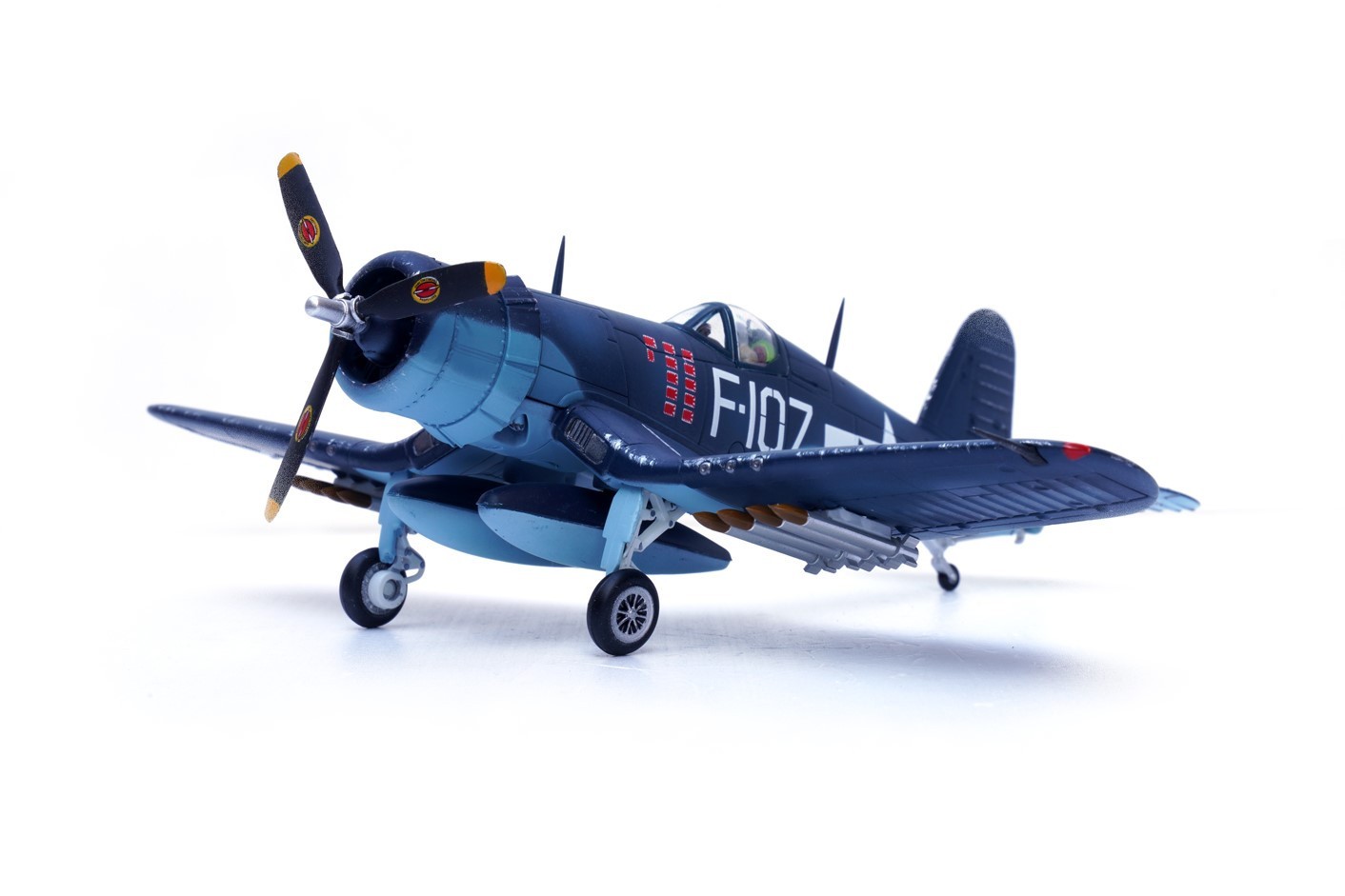
Pictured here is a 1:72 scale replica of a US Navy Chance-Vought F4U-1 Corsair fighter that was piloted by 1st Lt. Phillip DeLong, then attached to VMF-224 \"Fighting Bengals\" during 7-inches
Length: 6-inches
Features:
- Diecast construction with some plastic parts
- Fully assembled
- Accurate markings and insignia
- Full complement of weapons
- Interchangeable landing gear
- Opening canopy
- Comes with seated pilot figure
- Comes with display stand
Historical Account: \"Civilian Soldier\" - Phillip C. DeLong was born on July 9th, 1919, in Jackson, Michigan. DeLong joined the Marine Corps on March 26th, 1942. In December, he was commissioned as a second lieutenant and earned his flying wings. By August 1943, DeLong was assigned to Marine Fighting Squadron 212 (VMF-212) in the Solomon Islands. By late-October, VMF-212 was based at Barakoma Airfield. About one month later, the squadron moved to Torokina Airfield.
In the Solomon Islands, First Lieutenant DeLong flew the F4U Corsair and participated in bomber escort missions at Rabaul and Bougainville, where he shot down enemy planes which were attempting to down friendly bombers. These missions inflicted a great amount of damage on Japanese held airfields, shorelines, and ships. He also volunteered for strafing missions against heavily defended Japanese positions.
On February 15th, 1944, Lieutenant DeLong was on an aerial patrol providing over watch for friendly troops landing on Green Island. When Japanese bombers were located approaching friendly ships, DeLong unhesitatingly flew through American anti-aircraft fire to engage the enemy planes. DeLong personally shot down three enemy planes and helped prevent the bombers from inflicting damage on our ships.
By mid-February, Lieutenant DeLong had downed eight Japanese planes and established himself as a flying ace. He also claimed to have probably downed a ninth enemy plane and he damaged two others. DeLong continued flying combat missions over the Bismarck Archipelago until April. DeLong was credited with downing a total of 11+2⁄3 enemy aircraft during the war. He was awarded a total of four Distinguished Flying Crosses.
We are a leading retailer of Legion Models products. We work very closely with both the manufacturer and distributor to help sell their items. As such, we would appreciate it if you could immediately contact us if the item you receive is either missing or comes with defective parts prior to opening a return or leaving anything but positive response. We will do our utmost to correct any deficiencies and ensure that you are happy with the product you ordered.
Please note: We do not accept buyer offers. The prices we charge on are both fair and competitive and take into account both our shipping costs as well as our seller fees. Also, it would be helpful if you could place all of the items you wish to purchase in a single cart rather than submitting them to us one at a time. Lastly, please make sure to ask us any questions BEFORE you purchase an item, not AFTER. This reduces the likelihood of order cancellation by either party and ensures a smooth transaction. Thank you for your consideration.