When you click on links to various merchants on this site and make a purchase, this can result in this site earning a commission. Affiliate programs and affiliations include, but are not limited to, the eBay Partner Network.
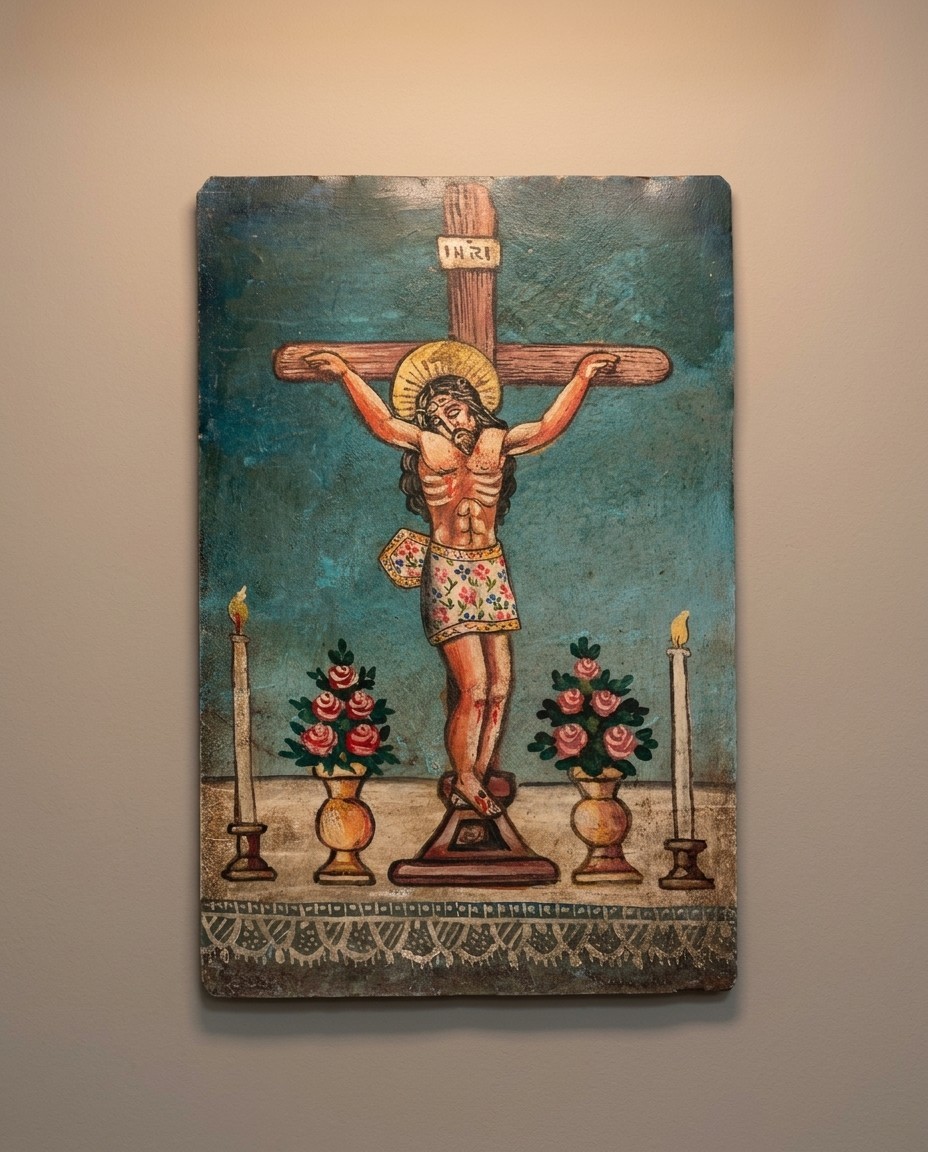
This is an authentic Mexican devotional retablo, oil painted by hand on a heavy sheet of tin, dating to approximately 1890 to 1920. It came out of a private collection in Jalisco. At 16 by 11 inches it is substantially larger than the great majority of surviving retablos, and it is painted on a notably thick and heavy gauge of metal — the most substantial sheet I have handled in this category. Nothing about it is reproduced, printed or restored. The paint is where the artist left it more than a century ago.
THE COMPOSITION
The panel does not depict the historical Crucifixion. It depicts a venerated crucifix image as it stood on its altar, and that distinction is the whole character of the piece.
Christ is shown on a rendered wooden cross, the grain of the timber carefully drawn, with the INRI titulus set above his head on a white plaque. Behind the head is a gold rayed nimbus with a cruciform mark at the crown. The body is modeled with an articulated rib cage and drawn musculature, the wounds marked in red at the side, the knees and the feet. Long dark hair falls to both shoulders and the crown of thorns is picked out in fine white strokes.
The figure wears an embroidered faldellín — a cloth loincloth of the kind used to dress carved crucifixes in Mexican churches — worked in white with scattered red and blue flowers on green stems, bordered top and bottom in gold with a scrolling pattern, and finished with a hanging side panel in the same cloth. The figure stands on a stepped wooden plinth, which is what marks it as a sculpture rather than a scene.
The crucifix stands on a dressed altar. Two lit tapers in candlesticks flank the composition at left and right. Between them stand two footed urns of roses, painted in red and pink with white highlights on every petal and set in dark green foliage. Across the foot of the panel runs the altar frontal, worked in two registers — an upper band of alternating dots and dashes, and below it a deep swagged lace fringe rendered in white over a dark ground.
The ground behind the figure is a deep blue-green, worked thin and atmospheric, with the altar table reading as a pale ochre shelf across the lower third.
A NOTE ON WHAT THIS PIECE IS — AND WHAT IT IS NOT
I want to be exact about this, because it affects both what the piece is and what it is worth.
There are two distinct traditions painted on tin in Mexico, and dealers routinely blur them.
A narrative ex-voto records a specific miracle. It names a petitioner, gives a date, names a town, and carries a handwritten inscription describing the affliction and the deliverance — a fever survived, a fall from a horse, a child recovered. The inscription is the point of the object. It was commissioned by a named person, in thanksgiving, and hung at a specific shrine.
A devotional retablo is a different thing. It is an image of a saint or a venerated figure, painted for household devotion, with no miracle recorded and no petitioner named. It hung in a home, in a nicho or on a wall, and it was an object of daily prayer rather than a public record of thanks.
This panel is a devotional retablo. There is no inscription anywhere on it. No date, no petitioner, no place name, no signature. Nothing is missing or lost — it was never there. The painter recorded the venerated image and stopped.
I am telling you this plainly because it matters to the price. A narrative ex-voto with a legible inscription and a firm date is a document as well as a painting, and it prices accordingly. This piece is priced as a devotional panel, and the grading section below scores both attribution and narrative as absent on that basis.
What it has instead is scale, an unusually heavy support, and a level of decorative execution well above the ordinary run of the category — and those are the reasons it sits where it does rather than lower.
WHAT IS A MEXICAN RETABLO?
The retablo tradition begins in the Spanish colonial period, when small devotional paintings on wood and copper were made for churches and for the households that could afford them. In the 1820s, cheap rolled tinplate arrived in Mexico in quantity, and within a generation the retablo became something ordinary families owned.
Tin was inexpensive, it took oil paint well, and it did not crack or split the way a wood panel does. Village painters — most of them anonymous, working from prints and from the venerated statues in their own parish churches — turned out devotional panels by the thousand through the second half of the nineteenth century. They were sold at fairs and outside shrines, and they hung in kitchens and bedrooms and in the small wall niches called nichos.
The tradition faded in the early twentieth century as cheap chromolithographs reached the same households at a fraction of the cost. By the 1930s the hand-painted retablo was largely finished as a living trade, which is why panels from the 1890s survive in far smaller numbers than the mid-century ex-votos that came after them.
ON DRESSED CRUCIFIXES
The figure in this panel wears cloth, and that is not a painter\'s invention. In Mexico, venerated crucifixes in churches are dressed — a carved corpus is fitted with an embroidered faldellín, often worked by the women of the parish and changed for feast days and for the seasons of the liturgical year. The finest of them are heavy with gold thread and take months to make.
When a village painter recorded a venerated crucifix, he painted what he saw: the carved figure, the cloth it was dressed in, the plinth it stood on, the candles and flowers the parish set before it. That is what this panel is. The floral faldellín with its gold borders, the stepped wooden base, the tapers and the urns of roses and the lace-fringed altar cloth are a record of a specific image on a specific altar, seen by a painter who stood in front of it.
Jalisco and the surrounding Bajío states hold a dense concentration of these venerated crucifixes, each with its own advocation and its own local following. Without an inscription I will not attach a name to this one. What I can say is that the panel records a real image that real people prayed in front of, and that the painter took the trouble to get the embroidery right.
PHYSICAL DESCRIPTION
Oil on tinplate, hand painted.
Dimensions: 16 x 11 inches (approximately 40.6 x 27.9 cm). Vertical format. Unframed.
The support. This panel is painted on an exceptionally heavy gauge of tinplate. In more than a hundred retablos handled, this is the most substantial sheet I have come across in the category, matched only by a copper panel currently in my collection. The distinction matters. The great majority of Mexican retablos were painted on thin, light tinplate — often recovered from cans, roofing stock or packing sheet — which is why so few survive without creases, dents or split corners. A plate of this weight was cut for the purpose, not salvaged, and it is a further indication that this was a considered commission rather than a market panel.
The sheet has been hand cut. The edges are slightly irregular where the shears travelled, and the corners are softly rounded rather than square. The blue-green ground carries around all four edges, which establishes that the metal was cut to size first and painted afterward.
There are no nail holes anywhere in the panel. A sheet of this weight had sufficient body to stand in a nicho or on a shelf without being tacked to a wall, and it appears never to have been.
The paint. Oil applied directly to the metal. Brushwork is visible throughout — the impasto in the flesh, the individual white highlights struck onto each rose petal, the fine strokes of the crown of thorns, and the dotted and swagged registers of the altar frontal, which were laid in one at a time by hand.
The verso. Bare tin. No backing board, no paper, no labels, no maker\'s stamp, no inscription and no later dealer marks. Surface condition of the verso is described in the section following.
Weight. Substantial for its size. This is a heavy object in the hand and will be packed accordingly.
CONDITION
I describe condition honestly and in full. A piece of this age carries its history on its surface, and I would rather you know exactly what is arriving than be surprised by it.
The painted face. Sound and stable overall. The image reads clearly at every point — the figure, the faldellín embroidery, the candles, the urns of roses and the full lace fringe of the altar frontal are all present and legible.
The paint film shows scattered small losses across the field, most visible in the blue-green ground where the darker tin shows through as fine flecks. There is abrasion in the lower register, running through the altar table and the fringe, where the white has worn thin against the darker ground. Some chalking and light blooming in the pale altar shelf. A scatter of small pale losses across the upper ground.
The blue-green ground has greyed and darkened unevenly over time, which is characteristic and is not damage. Ingrained surface grime throughout, worked into the texture of the paint. The panel has not been cleaned and I have not attempted to clean it — I leave that decision to the buyer.
No overpaint. No restoration. No inpainting anywhere on the panel.
The verso. Bare tin with rust across essentially the entire surface, ranging from fine even oxidation to deeper pitting, with areas of white oxidation product. This is genuine long-term surface corrosion and it is disclosed here without qualification. The metal remains structurally sound throughout — there are no perforations and no soft spots. A horizontal band runs across the middle of the verso where the sheet rested against a batten or shelf edge over a long period; a corresponding faint crease is visible in raking light.
Edges and corners. Hand-cut with slight irregularity along all four sides. Minor paint loss at the extreme edges where the ground wraps the metal. Corners intact, softly rounded, no splits or tears.
No frame. The panel is sold unframed, as found.
Summary. An honest, unrestored survivor in structurally sound condition, with the surface wear and verso corrosion consistent with more than a century of devotional use and storage. It presents well and it will present better still behind glass.
A NOTE ON THE PHOTOGRAPHS
Every photograph in this listing is of the actual panel you will receive. Nothing is stock, nothing is borrowed from another example, and nothing has been retouched to flatter the piece.
The images were taken in natural daylight without filters, without colour correction and without artificial lighting. What you see is what is on the metal. I have deliberately photographed the wear, the losses and the verso corrosion as clearly as the whole panel, because a buyer at this price is entitled to see the flaws at the same resolution as the strengths.
Close-up images are included so the surface can be examined properly — the brushwork in the flesh, the individual highlights on the rose petals, the embroidery of the faldellín, the dotted and swagged registers of the altar frontal, and the texture of the paint film. The verso is photographed in full.
Colours may shift slightly on different screens. Daylight on a hand-painted oil surface is difficult to reproduce exactly, and the blue-green ground in particular reads warmer or cooler depending on the display.
On background images. Where a photograph shows the panel in a room setting, that background is provided to give a sense of scale and how the piece presents on a wall. The background, and any furniture, frame or object appearing in it, is not included in the sale. Only the retablo panel described above is being sold.
HOW THIS PIECE WAS GRADED — AND WHY IT IS PRICED WHERE IT IS
Most sellers give you a price and leave you to guess at the reasoning. I would rather show you the work.
A word first on what this panel is being measured against. The small mid-century ex-voto on tin — the eight-by-ten inch panel with a handwritten miracle and a date in the 1940s or 1950s — is a different class of object with a different market, and grading a nineteenth-century large-format panel against those sales would produce a misleading number. This piece is graded against large-format nineteenth-century devotional retablos of comparable size and provenance, and the tier below them.
That class does not trade often enough for realized-sale data to be meaningful, so the bands below are built from the live market — current asking prices across specialist dealers and marketplaces for antique Mexican retablos on tin and lámina of this period. The sample: ten panels, ranging from a heavily distressed 1880s example at $175 to a late nineteenth-century Santa Rita at $1,450. Mean $784. Median $713. Standard deviation $376. The spread is wide, which is itself the honest finding — condition and scale swing this category harder than subject does.
GRADE SCALE — 19th-CENTURY LARGE-FORMAT DEVOTIONAL RETABLOS
GradeWhat it meansMarket bandAExceptional. Large scale, fine execution, strong condition, often dated or attributable$900+B+Upper quartile. Strong on scale and execution with sound condition$700–900BAround the median. Above average on several factors with clear offsetting weaknesses$560–700CTypical of the class. Representative rather than exceptional$420–560DBelow average. Small scale, weak execution, or significant condition problems$250–420FCompromised. Heavy loss, structural damage or substantial restorationbelow $250
These bands come from asking prices because realized data at this level is too thin to publish honestly. I would rather tell you that than pretend to a precision the market does not support.
THIS PIECE, FACTOR BY signature, no date, no place name, no painter\'s mark on panel or versoScaleWell above average16 x 11 inches. The comparable set clusters between 7 x 10 and 14 x 10. Only one panel in the sample exceeded this footprint, and it was heavily distressedNarrativeAbsentNo inscription, no petitioner, no miracle recorded. A devotional panel, not a narrative ex-votoExecutionWell above averageIndividually highlighted rose petals, a two-register lace altar frontal laid in stroke by stroke, an articulated rib cage, and a faldellín carrying some forty separate embroidered flowers with gold-worked bordersSupportWell above averageExceptionally heavy gauge tinplate, hand cut to size and painted after cutting. Purpose-cut stock rather than salvaged sheet — uncommon in the classSubject demandStrongThe Crucifixion is the most universally collected subject in Mexican devotional painting, reaching well beyond the regional folk-art audienceConditionBelow averageScattered paint losses, abrasion through the lower register, ingrained grime, and rust across essentially the whole verso
ASSIGNED GRADE: B
Two factors score as absent, and both are structural. There is no inscription and no signature, and no quality elsewhere converts a devotional panel into a documented ex-voto. That is what holds it out of the B+ and A bands, where the sound-condition panels at $700 and above sit.
Against that, four factors score well above average, and none of them marginally: the scale, the weight and quality of the support, the decorative execution, and the strength of the subject. Condition is the honest drag — the panels asking $700 to $750 in the comparable set are cleaner than this one, and the one heavily distressed example in the sample sits at $175.
COLLECTOR APPRAISAL — GALLERY REPLACEMENT VALUE
This is a different question from the grading table above, and I keep the two separate on purpose.
The grade band tells you what the panel trades for between collectors and dealers — the level at which pieces like this actually change hands. Gallery replacement value asks something else: what it would cost to walk into an established gallery and replace this object with a comparable one, framed, guaranteed and ready to hang.
That figure is always higher, and it should be. It carries the gallery\'s authentication, its overhead, its return policy and its curation. It is the number your insurer and your estate appraiser will want.
GALLERY REPLACEMENT VALUE: $1,200 USD
That figure reflects retail replacement through a Santa Fe, San Miguel de Allende or Mexico City gallery specializing in Spanish Colonial and Mexican devotional painting. It accounts for the scale, the exceptional weight of the support, the quality of execution and the period, and it assumes the panel sensitively framed under glass.
It is offered for insurance and estate purposes. It is not the price I am asking, and I am not suggesting you could resell it at that figure tomorrow.
What you are paying today is the trade-level number, not the retail one. That is the whole point of buying from a dealer who shows his grading rather than a gallery that shows you a price tag.
ITEM SPECIFICS
- Object: Devotional retablo (lámina)
- Subject: Crucified Christ — a venerated crucifix image on its altar
- Medium: Oil on tinplate, hand painted
- Support: Heavy gauge tinplate, hand cut
- Dimensions: 16 x 11 in (40.6 x 27.9 cm)
- Orientation: Vertical
- Period: c. 1890–1920
- Origin: Mexico
- Inscription: None
- Signature: None
- Date on panel: None
- Frame: None — sold unframed
- Condition: Unrestored. No overpaint, no inpainting. Scattered paint loss, lower-register abrasion, ingrained grime, verso rust throughout. Structurally sound
- Provenance: Private collection, Jalisco, Mexico
- Grade: B (19th-century large-format devotional retablo scale)
- Gallery replacement value: $1,200 USD
SHIPPING AND DUTIES — FULLY COVERED BY ME
Shipping is free worldwide. Import duties and taxes are prepaid by me. You pay the listed price and nothing further.
I ship exclusively by DHL Express, with tracking, and I do not use another carrier. DHL has never lost a package for me, and it is the only service that lets me prepay duties so that nothing is collected from you at the door.
Packing. Every piece is professionally packed by Diseños de Cartón in Colonia Americana, Guadalajara — a custom box built to the object, not a stock carton. I hand-deliver each package to DHL myself. This panel is heavy for its size and will be packed for that weight.
Opening your package. Please cut along the seams only. Never run a blade across the face of the box. Tin panels sit close to the wall of a fitted carton, and a knife drawn across the surface can score the paint. Take the extra thirty seconds.
A note on the delivery address. The price includes freight and duties to the address on your account at the time of purchase. If you request delivery to a different country at checkout, the difference in freight and duty is payable by you before the piece ships. This is not a fee I profit from — it protects a firm price against a destination change that would otherwise erase the margin entirely.
Tracking is sent as soon as the waybill is issued.
ON THE PRICE
The price is firm.
I can say that plainly because I have shown you exactly how I arrived at it. The grade scale above is built from live market data on comparable panels, the factor table shows you where this piece scores and where it does not, and the assigned grade places it at the median of its class. There is no cushion built in to be negotiated away.
That is a deliberate choice, and it works in your favour. Sellers who pad a price expecting to be talked down are asking you to do work that should have been done before the listing went up. I would rather publish the honest number once.
What is included at that number: the panel itself, free worldwide DHL Express shipping with tracking, all import duties and taxes prepaid, and professional custom packing. There is nothing to add at checkout and nothing collected at your door.
One condition. The price covers freight and duties to the address on your account at the time of purchase. If you ask for delivery to a different country, the difference in freight and duty is payable before shipping.
If the piece is not right for you at this figure, I would genuinely rather you passed on it than felt pushed. It will find its collector.
QUESTIONS
Message me. You will reach me, not an assistant and not an automated system. There is no AI answering my messages and there never will be — every reply you get from this shop is written by hand.
Ask me anything about this panel. If you want additional photographs of a specific area, raking light across the surface, a closer look at the verso or a measurement I have not listed, tell me what you need and I will take it and send it the same day. If you want to know how I arrived at the date, or what I think the piece is worth in five years, I will tell you straight — including where I am uncertain.
If you are buying this as a gift, or you need it to arrive by a particular date, let me know before you purchase and I will tell you honestly whether it is achievable.
I have been dealing in Mexican devotional art from Guadalajara for years and I handle every piece personally — sourcing, research, condition assessment, packing and the drop-off at DHL. If something is not right when it arrives, write to me first. I will make it right.
Thank you for reading this far. Pieces like this survived because somebody in a Mexican household cared enough to keep them safe for a hundred years, and I take the job of passing them on seriously.
God bless,
Ricardo Ivan Cardenas
St. Joseph\'s College University NY, EMBA Graduate