When you click on links to various merchants on this site and make a purchase, this can result in this site earning a commission. Affiliate programs and affiliations include, but are not limited to, the eBay Partner Network.
For sale
We will be putting up for sale tribal pieces from several tribal regions in the Philippines, notably from the Mountain Province on Luzon and from Mindanao. Most of these antique primitive tribal pieces are from the so-called Ifugao and Mt. Province people (Kalinga), the indigenous peoples of the Cordillera in northern Luzon, Philippines and from the Bagobo people of southern Mindanao.
We lived in the Philippines for a decade beginning in 1985. Several times we visited the rugged Mountain Province in northern Luzon and in southern Mindanao. Our interest in the life of these peoples was piqued, and as a consequence we built up a modest collection of \"primitive artifacts.\" This collection is wide in nature, most is Colonial era of the early 20th century (some later), it includes a hut ladder, spear, drum, baskets of various types and utilities, and other baskets with animal or human forms and Bulul (rice god) figures on one, and a beaded bag.
We purchasedmost of these piece from 1986 to 1989. Almost all were purchased from highly reputable dealers, for example, The Tribal Arts House of Henry N. Beyer in Manila, Tawalisi Antiques of Maria Roxas in Manila, Tucucan Antiques in Bagio City, Artifact and Baskets of Mary Ngalawen in Manila, Herencia Arts & Antiques in Manila. We also purchased pieces at small local shops in Bontoc, the principal city in the Mountain Province.
Please read everything, ask questions, and request more pictures. If you are in Japan, China or the Philippines, and want to offer on a piece, please write to me before offerding. The shipping cost does not include for overseas shipping through \'s international shipping policy. Also, I can combine shipping but the rate needs to reflect the larger shipping box and higher weight. We will ensure the sale piece is packed well.
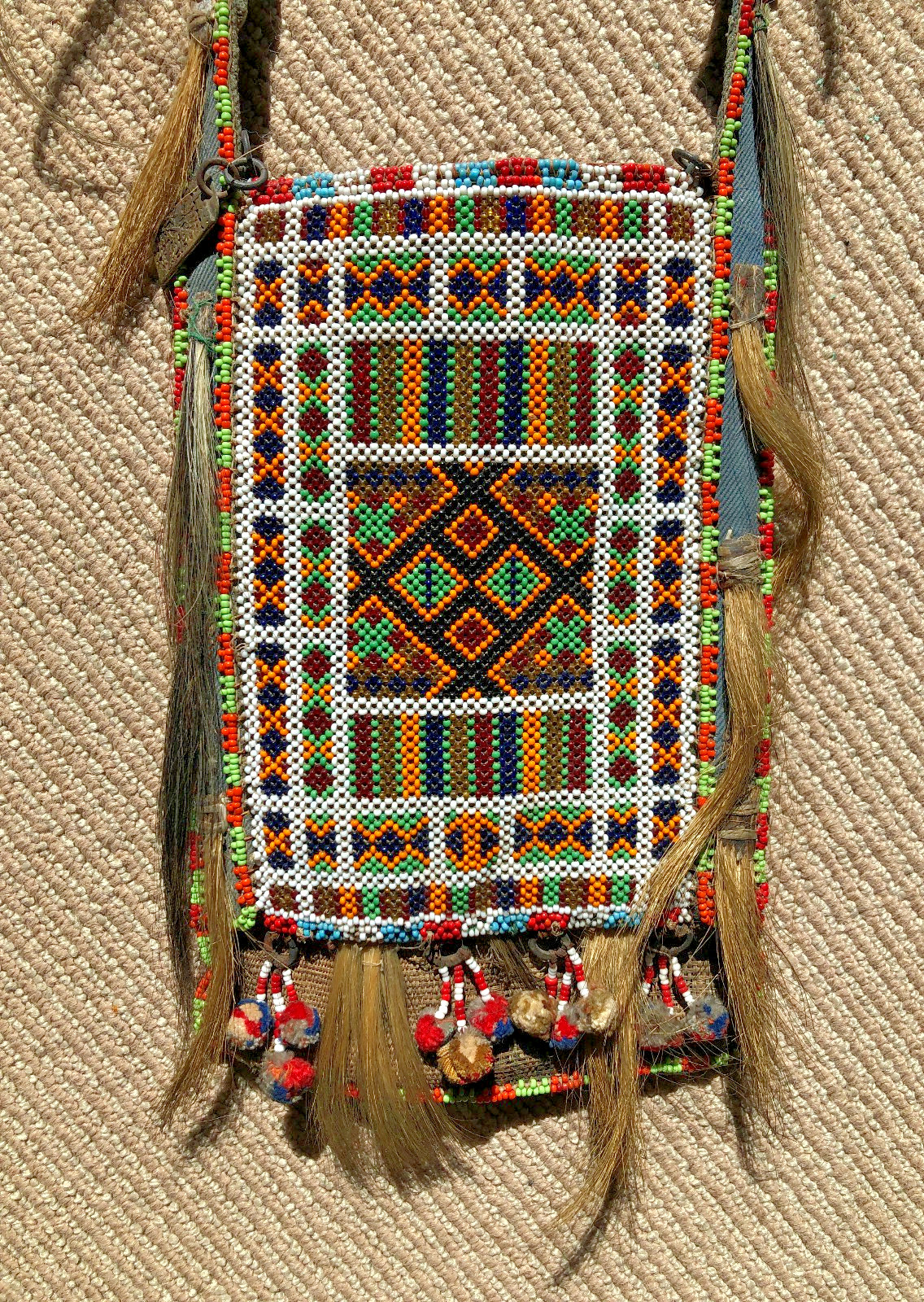
This sale item: a Bagobo Beaded Woven Men\'s Shoulder Carrying Bag or Cabir (~64cm L x 16cm W or 25\"x6\", measured) with horse hair and beaded tassels is beautifully made and has no real damage, as seen in Photos 1 to 17. The series of photos highlight all aspects of this \'museum quality\' flat shoulder carrying bag – with two pockets on the back side – primarily for men: beading, tassel work, horse hair (?) strands, stitching, handwoven fabrics including on the back what appears to be abaca in a dyed ikat design. Everything about this piece from the Philippine Island of Mindanao, likely early 20th c. pre-WWII (could be late 19th c.), is stunning. Notice in Photos 7 and 8 limited wear on the back of bag; yet this piece was used. The beading is phenomenal, great graphic design, in transparent red and clear, white, green, orange, blues, and black. The strap has hair (horses likely) and glass beading. The tassels lengths -- possibly wool -- are beaded in various colors, including what appears to be held on by flat metal rings. There are two metal medallions near the front top of the bag, appear to be brass.We purchased this piece in 1986, 40 years ago and it was represented as old, late 19th to early 20th century.
This well cared for piece may be quite old. See Photo 18 for an example of a Bagobo Cabir bag from the 19th century. The Bagobo people are still \"people the mountains\" of Mindanao between the crest of the range near the volcanic Mt. Apo, the highest peak in the Philippines, and the waters at the western side of the head of the Gulf of Davao. These people have a population of some ten or twelve thousand, still considered largely pagan. For more information see: penn.museum/sites/journal/516/ (need to add appropriate prefix address) as originally published in 1916.
Details: Clear (red and white on this piece) glass beads on a Bagobo bag are most likely late 19th to early 20th century, roughly 1880–1930. Some museum-collected Bagobo bags are specifically dated to the 19th century, but the beads themselves may have been imported trade beads and could be older or newer than the bag.
The clear beads alone cannot establish an exact age. They were commercially produced and circulated widely in the Philippines. Dating should also consider:
- the fiber or textile condition and sewing technique;
- the bag’s motifs and construction;
- bead size, shape, perforation, and whether they are glass or modern plastic;
- signs of later repair or replacement.
A reasonable description without documentation would be: “Bagobo, Mindanao, Philippines, probably late 19th or early 20th century; age uncertain.” Similar examples are cataloged as 19th-century Bagobo beaded bags, while ethnographic collecting and production continued into the early 1900s.
The piece has received very little handling by us, just displayed in our home out of direct sunlight. No pets, no smoking. Our story: We lived in the Philippines for nearly a decade beginning in 1985. From 1986 to 1989, we collected a number of old tribal artifacts. Our pieces were represented as being from the late 19th century to pre-WWII. We are now selling these pieces as we downsize.