When you click on links to various merchants on this site and make a purchase, this can result in this site earning a commission. Affiliate programs and affiliations include, but are not limited to, the eBay Partner Network.
Dating & Identification
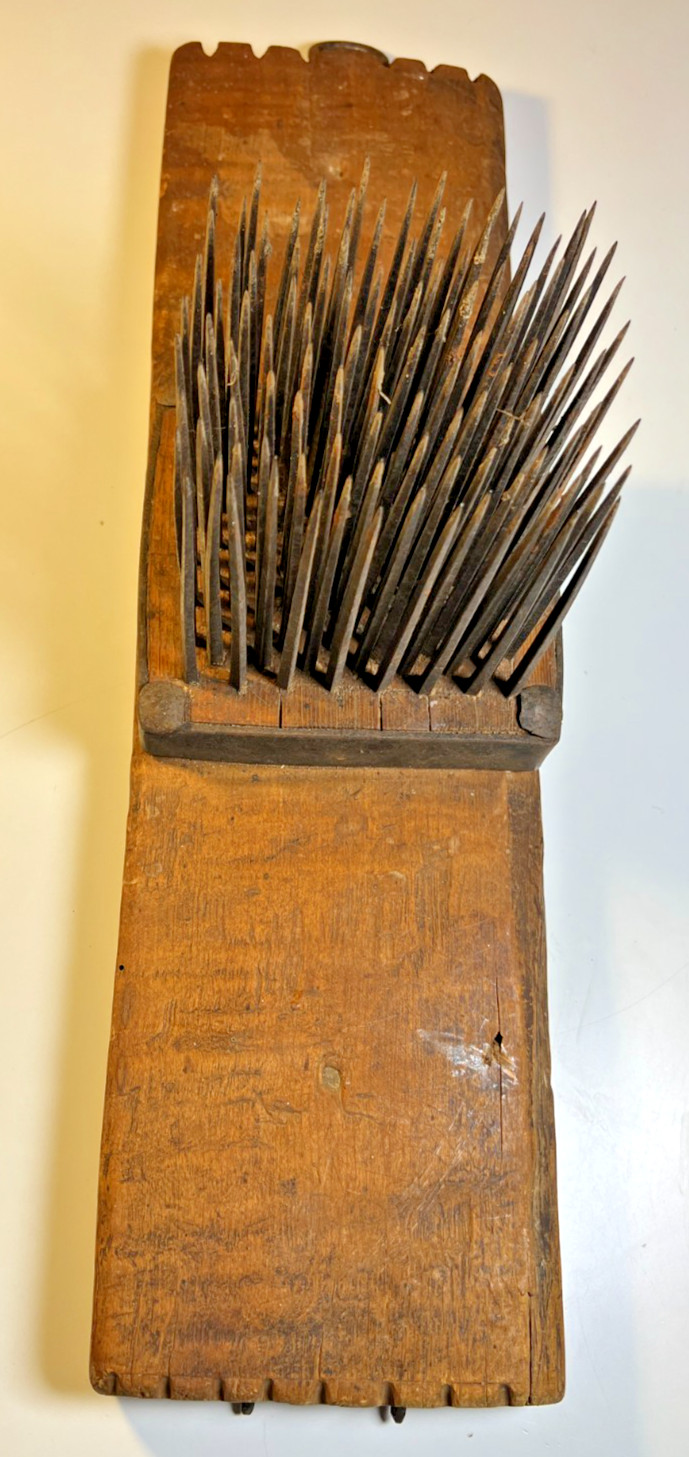
This is an unusually substantial American flax hetchel, also called a hatchel, hackle, heckle, or flax comb. Based on the heavy hand-forged square teeth, wrought-iron retaining band, oversized individually headed fasteners, hand-worked wooden board, decorative scalloping, and hanging loop, I would date it approximately:
Circa 1790–1830, most likely early 19th century.
It could conceivably be late 18th century, but without a carved date, initials, or documented provenance, “circa 1790–1830” is the strongest defensible range.
The exact maker cannot be identified. Tools like this were normally produced locally: the wooden body by a farmer, carpenter, or joiner, with the demanding ironwork supplied by a skilled village blacksmith. Its rugged construction and New England-style utilitarian form make a Northeastern American origin plausible, though not provable from the tool alone.
Description
An Exceptional Early Hand-Forged Flax Hetchel
Offered here is a remarkably complete antique flax-processing hetchel dating to approximately circa 1790–1830. Measuring nearly 20 inches long and weighing an extraordinary 6.14 pounds, this is no lightweight decorative farm tool—it is an imposing, heavily constructed survivor from the age when linen was produced by hand.
The hetchel combines a long, hand-shaped wooden working board with an extremely dense forest of individually formed iron teeth. Each approximately 4 1/8-inch-long spike was forged into a long, square-section shaft and painstakingly tapered to a remarkably fine point.
Especially impressive is the survival of the teeth: none appear broken, missing, or noticeably bent. Considering their great age, extreme length, and very sharp ends, that completeness is exceptional.
Entirely Handcrafted Construction
Every principal component displays early hand workmanship:
- Individually forged square iron teeth
- Long, carefully drawn and sharpened points
- Heavy wrought-iron retaining frame
- Enormous hand-forged fasteners with rounded-over heads
- Thick, hand-worked wooden mounting board
- Decorative scalloped shaping at the ends
- Original round iron loop for hanging
The teeth are secured within a square mounting block surrounded by a broad iron strap. Huge, irregularly headed forged fasteners pass through the assembly and board, mechanically locking everything together. The slight differences among the teeth and fastener heads are not flaws—they are evidence that each part was individually worked by a blacksmith rather than stamped or machine-produced.
The scale is remarkable. The spike bed alone occupies approximately 4 1/4 × 4 1/4 inches, while the central mounting assembly measures approximately 5 1/4 × 5 1/4 inches.
How It Was Used
This formidable-looking implement was essential to the production of linen. After flax plants were harvested, dried, retted, broken, and scutched, the remaining fibers still contained tangled strands and bits of woody material.
Bundles of flax were repeatedly pulled through the sharp iron teeth of the hetchel. This combed and aligned the longest fibers while separating out shorter fibers called tow. The finest long fibers could then be spun into stronger, smoother linen thread, while the coarser tow was retained for rougher textiles, cordage, stuffing, or other household uses.
Several grades of hetchel were sometimes used in succession, beginning with widely spaced teeth and progressing to increasingly fine combs. The very dense arrangement and finely sharpened teeth on this example suggest that it was intended for comparatively thorough or fine combing.
Before commercially produced cotton cloth became inexpensive and widely available, converting flax into linen was an important—and extremely labor-intensive—part of domestic life. A tool like this connects directly with the household production of thread, sheets, towels, shirts, table linens, sacks, and other necessities.
A Striking Piece of Early American Material Culture
Although made strictly as a working tool, this hetchel now has tremendous sculptural presence. Nearly twenty inches long, more than six pounds in weight, and bristling with long blacksmith-forged spikes, it makes an unforgettable example of early craftsmanship.
The warm, deeply aged wooden surface contrasts beautifully with the dark iron. The scalloped board ends and circular hanging loop add a pleasing touch of intentional design to an otherwise fiercely practical object.
It would make an outstanding addition to a collection of:
- Early American agricultural tools
- Antique textile and weaving equipment
- Blacksmith-made ironwork
- Primitive or country furnishings
- Flax, spinning, or linen-production artifacts
- Colonial and early American domestic implements
- Folk-art and sculptural farm tools
Measurements
- Overall length: 19 7/8 inches
- Overall width: 5 1/2 inches
- Central mounting assembly: 5 1/4 × 5 1/4 inches
- Footprint of spike group: approximately 4 1/4 × 4 1/4 inches
- Exposed spike length: approximately 4 1/8 inches
- Weight: 6.14 pounds
Condition
Exceptional condition for its approximately 200-year age. Most importantly, the numerous long iron teeth remain present, straight, firmly mounted, and sharply pointed. No broken or conspicuously bent teeth were observed.
The wooden body remains solid and displays a rich, untouched, naturally aged surface with expected scratches, checking, wear, small edge imperfections, and darkening from generations of handling and use. The iron retains an attractive dark oxidation and honest surface patina. The heavy retaining band, large forged fasteners, and hanging loop remain intact.
No attempt has been made to polish away its wonderfully aged character.
Please use extreme caution when handling or unpacking. The spikes remain genuinely needle-sharp. This should be displayed well beyond the reach of children and pets.